
Best Ceiling Fan for High Ceilings 2026 Picks

A best ceiling fan for high ceilings needs to do more than fill empty space above a living room. Tall ceilings collect warm air, create noticeable temperature layers, and can make an undersized fan feel almost useless at floor level. Strong airflow matters, but mounting height, blade span, motor design, and room shape matter just as much. A fan that looks impressive from below may still struggle if its blades sit too close to the ceiling.
Downrod length has a direct effect on how well the breeze reaches the occupied part of the room. Mounting the fan several feet below a very tall ceiling often improves circulation because the blades can move air through the space where people actually sit, sleep, or gather. Too short, and the air stays trapped near the roofline. Too long, and the fan may hang awkwardly, interfere with sightlines, or develop more visible movement if the mounting hardware isn’t secure.
Blade size should match the room’s width rather than ceiling height alone. A moderate bedroom may work well with a 52-inch fan, while a large great room, loft, or open-plan space may need a 60-inch, 72-inch, or even wider model. Bigger isn’t automatically better, though. Oversized blades can crowd beams, tall cabinets, pendant lights, or narrow vaulted sections, so proper clearance deserves careful measurement before buying.
A DC motor often makes sense in rooms where the fan runs for many hours. These motors generally provide several speed settings, smooth operation, and lower noise, which helps in spaces where conversations, television, or sleep shouldn’t compete with a steady hum. Reversible airflow adds year-round value by circulating warm air that gathers near the ceiling during colder months. Still, reverse mode won’t replace good insulation or heating; it simply helps reduce the temperature difference between the upper and lower parts of the room.
Remote control is more than a convenience once the fan hangs far above normal reach. Speed, direction, lighting, and timer adjustments should be available without pulling out a ladder. Wall controls can feel dependable and familiar, while app-based control adds flexibility when the remote disappears under a cushion. Compatibility matters, though, because some fans work only with their included controller and may buzz, flicker, or lose functions when paired with the wrong wall switch.
Lighting deserves a practical look as well. An integrated LED can brighten a tall room without adding another hanging fixture, and adjustable color temperatures help the same space shift from warm evening light to brighter task lighting. The tradeoff is replacement. A standard bulb is easier to swap, while a built-in LED module may require a specific part if it fails years later.
Sloped-ceiling compatibility becomes essential in vaulted rooms. Some canopies support only a modest angle, while steeper ceilings require a dedicated adapter or manufacturer-approved mounting kit. Guessing can lead to a tilted motor housing, uneven blade movement, and extra strain on the bracket. Measuring the ceiling angle before ordering saves a surprising amount of frustration.
Installation isn’t a job to rush. High ceilings make wiring, balancing, and hardware checks harder, especially above stairwells or two-story living areas. The electrical box must be fan-rated and attached securely to structural framing rather than treated like a lightweight light-fixture box. A properly installed high-ceiling fan should remain steady at every speed instead of wobbling whenever the motor ramps up.
Airflow ratings can help compare models, but numbers alone don’t tell the whole story. Blade pitch, motor torque, downrod position, and nearby obstacles all affect how the air feels in real use. A fan with impressive specifications may disappoint if it’s mounted poorly or placed in a room with beams blocking circulation. Realistic ectations matter, especially in huge open spaces where two smaller fans may distribute air more evenly than one enormous centerpiece.

Westinghouse Lighting Adjustable Ceiling Fan with Light, 96-Inch Industrial Indoor/Outdoor
View on Amazon- LFR Score10.0
LFR Score is a ranking system developed by lightfansreviews.com. LFR Score has no relationship or impact from any manufacturers or sales agent websites. Learn more
- BrandWestinghouse
- LFR Score9.6
LFR Score is a ranking system developed by lightfansreviews.com. LFR Score has no relationship or impact from any manufacturers or sales agent websites. Learn more
- BrandFanbulous

- LFR Score9.6
LFR Score is a ranking system developed by lightfansreviews.com. LFR Score has no relationship or impact from any manufacturers or sales agent websites. Learn more
- BrandObabala

- LFR Score9.4
LFR Score is a ranking system developed by lightfansreviews.com. LFR Score has no relationship or impact from any manufacturers or sales agent websites. Learn more
- BrandFanbulous

- LFR Score9.2
LFR Score is a ranking system developed by lightfansreviews.com. LFR Score has no relationship or impact from any manufacturers or sales agent websites. Learn more
- BrandTCL

- LFR Score9.2
LFR Score is a ranking system developed by lightfansreviews.com. LFR Score has no relationship or impact from any manufacturers or sales agent websites. Learn more
- BrandBvenuBigLite

- LFR Score9.2
LFR Score is a ranking system developed by lightfansreviews.com. LFR Score has no relationship or impact from any manufacturers or sales agent websites. Learn more
- BrandFanbulous

- LFR Score9.0
LFR Score is a ranking system developed by lightfansreviews.com. LFR Score has no relationship or impact from any manufacturers or sales agent websites. Learn more
- BrandJAZAVA

- LFR Score8.4
LFR Score is a ranking system developed by lightfansreviews.com. LFR Score has no relationship or impact from any manufacturers or sales agent websites. Learn more
- BrandZOEYON
Last update on 2026-07-11 / Affiliate links / Images, Product Titles, and Product Highlights from Amazon Product Advertising API
Westinghouse 96-Inch Industrial Ceiling Fan With Light
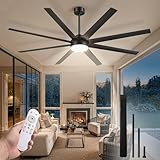
Large rooms often expose every weakness in air circulation. Warm air lingers overhead, the floor feels noticeably different, and smaller fans simply can't move enough air across the entire space. That's exactly where the best ceiling fan for high ceilings earns its reputation, and the Westinghouse Lighting Adjustable Ceiling Fan approaches that challenge with a combination of HVLS airflow, a modern DC motor, and an oversized blade span built for expansive interiors and covered outdoor areas.
Westinghouse 96-Inch Fan
The first thing that stands out is the 96-inch blade span. Six aluminum blades stretch across a wide area, allowing the fan to move a larger volume of air without relying on aggressive blade speeds. Instead of creating a concentrated breeze directly underneath, the airflow spreads gradually through open spaces, making the room feel more balanced.
The oversized dimensions naturally make this model unsuitable for average bedrooms or compact living spaces. Ceiling clearance becomes a critical consideration because the manufacturer specifies installation with the blades positioned at least 10 feet above the floor. That requirement limits installation options but also reflects how this fan is designed to perform safely and efficiently.
The matte black finish keeps the appearance understated despite its substantial size. Rather than dominating the ceiling visually, the clean lines and industrial styling blend surprisingly well with modern homes, workshops, restaurants, event spaces, barns, covered patios, and commercial interiors where oversized fixtures already feel appropriate.
Designed To Move Air Across Large Spaces
HVLS technology, which stands for high volume and low speed, focuses on moving a significant amount of air without producing the harsh draft associated with smaller high-speed fans. Instead of blasting one seating area, the airflow spreads gradually throughout the room, helping reduce stagnant pockets that often develop beneath tall ceilings.
The included DC motor complements that approach. Rather than relying on brute force, it delivers smooth operation while consuming less energy than many traditional AC motor designs. Quiet performance also becomes more noticeable in large gathering areas where constant motor noise could otherwise echo across hard surfaces.
Realistically, airflow depends on more than blade size alone. Ceiling height, room shape, nearby walls, shelving, and exposed beams all influence circulation. This fan offers the foundation for excellent coverage, but proper placement remains essential if the goal is even airflow throughout an oversized room.
Remote Control That Simplifies Daily Use
Access becomes a real issue once a ceiling fan hangs well above standard ceiling height. Climbing onto ladders to change settings isn't practical, so the included backlit remote control immediately becomes one of the strongest everyday conveniences. Speed adjustments, lighting control, timers, and seasonal direction changes remain accessible from ground level.
The remote offers six fan speeds, allowing airflow to match changing conditions instead of forcing users to settle for only a few preset options. Lower settings work well during cooler evenings, while higher speeds become useful during hotter months or inside larger commercial environments where additional circulation makes a noticeable difference.
A helpful addition is the speed memory function. Instead of resetting every time power cycles, the fan remembers the preferred operating speed, reducing unnecessary adjustments during daily use. Small conveniences like this tend to become more valuable over months of ownership than they initially appear.
Lighting That Matches The Modern Design
The integrated dimmable LED light complements the industrial styling without making the housing bulky. An opal frosted glass diffuser softens the light output, helping reduce harsh glare that often becomes obvious in rooms with exposed ceilings or polished concrete floors.
Dimming flexibility makes the fixture useful beyond simple illumination. Brighter settings work well during projects, maintenance tasks, or gatherings, while lower brightness creates a calmer atmosphere without requiring separate lighting fixtures. That versatility becomes particularly useful in multipurpose spaces where lighting needs change throughout the day.
Integrated lighting also introduces one tradeoff. Replacing a dedicated LED component isn't always as simple as changing a standard light bulb. Anyone who prefers fully replaceable bulbs may see this as a minor limitation, although the streamlined appearance remains one of the design's strengths.
Built For Indoor And Covered Outdoor Conditions
Damp location approval expands installation possibilities beyond interior rooms. Covered patios, outdoor dining areas, open-air pavilions, garages, and similar protected environments benefit from additional airflow while maintaining the fan's durability under changing humidity levels.
It's worth separating damp-rated construction from direct weather exposure. The fan is designed to tolerate moisture in protected locations, but continuous rain or fully exposed outdoor installation falls outside its intended use. Choosing the correct location helps preserve both appearance and long-term reliability.
The aluminum blade construction also supports durability in environments where temperature changes and humidity fluctuate throughout the year. Unlike some heavier materials, aluminum resists corrosion while keeping blade weight manageable for smooth operation.
Installation Considerations Before Buying
Installation deserves careful planning because this isn't a compact residential ceiling fan. The manufacturer specifies that the blades must remain at least 10 feet above the floor, making ceiling height one of the first measurements to verify before placing an order.
Its 96-inch diameter also requires generous clearance from nearby walls, lighting fixtures, beams, garage doors, or overhead equipment. Large open spaces allow the fan to perform as intended, while tighter layouts may restrict airflow or reduce visual balance.
Professional installation may be a sensible choice simply because of the fan's overall size and weight. Proper mounting becomes especially important with oversized ceiling fans since even small alignment issues can become more noticeable over years of continuous operation.
Strengths And Practical Tradeoffs
The biggest strength lies in the combination of a large HVLS blade span, quiet DC motor, flexible remote control, integrated dimmable lighting, and indoor or covered outdoor versatility. Those features work together to address the airflow challenges commonly found beneath high ceilings without relying on excessive motor speed.
Several tradeoffs deserve equal attention. The required installation height immediately rules out many standard residential ceilings, while the oversized footprint demands careful planning around lighting, structural beams, and nearby architectural features. Integrated LED lighting may also be less appealing for those who strongly prefer replaceable bulbs.
Overall, this model fits spaces where conventional ceiling fans simply lack the reach to circulate air effectively. Its design focuses less on decorative styling and more on creating steady, broad airflow across expansive interiors, making it a compelling option for anyone researching the best ceiling fan for high ceilings based strictly on the specifications provided.
Fanbulous 72-Inch Ceiling Fan With Light
Wide rooms can make an ordinary fan feel like it’s spinning for show. Air gathers near the ceiling, the corners stay stuffy, and the center of the room may feel comfortable only at the highest speed. The Fanbulous model tackles that familiar problem with a 72-inch blade span, eight blades, and the broad coverage expected from the best ceiling fan for high ceilings. It’s built around practical control, flexible lighting, and year-round circulation rather than a stripped-down, one-speed setup.
Fanbulous 72-Inch Fan
The size sets the tone right away. Eight blades stretch across a 72-inch diameter, giving the fan enough visual and functional presence for living rooms, dining areas, kitchens, studies, cafés, workshops, and similarly spacious settings. That broader sweep helps move air across more of the room instead of concentrating the breeze in one narrow spot. In an open layout, that can mean fewer stagnant pockets near seating areas or worktables.
The styling walks a line between retro influence and a cleaner modern finish. A black body gives it a grounded look, while the large blade arrangement adds enough character to keep the fixture from disappearing into the ceiling. This isn’t a tiny fan pretending to handle a large room, and the substantial proportions make that obvious. Still, the scale could overwhelm a compact bedroom or a room with low walls and crowded ceiling details.
Space planning matters before installation. A fan this wide needs proper clearance from walls, cabinets, beams, pendant lights, and tall storage units. The large footprint is an advantage in open rooms, but it becomes a limitation in narrow layouts or areas with several ceiling fixtures. Measuring first saves the headache of realizing later that the blades sit too close to another feature.
Airflow Built For Large Rooms
Six speed settings give the airflow more nuance than a basic low-medium-high setup. Lower speeds can keep air moving during quiet evenings, while higher settings add a stronger breeze during warm afternoons or busy gatherings. That six-speed range helps avoid the common problem of choosing between barely noticeable airflow and an overly aggressive draft. The fan can be adjusted more precisely to match the room rather than forcing the room to adapt to the fan.
The reversible motor broadens its usefulness beyond summer. Forward operation creates a cooling breeze, while reverse mode helps circulate warm air that naturally collects near a high ceiling during colder months. That reversible airflow can make the temperature feel more even from floor to ceiling, especially in rooms with vaulted architecture or open upper levels. It won’t replace heating or insulation, but it can reduce the sense that all the warmth is trapped overhead.
Large blade count and wide span don’t automatically guarantee equal airflow in every layout. Walls, loft railings, beams, and furniture placement can interrupt circulation, so the installation position still plays a major role. Centering the fan in the largest open zone usually makes more sense than mounting it over one small activity area. In very long rooms, one 72-inch fan may still leave distant corners less affected than the central space.
Lighting That Shifts With The Room
The integrated light offers a useful brightness range from 10% to 100%. That flexibility lets the same fixture provide softer ambient lighting at night and brighter illumination for cleaning, cooking, projects, or garage work. A fully bright setting may suit practical tasks, while a dimmed level keeps the room from feeling washed out. The fan and light also operate independently, so airflow doesn’t have to be tied to illumination.
Three color temperatures cover noticeably different moods. The 3000K setting gives off a warmer tone, 4200K sits closer to a balanced neutral white, and 6500K provides a cooler, crisper appearance. These three color settings help the fan adapt to different rooms without requiring a separate bulb change. Warm light fits relaxed living spaces, while cooler light can be more useful in workshops, kitchens, or garages where visibility matters.
The memory function keeps the last lighting preference instead of resetting after every use. That sounds like a small feature, but repeated adjustments get old fast when a room is used the same way every evening. The light memory supports a more consistent routine, particularly when brightness and color temperature have already been dialed in. One tradeoff remains: integrated light systems aren’t always as simple to service as standard replaceable bulbs.
Remote, App, And Wall Control
The included remote handles the full set of functions, including six speeds, light color, brightness, timer settings, direction, and basic on or off control. That matters in a high-ceiling installation because pull chains would be awkward or completely impractical. The back-and-forth adjustments happen from floor level, without reaching for a ladder every time the season changes. Once installed, the remote can also function as a wall-mounted control.
Timer choices include one, two, and four hours. These settings are useful at bedtime, during short work sessions, or on a covered patio where the fan doesn’t need to run after everyone leaves. Automatic shutoff also prevents the fan from running longer than intended. It’s simple, but it solves a real nuisance, especially in rooms that aren’t occupied all day.
Support for remote, app, and wall-switch control adds flexibility, though each method has its own appeal. A remote is quick and familiar, app control can help when the remote goes missing, and a wall switch gives the setup a permanent control point. The multiple control options reduce dependence on a single device. Still, anyone who dislikes app setup may prefer to stick with the remote and wall control rather than adding another connected function.
Noise And Everyday Comfort
The listed operating noise is 35 decibels, which places quiet performance near the center of the product’s appeal. Low mechanical noise matters in bedrooms, nurseries, studies, and living rooms where a constant hum can become distracting. The motor is designed to keep airflow present without making the fan the loudest thing in the room. At higher speeds, air movement itself may become more noticeable, even if the motor remains controlled.
Quiet operation also helps in large rooms with hard floors and high walls, where sound tends to travel and echo. A rattling housing or rough motor would be far more irritating in that kind of space than in a heavily furnished room. The steady motor sound supports sleep, reading, conversation, and focused work without adding much background interference. Proper installation still matters because loose hardware can create noise that has nothing to do with the motor design.
Comfort depends on more than silence, of course. The ability to adjust speed, reverse direction, dim the light, and set a timer gives the fan a more tailored feel throughout the day. Those everyday controls are especially useful in rooms that shift between work, meals, relaxation, and sleep. Instead of leaving one fixed setting in place, the fan can respond to the room’s changing demands.
Installation And Long-Term Tradeoffs
The package includes the necessary hardware and detailed instructions, which should make the installation process more straightforward. Still, a 72-inch ceiling fan isn’t a casual one-person project for every household. The large blade assembly takes space to handle, and careful balancing matters if the fan is expected to run smoothly at all six speeds. Professional installation may be the safer route in very tall rooms or locations with difficult ceiling access.
The product description lists a 10-year motor warranty and a two-year warranty for other parts. That distinction suggests the motor receives longer coverage than the light, remote, blades, or remaining components. It’s a reassuring detail, but it shouldn’t be mistaken for identical protection across the entire fixture. Keeping purchase records and installation details organized can make future service questions easier to handle.
Outdoor placement also deserves realistic expectations. The fan is presented for patios and porches, but protected installation remains the sensible approach unless the exact location meets the product’s environmental requirements. A covered outdoor area shields the motor, light, and controls from direct rain while still benefiting from the broad airflow. Fully exposed locations, cramped rooms, and ceilings crowded with beams are less natural fits for a fan of this scale.
The strongest case for this model comes down to room size and control. It combines a 72-inch span, reversible operation, six speeds, dimmable three-color lighting, memory, timers, and several control methods in one fixture. Those features address the everyday frustrations that show up in large rooms, from uneven air to inconvenient controls mounted far overhead. The main compromises are equally clear: it needs generous space, thoughtful installation, and acceptance of an integrated lighting system rather than a simple bulb-based design.
Obabala 52-Inch Black Outdoor Ceiling Fan
Big rooms don’t always need the biggest fan on the market. Sometimes the smarter move is a well-sized model that keeps air moving without swallowing the ceiling or crowding nearby fixtures. The Obabala 52-inch fan takes that middle-ground approach, pairing a quiet reversible DC motor with simple controls and a moisture-resistant build. For someone weighing the best ceiling fan for high ceilings, it offers a practical fit where a 72-inch or 96-inch fan would feel excessive.
Obabala 52-Inch Outdoor Fan
The overall design is clean, restrained, and easy to place. Three black ABS blades give the fan a lighter visual footprint than models with six or eight blades, so it won’t make a room feel overly busy. The matte black appearance suits modern interiors, covered patios, farmhouse spaces, kitchens, bedrooms, and porches without forcing the rest of the decor into an industrial theme.
A 52-inch blade span is versatile, but expectations need to stay realistic. It can suit medium to moderately large rooms, especially where the ceiling is high but the floor area isn’t enormous. In a huge open-plan space, warehouse-style room, or wide commercial setting, this fan may not push enough air across the entire area by itself.
The three ABS blades bring a practical advantage in damp or humid surroundings. Plastic won’t react to moisture the same way unfinished wood can, and the smooth surfaces should be easier to wipe down after dust, pollen, or cooking residue builds up. The tradeoff is mostly aesthetic, since some people prefer the richer look of real wood or metal blades over molded ABS construction.
Quiet DC Motor And Seasonal Airflow
The motor is listed at 35 dB or below, which puts quiet operation near the center of the design. That matters in bedrooms, reading areas, covered porches, and living rooms where motor hum can become irritating after an hour or two. The sound of moving air may still be noticeable at higher speeds, but the motor itself is intended to stay controlled and unobtrusive.
Reversible rotation gives the fan a role during both hot and cold seasons. In summer, the standard direction creates a downward breeze that helps the room feel cooler. In winter, the reverse setting circulates warm air that has collected near the ceiling, which can make tall rooms feel less divided between a warm upper zone and a cooler floor.
The DC motor also supports smoother speed changes and lower energy use than many older AC designs. That doesn’t mean the fan will slash utility bills on its own, but efficient air circulation can reduce the urge to keep adjusting heating or cooling equipment. A fan works best as part of the room’s comfort strategy, not as a replacement for insulation, air conditioning, or proper heating.
Six Speeds And Useful Timer Settings
Six speed levels provide more control than a basic three-speed setup. A low setting can keep air from feeling stagnant during sleep, while middle speeds suit everyday use around a dining table or sofa. Higher settings add a stronger breeze for warmer afternoons, though the 52-inch size still places a natural limit on how much ground the fan can cover.
The remote includes one-hour, two-hour, and four-hour timers. Those settings make sense for bedtime, quiet work sessions, or a patio that won’t be occupied all evening. Instead of leaving the fan running until someone remembers to turn it off, the timer handles the shutoff automatically.
Remote control is especially useful on a high ceiling because pull chains become awkward or impossible to reach. Speed, direction, and timer adjustments stay accessible from the floor, which cuts down on unnecessary ladder trips. The weakness is obvious, though: a misplaced remote can interrupt that convenience, so keeping it in a fixed spot makes day-to-day use much easier.
Indoor And Covered Outdoor Placement
The moisture-resistant design broadens the list of reasonable installation locations. Covered patios, kitchens, farmhouses, porches, and other humid areas can benefit from the outdoor-friendly blade material. Still, moisture resistance shouldn’t be confused with full exposure to rain, so sheltered placement remains the sensible choice unless the installation area is completely protected.
Patios often present a tougher airflow problem than indoor rooms because air can escape through open sides. A 52-inch fan can improve comfort over a seating or dining zone, but it won’t cool an entire sprawling deck. The localized airflow works best when the fan is centered above the area where people actually spend time.
Indoor rooms give the fan a more controlled environment. Walls and furniture help contain the airflow, so the breeze may feel more noticeable in a bedroom or living room than on an open porch. The absence of a light kit also keeps the housing visually simple, but it means separate lighting will be necessary in rooms without existing fixtures.
Installation On Flat And Sloped Ceilings
Compatibility with flat and sloped ceilings up to 18 degrees gives the fan more flexibility than a flush-mount-only design. That makes it useful for rooms with modest vaults, angled porch roofs, or farmhouse-style ceilings. A steeper slope may require different hardware or another fan altogether, so the ceiling angle should be measured rather than guessed.
The product description mentions installation on both wooden and concrete ceilings. The ceiling structure still needs a properly rated fan box and secure support because ordinary light-fixture hardware isn’t enough for a moving appliance. On a high ceiling, solid mounting matters even more since any wobble becomes harder to correct after installation.
Detailed instructions can simplify the process, but ceiling height changes the difficulty. Working several feet above the floor while handling the motor housing and blades isn’t everyone’s idea of a pleasant Saturday. A professional installer may be the better call for tall, sloped, concrete, or otherwise awkward ceilings, especially where safe ladder placement is limited.
Where This Fan Makes Sense
This model fits spaces that need dependable circulation without the visual weight of an oversized industrial fan. A bedroom with a vaulted ceiling, a medium living room, a kitchen, or a covered porch can benefit from the balanced 52-inch format. The black finish also makes it easy to pair with dark window frames, metal furniture, exposed beams, or simple contemporary decor.
The fan is less convincing for enormous rooms where airflow must travel across a very wide footprint. A larger blade span, multiple fans, or an HVLS design may serve those spaces better. The main limitation isn’t the motor or controls; it’s the physical coverage expected from a 52-inch fan.
The lack of integrated lighting is another clear dividing line. Rooms with recessed lights, pendants, or wall sconces won’t lose much, and the cleaner fan profile may actually be preferred. Spaces that rely on a single central ceiling fixture, however, will need a separate lighting plan, which adds cost and installation work.
Practical Strengths And Tradeoffs
The strongest features are straightforward: a quiet DC motor, reversible airflow, six speed levels, three timer options, remote control, moisture-resistant blades, and compatibility with modestly sloped ceilings. None of these features feels flashy, but together they address the small frustrations that tend to matter after the novelty wears off. Quiet nights, easier seasonal changes, and simple speed adjustments carry more weight than decorative extras for many rooms.
Several compromises deserve equal attention. The 52-inch span may feel undersized in a massive great room, the fan has no built-in light, and the remote becomes the main control point. Its 18-degree slope limit also excludes sharply vaulted ceilings unless another mounting solution is available.
As a candidate for the best ceiling fan for high ceilings, the Obabala works best where the ceiling is tall but the room itself remains reasonably sized. It isn’t trying to compete with giant commercial fans, and that’s fine. Its appeal comes from a quieter, simpler formula: broad enough for everyday rooms, restrained enough for modern spaces, and flexible enough for indoor or covered outdoor use.
Fanbulous 72-Inch Ceiling Fan With Light
Heat pooling near a tall ceiling can make a spacious room feel strangely uneven, with warm air overhead and only a faint breeze below. A wide fan has to do more than spin slowly and look impressive; it needs enough blade coverage, motor control, and mounting flexibility to move air where people actually spend time. The Fanbulous model brings those pieces together with a 72-inch span, eight blades, three downrods, and a reversible DC motor. That combination gives it a credible place among options for the best ceiling fan for high ceilings, especially in large living areas, garages, barns, and covered porches.
Fanbulous 72-Inch Reversible Fan
The fan’s scale is its defining feature. Eight wooden blades cover a 72-inch diameter, giving the fixture enough reach for rooms where a standard 52-inch design might leave distant corners feeling untouched. Fanbulous states that the model is engineered for spaces up to 650 square feet, which places it firmly in the large-room category. That size makes sense above a great room or workshop, but it could feel overpowering in a narrow bedroom or compact dining area.
The dual-sided blade finish adds a practical design choice rather than a purely decorative flourish. Flipping the blades allows the fan to fit different color palettes without replacing the entire fixture, which is useful when furniture, flooring, or wall colors change later. The reversible blade surfaces also soften the commitment that usually comes with buying a large ceiling fixture. Once a 72-inch fan is mounted, swapping styles isn’t exactly a five-minute job, so a second finish has real value.
Warp resistance matters more on a large fan than it does on a compact one. Long blades place greater demands on balance, and even a slight droop can become visible as the fan rotates. The described warp-resistant construction is intended to preserve blade alignment and reduce the risk of uneven movement over time. Still, careful assembly remains essential because durable blade material can’t compensate for loose screws or an improperly seated mounting bracket.
Broad Airflow For Expansive Rooms
Eight blades and a wide sweep give this fan the physical foundation for moving air across a broad area. That doesn’t mean every corner will feel identical, since furniture, beams, loft railings, and room shape can interrupt circulation. The large airflow footprint should work best in open layouts where the fan can sit near the center of the occupied zone. In a long rectangular room, two smaller fans may still distribute air more evenly than one oversized unit mounted at one end.
The 64W DC motor is presented as using up to 80% less power than traditional AC fan motors. That manufacturer claim gives the fan an efficiency angle, especially for spaces where airflow runs for several hours at a time. A DC motor also supports smoother speed control and reversible operation without adding a bulky control system. Actual energy savings will depend on speed, operating hours, and the AC fan being used as the comparison point.
Six speeds provide a useful spread between gentle circulation and a stronger cooling breeze. Lower settings can keep air from going stale during quiet evenings, while higher settings make more sense in garages, barns, or large rooms that heat up during the afternoon. The six-speed control keeps the fan from feeling like an all-or-nothing appliance. That flexibility is particularly helpful in tall rooms, where a barely moving fan may not push enough air downward to make a noticeable difference.
Lighting With Better Everyday Control
The wide-angle LED light supports stepless dimming from 12% to 100%. That range is more flexible than a few fixed brightness levels, allowing the light to move gradually from a soft evening glow to a brighter setting for cleaning, projects, or general room use. Large rooms often need layered lighting, so this fixture may not replace every lamp or recessed light. Even so, broad illumination from the center of the ceiling can fill in darker areas and reduce harsh contrast.
Three color temperatures cover warm, neutral, and cool lighting needs. The 3000K setting suits relaxed evenings, 4500K creates a clearer middle ground, and 6000K delivers a cooler tone that may feel more appropriate in garages or work areas. These 3CCT settings let one fixture adapt to different routines without changing bulbs. The cooler option may feel too stark in cozy living spaces, while the warm setting might not provide the crisp visibility preferred for detailed tasks.
The smart memory function addresses a small annoyance that becomes surprisingly irritating over time. Instead of cycling through brightness and color options after each restart, the fan restores the last selected light settings. That lighting memory keeps the room consistent and saves repeated remote adjustments. It’s especially handy in a main living area where the same color temperature and dimming level are used every evening.
High-Ceiling Installation Flexibility
Three included downrods give this model more mounting flexibility than fans supplied with only one short rod. The package includes 5-inch, 10-inch, and 20-inch downrods, covering a range of standard, vaulted, and higher ceilings. A longer rod can lower the blades into a more useful airflow zone instead of leaving them tucked near the roofline. Choosing the right length still requires measuring the room, since the goal is effective circulation without placing the blades uncomfortably low.
The fan is described as suitable for ceilings from 8 feet to more than 20 feet, though the correct setup depends on safe blade clearance and the room’s actual dimensions. A 20-inch downrod alone won’t bring a fan dramatically lower from an extremely tall ceiling, so some installations may require a compatible longer rod. The included mounting choices are generous for a packaged fan, but they don’t eliminate the need for basic ceiling-height planning. High rooms can be forgiving visually and demanding mechanically at the same time.
Sloped-ceiling support extends to 15 degrees. That covers modest vaults and angled ceilings, but sharply pitched roofs may need a separate adapter or a different mounting arrangement. Guessing at the angle can lead to poor alignment, wobble, or strain on the canopy. A quick measurement before installation is far easier than taking down an assembled 72-inch fan after discovering the slope exceeds the supported limit.
Quiet Operation And Seasonal Use
The DC motor is described as operating at a quiet noise level, which suits bedrooms, living rooms, and covered outdoor seating areas where constant motor hum would wear thin. Quiet doesn’t mean silent, especially at higher speeds where blade movement naturally creates more air noise. The low-noise motor design should keep mechanical sound from becoming the main event. Proper blade balancing and tight hardware are still crucial because installation-related rattles can make any motor seem louder than it is.
Reversible rotation expands the fan’s role into colder seasons. Downdraft mode creates a cooling breeze in summer, while updraft mode pulls cooler air upward and helps recirculate warm air that has collected near the ceiling. This year-round airflow control is particularly relevant in high-ceiling rooms, where temperature layers can become pronounced. The fan won’t generate heat, but better mixing may help the room feel less divided between a warm upper zone and a chilly floor.
The remote includes timer settings for one, four, and eight hours. A one-hour timer suits short cooling periods, while the longer options make sense overnight or during extended use in a workshop or covered patio. Automatic shutoff prevents the fan from running indefinitely after the room empties. The missing two-hour setting may stand out to some people, though the available choices still cover quick, medium, and long operating windows reasonably well.
Damp-Rated Use And Placement Limits
Damp-rated construction opens the door to covered patios, gazebos, porches, and shops where humidity or occasional moisture is part of the environment. The key word is covered. A damp-rated ceiling fan is suited to protected outdoor areas, not locations where rain can strike the motor or blades directly. That distinction matters because outdoor placement can shorten the life of electronics if the fixture is treated as fully weatherproof.
The warp-resistant wooden blades are intended to handle changing conditions better than thin blades that may sag over time. Even so, covered outdoor areas can expose the fan to pollen, dust, insects, and temperature swings that don’t occur indoors. Regular cleaning will help preserve the blade balance and finish, particularly across eight long blades. Waiting until buildup becomes heavy can make cleaning more awkward and may contribute to uneven rotation.
Indoor placement gives the fan a more predictable working environment. Great rooms, master bedrooms, garages, and barns can all benefit from the broad sweep, provided the room has enough width and ceiling clearance. The 72-inch scale deserves respect, though, because it can crowd hanging lights, exposed beams, tall shelving, or nearby walls. A generous room can make the fan look proportionate; a tight one can make it feel like the ceiling has been taken over.
Strengths, Weaknesses, And Realistic Fit
The strongest part of this Fanbulous design is how its features work together. A wide blade span, eight warp-resistant blades, six speeds, reversible airflow, dimmable lighting, three color temperatures, memory, and multiple downrods all address different frustrations found in large rooms. The feature set feels coordinated rather than random. Each control has a practical purpose, from improving seasonal circulation to avoiding repeated light adjustments.
The tradeoffs are mostly tied to scale and complexity. Eight blades take longer to assemble than three, the integrated LED isn’t as simple to replace as a standard bulb, and a large fan demands careful mounting. The 15-degree slope limit may also be restrictive in sharply vaulted spaces. App-free operation isn’t listed in the provided details, so the remote remains the main control point described here.
This model makes the most sense where the ceiling is tall, the floor plan is broad, and ordinary fans have struggled to move air beyond the center of the room. Its claimed coverage of up to 650 square feet gives it a clear role in large residential and utility spaces. The best ceiling fan for high ceilings still depends on room shape, mounting height, and lighting needs, but this Fanbulous model covers those concerns with more flexibility than a typical mid-size fan. It’s less convincing for small rooms, steep ceilings, or anyone who prefers a simple fan without an integrated light.
TCL 72-Inch Ceiling Fan With Light
Ceiling height can turn a beautiful open room into a stubborn comfort problem. Warm air settles overhead, weak fans barely disturb the space below, and a small light fixture often leaves the far corners looking gloomy. The TCL model answers those issues with a 72-inch blade span, eight wooden blades, a reversible DC motor, and a broad 36W LED panel. Those features make it a serious candidate for the best ceiling fan for high ceilings in large residential, outdoor, commercial, and light industrial settings.
TCL 72-Inch Large Ceiling Fan
The wide profile immediately separates this fan from ordinary bedroom models. Eight wooden blades stretch across a 72-inch diameter, giving the fixture enough reach to look proportional in a large living room, open kitchen, studio, café, or high-ceiling dining area. A smaller fan can seem lost in these rooms, both visually and functionally. This one has the scale to become part of the architecture rather than a tiny object floating overhead.
TCL describes the fan as suitable for rooms up to 400 square feet. That figure gives buyers a useful reference point, though the actual experience will still depend on ceiling height, furniture placement, wall layout, and nearby beams. A square open room should allow air to spread more evenly than a long divided space. In a very large shop or factory, several fans may still be needed to avoid quiet pockets at the edges.
The black finish keeps the design modern without making it look overly decorative. Wooden blades soften the industrial size, which helps the fan sit comfortably in a home while still looking appropriate in an office, restaurant, garage, or studio. The eight-blade arrangement creates plenty of visual presence, so it won’t disappear into the ceiling. That same presence may feel excessive in a narrow room or above furniture packed tightly together.
Broad Airflow For Large Open Areas
Large rooms need airflow that reaches beyond the exact center of the floor. The eight-blade design is intended to move air across a wider section of the room instead of sending a concentrated breeze straight down. This broad circulation pattern can make family seating areas, dining tables, workstations, and open commercial floors feel less stagnant. The improvement should be most noticeable where the fan has clear space around the blades.
The reversible DC motor gives the fan useful seasonal flexibility. Standard rotation creates a downward breeze during warm weather, while reverse mode helps recirculate warm air that collects close to high ceilings in winter. That reversible airflow matters because tall rooms often develop a noticeable temperature difference between the floor and the upper level. The fan won’t create cool or warm air, but it can help distribute what the room already has.
Quiet operation is another practical strength, particularly in rooms where noise echoes. Hard flooring, high walls, and open layouts can magnify a rough motor hum that might go unnoticed in a smaller furnished bedroom. The quiet DC motor is designed to keep mechanical sound from interrupting conversation, sleep, office work, or restaurant service. Air movement may still be audible at stronger settings, which is normal for a fan of this size.
Large LED Panel With Adjustable Light
The fan includes a 12-inch LED panel rated at 36 watts. Its larger surface should spread light more evenly than a small center lamp, helping illuminate broad rooms without creating one harsh bright spot directly underneath. That can be useful in living rooms, dining spaces, garages, studios, or cafés where the fan also serves as a central light source. Separate lamps may still be needed in distant corners or task-heavy areas.
Color temperature adjusts from 2700K to 6500K, covering warm, neutral, and cool lighting preferences. A warmer setting can soften a bedroom or dining room at night, while cooler light may suit a garage, kitchen, office, or workshop. The stepless control lets the light move between those tones rather than limiting the room to three fixed presets. That flexibility helps one fixture support several moods and practical routines.
Brightness is also dimmable, so the LED doesn’t have to stay at full intensity. Lower light can make a large room feel calmer during television time or evening conversation, while brighter output suits cleaning, cooking, paperwork, or detailed projects. The adjustable LED system makes the fan more useful throughout the day. Its main tradeoff is that an integrated panel may be less convenient to replace than a common screw-in bulb.
Remote Operation From Floor Level
A remote control is essential for a fan mounted on a high ceiling. Pull chains would be difficult or impossible to reach, and using a ladder for routine changes would get old in a hurry. The included controller provides convenient fan and light access without requiring anyone to reach above normal height. That benefit becomes even more valuable in vaulted rooms, cafés, garages, and commercial interiors.
Remote operation also makes it easier to respond to changing conditions. The room may need stronger circulation during a crowded afternoon, softer airflow during dinner, and dimmer lighting later in the evening. A single handheld control keeps those adjustments simple and immediate. Mounting or storing the remote in one consistent location would prevent the usual search through drawers and couch cushions.
The supplied details don’t specify the exact number of speed settings, timer options, or memory behavior. Those functions shouldn’t be assumed simply because other ceiling fans include them. What is confirmed is that the fan and dimmable light are controlled remotely. That straightforward control system may suit shared spaces better than an app-only setup that depends on one person’s phone.
Residential Comfort Without A Small-Room Feel
Large living rooms often expose the limitations of a standard ceiling fan. A narrow blade span may stir the air near the center while sofas, reading chairs, or dining areas near the walls remain warm. The TCL fan’s 72-inch coverage better matches broad layouts where people gather across several seating zones. It can also look more visually balanced beneath a tall or vaulted ceiling.
Bedrooms can benefit from the quiet motor and dimmable lighting, though room size matters. An oversized primary bedroom with a high ceiling may suit the fan well, while a standard compact bedroom could feel crowded beneath eight long blades. The large-scale design needs enough breathing room around walls, wardrobes, and hanging fixtures. Bigger isn’t automatically better if blade clearance becomes tight.
Kitchens and dining rooms gain a different set of benefits. Broad airflow can make cooking areas feel less stuffy, while the adjustable light supports meal preparation, cleaning, and relaxed dining. Still, a ceiling fan shouldn’t be placed too close to a tall cabinet, pendant light, or open shelving. Proper spacing helps the wide blade sweep work without visual or physical interference.
Outdoor And Commercial Applications
TCL lists gazebos, patios, and garages among the fan’s suitable settings. Those areas often need more air movement than a compact porch fan can provide, especially during humid afternoons or crowded gatherings. A protected outdoor installation can place the airflow over a seating or dining zone while keeping the large LED panel useful after sunset. Direct weather exposure should be avoided unless the exact installation conditions match the fan’s stated rating.
Restaurants, cafés, offices, and studios may suit the fan’s mix of quiet operation and strong visual presence. The black finish looks professional, while the wooden blades prevent the fixture from feeling too severe. In these spaces, broad air distribution can improve comfort without placing a small fan above every table or workstation. The central light also helps reduce ceiling clutter where separate fixtures would otherwise compete for space.
Shops and factory areas present a more demanding challenge. A 72-inch fan can improve circulation over a defined work zone, but one unit won’t necessarily serve an entire large industrial floor. Machinery, tall storage racks, partitions, and open doors can all disrupt the airflow path. The 400-square-foot guidance provides a more realistic planning reference than treating the fan like a full commercial HVLS system.
Installation Needs Careful Planning
Eight wooden blades require more assembly than a simple three-blade design. Each blade needs to sit evenly so the fan remains balanced once the motor begins turning. The large rotating assembly also requires a fan-rated ceiling box and secure structural support. Standard light-fixture hardware isn’t designed for the weight and movement of a ceiling fan this large.
High ceilings make the job more complicated because reaching the mounting point may require tall ladders or scaffolding. Lifting the housing, connecting wiring, and attaching eight blades overhead can be awkward even for someone comfortable with basic home projects. A professional installation may be the safer route in vaulted rooms, commercial spaces, or locations with limited ladder access. That added cost should be considered before purchase rather than treated as a surprise later.
The product description mentions compatibility with standard and vaulted ceilings but doesn’t provide the included downrod lengths or maximum slope angle. Those measurements matter because the fan needs to hang low enough to circulate air effectively while maintaining safe blade clearance. A proper mounting height is especially important in high-ceiling rooms, where a fan placed too close to the roofline may move air mostly above the occupied zone. Additional compatible hardware could be necessary in unusually tall or sharply angled spaces.
Useful Strengths And Honest Limitations
The strongest part of this fan is the way its main features serve large rooms. The 72-inch blade span supports broad circulation, the reversible DC motor adds year-round use, and the 36W LED panel handles both bright and relaxed lighting needs. Remote control keeps everything manageable from the floor. Together, those features address several practical problems without relying on decorative extras that add little daily value.
The limitations are tied mainly to size and missing installation details. Eight blades take time to assemble, the integrated LED may be harder to service than ordinary bulbs, and the fixture could overwhelm smaller rooms. The unspecified downrod and slope information also means the ceiling should be measured carefully before committing. A fan this wide deserves planning, not guesswork.
The TCL model fits best where a standard fan looks undersized and leaves the room unevenly ventilated. Its stated suitability for spaces up to 400 square feet gives it a clear role in great rooms, studios, cafés, garages, and covered outdoor zones. As an option for the best ceiling fan for high ceilings, it stands out through wide coverage, adjustable lighting, and a quieter modern motor. Small rooms, fully exposed outdoor locations, and sharply sloped ceilings may call for a different design.


Best Quiet Ceiling Fan For Bedroom 2026 Ultimate Comfort Picks

Best Ceiling Fan For Master Bedroom 2026 With Ultimate Comfort

Best White Ceiling Fan With Light For Bedroom 2026 Top Picks

Best Quorum Medallion Ceiling Fan 2026 With Style & Breeze
Best Outdoor Fan For Pergola 2026 Comfort Boost

Best Ceiling Fan For Great Room 2026 With Ultimate Comfort

Best Outdoor DC Ceiling Fans 2026 For Breezy Comfort
Best ceiling exhaust bath fan with light and heater 2026





