
Best Clip On Fan for Car 2026 : Cool Air That Stays Put

A hot cabin rarely cools evenly. The front vents may blast cold air toward the dashboard while the back seat stays stuffy, especially during slow traffic or after the car has baked in the sun. A best clip on fan for car helps redirect moving air toward the exact spot that needs it instead of forcing everyone to fight over the vent position. It won't replace air conditioning, but it can make the first uncomfortable minutes of a drive much easier to handle.
The clamp is the first detail worth checking because weak mounting ruins an otherwise useful fan. A sturdy padded clip should grip a headrest post, console edge, visor, or another solid surface without sliding every time the car turns. Thick rubber padding can reduce scratches and vibration, though an oversized clamp may not fit narrow trim pieces. Measuring the intended mounting point beforehand avoids the annoying cycle of clipping, adjusting, and watching the fan fall loose again.
Directional control matters more than raw fan size. A compact fan with a flexible neck or rotating head can send airflow toward a rear passenger, child seat, pet crate, or driver without blocking the road view. Fixed-angle models may cost less, but they often force awkward mounting positions when the available surface doesn't line up with the warm area. A 360-degree adjustable head offers more freedom, provided the joint is firm enough to hold its position on bumpy streets.
Speed settings shape the day-to-day experience. Low speed works better for quiet circulation during calls, naps, or nighttime driving, while a stronger setting can help after the vehicle has been parked outdoors. Tiny blades usually need to spin faster to move noticeable air, so full power may produce a steady hum. The sensible goal isn't silent operation at maximum speed. It's a balanced airflow level that cools without becoming the loudest thing inside the cabin.
USB power keeps setup simple in most modern vehicles. The fan can connect to a built-in USB port, car charger, or power bank without disposable batteries. Cable length still deserves attention because a short cord limits mounting choices, while a long loose cord can tangle around seat tracks or controls. Routing the cable along the console or seat edge keeps the cabin tidy and prevents a small convenience from becoming a driving distraction.
Rechargeable models reduce visible wiring and can keep running when the engine is off. That freedom sounds handy, but battery performance changes with speed, temperature, and age. High mode drains power much faster, and forgetting to recharge the fan can leave it useless on the hottest afternoon of the week. A wired model offers steadier operation, while a rechargeable model suits setups where cable clutter matters more than nonstop runtime.
Safety should guide the final mounting position. The fan must stay clear of airbags, mirrors, touchscreens, steering controls, gear selectors, and the driver's sightline. A protective grille helps keep fingers away from moving blades, but the entire unit also needs to remain secure during sudden braking. The best clip on fan for car should feel like part of the cabin setup, not a loose object waiting to bounce onto the floor.
Cabin size also changes what works well. A single-head fan often provides enough focused airflow in a compact sedan, while a dual-head model can cover separate seats in an SUV, van, or rideshare vehicle. Dual fans take up more space and may draw more power, so bigger isn't automatically better. The smartest pick matches the available mounting area, the distance to the warm spot, and the amount of noise that feels acceptable during a long drive.
A fan only circulates existing cabin air, so realistic expectations matter. It cannot make a parked vehicle safe for a child, pet, or vulnerable passenger, and it shouldn't be treated as a substitute for proper ventilation or active climate control. Used responsibly, a clip on car fan fills the gaps left by poorly placed vents and uneven cooling. That simple, movable airflow can turn a sweaty ride into a far more tolerable one without permanent installation.
- LFR Score9.2
LFR Score is a ranking system developed by lightfansreviews.com. LFR Score has no relationship or impact from any manufacturers or sales agent websites. Learn more
- BrandGaiatop

- LFR Score9.2
LFR Score is a ranking system developed by lightfansreviews.com. LFR Score has no relationship or impact from any manufacturers or sales agent websites. Learn more
- BrandGaiatop

- LFR Score9.0
LFR Score is a ranking system developed by lightfansreviews.com. LFR Score has no relationship or impact from any manufacturers or sales agent websites. Learn more
- BrandKoonie

- LFR Score8.8
LFR Score is a ranking system developed by lightfansreviews.com. LFR Score has no relationship or impact from any manufacturers or sales agent websites. Learn more
- BrandOpenBay

- LFR Score8.6
LFR Score is a ranking system developed by lightfansreviews.com. LFR Score has no relationship or impact from any manufacturers or sales agent websites. Learn more
- Brandxuenair
- LFR Score8.4
LFR Score is a ranking system developed by lightfansreviews.com. LFR Score has no relationship or impact from any manufacturers or sales agent websites. Learn more
- BrandXOOL

- LFR Score8.0
LFR Score is a ranking system developed by lightfansreviews.com. LFR Score has no relationship or impact from any manufacturers or sales agent websites. Learn more
- BrandKIMMOO
Last update on 2026-07-08 / Affiliate links / Images, Product Titles, and Product Highlights from Amazon Product Advertising API
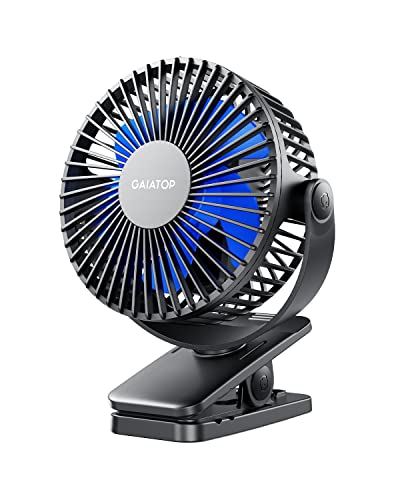
Gaiatop Portable Clip on Fan Battery Operated
Summer drives can get uncomfortable long before the air conditioner catches up, especially after a vehicle has been sitting in direct sunlight. That's exactly where the best clip on fan for car category earns its place, and the Gaiatop Portable Clip on Fan aims to solve that uneven airflow without taking over valuable cabin space. Instead of relying on oversized housings or complicated mounting systems, this compact model focuses on flexibility, quiet operation, and portable cooling that fits naturally into everyday travel.
Gaiatop Clip Fan Review
The overall design feels intentionally practical. Measuring just over five inches wide and weighing around 0.71 pounds, the fan slips into a travel bag, glove compartment, or storage pocket without becoming another bulky accessory. Its compact frame also makes it easier to position around headrests, center consoles, camping chairs, or stroller handles where larger fans simply don't fit.
The black and blue finish gives it a clean appearance without drawing unnecessary attention inside the vehicle. More importantly, the rotating head doesn't require moving the entire clip whenever airflow needs adjustment. That simple detail becomes surprisingly valuable during long drives where passengers constantly shift positions.
Portability stands out immediately, but portability alone doesn't guarantee usefulness. The design succeeds because every major control remains straightforward, allowing quick adjustments without spending time figuring out complicated mechanisms.
Cooling Performance During Everyday Driving
Air movement matters far more than fan size, and Gaiatop approaches this with a brushless motor paired with redesigned blades intended to improve airflow efficiency. Instead of producing scattered air, the fan directs a focused stream that works well for cooling one seating area at a time.
The three speed settings provide welcome flexibility. Lower speeds create gentle circulation during casual commuting, while higher settings become useful after entering a hot vehicle that hasn't cooled down yet. Since airflow needs vary throughout the trip, having several speed choices feels far more practical than a simple on-and-off switch.
Quiet operation deserves equal attention. Small fans often develop an irritating mechanical buzz at higher speeds, yet the upgraded blade design attempts to reduce unnecessary noise. While no compact fan becomes completely silent at maximum output, the sound profile remains suitable for conversations, music, or children sleeping nearby.
Balanced airflow and reduced operating noise create a better everyday experience than simply chasing maximum wind speed.
Battery Life And Charging Convenience
Power flexibility is one of the stronger aspects of this model. The built-in 2000 mAh rechargeable battery allows cordless use while also supporting operation during charging, giving it more versatility than products limited to only one power source.
According to the supplied specifications, runtime varies between approximately 2.5 and 9 hours depending on the selected speed. That's a realistic pattern for compact rechargeable fans because stronger airflow naturally demands more energy. Rather than treating battery life as a fixed number, it's better viewed as something that changes with actual usage.
USB charging also expands where the fan can be used. Inside a vehicle, it connects easily to a USB adapter or portable power bank. Outside the car, the same fan moves effortlessly to a campsite, office desk, picnic table, or hotel room without requiring another dedicated power solution.
Rechargeable operation combined with USB charging increases convenience instead of locking the fan into one environment.
Clip Design And Mounting Stability
A clip-on fan becomes frustrating very quickly if the mount can't hold its position. Gaiatop addresses this with an easy-to-open clamp designed for surfaces up to one inch thick. That measurement covers many common mounting locations including headrest bars, stroller frames, folding chairs, shelves, and certain dashboard accessories.
The addition of a sponge pad inside the clamp deserves recognition because it reduces the chance of scratching finished surfaces. Small touches like this often matter more over months of ownership than cosmetic styling.
Mounting flexibility also benefits from the dual-axis rotation system. With 360-degree horizontal rotation and 360-degree vertical adjustment, directing airflow becomes much easier than repeatedly unclipping and repositioning the entire fan.
One practical limitation still exists. Any clip designed around a one-inch opening won't fit every oversized support bar or unusually thick surface, so checking mounting dimensions beforehand remains worthwhile.
Safety Features And Family-Friendly Design
Small portable fans frequently end up around children, making blade protection far more important than many buyers initially realize. Gaiatop reduces this concern by using approximately 5.5 mm openings in the protective grille, limiting access to the spinning blades while maintaining usable airflow.
The quieter motor also contributes to a calmer environment during naps or longer journeys. Loud mechanical fans often become distracting even if their airflow is acceptable, so reducing unnecessary noise improves overall comfort.
Finger protection, quiet performance, and compact construction combine to make the fan suitable for situations where safety deserves equal consideration alongside cooling.
Versatility Beyond The Car
One reason portable clip fans remain popular is their ability to move between completely different environments without feeling out of place. This model works inside vehicles, yet it also adapts naturally to desks, camping setups, travel accommodations, outdoor seating, and strollers.
That versatility means the purchase doesn't spend most of the year sitting unused inside a glove compartment. Instead, the same cooling solution follows changing routines throughout different seasons and activities.
Interestingly, ceiling airflow solves an entirely different cooling challenge, and a related discussion appears in best high power ceiling fan. The comparison highlights how portable airflow and whole-room circulation serve separate purposes rather than competing directly.
Multi-location usability increases the long-term value because the fan continues serving practical roles long after the road trip has ended.
Strengths, Tradeoffs, And Overall Experience
The strongest qualities revolve around practical usability instead of flashy specifications. Compact dimensions, rechargeable operation, USB charging support, rotating airflow, protective grille design, and a padded clip create a package that fits naturally into everyday routines.
Tradeoffs remain realistic. The one-inch clip opening limits certain mounting locations, and maximum battery runtime naturally decreases at higher fan speeds. Neither point feels unusual for a portable fan in this size category, but they're worth considering before purchasing.
Daily use favors products that require little attention after setup. This fan largely succeeds because adjustments remain simple, airflow stays focused, and moving it from the car to another location takes only a few seconds.
Portable cooling, flexible positioning, and quiet operation define the overall experience far better than raw specifications alone.
Gaiatop Portable Clip on Fan Battery Operated
Summer drives can get uncomfortable long before the air conditioner catches up, especially after a vehicle has been sitting in direct sunlight. That's exactly where the best clip on fan for car category earns its place, and the Gaiatop Portable Clip on Fan aims to solve that uneven airflow without taking over valuable cabin space. Instead of relying on oversized housings or complicated mounting systems, this compact model focuses on flexibility, quiet operation, and portable cooling that fits naturally into everyday travel.
Gaiatop Clip Fan Review
The overall design feels intentionally practical. Measuring just over five inches wide and weighing around 0.71 pounds, the fan slips into a travel bag, glove compartment, or storage pocket without becoming another bulky accessory. Its compact frame also makes it easier to position around headrests, center consoles, camping chairs, or stroller handles where larger fans simply don't fit.
The black and blue finish gives it a clean appearance without drawing unnecessary attention inside the vehicle. More importantly, the rotating head doesn't require moving the entire clip whenever airflow needs adjustment. That simple detail becomes surprisingly valuable during long drives where passengers constantly shift positions.
Portability stands out immediately, but portability alone doesn't guarantee usefulness. The design succeeds because every major control remains straightforward, allowing quick adjustments without spending time figuring out complicated mechanisms.
Cooling Performance During Everyday Driving
Air movement matters far more than fan size, and Gaiatop approaches this with a brushless motor paired with redesigned blades intended to improve airflow efficiency. Instead of producing scattered air, the fan directs a focused stream that works well for cooling one seating area at a time.
The three speed settings provide welcome flexibility. Lower speeds create gentle circulation during casual commuting, while higher settings become useful after entering a hot vehicle that hasn't cooled down yet. Since airflow needs vary throughout the trip, having several speed choices feels far more practical than a simple on-and-off switch.
Quiet operation deserves equal attention. Small fans often develop an irritating mechanical buzz at higher speeds, yet the upgraded blade design attempts to reduce unnecessary noise. While no compact fan becomes completely silent at maximum output, the sound profile remains suitable for conversations, music, or children sleeping nearby.
Balanced airflow and reduced operating noise create a better everyday experience than simply chasing maximum wind speed.
Battery Life And Charging Convenience
Power flexibility is one of the stronger aspects of this model. The built-in 2000 mAh rechargeable battery allows cordless use while also supporting operation during charging, giving it more versatility than products limited to only one power source.
According to the supplied specifications, runtime varies between approximately 2.5 and 9 hours depending on the selected speed. That's a realistic pattern for compact rechargeable fans because stronger airflow naturally demands more energy. Rather than treating battery life as a fixed number, it's better viewed as something that changes with actual usage.
USB charging also expands where the fan can be used. Inside a vehicle, it connects easily to a USB adapter or portable power bank. Outside the car, the same fan moves effortlessly to a campsite, office desk, picnic table, or hotel room without requiring another dedicated power solution.
Rechargeable operation combined with USB charging increases convenience instead of locking the fan into one environment.
Clip Design And Mounting Stability
A clip-on fan becomes frustrating very quickly if the mount can't hold its position. Gaiatop addresses this with an easy-to-open clamp designed for surfaces up to one inch thick. That measurement covers many common mounting locations including headrest bars, stroller frames, folding chairs, shelves, and certain dashboard accessories.
The addition of a sponge pad inside the clamp deserves recognition because it reduces the chance of scratching finished surfaces. Small touches like this often matter more over months of ownership than cosmetic styling.
Mounting flexibility also benefits from the dual-axis rotation system. With 360-degree horizontal rotation and 360-degree vertical adjustment, directing airflow becomes much easier than repeatedly unclipping and repositioning the entire fan.
One practical limitation still exists. Any clip designed around a one-inch opening won't fit every oversized support bar or unusually thick surface, so checking mounting dimensions beforehand remains worthwhile.
Safety Features And Family-Friendly Design
Small portable fans frequently end up around children, making blade protection far more important than many buyers initially realize. Gaiatop reduces this concern by using approximately 5.5 mm openings in the protective grille, limiting access to the spinning blades while maintaining usable airflow.
The quieter motor also contributes to a calmer environment during naps or longer journeys. Loud mechanical fans often become distracting even if their airflow is acceptable, so reducing unnecessary noise improves overall comfort.
Finger protection, quiet performance, and compact construction combine to make the fan suitable for situations where safety deserves equal consideration alongside cooling.
Versatility Beyond The Car
One reason portable clip fans remain popular is their ability to move between completely different environments without feeling out of place. This model works inside vehicles, yet it also adapts naturally to desks, camping setups, travel accommodations, outdoor seating, and strollers.
That versatility means the purchase doesn't spend most of the year sitting unused inside a glove compartment. Instead, the same cooling solution follows changing routines throughout different seasons and activities.
Interestingly, ceiling airflow solves an entirely different cooling challenge, and a related discussion appears in best high power ceiling fan. The comparison highlights how portable airflow and whole-room circulation serve separate purposes rather than competing directly.
Multi-location usability increases the long-term value because the fan continues serving practical roles long after the road trip has ended.
Strengths, Tradeoffs, And Overall Experience
The strongest qualities revolve around practical usability instead of flashy specifications. Compact dimensions, rechargeable operation, USB charging support, rotating airflow, protective grille design, and a padded clip create a package that fits naturally into everyday routines.
Tradeoffs remain realistic. The one-inch clip opening limits certain mounting locations, and maximum battery runtime naturally decreases at higher fan speeds. Neither point feels unusual for a portable fan in this size category, but they're worth considering before purchasing.
Daily use favors products that require little attention after setup. This fan largely succeeds because adjustments remain simple, airflow stays focused, and moving it from the car to another location takes only a few seconds.
Portable cooling, flexible positioning, and quiet operation define the overall experience far better than raw specifications alone.
Koonie 10000mAh Rechargeable 8-Inch Clip-on Fan
A weak dashboard vent can leave one side of a vehicle chilly while the other stays sticky and uncomfortable. That uneven cooling gets old fast during traffic jams, parked-car cooldowns, and long stretches on the highway. The Koonie model approaches the best clip on fan for car problem with a larger eight-inch fan head, a substantial rechargeable battery, and a clamp built for more than dainty mounting points. Its size brings stronger coverage, though it also asks for more cabin room than a pocket-sized fan.
Koonie Rechargeable Clip-on Fan
The first thing that separates this fan from compact personal models is its eight-inch frame. Three broad blades are designed to move air across a wider area rather than creating a narrow stream aimed at one cheek or shoulder. That broader reach makes sense near a back seat, inside a parked work vehicle, or beside exercise equipment where gentle circulation won't cut it. Still, the larger housing may feel bulky in a small coupe with limited mounting surfaces.
Koonie combines a clip fan and a desk fan in one body, which gives it more value outside the vehicle. The base can sit on a stable surface, while the three-inch clamp attaches to desk edges, treadmill frames, nightstands, golf carts, and other sturdy supports. Inside a car, that clamp offers more gripping depth than many miniature designs. The tradeoff is simple: a larger clamp needs enough clearance to open and close without colliding with trim.
The product information points to four operating choices, described as three speed settings plus an energy-saving mode. That range lets the fan shift from mild circulation to more forceful cooling as cabin conditions change. A low setting makes sense once the air conditioner has stabilized the temperature, while a stronger mode can help move trapped warm air during the first part of a drive. The energy-saving setting also gives the large battery a better chance of stretching through a full day.
Battery Capacity Built For Long Sessions
The 10000mAh rechargeable battery is the headline feature, and rightly so. The supplied description states that runtime can reach up to 24 hours on a full charge, though actual endurance will depend heavily on the selected speed. Higher airflow draws more power, so that upper figure shouldn't be treated as an all-speed promise. Even with that caveat, the capacity is far above what smaller clip fans usually carry.
Cordless operation removes one of the most irritating problems inside a vehicle: wires snaking across consoles, seats, and charging ports. The fan can be placed where airflow is needed rather than where the nearest USB connection happens to be. That freedom is a major practical strength for rear seats, vans, golf carts, tents, and temporary workspaces. It also keeps valuable charging outlets available for phones, navigation devices, or dash cameras.
Charging convenience is handled through both USB-C and Micro USB inputs, according to the provided specifications. Support for 5V/2A charging is said to bring the battery back to full capacity in about six hours. That isn't instant, but the charging time feels reasonable for a battery of this size. Compatibility with laptops, wall adapters, power banks, and USB chargers also reduces the odds of being stranded without a suitable cable.
The battery adds weight and bulk, of course, and there's no getting around that physical reality. A high-capacity pack makes the fan less featherlight than smaller stroller-style models, which may matter if it's clipped to thin plastic trim. The payoff is longer untethered use and fewer charging interruptions. For extended travel, outdoor work, or repeated daily use, that exchange often makes sense.
Airflow And Noise In Daily Use
Three eight-inch blades give this fan a different airflow character from tiny high-RPM models. Instead of relying entirely on rapid blade speed, the larger diameter can push a wider column of air across the cabin. That design favors area coverage over ultra-compact placement. A rear passenger area, open hatch, or parked van can benefit more from that broad sweep than from a small fan aimed at a single seat.
The manufacturer describes the motor as both strong and quiet, but those terms should be read with realistic expectations. Any fan moving substantial air will create some blade and motor sound, particularly at its highest setting. The useful question is whether the noise stays steady and unobtrusive rather than rattly or harsh. A consistent hum is much easier to live with during calls, music, naps, or focused desk work.
The energy-saving mode deserves attention for situations where constant maximum airflow would be unnecessary. Once a car's air conditioner has lowered the cabin temperature, gentle circulation can help distribute cool air without draining the battery as quickly. That setting may also suit nighttime use, bedside placement, or quiet office work. It won't deliver the strongest breeze, but that's precisely the point.
Strong airflow can expose weak mounting hardware, especially on rough roads. A fan head this large creates more leverage than a miniature model, so the clamp needs a firm, flat surface to stay put. Mounting it on a flexible visor edge or flimsy trim panel may invite wobbling. A solid headrest support, sturdy console edge, or fixed shelf offers a more sensible foundation.
Clamp Strength And Flexible Positioning
The three-inch clamp opens up mounting possibilities that narrower clips can't handle. Thick desk edges, gym equipment frames, cart supports, and substantial interior fixtures are more likely to fit within its reach. That makes the fan adaptable across several settings instead of confining it to one vehicle. The clamp's size also gives the body a stable base when used on a tabletop.
A rotating head handles directional control, with the supplied details stating 360-degree vertical and horizontal adjustment. That freedom allows the breeze to be redirected without removing the fan from its mounting point. Air can be aimed toward the back seat during one trip, then toward the driver's side while the vehicle is parked. The mechanism also helps compensate for mounting surfaces that aren't perfectly aligned.
Rotation flexibility is useful, but a joint still needs enough resistance to hold an eight-inch fan head in place. Frequent repositioning may gradually loosen any adjustable mechanism, so gentle handling is wiser than snapping the head through abrupt angle changes. The design's real advantage is controlled aiming rather than constant fiddling. Set correctly, multi-angle airflow can cover awkward cabin zones that fixed vents miss entirely.
The fan's larger dimensions create a visibility concern that shouldn't be brushed aside. Mounting it high on the dashboard or near the windshield could obstruct the driver's view. A lower position beside a seat, behind a headrest, or near the rear cargo area is often safer. Good airflow means little if the setup interferes with mirrors, airbags, controls, or sightlines.
How It Fits The Best Car Fan Category
The Koonie model fits the best clip on fan for car category through endurance and airflow coverage rather than miniature convenience. Its battery capacity supports long periods away from power, while the eight-inch blades move air across a broader zone. That combination suits vehicles where factory vents struggle to reach rear passengers or cargo areas. It may be more fan than needed for someone seeking a tiny unit beside the steering wheel.
Compact competitors usually win on easy storage and discreet mounting. Koonie answers with a larger cooling footprint, a deeper clamp, and extended cordless runtime. Neither approach is automatically better. The choice depends on whether cabin space or sustained airflow carries more weight.
Whole-room air movement belongs to another branch of cooling altogether, and a neutral design reference appears in rustic farmhouse ceiling fans for settings where fixed overhead circulation and lighting share the same space. That distinction matters because a portable clip fan solves localized heat, not full-room temperature management. Koonie is built to move with the situation rather than become part of a permanent fixture. Its strongest role remains focused circulation wherever a sturdy mounting point is available.
The model also carries realistic limitations. A six-hour stated charging period requires planning, the housing needs more room than a mini fan, and high-speed use won't deliver the maximum advertised runtime. Those are practical tradeoffs, not hidden flaws. Buyers who understand the size and battery relationship are less likely to be disappointed.
Strengths And Weaknesses Worth Weighing
The clearest strength is battery endurance. A 10000mAh pack reduces dependence on vehicle outlets and makes the fan useful through long drives, outdoor events, workouts, or overnight stays. Dual charging inputs also add flexibility when one cable type isn't nearby. Few small accessories are truly convenient if they constantly need to be plugged in, and this fan tries to avoid that trap.
Airflow coverage is another meaningful advantage. The eight-inch blades can serve a broader area than tiny personal fans, making the unit better suited to shared seating zones or open spaces. Four operating choices provide control over noise, cooling force, and power consumption. That balance between strong circulation and an energy-saving option gives the fan more range than a basic one-speed design.
The main weakness is the physical footprint. Larger blades, a heavy battery, and a deep clamp require a stable location with enough clearance around the rotating head. Tight dashboards and delicate trim aren't natural partners for this design. Smaller cars may need careful placement behind a seat rather than near the front controls.
Another limitation comes from the gap between maximum runtime and maximum performance. The fan may reach the stated upper runtime only under lower-demand operation, while stronger settings will shorten each charge. That's normal battery behavior, but it matters during camping trips or all-day travel. Used with reasonable speed choices, the Koonie fan offers lasting portable airflow without pretending that one setting can do everything.
Koonie 10000mAh Rechargeable 8-Inch Clip-on Fan
A weak dashboard vent can leave one side of a vehicle chilly while the other stays sticky and uncomfortable. That uneven cooling gets old fast during traffic jams, parked-car cooldowns, and long stretches on the highway. The Koonie model approaches the best clip on fan for car problem with a larger eight-inch fan head, a substantial rechargeable battery, and a clamp built for more than dainty mounting points. Its size brings stronger coverage, though it also asks for more cabin room than a pocket-sized fan.
Koonie Rechargeable Clip-on Fan
The first thing that separates this fan from compact personal models is its eight-inch frame. Three broad blades are designed to move air across a wider area rather than creating a narrow stream aimed at one cheek or shoulder. That broader reach makes sense near a back seat, inside a parked work vehicle, or beside exercise equipment where gentle circulation won't cut it. Still, the larger housing may feel bulky in a small coupe with limited mounting surfaces.
Koonie combines a clip fan and a desk fan in one body, which gives it more value outside the vehicle. The base can sit on a stable surface, while the three-inch clamp attaches to desk edges, treadmill frames, nightstands, golf carts, and other sturdy supports. Inside a car, that clamp offers more gripping depth than many miniature designs. The tradeoff is simple: a larger clamp needs enough clearance to open and close without colliding with trim.
The product information points to four operating choices, described as three speed settings plus an energy-saving mode. That range lets the fan shift from mild circulation to more forceful cooling as cabin conditions change. A low setting makes sense once the air conditioner has stabilized the temperature, while a stronger mode can help move trapped warm air during the first part of a drive. The energy-saving setting also gives the large battery a better chance of stretching through a full day.
Battery Capacity Built For Long Sessions
The 10000mAh rechargeable battery is the headline feature, and rightly so. The supplied description states that runtime can reach up to 24 hours on a full charge, though actual endurance will depend heavily on the selected speed. Higher airflow draws more power, so that upper figure shouldn't be treated as an all-speed promise. Even with that caveat, the capacity is far above what smaller clip fans usually carry.
Cordless operation removes one of the most irritating problems inside a vehicle: wires snaking across consoles, seats, and charging ports. The fan can be placed where airflow is needed rather than where the nearest USB connection happens to be. That freedom is a major practical strength for rear seats, vans, golf carts, tents, and temporary workspaces. It also keeps valuable charging outlets available for phones, navigation devices, or dash cameras.
Charging convenience is handled through both USB-C and Micro USB inputs, according to the provided specifications. Support for 5V/2A charging is said to bring the battery back to full capacity in about six hours. That isn't instant, but the charging time feels reasonable for a battery of this size. Compatibility with laptops, wall adapters, power banks, and USB chargers also reduces the odds of being stranded without a suitable cable.
The battery adds weight and bulk, of course, and there's no getting around that physical reality. A high-capacity pack makes the fan less featherlight than smaller stroller-style models, which may matter if it's clipped to thin plastic trim. The payoff is longer untethered use and fewer charging interruptions. For extended travel, outdoor work, or repeated daily use, that exchange often makes sense.
Airflow And Noise In Daily Use
Three eight-inch blades give this fan a different airflow character from tiny high-RPM models. Instead of relying entirely on rapid blade speed, the larger diameter can push a wider column of air across the cabin. That design favors area coverage over ultra-compact placement. A rear passenger area, open hatch, or parked van can benefit more from that broad sweep than from a small fan aimed at a single seat.
The manufacturer describes the motor as both strong and quiet, but those terms should be read with realistic expectations. Any fan moving substantial air will create some blade and motor sound, particularly at its highest setting. The useful question is whether the noise stays steady and unobtrusive rather than rattly or harsh. A consistent hum is much easier to live with during calls, music, naps, or focused desk work.
The energy-saving mode deserves attention for situations where constant maximum airflow would be unnecessary. Once a car's air conditioner has lowered the cabin temperature, gentle circulation can help distribute cool air without draining the battery as quickly. That setting may also suit nighttime use, bedside placement, or quiet office work. It won't deliver the strongest breeze, but that's precisely the point.
Strong airflow can expose weak mounting hardware, especially on rough roads. A fan head this large creates more leverage than a miniature model, so the clamp needs a firm, flat surface to stay put. Mounting it on a flexible visor edge or flimsy trim panel may invite wobbling. A solid headrest support, sturdy console edge, or fixed shelf offers a more sensible foundation.
Clamp Strength And Flexible Positioning
The three-inch clamp opens up mounting possibilities that narrower clips can't handle. Thick desk edges, gym equipment frames, cart supports, and substantial interior fixtures are more likely to fit within its reach. That makes the fan adaptable across several settings instead of confining it to one vehicle. The clamp's size also gives the body a stable base when used on a tabletop.
A rotating head handles directional control, with the supplied details stating 360-degree vertical and horizontal adjustment. That freedom allows the breeze to be redirected without removing the fan from its mounting point. Air can be aimed toward the back seat during one trip, then toward the driver's side while the vehicle is parked. The mechanism also helps compensate for mounting surfaces that aren't perfectly aligned.
Rotation flexibility is useful, but a joint still needs enough resistance to hold an eight-inch fan head in place. Frequent repositioning may gradually loosen any adjustable mechanism, so gentle handling is wiser than snapping the head through abrupt angle changes. The design's real advantage is controlled aiming rather than constant fiddling. Set correctly, multi-angle airflow can cover awkward cabin zones that fixed vents miss entirely.
The fan's larger dimensions create a visibility concern that shouldn't be brushed aside. Mounting it high on the dashboard or near the windshield could obstruct the driver's view. A lower position beside a seat, behind a headrest, or near the rear cargo area is often safer. Good airflow means little if the setup interferes with mirrors, airbags, controls, or sightlines.
How It Fits The Best Car Fan Category
The Koonie model fits the best clip on fan for car category through endurance and airflow coverage rather than miniature convenience. Its battery capacity supports long periods away from power, while the eight-inch blades move air across a broader zone. That combination suits vehicles where factory vents struggle to reach rear passengers or cargo areas. It may be more fan than needed for someone seeking a tiny unit beside the steering wheel.
Compact competitors usually win on easy storage and discreet mounting. Koonie answers with a larger cooling footprint, a deeper clamp, and extended cordless runtime. Neither approach is automatically better. The choice depends on whether cabin space or sustained airflow carries more weight.
Whole-room air movement belongs to another branch of cooling altogether, and a neutral design reference appears in rustic farmhouse ceiling fans for settings where fixed overhead circulation and lighting share the same space. That distinction matters because a portable clip fan solves localized heat, not full-room temperature management. Koonie is built to move with the situation rather than become part of a permanent fixture. Its strongest role remains focused circulation wherever a sturdy mounting point is available.
The model also carries realistic limitations. A six-hour stated charging period requires planning, the housing needs more room than a mini fan, and high-speed use won't deliver the maximum advertised runtime. Those are practical tradeoffs, not hidden flaws. Buyers who understand the size and battery relationship are less likely to be disappointed.
Strengths And Weaknesses Worth Weighing
The clearest strength is battery endurance. A 10000mAh pack reduces dependence on vehicle outlets and makes the fan useful through long drives, outdoor events, workouts, or overnight stays. Dual charging inputs also add flexibility when one cable type isn't nearby. Few small accessories are truly convenient if they constantly need to be plugged in, and this fan tries to avoid that trap.
Airflow coverage is another meaningful advantage. The eight-inch blades can serve a broader area than tiny personal fans, making the unit better suited to shared seating zones or open spaces. Four operating choices provide control over noise, cooling force, and power consumption. That balance between strong circulation and an energy-saving option gives the fan more range than a basic one-speed design.
The main weakness is the physical footprint. Larger blades, a heavy battery, and a deep clamp require a stable location with enough clearance around the rotating head. Tight dashboards and delicate trim aren't natural partners for this design. Smaller cars may need careful placement behind a seat rather than near the front controls.
Another limitation comes from the gap between maximum runtime and maximum performance. The fan may reach the stated upper runtime only under lower-demand operation, while stronger settings will shorten each charge. That's normal battery behavior, but it matters during camping trips or all-day travel. Used with reasonable speed choices, the Koonie fan offers lasting portable airflow without pretending that one setting can do everything.
xuenair Car Fan Battery Powered Visor Clip Fan
Some accessories only prove their value after sitting in slow-moving traffic on a scorching afternoon. Uneven airflow inside a vehicle can leave rear passengers uncomfortable even when the air conditioner is running, which is exactly where the best clip on fan for car becomes useful. The xuenair Car Fan approaches this everyday problem with a visor-friendly mounting design, a rechargeable battery, and flexible positioning that keeps the airflow moving without crowding the cabin.
xuenair Visor Clip Fan Review
Rather than copying the typical headrest-mounted approach, this model introduces a visor-compatible clip that immediately broadens its placement options. It can also attach to roof handles, back seat headrest rods, and other mounting points, making it adaptable for different vehicle layouts. That flexibility helps distribute airflow where factory vents often struggle to reach.
The yellow finish gives the fan a more noticeable appearance than traditional black accessories. Some drivers may appreciate the brighter look, while others may prefer something that blends into the interior. Fortunately, appearance has little impact on the fan's actual performance.
The compact housing avoids taking up unnecessary room, which matters in smaller vehicles where every inch counts. Even with its portable size, the design still focuses on adjustable airflow rather than simply squeezing into tight spaces.
Airflow And Cooling Performance
The built-in brushless motor powers three selectable speed levels, allowing the airflow to match changing cabin conditions throughout a trip. Lower speeds provide gentle circulation once the interior has cooled, while the highest setting helps reduce heat buildup after entering a vehicle that has been parked in direct sunlight.
Instead of limiting the airflow to one fixed direction, the fan combines a 180-degree folding visor design with 360-degree horizontal and vertical rotation. That combination allows the breeze to reach front passengers, rear occupants, or even a child seat without constantly moving the mounting clip.
Quiet operation is another welcome detail. According to the supplied specifications, the upgraded motor is designed to reduce operating noise while extending service life. No portable fan is completely silent when pushing stronger airflow, but reducing mechanical noise makes long drives noticeably more comfortable.
Balanced airflow matters more than chasing extreme wind speed. The xuenair model appears to prioritize steady cooling instead of creating an overwhelming blast of air that quickly becomes uncomfortable.
Battery Life And Charging Options
The integrated 2000mAh rechargeable battery gives the fan cordless flexibility without making the body excessively heavy. The supplied description indicates a runtime of up to eight hours depending on the selected speed, which reflects realistic battery behavior rather than promising identical endurance under every condition.
Type-C charging adds convenience because many travelers already carry compatible charging cables for phones and tablets. Fewer proprietary cables mean fewer items to remember before leaving home, especially during road trips or camping weekends.
One practical advantage is the ability to continue operating while connected to power. If the battery begins running low during a longer drive, plugging it into a USB outlet allows continuous cooling instead of waiting for a recharge cycle to finish.
Rechargeable convenience combined with USB operation creates a flexible power system that works equally well inside and outside the vehicle.
Mounting Stability On Rough Roads
A portable fan becomes frustrating if every pothole sends it sliding out of position. xuenair addresses that issue with a clip designed for surfaces up to 1.4 inches thick, giving it compatibility with more mounting locations than narrower clamp designs.
The inside of the clamp is lined with protective silicone padding, helping reduce scratches while improving grip. That additional friction should help the fan remain stable on uneven roads without damaging trim pieces or interior surfaces.
The visor mounting concept is especially interesting because it keeps the fan elevated while the supplied description specifically notes that it is intended not to block the driver's vision. Placement still matters, of course, since every vehicle has a different interior layout.
A firm clip doesn't guarantee perfect stability on every surface, but secure mounting and thoughtful padding increase confidence during everyday driving.
Everyday Versatility Beyond The Car
The product isn't limited to automotive use. The supplied information lists desks, beds, strollers, baby cribs, cabinets, golf carts, and camping tents among its intended applications, making the fan useful throughout the year instead of only during commuting.
That flexibility improves overall value because the fan can move from the vehicle to a hotel room, campsite, or home office within seconds. Rather than buying separate cooling devices for different situations, one portable unit covers several everyday needs.
Discussions about fixed household cooling often involve different design priorities, and a related reference appears in 3 blade ceiling fan with light and remote. That comparison highlights how portable airflow and permanent room circulation solve completely different cooling challenges.
Portable versatility remains one of the strongest reasons many drivers choose rechargeable clip fans instead of vehicle-specific accessories.
Strengths And Realistic Tradeoffs
The visor-friendly mounting system gives this fan a distinctive advantage over products that only attach behind the seats. Combined with 360-degree adjustment, it provides far more freedom when directing airflow exactly where it's needed.
The rechargeable battery, quiet brushless motor, silicone-protected clamp, and multiple installation options all contribute to a thoughtful overall package. None of those features feel unnecessary because each one addresses a practical inconvenience encountered during everyday travel.
There are still reasonable limitations. A 2000mAh battery won't deliver the extended runtime of much larger battery packs, especially when operated continuously at the highest speed. Likewise, the compact fan head is intended for localized airflow rather than cooling an entire vehicle cabin.
Buyers expecting focused circulation instead of whole-cabin climate control are likely to appreciate the design. The combination of compact portability, stable mounting, and flexible airflow direction makes the xuenair model a sensible option for drivers looking to improve comfort without installing permanent accessories.


Best Quiet Ceiling Fan For Bedroom 2026 Ultimate Comfort Picks

Best Ceiling Fan For Master Bedroom 2026 With Ultimate Comfort

Best White Ceiling Fan With Light For Bedroom 2026 Top Picks

Best Quorum Medallion Ceiling Fan 2026 With Style & Breeze
Best Outdoor Fan For Pergola 2026 Comfort Boost

Best Ceiling Fan For Great Room 2026 With Ultimate Comfort

Best Outdoor DC Ceiling Fans 2026 For Breezy Comfort
Best ceiling exhaust bath fan with light and heater 2026





