Best Cooling Fan for Car Interior 2026: Smarter Picks

A parked vehicle can turn uncomfortable fast, especially after the dashboard, seats, and steering wheel have spent hours absorbing sunlight. Even after the air conditioner starts, cool air may stay concentrated near the front vents while the back seat remains stuffy. A best cooling fan for car interior helps move that trapped heat, circulate conditioned air, and reduce the long, sweaty stretch before the cabin finally feels bearable. It won't replace a working air-conditioning system, but it can make the system feel more effective by pushing air toward neglected areas.
Airflow direction matters more than flashy styling. A fan with an adjustable head can aim air toward a rear-facing child seat, a passenger sitting behind the driver, or a pet carrier placed away from the dashboard vents. Dual-head designs offer wider coverage, though they usually take up more space and may create extra visual clutter. Compact single-head models fit tighter dashboards and consoles, but their narrower stream can leave parts of a large cabin untouched.
Power options deserve a close look, too. A 12-volt plug delivers steady power during long drives and avoids the headache of remembering to recharge another device. USB-powered fans are easier to use with power banks, newer vehicle ports, and charging adapters, but weak USB outlets may limit fan speed. Rechargeable models keep running while the engine is off, yet battery life drops quickly at the highest setting, so there’s a tradeoff between stronger airflow and longer use.
Noise level becomes noticeable once the initial heat settles down. A loud motor can compete with podcasts, phone calls, or quiet conversation, especially in a small sedan where every sound bounces around the cabin. Brushless motors generally produce a smoother hum and handle frequent use better than cheap motors that rattle after a few weeks. Still, even a quiet fan will become distracting if its mount vibrates against hard plastic, so a padded base or firm clip can matter as much as the motor itself.
Mounting style can make or break the experience. Strong clips attach securely to headrests, vents, or seat pockets, but oversized clamps may block controls or leave pressure marks on softer trim. Suction mounts provide flexible positioning on glass, although summer heat can weaken the seal and send the fan tumbling at the worst possible moment. Dashboard bases feel simple and tidy, yet they need enough flat space and reliable grip to stay put during sharp turns or sudden stops.
Safety should never take a back seat to comfort. Cords need enough length to reach the outlet without stretching across the gear selector, pedals, or passenger footwell. Protective grilles should keep fingers, fabric, and loose hair away from spinning blades. A stable car fan should also hold its angle over rough roads instead of slowly drooping toward the floor, which is a common frustration with weak hinges.
The right pick depends on the cabin rather than the biggest speed number printed on a product page. Small hatchbacks often need controlled, quiet circulation, while minivans and SUVs benefit from broader oscillation or separate fan heads. Dark upholstery, limited rear vents, frequent stop-and-go driving, and long parking periods all increase the value of focused airflow. Realistically, the strongest setting is useful for the first blast of heat, while medium or low speed usually feels better once the air conditioner catches up.

- LFR Score9.0
LFR Score is a ranking system developed by lightfansreviews.com. LFR Score has no relationship or impact from any manufacturers or sales agent websites. Learn more
- BrandKoonie

- LFR Score8.6
LFR Score is a ranking system developed by lightfansreviews.com. LFR Score has no relationship or impact from any manufacturers or sales agent websites. Learn more
- BrandIriQuart
- LFR Score8.4
LFR Score is a ranking system developed by lightfansreviews.com. LFR Score has no relationship or impact from any manufacturers or sales agent websites. Learn more
- BrandXOOL

- LFR Score8.4
LFR Score is a ranking system developed by lightfansreviews.com. LFR Score has no relationship or impact from any manufacturers or sales agent websites. Learn more
- BrandHayousui

- LFR Score8.4
LFR Score is a ranking system developed by lightfansreviews.com. LFR Score has no relationship or impact from any manufacturers or sales agent websites. Learn more
- BrandHUENLYEL

- LFR Score8.4
LFR Score is a ranking system developed by lightfansreviews.com. LFR Score has no relationship or impact from any manufacturers or sales agent websites. Learn more
- BrandRoadPro

- LFR Score8.2
LFR Score is a ranking system developed by lightfansreviews.com. LFR Score has no relationship or impact from any manufacturers or sales agent websites. Learn more
- BrandHayousui
Last update on 2026-07-31 / Affiliate links / Images, Product Titles, and Product Highlights from Amazon Product Advertising API
Koonie 10000mAh Rechargeable Clip-On Fan
A closed car can hold onto heat long after the doors swing open, leaving the seats warm and the rear cabin stubbornly stuffy. Dashboard vents often cool the driver first while passengers, pets, or gear near the back continue sitting in stale air. The Koonie 10000mAh Rechargeable Clip-On Fan approaches that problem with an 8-inch fan head, a cordless battery design, and a clamp that can be positioned away from the crowded center console. It isn't a substitute for air conditioning, but it can help circulate cooled air into places the factory vents don't reach well.
Koonie Rechargeable 8-Inch Clip Fan
The main appeal is simple: this fan doesn't need to remain tethered to the car's power outlet. Its built-in 10000mAh rechargeable battery is rated to run for up to 24 hours on a full charge, though actual runtime will naturally depend on the selected speed. That freedom solves a surprisingly common headache in vehicles where the only available outlet is already occupied by a phone charger, dash camera, or navigation device. Fewer loose wires also mean less clutter around the shifter and passenger footwell.
Battery power gives the fan a life beyond the vehicle, too. The same unit can move from a car headrest to a desk, treadmill, stroller, tent, or nightstand without requiring a different stand or adapter. Its two-in-one clip and desk design makes that flexibility possible, so the fan doesn't become a single-purpose accessory gathering dust once summer driving season ends. That broader usefulness helps offset its larger physical size compared with a small vent-mounted car fan.
Charging is handled through two input options, including USB-C and Micro USB ports. The fan supports 5V/2A charging and is described as reaching a full charge in about six hours under suitable charging conditions. Compatibility with laptops, wall adapters, power banks, and other USB power sources makes charging straightforward on a trip. Still, a six-hour refill isn't exactly quick if the battery has been completely drained, so topping it up before a long drive makes more sense than waiting until the last minute.
The battery's biggest strength is also tied to a practical limitation. A 10000mAh cell adds weight, and an 8-inch fan won't disappear neatly into a glove compartment like a tiny dashboard model. Cordless runtime is valuable, but buyers should expect a more substantial accessory that needs a secure mounting location. In a compact cabin, that tradeoff deserves a little planning before the fan is clipped in place.
Airflow That Reaches Beyond The Front Vents
Three 8-inch blades give this model a larger airflow surface than many miniature car fans. The broader fan head can push air across a seat or toward a rear passenger rather than creating a narrow stream that cools only one small spot. Four operating choices are provided, including three regular speed settings and an energy-saving mode. That range lets the fan handle the first blast of trapped heat, then settle into a gentler setting after the cabin starts cooling down.
Strong airflow matters most in vehicles where rear ventilation is weak or completely absent. Clipping the fan to a front headrest post can help redirect conditioned air toward the back seat, while a side placement may reduce the stagnant pocket that forms beside a pet carrier or child seat. The fan's 360-degree vertical and horizontal adjustment allows the airflow angle to change without repeatedly moving the entire clamp. That flexibility is much more useful than a fixed fan that points in the right direction only when the vehicle is parked.
Noise is another part of the design worth considering. The product description emphasizes quiet operation even at higher speeds, which could make the fan less intrusive during calls, podcasts, naps, or everyday conversation. Quiet, of course, doesn't mean silent, and airflow itself will always create some sound. The more realistic benefit is a smoother background hum rather than the buzzy rattle often associated with very small, cheaply mounted fans.
Speed selection also keeps the fan from feeling unnecessarily aggressive. Full power may be welcome after the car has baked in direct sun, but constant high-speed air can become drying during a long drive. The energy-saving setting offers a softer option for maintaining circulation without burning through the battery as quickly. That makes the fan easier to live with over several hours rather than treating it as a short burst of emergency cooling.
Clamp Strength And Cabin Placement
The three-inch clamp is one of the product's defining features. It can grip surfaces that ordinary desk fans can't use, including a shelf edge, treadmill frame, nightstand, or suitable part of a vehicle interior. Inside a car, secure placement matters because sudden braking, potholes, and sharp turns can expose weak mounts in a hurry. A sturdy clamp has a better chance of keeping the fan steady than a lightweight base sitting loose on the dashboard.
Headrest posts, seat edges, and certain console areas may provide workable mounting points, depending on the vehicle's layout. The rotating head makes it possible to clip the base where it fits securely and then aim the fan where the air is needed. That distinction is important because the safest mounting point isn't always directly in line with the passenger. Flexible positioning helps bridge that gap without relying on a long, awkward extension arm.
The clamp isn't guaranteed to suit every interior surface. Thick padded trim, rounded panels, soft upholstery, or tightly enclosed headrest hardware may not give it a firm bite. Care is also needed to avoid blocking mirrors, controls, airbags, or the driver's line of sight. The fan's larger diameter can deliver better coverage, but it also demands more clearance than a compact vent-mounted unit.
A completely unrelated household airflow need may arise in rooms that require much broader circulation, and large ceiling fan guidance offers a neutral reference for that separate situation. Inside the car, the Koonie's clamp remains the more relevant feature because it supports targeted airflow in a confined space. Placement should feel stable before the vehicle moves, with enough clearance around the blades and grille. A quick tug on the mount can reveal whether the chosen surface is solid enough for regular driving.
Daily Use Without Cord Clutter
Cordless operation changes the day-to-day experience more than the specification sheet might suggest. There is no cable stretching from the dashboard to the back seat, no need to route a wire around cup holders, and no fight over a single charging socket. The rechargeable design also allows the fan to keep moving air while the vehicle is parked and switched off, provided it is used safely and never left unattended in extreme heat. That independence suits short stops, outdoor events, and stationary use around a campsite or golf cart.
The controls should be easy enough to cycle through the available settings without much fuss. Four airflow modes give more flexibility than a basic on-or-off fan, though remembering which mode comes next may take a few presses if the controls use a single button. A physical speed indicator would make operation easier at a glance, but none is specified in the provided description. So, expectations should stay grounded in the confirmed features rather than assumed extras.
Cleaning will matter because vehicle cabins collect dust, lint, pollen, and pet hair. An 8-inch grille presents a larger surface than a pocket fan, and buildup can reduce airflow or create extra noise over time. The supplied details don't state whether the grille is removable, so easy internal cleaning shouldn't be assumed. Regularly wiping the exterior grille and keeping fabric away from the intake should help maintain consistent airflow.
Storage is another practical consideration. The fan is portable, but “portable” here means movable rather than tiny. It can shift between a vehicle, office, gym, and campsite, yet it will take meaningful space in a backpack or trunk. The sturdy clamp and battery make it more capable than a slim travel fan, while the larger body makes spontaneous glove-box storage unlikely.
Strengths That Matter In A Hot Car
The strongest benefit is the combination of large-blade airflow and battery independence. Many car fans either produce a narrow breeze or depend entirely on a 12-volt cable. This model offers a wider fan head without forcing a permanent connection to the vehicle. That setup can help distribute cold air from the front vents toward warm rear areas more effectively.
The second strength is its range of movement. A fan that rotates vertically and horizontally can adapt as seating arrangements change, which is handy during carpools, road trips, or outings with pets. The 360-degree adjustment also reduces the need to loosen and reposition the clamp every time the airflow target changes. Less fiddling means the fan is more likely to stay securely mounted.
Its multipurpose build adds practical value. A product purchased for hot commutes can later sit on a desk, attach to exercise equipment, or move into a tent. That doesn't make it universally suited to every setting, but it does prevent the fan from being locked into one narrow role. The clip-and-stand design is especially useful where table space is limited or an ordinary fan base would wobble.
Charging flexibility rounds out the useful features. Supporting both USB-C and Micro USB inputs gives owners more chances of having a compatible cable nearby. The 5V/2A charging support is sensible for a battery of this size, though the stated six-hour full-charge time still requires advance planning. Keeping the battery partially topped up will make the fan far more dependable during sudden hot-weather trips.
Weaknesses And Realistic Tradeoffs
Size is the clearest drawback for car use. An 8-inch clip-on fan occupies considerably more visual and physical space than a small vent fan, especially in a compact sedan. Poor placement could interfere with passengers, obstruct visibility, or become distracting. The stronger airflow may justify the footprint, but the cabin needs a genuinely safe spot for it.
The clamp also isn't a universal mounting answer. It works best on a rigid edge or post that fits within its opening and can tolerate firm pressure. Soft trim may compress, curved surfaces may slip, and delicate finishes could need extra protection. A thin rubber pad between the clamp and the mounting surface may reduce marks, provided it doesn't weaken the grip.
Battery claims deserve sensible expectations. “Up to 24 hours” generally describes operation under favorable conditions, often at a lower speed, while stronger modes consume energy faster. The supplied information doesn't provide separate runtime figures for each setting, so precise endurance at maximum speed can't be stated. Anyone planning an all-day outing should carry a charging cable or power bank rather than relying on the headline number alone.
The Koonie also won't actively lower air temperature. It circulates existing air, helps evaporative cooling on the skin, and can spread conditioned air around the cabin. In a parked car without air conditioning, the fan may make the heat feel less stagnant, but it can't overcome dangerously high interior temperatures. Air circulation is the benefit; actual refrigeration isn't part of the design.
Best Use Cases And Practical Verdict
This model makes the most sense in vehicles with weak rear airflow, crowded charging outlets, or frequent stops where a plugged-in fan becomes inconvenient. Its cord-free operation can keep the setup tidy while allowing placement near the people or areas that need circulation most. Larger cabins may benefit more from the 8-inch head than very small cars, where clearance is limited. A careful mounting check should come before daily road use.
Long drives highlight the value of adjustable speeds. High airflow can help during the first hot minutes, then a quieter lower setting can maintain circulation without dominating the cabin. The energy-saving mode is particularly relevant when charging access is limited. This layered use feels more practical than leaving the fan at full blast until the battery gives out.
The fan's broader usefulness also suits routines that don't end at the parking lot. It can move from the car to a workbench, campsite, exercise area, or outdoor table with the same clamp and battery. That versatility isn't just a nice extra; it makes the fan easier to justify for homes with limited storage and little patience for single-use gadgets. Still, the relatively bulky body should be accepted as part of the bargain.
The Koonie 10000mAh Rechargeable Clip-On Fan stands out through its substantial battery, adjustable 8-inch head, four airflow modes, and sturdy clamp. Its best role is supporting an air conditioner, redirecting cool air, and reducing stagnant pockets rather than trying to cool an entire sun-baked vehicle by itself. Buyers who have a secure mounting point and enough cabin space are likely to appreciate the freedom from cords. Drivers with very tight interiors may be better served by a smaller fan, even if that means accepting narrower airflow and less battery capacity.
IriQuart Portable 3-Head Car Cooling Fan
Heat rarely spreads evenly through a vehicle, and that’s where a single small fan often falls flat. One person gets the breeze while the rear seat, passenger side, or cargo area stays muggy and still. The IriQuart Portable 3-Head Car Cooling Fan tackles that uneven airflow with three independently positioned fan heads powered directly from a 12-volt cigarette lighter socket. It won’t chill the air like an air conditioner, but it can move existing air across more of the cabin and help reduce those stubborn hot pockets.
IriQuart Triple-Head 12V Car Fan
The defining feature is easy to spot: three separate fan heads sit on one dashboard-oriented unit. That layout provides broader coverage than a typical single-head car fan, especially when several seating areas need airflow at the same time. One head can face the driver, another can point toward the passenger side, and the third can send air farther into the rear cabin. The result is a more flexible setup without requiring three individual fans and three separate power connections.
Each fan head supports 360-degree rotation, which matters because car interiors rarely offer a straight, unobstructed path for air. Headrests, seatbacks, consoles, and dashboard contours can all interrupt a fixed stream. Being able to tilt and turn each head allows the airflow to work around those obstacles instead of simply blasting the nearest surface. That adjustability also makes it easier to shift the setup between solo commuting, family trips, or pet transport.
The fan offers two speed settings rather than an elaborate row of controls. Low speed can maintain steady circulation once the cabin starts cooling, while the stronger setting suits the first few minutes after opening a sun-heated vehicle. Two choices won’t satisfy someone who wants fine control over airflow intensity, but the simple arrangement keeps operation straightforward. A quick change is easier than cycling through several barely different modes while driving.
The product contains no internal battery, and that detail shapes the entire experience. It starts working through cigarette lighter power, so there’s no waiting for a recharge and no battery capacity to monitor. The tradeoff is just as clear: the fan can’t operate independently once it is unplugged or the vehicle socket loses power. That makes it a road-use accessory rather than a cordless fan that follows you into a tent, office, or campsite.
Three-Way Airflow Across The Cabin
A three-head design earns its keep in vehicles where the factory vents favor the front seats. Many dashboards send strong air toward the driver and front passenger while the rear receives whatever manages to drift backward. The IriQuart fan can help bridge that gap by directing separate streams of airflow toward different zones. It’s especially practical for wider dashboards or cabins where one narrow fan would leave too much area untouched.
Air distribution is the real benefit, not raw temperature reduction. The fan moves cabin air and can help carry cooled air from the air-conditioning vents toward warmer sections. Without air conditioning, it may still reduce the stale, trapped feeling by keeping air in motion, but it can’t make hot air cold. That realistic distinction matters because circulation support and active cooling aren’t the same thing.
The rotating heads also make uneven preferences easier to manage. A passenger who dislikes direct air can angle one head away, while another occupant can receive a stronger stream. The third head can face upward to disturb heat collecting near the windshield or roofline. That kind of independent positioning gives the fan a practical edge over a broad fixed grille that pushes everything in one direction.
Three fan heads naturally require more dashboard space than a compact vent-mounted unit. A crowded dash already holding a phone mount, navigation screen, or camera may feel cramped once this fan is added. Visibility and airbag clearance deserve attention before settling on a permanent position. Wider airflow is useful, but safe placement matters more than covering every seat.
Plug-In Power And Everyday Reliability
The direct 12-volt connection keeps power simple. Plug the unit into a compatible cigarette lighter socket, select a speed, and the fan begins moving air without battery preparation. That plug-and-play operation suits frequent driving because there’s no separate charging routine to remember. It also avoids the gradual battery decline that can affect rechargeable fans after repeated use.
Power dependence brings a few practical limits. Some vehicles switch off the cigarette lighter socket with the ignition, while others keep the socket active after the engine stops. Leaving the fan connected in an always-on outlet could drain the vehicle battery if it continues running unattended. The supplied description doesn’t specify automatic shutoff, so manual unplugging is the safer habit after parking.
The 4.4-foot power cord offers reasonable reach for many front-dashboard installations. Still, vehicle layouts vary, and a socket located deep in the center console may shorten the usable distance more than expected. Measuring the route before purchase is sensible because the cable must travel around controls and storage areas rather than cutting across them. A cord that reaches on paper can still feel awkward if it interferes with the shifter or hangs into the passenger footwell.
Cable management can make the difference between a tidy setup and a daily nuisance. The wire should stay clear of pedals, steering components, cup holders, and frequently used controls. Small adhesive cable clips may help guide it along a safe edge, though none are listed in the provided details. The fan’s corded reliability is strongest when the installation feels deliberate rather than temporary.
Dashboard Fit And Vehicle Compatibility
The fan is described as compatible with most cars, SUVs, trucks, and vans equipped with a cigarette lighter socket. That covers a broad range of vehicles, but socket compatibility is only half the equation. The dashboard also needs enough stable space for the unit without blocking the windshield or interfering with factory controls. A large SUV may accommodate it easily, while a compact car could demand more careful positioning.
The three-head layout appears better suited to horizontal coverage than a narrow vent clip. That can be useful across a wide dashboard, particularly in trucks or vans where the cabin spans more distance from side to side. Each head can take responsibility for a different area instead of forcing one strong stream through the center. The wider coverage pattern is the model’s clearest advantage in larger interiors.
Smaller cabins introduce the opposite problem. Three airflow sources can feel excessive if the fan sits too close to the occupants, and the unit may compete with phones, screens, or storage trays for space. Low speed should feel more manageable in that situation, but the physical footprint remains. A buyer who values minimal clutter may prefer a single-head design even if it sacrifices coverage.
Household airflow has different scale and mounting needs, and a separate reference appears in designer ceiling fans with lights for rooms rather than vehicles. Inside a car, the IriQuart’s dashboard format remains more relevant because it focuses airflow across a confined cabin. The two products solve unrelated circulation problems, so the connection should stay strictly informational. For vehicle use, socket access and dashboard clearance remain the deciding factors.
Noise, Control, And Daily Comfort
The provided description doesn’t state a measured noise level, so quiet performance shouldn’t be assumed. Three motors may produce more combined sound than one small fan, particularly on the stronger setting. Road noise and air-conditioning airflow may mask much of it during normal driving, but a parked vehicle or quiet phone call could make the sound more noticeable. Noise tolerance is therefore worth considering alongside airflow coverage.
Two speeds keep the control scheme uncomplicated. Low gives a softer breeze for steady circulation, and high delivers more force when the cabin feels especially stuffy. There’s no listed intermediate mode, timer, remote, or variable dial. That simplicity can be refreshing, though it also means airflow control is less precise than on a four-speed fan.
The ability to rotate each head helps compensate for the limited speed range. Instead of reducing motor output, a head can be angled farther away to soften the breeze or directed toward a surface to diffuse it. That’s a practical workaround, especially for anyone sensitive to constant air on the face. Adjusting direction may provide more comfort than repeatedly switching between the two available settings.
Constant plug-in power also makes the fan predictable on long trips. Runtime isn’t tied to battery capacity, so it can continue operating as long as the vehicle supplies power. That’s useful during highway drives, delivery routes, or extended travel where charging a portable fan would become another chore. The compromise is losing the freedom to use it away from the socket.
Strengths, Weaknesses, And Best-Fit Situations
The strongest point is multi-zone airflow. Three adjustable heads can serve different seats or cabin areas without requiring separate devices. The fan also starts immediately from the cigarette lighter socket, removing charging delays and battery uncertainty. Those traits make it practical for routine vehicle use where broad coverage matters more than portability outside the car.
The second strength is its uncomplicated operation. Two speeds, direct power, and rotating heads provide the essential controls without a steep learning curve. There’s little reason to dig through menus or remember button combinations. For a device used while driving, simple control can be more valuable than a long feature list.
The main weakness is dependence on a 12-volt socket. No battery means no cordless use, and the fan becomes useless if the socket is occupied, incompatible, or switched off. A splitter could add connection options, but the provided information doesn’t include one, and overloading a socket should be avoided. The power limitation is straightforward and should be accepted before purchase.
Dashboard space is the other meaningful tradeoff. Three heads create broader airflow but also add bulk, visual presence, and more moving parts. The fan may suit an SUV, truck, or van more naturally than a tight two-seat cabin. Careful placement can reduce clutter, though it won’t make the unit physically smaller.
The IriQuart Portable 3-Head Car Cooling Fan fits best where several areas of the cabin need air at once and a cigarette lighter socket is readily available. Its 360-degree head adjustment, two speed settings, and continuous plug-in power support long drives without battery anxiety. It won’t lower cabin temperature on its own, and it demands enough dashboard room to operate safely. Used as an airflow companion to the vehicle’s ventilation or air-conditioning system, it offers a practical way to spread moving air beyond the front vents.
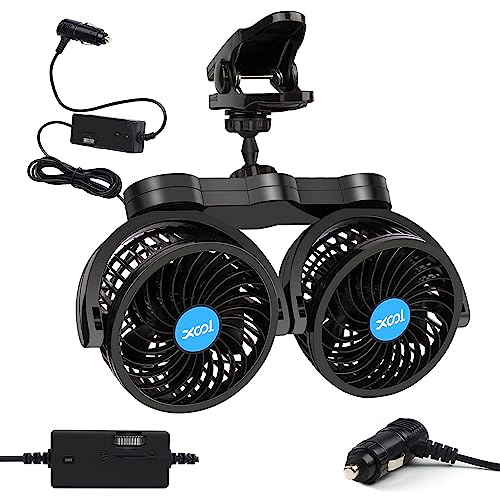
XOOL Dual-Head 12V Clip Car Fan
Rear-seat heat has a way of hanging around, even after the front vents start blowing cold air. The driver may feel comfortable while a passenger, sleeping child, or pet behind the front seats gets little more than a weak drift. The XOOL Dual-Head 12V Clip Car Fan addresses that uneven cabin airflow with two independently adjustable four-inch heads, a large mounting clamp, and continuous power from a 12V cigarette lighter socket. As a candidate for the best cooling fan for car interior use, its biggest advantage is control rather than complexity.
XOOL Dual-Head 4-Inch Car Fan
The design centers on two compact fan heads attached to one clip-mounted base. Each head can face a different direction, allowing one stream to serve the left side of the rear seat while the other covers the right. That split arrangement makes sense in cars where factory vents don’t reach every corner equally. It also avoids the clutter of mounting two separate fans and routing multiple power cables through the cabin.
Both heads support 360-degree tilt rotation, so airflow isn’t locked into a narrow forward-facing path. One fan can point toward a rear passenger while the second directs conditioned air toward a pet carrier, child seat, or warm cargo area. The freedom to change angles helps the unit adapt as seating arrangements shift from one trip to the next. A fixed fan simply can’t offer the same level of directional control.
Power comes from a standard 12V cigarette lighter socket, and the manufacturer specifically states that the fan isn’t intended for 24V trucks. Direct vehicle power removes the need to charge an internal battery, which is handy during long drives or daily commutes. Plug it in, set the airflow, and it keeps running as long as the socket supplies power. The tradeoff is obvious, though: this isn’t a cordless fan that can operate away from a compatible outlet.
The four-inch heads keep the overall setup smaller than many large dashboard fans. That compact size can help in sedans and crossovers where dashboard space is tight or visibility is already crowded by phone mounts and navigation screens. Still, two heads and a large clamp need a secure location with enough clearance to rotate freely. Compact airflow coverage doesn’t mean the mounting step can be treated casually.
Stepless Speed Control Feels More Natural
A large rotary controller gives this fan stepless speed regulation rather than a handful of preset levels. That means airflow can be increased gradually until it feels right instead of jumping from a weak low setting to an overly forceful high setting. Small adjustments matter during longer drives, especially when direct air starts feeling harsh on the face or skin. The dial also looks easier to operate by touch than a tiny button that must be pressed repeatedly.
Fine control helps the fan serve different cabin conditions without much fuss. A stronger setting can break up the first wave of trapped heat, while a softer stream can maintain circulation once the air conditioner catches up. Passengers resting in the back may prefer a barely noticeable breeze rather than constant full-speed airflow. The variable-speed dial makes that balance easier to achieve.
Stepless control also compensates for the lack of separate speed settings on each head, assuming both heads share the same main controller. The supplied information doesn’t state that each motor can be adjusted independently, so separate airflow strength shouldn’t be assumed. Direction can be customized head by head, while overall speed appears to be handled through the main dial. That’s still practical, but it isn’t the same as giving every passenger a personal speed setting.
The large controller is a thoughtful detail for vehicle use. Small switches can be awkward to locate while seated, particularly if the fan is clipped behind a headrest or along the edge of a console. A bigger knob is easier to grip and turn without staring at it. Simple physical control is a real benefit in a moving car, where attention belongs on the road rather than on accessory settings.
Airflow For Front And Rear Seat Trouble Spots
Vehicle ventilation systems often concentrate their strongest output near the front dashboard. Older sedans, compact SUVs, and work vehicles may have no dedicated rear vents at all. The XOOL fan can help carry cooled air farther back by creating active cabin circulation between the front and rear seats. It won’t lower the temperature on its own, but moving conditioned air into stagnant areas can make the cabin feel more evenly comfortable.
Dual heads are especially useful when the airflow needs to cover more than one narrow spot. One head may face across the rear bench while the other points downward toward a footwell or pet bed. The setup can also direct one stream forward if the driver’s factory vent is weak. That kind of flexibility helps the fan fit real seating arrangements rather than forcing every trip into one fixed layout.
The manufacturer also mentions moving unwanted smoke, dust, and pet odors through improved circulation. A fan can help prevent stale air from sitting in one area, but it doesn’t filter particles or remove odor sources. Open windows, clean upholstery, and a functioning cabin filter still matter. Air movement can freshen the feel of the cabin, yet it shouldn’t be mistaken for air purification.
Strong airflow from compact heads can feel focused, so placement deserves a bit of trial and error. Pointing the fans directly at faces from close range may become uncomfortable after several minutes. Angling them across the cabin usually creates a softer, broader effect. With the 360-degree adjustment, indirect circulation is easy to arrange without moving the entire clamp.
Noise And Passenger Safety
The stated noise level is below 50 dB, which suggests the fan is designed to remain relatively subdued during operation. That can matter during naps, conversations, phone calls, or quiet highway stretches. Three or four extra decibels may not sound dramatic on paper, but rattling mounts and rough motors can become irritating in a confined cabin. A low-noise design is most valuable when the fan runs for hours rather than a few minutes.
Actual sound can still depend on speed, mounting surface, and vibration. A clamp attached to thin plastic may amplify motor hum, while a solid headrest post or sturdy edge may keep the unit calmer. Running the fans at maximum output will naturally produce more air noise than a gentle setting. The stepless controller helps here because the airflow can be backed off slightly instead of dropping to a much weaker preset.
A tight protective grille covers the fan blades to reduce the chance of fingers reaching moving parts. That detail is especially relevant near a child seat, curious passenger, or pet riding in the rear. The grille also helps keep loose fabric and hair away from the blades. Even so, cords and rotating heads should remain outside easy reach whenever possible.
Safe positioning involves more than blade protection. The fan shouldn’t interfere with airbags, seat belts, mirrors, steering movement, or the driver’s view. A sturdy clamp can hold the unit securely, but it still needs a rigid mounting point that won’t flex or release over rough roads. Stable installation matters just as much as the enclosed grille.
Clamp Mounting And Cabin Fit
The large adjustable clamp broadens the number of places where the fan can be installed. Depending on the vehicle, it may attach to a headrest post, seat edge, console lip, or another solid interior surface. The clip design also supports use on office desks, stroller frames, tent supports, and other compatible edges. However, those off-car settings still require access to suitable 12V power unless an appropriate power source is available.
Clamp pressure can be both a strength and a concern. A firm grip helps the fan resist vibration during turns and sudden stops, but soft trim may compress or develop marks. Rounded surfaces can also let the clamp creep out of position over time. A thin protective pad may help protect delicate materials, provided it doesn’t make the grip less secure.
Cord routing needs the same careful thought as mounting. The cable should stay clear of pedals, gear controls, door hinges, seat tracks, and passenger foot space. Direct 12V power is dependable, but a poorly routed wire can become annoying or unsafe. Clean cable placement makes the accessory feel like part of the cabin rather than something temporarily draped across it.
Room-scale airflow follows different rules than targeted vehicle circulation, and a separate household reference appears in modern farmhouse ceiling fans for that unrelated setting. Inside a vehicle, the XOOL fan’s clamp and twin heads remain the practical focus because they can be repositioned around seats and consoles. The link between the topics is limited to air movement, not product use. Each solves a different space, power, and mounting problem.
Useful Strengths Without Battery Guesswork
The lack of an internal battery removes one common frustration: forgotten charging. A rechargeable fan may be convenient away from the car, but it’s not much help when the battery is empty during a hot commute. The XOOL draws continuous 12V power, so runtime depends on the vehicle’s electrical supply rather than a small internal cell. That reliability suits road trips, delivery work, and repeated daily use.
Battery-free construction may also avoid gradual runtime loss as rechargeable cells age. There’s no advertised battery duration to calculate, no charging cycle to plan, and no waiting for a full refill. On the flip side, the fan stops being useful as soon as the plug is disconnected. Its strength is dependable in-vehicle operation, not portable independence.
The dual-head layout is another solid advantage. It spreads airflow more thoughtfully than a single four-inch fan, yet it occupies less dashboard area than many triple-head units. Two rotating heads provide enough flexibility for several common seating arrangements without turning the cabin into a wall of small fans. Balanced coverage is a fair description of what this layout does well.
Variable speed rounds out the design. Instead of accepting whatever low, medium, or high happens to feel closest, the dial can stop at a comfortable point between extremes. That’s a modest feature with a noticeable effect during long use. Comfort often depends less on maximum power and more on avoiding too much or too little airflow.
Limitations Worth Sorting Out Before Purchase
The biggest restriction is electrical compatibility. This fan is designed for 12V cigarette lighter sockets and is specifically listed as unsuitable for 24V trucks. A vehicle without the correct socket will need another solution, and the product details don’t mention a USB adapter or household power supply. Confirming voltage prevents both disappointment and unsafe use.
Two fan heads improve coverage, but each head is only four inches across. A large van or RV may need more than one unit if air must travel through several seating rows. The compact heads are better suited to focused zones than whole-vehicle cooling. Buyers expecting them to replace a strong rear climate system may be asking too much of a small accessory.
The fan also depends on a suitable clamping surface. Some modern interiors have smooth, curved panels with few exposed posts or edges. A clamp that feels secure while parked may loosen once the vehicle starts vibrating. Testing the mount with a firm pull before driving can reveal whether the chosen position is trustworthy.
Odor and smoke claims need realistic interpretation. Better circulation can move stale air toward an open window or ventilation outlet, but the fan doesn’t trap smoke particles, neutralize smells, or clean upholstery. A dirty cabin filter, spilled drink, or lingering pet odor needs direct attention. Circulation assistance helps with comfort, not source removal.
Where The XOOL Fan Makes The Most Sense
Cars without rear air vents stand to gain the most from this design. Clipping the unit behind a front seat can send air toward passengers who otherwise wait a long time for relief. The twin heads can cover separate spots, while the speed dial prevents the breeze from feeling too harsh. That combination makes the fan practical for family trips, pet transport, and routine summer errands.
Compact SUVs and sedans may also benefit because the four-inch heads don’t consume as much room as a large eight-inch fan. The unit still needs clearance, but its airflow can be divided without placing a bulky grille in the center of the dashboard. Space-conscious coverage is one of its quieter strengths. Larger vehicles can use it effectively for specific seats rather than expecting full-cabin cooling.
Long-distance driving suits the direct-power format. There’s no battery countdown, and low-noise operation may be easier to tolerate over several hours. The stepless dial allows small adjustments as the outside temperature, sunlight, and air-conditioning output change. Set thoughtfully, the fan can become a background comfort tool rather than a constant distraction.
The XOOL Dual-Head 12V Clip Car Fan earns attention through directional flexibility, continuous plug-in operation, and unusually fine speed control. Its weak points are equally plain: no cordless operation, no 24V compatibility, and no ability to actually refrigerate cabin air. It’s best treated as an airflow extender that helps factory vents reach neglected seats and corners. With a solid mounting point and careful cord routing, it offers a sensible answer to uneven car cooling without piling on unnecessary controls.
Dual USB Backseat Car Cooling Fan
Hot air often lingers behind the front seats while the dashboard vents keep most of their attention up front. That mismatch gets old fast on school runs, long drives, or trips with a pet carrier tucked into the rear cabin. The Dual USB Backseat Car Cooling Fan tackles the problem with two independently controlled fan heads, three speeds per side, and broad 360-degree adjustment. It won’t turn warm cabin air into refrigerated air, but it can spread conditioned air and keep stagnant pockets from sitting untouched.
Dual USB Rear Seat Fan
The fan uses a 5V/2A USB connection rather than a cigarette lighter plug or internal battery. That gives it a useful degree of flexibility because it can draw power from a compatible car charger, power bank, or AC adapter. Vehicles with 12V or 24V electrical systems can still use it through a suitable USB power source, so the original vehicle voltage isn’t the deciding factor. Stable 5V/2A output matters, though, because a weak USB port may reduce airflow or cause inconsistent operation.
This is not a rechargeable fan, and that distinction should be crystal clear before purchase. The unit runs only while connected to power, so it doesn’t store energy for later use. According to the supplied description, it stops once the vehicle stops supplying power, which reduces the chance of accidentally leaving it running after a trip. No internal battery also means there’s no charging schedule, aging cell, or runtime estimate to keep track of.
USB power can be more convenient than a fixed 12V plug when the cabin already has charging ports near the rear seats. It also opens the door to power-bank use during stationary situations, provided the bank can deliver the required output. Still, using a power bank adds another item that must be charged, secured, and kept away from direct summer heat. The cleanest setup will usually come from a reliable vehicle USB adapter and tidy cable routing.
The supplied details don’t state the cable length or mounting method, so those points shouldn’t be filled in with guesswork. Cable reach can have a major effect on backseat placement, especially in vans and three-row SUVs. A USB socket near the dashboard may require careful routing around the console and seat tracks. Power compatibility is promising here, but installation convenience will still depend on the vehicle.
Independent Fan Control Changes The Experience
Two fan heads are useful, but separate controls are what make this design stand apart from many basic dual fans. Each side has its own button, allowing one fan to run while the other stays off. That arrangement avoids wasting airflow on an empty seat and prevents one passenger from being blasted just because someone else wants stronger circulation. It’s a small control choice that fits real family driving better than a shared on-and-off switch.
Each head offers three speed settings: low, medium, and high. Low can provide a gentle stream during naps or quiet drives, while medium suits ordinary circulation once the cabin starts settling down. High is better reserved for the first stretch after a vehicle has been sitting in the sun or whenever the rear feels especially stuffy. The settings are simple enough to understand without fumbling through a complicated control sequence.
Independent speed adjustment also helps when the two fans serve different areas. One head might face a child seat at low speed while the other pushes stronger airflow toward a warm pet carrier or distant corner. That flexibility is more useful than doubling the airflow blindly across the entire rear bench. Personalized air direction matters because comfort isn’t identical from seat to seat.
A shared limitation remains: neither head controls actual air temperature. Both circulate whatever air already exists in the cabin, whether that air is cool, warm, or somewhere in between. The fan is most effective as an assistant to the vehicle’s ventilation or air-conditioning system. Without AC, moving air can feel less oppressive, but it won’t make a dangerously hot parked vehicle safe.
Full Rotation Reaches Awkward Cabin Areas
Both fan heads and the main body support 360-degree rotation, according to the product description. That broad movement makes it easier to direct air toward front seats, rear seats, footwells, or elevated areas where heat gathers. A fixed rear-seat fan often loses usefulness as soon as passengers switch positions. This design can be redirected without rebuilding the entire setup.
Rotation becomes especially helpful in SUVs, vans, and RVs where the cabin isn’t a neat little rectangle. One head can aim across the bench while the other points toward a third-row passenger or pet resting lower to the floor. The body adjustment adds another layer, letting the whole unit change orientation before each fan receives its final angle. Wide directional control gives the fan more reach than its physical size might suggest.
Indirect airflow is often more comfortable than a constant stream aimed straight at the face. Turning a fan slightly upward or across the cabin can create gentler circulation without sacrificing movement. That approach works well during longer drives, when direct air may dry the eyes or become irritating. The rotating design lets the breeze do its job without turning every ride into a wind tunnel.
Storage should also be easier when the heads and body can fold or rotate into a more compact position, though exact folded dimensions aren’t provided. Moving parts should be adjusted with care rather than forced past their natural range. A loose hinge could allow the head to droop on rough roads, but the supplied information doesn’t report hinge resistance. Flexible positioning is confirmed; long-term joint stiffness is not.
Brushless Motors And Cabin Noise
The fan uses brushless motors, a design commonly associated with smoother operation and reduced mechanical friction compared with brushed alternatives. The product is described as quiet, but no measured decibel figure is supplied. That means the safest expectation is restrained motor noise rather than complete silence. Air moving through a compact grille will always create some audible sound, especially at high speed.
Rear-seat noise matters more than it may seem on a product page. A sharp motor whine can interrupt naps, compete with conversation, or become tiresome during a multi-hour drive. Two motors also create two potential sound sources, though running only one fan can keep noise lower when broad coverage isn’t needed. The independent operation gives users some control over both airflow and sound.
Mounting vibration may influence noise as much as the motors themselves. A fan attached to a loose or hollow plastic surface can buzz even if the motor runs smoothly. Tight placement on a stable support usually reduces that problem, but the provided details don’t specify the attachment hardware. A quiet motor deserves a secure installation, or the cabin trim may end up doing the rattling for it.
High speed will naturally be the loudest setting, and that isn’t necessarily a flaw. Stronger airflow pushes more air through the housing, creating a broader rushing sound. Medium speed may offer the better balance once the initial heat eases. Three-speed control allows that compromise instead of forcing a choice between barely moving air and maximum output.
Cooling Support For Children And Pets
Rear-facing seats and low-mounted pet carriers often sit outside the strongest path of factory vents. The dual heads can redirect conditioned air toward those neglected areas without requiring the front vents to be aimed backward. That may help reduce the uncomfortable delay while the rest of the cabin cools down. Targeted rear airflow is the most convincing reason to consider this design.
Safety still requires sensible placement. Fan heads, cables, and controls should remain beyond easy reach of small hands, paws, loose blankets, and seat-belt hardware. The supplied description mentions overheat protection and short-circuit prevention, which address electrical risks within the unit. Those protections don’t replace careful cable routing or secure physical installation.
The independently controlled fans can also prevent overcooling one side of the rear bench. A sleeping child may need a soft breeze, while a sunlit pet carrier on the opposite side may benefit from stronger airflow. Separate buttons and speeds allow those needs to coexist. That’s more thoughtful than treating the backseat as one uniform temperature zone.
No portable fan should be relied on to protect a child or pet left inside a parked vehicle. Cabin temperature can rise beyond what simple air movement can safely manage, especially with the engine and air conditioning off. The fan belongs in an occupied, supervised vehicle with proper ventilation. Comfort assistance is its role, not heat-emergency protection.
Safety Features And Power Behavior
The listed overheat protection is reassuring for a device expected to run during hot-weather travel. Short-circuit prevention adds another layer of electrical protection when the fan is connected to USB power. Those features support safer operation, but the product description doesn’t identify specific certification standards. It’s better to stick with the stated safeguards than assume approvals that haven’t been provided.
Automatic stopping depends on how the vehicle handles USB power. Some vehicles cut power as soon as the ignition turns off, while others keep USB sockets active for a period or continuously. The product description says the fan stops with the car, but actual behavior may follow the power source rather than the fan itself. Vehicle socket behavior should be understood before relying on automatic shutdown.
A stable 5V/2A supply is specifically recommended for full performance. Cheap adapters or underpowered built-in USB ports may not provide enough current for both heads at higher speed. Inconsistent power could produce weaker airflow or interruptions, though the exact behavior isn’t described. Using a properly rated power source is the simplest way to avoid needless performance problems.
Cables should never cross pedals, door latches, or seat rails where they can be pinched. Rear-seat installations also need enough slack for normal seat adjustment without leaving loops in walking areas. A neatly routed wire reduces both visual clutter and snagging risk. Electrical protection inside the fan works best alongside good installation habits outside it.
Practical Strengths During Daily Driving
The strongest feature is the combination of dual airflow and independent control. Many twin fans share one power switch, forcing both heads to operate together at the same speed. This model lets each side respond to a different seat, temperature, or preference. That freedom is genuinely useful rather than decorative.
USB compatibility is another practical strength. A single fan can operate through car chargers, suitable power banks, and compatible AC adapters instead of being locked to one socket style. That helps in vehicles where the cigarette lighter port is occupied by another accessory. It also makes the fan easier to power in an RV or indoor setting, assuming the mounting arrangement fits.
The three-speed range strikes a sensible middle ground. There are enough settings to soften the breeze without turning the controls into a puzzle. Low, medium, and high are easy to remember, even when someone reaches back to make an adjustment. Separate buttons add flexibility without making the product feel fussy.
The broad rotation adds value every time the seating plan changes. Carpools, child seats, grocery loads, and pet carriers can all alter where the airflow needs to go. Instead of relocating the entire fan, the heads can be turned toward a new spot. Adaptable direction is what keeps this accessory from becoming useful for only one narrow setup.
Tradeoffs Hidden Behind The Convenience
The lack of a battery is both sensible and limiting. There’s no charging burden, but there’s also no operation after the power source shuts down. A power bank can provide mobility, though that adds another device to store and maintain. Anyone expecting true cordless use may be disappointed by the USB-only power design.
Two heads won’t necessarily cool an entire large RV or multi-row van. Their real strength lies in directing air toward specific seats and nearby zones. Expecting whole-cabin temperature control from a compact USB fan would be unrealistic. Larger spaces may need multiple circulation points or stronger built-in ventilation.
The supplied description calls the construction durable, but it doesn’t specify housing materials, grille dimensions, or attachment strength. Those missing details make it difficult to judge how the fan will handle years of vibration and repeated repositioning. A careful first installation can reduce stress on the joints and body. Long-term durability shouldn’t be promised without supporting information.
The separate household topic of quiet personal airflow appears in Noctua desk fan options, where power, mounting, and room use follow a different set of priorities. That reference doesn’t change how this car fan performs, but it highlights the difference between stationary desk cooling and rear-seat circulation. Vehicle accessories have to deal with vibration, moving seats, and limited power locations. The dual USB fan is built around those mobile constraints rather than desktop placement.
Best Use Cases And Realistic Expectations
This fan fits vehicles where rear passengers get poor airflow from the dashboard vents. It can serve sedans, vans, trucks, SUVs, and RVs as long as a stable 5V/2A USB source is available. The dual heads are particularly handy when two seats need different airflow directions or strengths. Small cabins may use only one head at times, which the independent controls allow.
Family trips benefit from the ability to make quick adjustments without changing the whole setup. One side can run low during a nap while the other stays at medium or high near a warm window. The 360-degree movement helps keep air off faces and aimed through the cabin instead. Separate speed control is the feature that makes those small comfort decisions possible.
Pet transport is another sensible use, especially when a carrier sits below or behind the normal path of the vents. The fan can move conditioned air toward that area, but it can’t replace safe temperature management or supervision. Hair and fabric should remain clear of the intake and grille. Directional airflow helps, yet basic vehicle safety still carries the load.
The Dual USB Backseat Car Cooling Fan offers a practical mix of independent controls, three speeds, brushless motors, and wide-angle positioning. Its strongest role is extending existing airflow toward neglected seats rather than creating cold air from scratch. USB-only operation keeps it simple but ties performance to a stable power source. With thoughtful placement and sensible expectations, it can make uneven cabin cooling feel far less frustrating.
HUENLYEL Portable 3-Head Car Cooling Fan
A hot cabin rarely cools evenly, especially when the front vents are doing all the heavy lifting. One passenger feels relief while a child seat, pet carrier, or rear corner stays warm and stale. The HUENLYEL Portable 3-Head Car Cooling Fan answers that imbalance with three independently adjustable heads, dashboard mounting, and continuous 12V power. For anyone sorting through the best cooling fan for car interior options, its main appeal is broad, targeted circulation without relying on a rechargeable battery.
HUENLYEL Triple-Head 12V Car Fan
The three-head layout is the feature that gives this model its identity. Instead of forcing one stream of air through the middle of the cabin, the unit can send airflow in three directions at once. One head may face the driver, another can serve the front passenger, and the third can angle toward the back seat. That wider distribution is useful in vehicles where the factory vents leave obvious warm zones.
Each fan head can rotate and tilt independently, which makes the setup far more adaptable than a fixed dashboard fan. The heads can be aimed toward individual passengers, a rear-facing child seat, or a pet carrier placed low behind the front seats. This independent positioning allows the fan to follow the seating arrangement instead of forcing everyone to share one narrow breeze. It also helps soften direct airflow by angling a head upward or across the cabin.
The fan has no internal battery, so there’s no charging routine, battery percentage, or limited cordless runtime to manage. It plugs directly into a 12V cigarette lighter socket and runs from the vehicle’s electrical supply. That arrangement is practical for daily commuting and extended road trips because the fan can continue operating while the socket remains powered. The drawback is equally plain: once unplugged, the fan stops.
This design is better viewed as a permanent or semi-permanent vehicle accessory than a fan that moves easily between unrelated locations. It may be portable in the sense that it can be removed from one car and installed in another, but it isn’t independent of vehicle power. Continuous plug-in operation is the strength, while off-car flexibility is the sacrifice. Buyers who need camping or desk use without a nearby 12V source will need a different power arrangement.
Three-Way Airflow For Uneven Cabin Heat
Rear-seat discomfort often comes from poor air movement rather than a complete lack of cooled air. The front air conditioner may be working, yet little of that air reaches passengers behind the front seats. By directing one or more heads backward, the HUENLYEL can help move conditioned air through the cabin. Its multi-angle circulation is most valuable in cars without dedicated rear vents.
Three heads also make it easier to handle different comfort preferences. A passenger sitting near a sunny window may want stronger direct airflow, while someone in the center seat may prefer a lighter stream from farther away. The independently adjustable heads let those needs exist side by side. That’s more practical than forcing every passenger to accept the same direction and intensity.
The fan doesn’t create refrigerated air, despite language commonly used around vehicle cooling accessories. It moves the air already inside the car and can spread cold air produced by the vehicle’s AC system. Without active air conditioning, the breeze may make the cabin feel less stagnant, but it won’t lower the actual air temperature in the way a compressor-driven system does. Air circulation, not temperature production, is the realistic benefit.
The three-head design should also help break up heat that collects around the dashboard and windshield. One head can face upward while the others serve passengers, preventing every stream from competing for the same area. This kind of distributed airflow can make the cabin feel more balanced during the first part of a drive. Still, the result depends on placement, vehicle size, and the strength of the existing ventilation system.
Dashboard Mounting And Installation
The fan attaches to the dashboard with strong adhesive stickers rather than a clamp. That creates a clean, low-profile installation and removes the need to search for a suitable edge or headrest post. Once positioned, the fan can remain ready for use without being unpacked for every trip. Adhesive mounting suits drivers who prefer a fixed setup and don’t plan to move the unit often.
Placement deserves careful thought before the adhesive touches the dashboard. The fan must stay clear of the windshield view, passenger airbags, infotainment controls, defroster vents, and frequently used storage areas. A position that looks convenient while parked can become distracting once the vehicle is moving. Measuring the available space first can prevent a frustrating removal and remounting process.
Dashboard materials vary, and adhesive performance can change with texture, dust, heat, and surface treatments. A clean, dry, smooth area will generally offer a better bond than soft-touch material, heavily grained plastic, or a surface coated with protectant. The supplied details don’t state whether the adhesive can be removed without residue. That uncertainty makes surface preparation and deliberate placement especially important.
Permanent dashboard exposure also means the unit may sit in strong sunlight and elevated cabin temperatures. The product is described as durable, but no material specifications or temperature limits are provided. Parking in shade or using a windshield cover may reduce long-term stress on the housing and adhesive. Fixed convenience is useful, though it comes with less flexibility than a removable clip mount.
12V Power And Daily Operation
Direct cigarette lighter power keeps operation simple. The fan can begin running as soon as it is plugged into a compatible 12V socket, with no battery waiting in the background. That means the driver doesn’t have to remember to recharge the unit before a hot afternoon trip. Reliable vehicle power is particularly helpful during long-distance travel where a small internal battery might run out.
The vehicle’s socket behavior will determine when the fan operates. Some cars cut power immediately after the ignition is switched off, while others keep the outlet live for a period or continuously. The provided description doesn’t mention automatic shutoff, so unplugging the fan after parking may be wise in vehicles with always-on sockets. That habit reduces the chance of unnecessary drain on the starter battery.
Cable placement can affect the cabin almost as much as the fan itself. The power cord should remain away from pedals, gear controls, seat rails, cup holders, and passenger foot space. A neatly routed cable makes the installation feel intentional and lowers the risk of snagging. Safe wire management is an essential part of setting up any dashboard-powered accessory.
The description doesn’t provide the cord length, speed settings, or individual motor controls. Those missing details should stay missing rather than being replaced with guesses. The confirmed strengths are the three adjustable heads and continuous 12V operation. Anyone who needs a specific cable reach or multiple speed levels should verify those points before treating them as part of the package.
Useful For Families, Pets, And Road Trips
Family travel is where the three-head layout starts making practical sense. One stream can reach a child seat, another can cool the front passenger, and the remaining head can support airflow through the center of the cabin. The design allows those directions to change without moving the entire base. Flexible passenger coverage is a meaningful advantage during longer drives.
Pet carriers often sit below the natural path of dashboard vents, particularly in the rear footwell or cargo area. Tilting one fan head downward may help carry conditioned air toward that lower space. The fan still can’t make a parked vehicle safe for an unattended animal, and it should never be treated as protection against extreme cabin heat. Its role is limited to improving circulation inside an occupied, properly ventilated vehicle.
Cars with weak AC may gain some comfort from moving the available cool air more deliberately. A fan can’t repair a failing climate system, but it may reduce the uneven feeling caused by poor vent direction. In vehicles with no rear vents, that support can be noticeable even though the fan doesn’t lower temperature by itself. Airflow extension is the sensible expectation.
Long trips also favor the battery-free design because runtime isn’t limited by an internal charge. As long as the vehicle supplies power, the fan can keep operating. That makes it suitable for highway drives, daily delivery routes, and regular commuting. The price of that consistency is complete dependence on the cigarette lighter socket.
Practical Strengths And Weaknesses
The strongest feature is the combination of three independently directed heads and a single power connection. This gives the cabin several airflow paths without creating a tangle of separate accessories. It also allows the fan to serve more than one passenger at the same time. For wider dashboards and family vehicles, that layout is more useful than a small single-head unit.
The adhesive mount is another strength for people who dislike bulky clamps. It keeps the fan in a predictable position and avoids pressure marks on headrest posts or console edges. On the other hand, it reduces portability and can make repositioning more difficult. Stable mounting and easy relocation rarely come together, so this design clearly favors stability.
The absence of a battery removes charging anxiety, yet it also removes independence. The fan can’t follow passengers to a picnic table, campsite, or office unless a compatible 12V source is available. It also occupies the cigarette lighter socket, which may already be needed for another device. A splitter might solve that issue, but none is listed in the supplied description.
Three fan heads add coverage but also take up more visual space on the dashboard. In a compact car, the unit may feel busy beside phone mounts, cameras, and infotainment screens. Larger vehicles will likely accommodate it more naturally. Cabin space is therefore a genuine consideration, not a minor detail.
Different Airflow Needs In Other Spaces
Vehicle circulation depends on small, directional streams, while room cooling uses a much broader airflow pattern. A neutral reference to two-blade ceiling fans with lights illustrates how household airflow relies on ceiling placement, blade span, and integrated lighting rather than dashboard mounting. The two categories solve different problems, even though both move air through occupied spaces. Inside a car, compact positioning and power compatibility matter far more than room-scale coverage.
The HUENLYEL remains focused on passenger-level airflow rather than whole-space circulation. Its heads can be aimed at individual seats, which a ceiling fan obviously isn’t designed to do. The dashboard mount also keeps the unit within easy reach, though it demands a clear and safe position. Targeted cooling support is the reason this format makes sense in a vehicle.
A household fan can run independently from the car’s electrical system, while this model is tied to a 12V socket. That dependence is not automatically a flaw, since continuous vehicle power suits long drives well. It simply defines where the product belongs and how it should be used. Purpose-built operation matters more than trying to make one fan serve every environment.
The broader lesson is that airflow tools work best when matched to the space. A compact car needs controlled direction, low obstruction, and secure mounting. A large room needs blade reach and overhead circulation. The HUENLYEL’s three-head format fits the first job, provided the dashboard has enough room for a safe installation.
Realistic Expectations Before Buying
The HUENLYEL Portable 3-Head Car Cooling Fan is best treated as a circulation assistant for vehicles with weak rear airflow or uneven AC distribution. It can direct moving air toward several people at once and run continuously without battery limits. That makes it practical for commuting, family outings, and pet transport. It does not replace a functioning air conditioner or reduce dangerous parked-car temperatures.
Drivers should confirm that their vehicle has a compatible 12V cigarette lighter socket and sufficient dashboard space. The adhesive surface must also be suitable for a firm, lasting bond. Once installed, the fan should remain clear of airbags, controls, and sight lines. Compatibility and placement will determine whether the product feels convenient or intrusive.
The lack of supplied speed information may matter to buyers who want fine airflow control. Three adjustable heads offer excellent directional flexibility, but direction and speed are separate concerns. Without confirmed speed settings, expectations should stay centered on coverage rather than precise output customization. That keeps the review grounded in the details actually provided.
Its clearest advantage is simple: three-way airflow from one dashboard-mounted, continuously powered unit. The compromises are fixed installation, socket dependence, and a larger dashboard presence than a single compact fan. In the right vehicle, those tradeoffs are manageable and the broader circulation can be genuinely useful. In a cramped cabin or a car with limited mounting space, a smaller removable fan may be the more sensible fit.

Best Quiet Ceiling Fan For Bedroom 2026 Ultimate Comfort Picks

Best Ceiling Fan For Master Bedroom 2026 With Ultimate Comfort

Best White Ceiling Fan With Light For Bedroom 2026 Top Picks

Best Quorum Medallion Ceiling Fan 2026 With Style & Breeze
Best Outdoor Fan For Pergola 2026 Comfort Boost

Best Ceiling Fan For Great Room 2026 With Ultimate Comfort

Best Outdoor DC Ceiling Fans 2026 For Breezy Comfort
Best ceiling exhaust bath fan with light and heater 2026