
Best Mini Desk Fan 2026: Small Fans That Deliver

A best mini desk fan should cool the space right in front of you without rattling across the tabletop, drowning out a call, or stealing room from a keyboard and coffee mug. Small dimensions alone don't guarantee comfort. A tiny fan with a narrow, harsh stream can leave one cheek cold while the rest of the room still feels stuffy, so balanced airflow matters more than flashy speed claims.
Noise deserves just as much attention. A soft motor hum often fades into the background, but clicking controls, vibrating guards, and high-pitched blade noise can become maddening during focused work. Models with several speed settings offer more control, letting a low setting handle long work sessions while a stronger mode cuts through midday heat. Still, the highest speed may sound too busy for video meetings or light sleepers, and that's a tradeoff worth accepting before buying.
Desk space gets crowded fast, so a stable base and sensible footprint make daily use much easier. A wide base can resist tipping, yet it may block notebooks, chargers, or a mouse pad. Clip-on designs save surface area, though they need a firm shelf or desk edge and may transmit vibration through hollow furniture. A compact freestanding model usually strikes the safer middle ground, especially when its head tilts far enough to direct air toward the face, chest, or hands.
Power options shape how portable the fan really feels. USB-powered fans work well beside a laptop, power bank, or wall adapter, but cable length can limit placement. Rechargeable models clear away cord clutter and keep running during a short outage, although battery life drops quickly at maximum speed. Replaceable batteries are uncommon, so long-term value depends partly on charging habits and how well the battery holds capacity after repeated use.
Cleaning is easy to overlook until dust clings to the blade edges and airflow starts feeling weak. A removable front grille makes routine care far less annoying, while sealed housings may require cotton swabs, compressed air, and more patience than expected. Smooth plastic surfaces wipe clean quickly, but tightly spaced guards trap lint faster. Frankly, a fan that's simple to open and clean often stays useful longer than one packed with gimmicky modes.
Controls should feel obvious without forcing a glance under the base every time the room warms up. A front button, rotary dial, or clearly marked top control works better than a tiny switch hidden behind the motor housing. Touch controls look neat but can be overly sensitive, especially during cleaning or repositioning. Mechanical buttons aren't glamorous, but they tend to provide reassuring feedback and fewer accidental changes.
The strongest pick won't be the same for every desk. A quiet bedroom setup benefits from gentle airflow and dim or removable indicator lights, while a workshop desk may need higher output and a tougher grille. Travelers may prefer a folding body, yet those hinges can loosen after frequent packing. The real win is a compact cooling setup that fits the available space, stays steady, and delivers enough air without becoming the loudest object in the room.
- LFR Score9.4
LFR Score is a ranking system developed by lightfansreviews.com. LFR Score has no relationship or impact from any manufacturers or sales agent websites. Learn more
- BrandGaiatop

- LFR Score9.2
LFR Score is a ranking system developed by lightfansreviews.com. LFR Score has no relationship or impact from any manufacturers or sales agent websites. Learn more
- BrandTriPole

- LFR Score9.2
LFR Score is a ranking system developed by lightfansreviews.com. LFR Score has no relationship or impact from any manufacturers or sales agent websites. Learn more
- BrandWHATOOK

- LFR Score9.2
LFR Score is a ranking system developed by lightfansreviews.com. LFR Score has no relationship or impact from any manufacturers or sales agent websites. Learn more
- BrandHoneywell

- LFR Score9.2
LFR Score is a ranking system developed by lightfansreviews.com. LFR Score has no relationship or impact from any manufacturers or sales agent websites. Learn more
- BrandGaiatop
- LFR Score9.2
LFR Score is a ranking system developed by lightfansreviews.com. LFR Score has no relationship or impact from any manufacturers or sales agent websites. Learn more
- BrandGaiatop
- LFR Score9.0
LFR Score is a ranking system developed by lightfansreviews.com. LFR Score has no relationship or impact from any manufacturers or sales agent websites. Learn more
- BrandGaiatop
- LFR Score9.0
LFR Score is a ranking system developed by lightfansreviews.com. LFR Score has no relationship or impact from any manufacturers or sales agent websites. Learn more
- BrandKIMMOO

- LFR Score8.8
LFR Score is a ranking system developed by lightfansreviews.com. LFR Score has no relationship or impact from any manufacturers or sales agent websites. Learn more
- BrandAecooly

- LFR Score8.8
LFR Score is a ranking system developed by lightfansreviews.com. LFR Score has no relationship or impact from any manufacturers or sales agent websites. Learn more
- Brandduludulu
Last update on 2026-07-08 / Affiliate links / Images, Product Titles, and Product Highlights from Amazon Product Advertising API
Gaiatop USB Fan for Compact Desk Cooling
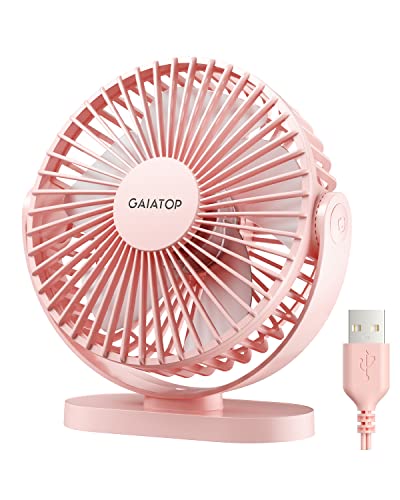
A crowded desk leaves little patience for a fan that rattles, slides, or blocks half the workspace. The best mini desk fan should create a useful pocket of moving air without turning a quiet room into a humming distraction. Gaiatop’s compact pink model approaches that job with a 5.5-inch frame, three speeds, and a tilting head that keeps the breeze aimed where it’s needed. Its appeal rests on focused personal cooling, not unrealistic promises about lowering the temperature of an entire room.
Gaiatop USB Desk Fan
The Gaiatop USB Desk Fan is built around a straightforward idea: keep the footprint small while giving the airflow enough punch to feel worthwhile. Its listed maximum wind speed reaches 5.3 meters per second, which helps explain why the upper setting is better suited to quick relief than a barely noticeable whisper of air. That stronger output should feel useful during a warm afternoon at a computer, inside a parked workspace with ventilation, or beside a bed where still air becomes uncomfortable. Still, stronger airflow at this size stays directional, so placement matters more than it would with a room fan.
The three available settings keep the controls uncomplicated. Low produces a gentler breeze, medium fills the gap for routine desk use, and high moves more air when the heat starts getting under the skin. That range gives the fan more flexibility than a single-speed design, especially since personal comfort changes throughout the day. The three-speed control also prevents the common annoyance of having to choose between no airflow and a blast that dries the eyes.
Noise is listed between 30 and 50 dB, depending on the setting and operating conditions. The lower end is better aligned with sleeping, reading, and focused work, while the upper end may become noticeable in a very quiet bedroom or during calls made through a sensitive desk microphone. A compact fan still has to spin quickly to create meaningful air movement, so silence shouldn’t be expected on high. The practical advantage is adjustable sound and airflow, letting the lower speed handle calm moments while the stronger modes deal with heavier heat.
Airflow Direction and Everyday Comfort
The fan head rotates through a 90-degree range, making it easier to aim the breeze toward the face, upper body, hands, or another nearby spot. That adjustment sounds simple, but it fixes a persistent flaw in fixed-angle mini fans that send air toward a monitor stand or the edge of a desk. A slight upward tilt can help the airflow reach someone sitting upright, while a lower position suits bedside use or a low shelf. This 90-degree adjustment makes the compact body far more useful than its size alone might suggest.
Personal fans work best from a short distance, and this model is no exception. Set too far away, the breeze loses much of its impact; placed too close on high, it may feel sharp or dry during long sessions. A position beside the keyboard or slightly behind the laptop usually creates a more comfortable stream than aiming it straight into the eyes. The focused breeze is a strength in tight spaces, though it won’t circulate air evenly across a large bedroom or shared office.
The pink finish adds personality without changing the practical side of the design. It can fit naturally into a colorful desk setup, vanity area, dorm room, or travel kit where plain black equipment feels a little dull. Color is subjective, of course, and the brighter look may not blend into every workspace. Even so, the compact 5.5-inch body keeps the visual impact modest, so it won’t dominate the surface around it.
USB Power and Portable Use
USB power gives the Gaiatop fan a broad range of possible power sources. It can connect to a laptop, desktop computer, power bank, USB wall adapter, car charger, or another compatible USB supply. The manufacturer specifies a 5 V, 2 A power source, an important detail because a weak port may reduce performance or cause inconsistent operation. The USB-powered design is convenient, but the lack of a built-in battery means the fan must remain connected while running.
No wall charger is included, so the box doesn’t provide a complete outlet-ready setup by itself. That omission won’t matter much where spare USB adapters are already lying around, though it may be annoying for a nightstand or guest room without an available charging block. A power bank can make the fan portable outdoors, but runtime then depends entirely on the power bank’s capacity and condition. The tradeoff is clear: flexible power compatibility comes without the weight, aging concerns, or charging downtime of an internal battery.
The attached five-foot cord gives the fan more placement freedom than short-cable desktop models. It can sit farther from a laptop port, reach a wall adapter behind furniture, or move around a desk without pulling other devices out of position. On the flip side, a long cord adds another line to manage in an already cluttered workspace. A small cable clip or loose coil can keep the five-foot power cord from tangling around notebooks, controllers, or charging leads.
At approximately 0.6 pounds, the fan is light enough to move between rooms or pack for travel without much fuss. It makes sense beside a computer, on a nightstand, inside a car with a suitable USB connection, or near a campsite powered by a portable battery. Outdoor airflow can easily overpower a small personal fan, though, especially in an open area with natural wind. Its lightweight travel-friendly build is most useful in sheltered spots where the fan can stay close and stable.
Stability, Cleaning, and Maintenance
Small fans often suffer from base movement because their blades spin quickly while the housing weighs very little. Gaiatop addresses that issue with silicone pads at four points underneath the base. Those pads should improve grip on smooth desks, tables, and nightstands while also reducing some vibration transferred into the surface. The anti-skid base is especially valuable on laminate or glass, where a bare plastic fan can slowly creep during use.
Surface condition still affects stability. Dust, moisture, or an uneven tabletop can weaken the grip, and a lightweight fan remains easier to knock over than a heavier desk circulator. The cord can also tug on the base if it hangs sharply from the back of a desk. Careful cord routing helps the stable base design do its job without fighting against cable tension.
The removable front cover solves one of the more irritating maintenance problems with compact fans. Dust collects along the blade edges and grille over time, gradually weakening airflow and making the motor work against a dirty path. Being able to detach the cover provides better access than trying to thread a cotton swab through narrow guard openings. This detachable cover makes routine cleaning less tedious and may help preserve consistent airflow through regular use.
Cleaning should still be handled with the fan unplugged, using a soft cloth or brush rather than soaking the motor housing. The removable guard doesn’t make the entire unit washable, and forcing the cover could damage its attachment points. Regular light cleaning is easier than waiting for a thick layer of lint to build up. The biggest maintenance benefit isn’t novelty; it’s the simple access to dusty surfaces that sealed mini fans often hide.
Strengths, Weaknesses, and Best Uses
The strongest part of this model is the balance between size and usable airflow. A 5.5-inch frame can fit beside a monitor, on a narrow shelf, or in luggage while still offering three distinct speed levels. The adjustable head and grippy base support everyday placement rather than adding decorative features with little practical value. For localized relief, the combination of compact size and three-speed airflow covers the essentials well.
Its main weakness is the absence of cordless operation. A rechargeable fan can move freely around a room, while this model always needs access to a USB power source and must carry its cable along. High speed may also be too audible for someone expecting near-silent operation, particularly in a quiet bedroom or recording setup. These aren’t hidden flaws, but they define the realistic boundaries of the corded mini fan design.
The fan makes the most sense where space, direct airflow, and easy power access matter more than whole-room circulation. It can cool a workstation without blowing papers across the desk, offer a light bedside breeze, or provide close-range relief from a power bank during a summer outing. Larger areas and shared spaces call for a wider fan with greater air throw. Inside its intended role, the Gaiatop offers personal cooling without bulky hardware, provided the cable and moderate high-speed noise fit the setting.
Expectations ultimately decide whether this fan feels satisfying. It won’t lower the ambient temperature, replace a ceiling fan, or spread air evenly from one side of a room to the other. What it can do is move a concentrated stream of air across a small personal zone with adjustable intensity and straightforward controls. That practical scope makes the Gaiatop a sensible best mini desk fan candidate for close-range cooling, especially where easy cleaning and a small footprint carry more weight than battery operation.
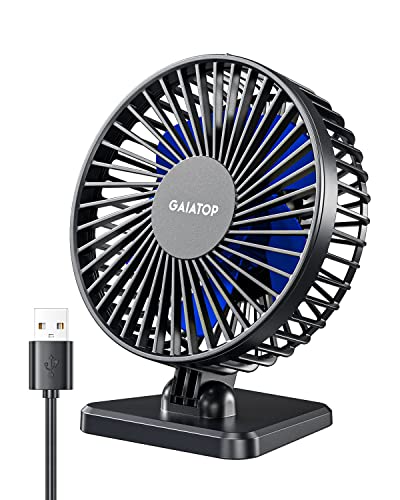
TriPole USB Fan for Focused Personal Cooling
Limited desk space can make a full-size fan feel like one more obstacle rather than a source of relief. The TriPole model tackles that problem with a 4.5-inch frame, a broad base, and a fully adjustable head that directs air without crowding a keyboard, lamp, or nightstand. Among products competing for the best mini desk fan label, its strongest selling points are three-speed airflow, USB compatibility, and a 360-degree tilting range. It’s a practical little machine, though its corded design and power requirements deserve a close look before it earns a permanent place on the desk.
TriPole USB Desk Fan
Three speed settings give this fan enough flexibility for changing conditions across the day. Low can provide a light background breeze during reading or computer work, while medium adds more noticeable circulation without immediately jumping to full power. High is intended for those muggy stretches when subtle airflow simply won’t cut it. The rear-mounted button controls every setting, keeping the speed adjustment simple but requiring a quick reach behind the fan whenever the airflow needs changing.
The compact housing measures 4.5 inches in diameter, so it occupies much less room than a conventional table fan. That smaller size suits narrow desks, crowded counters, bedside tables, and travel bags where every inch counts. A mini fan won’t cool an entire room, and TriPole doesn’t escape that physical limitation. Its personal cooling zone works best from close range, where the breeze can reach the face or upper body before dispersing into the surrounding air.
Size also shapes the character of the airflow. Smaller blades generally create a tighter stream, which can feel refreshing when aimed correctly but less useful for moving air across a broad area. Placing the fan beside a monitor or slightly below eye level can keep the breeze comfortable without blowing directly into dry eyes. The focused airflow is a strength for solo desk use, yet it won’t satisfy anyone expecting wide circulation across a shared office or large bedroom.
Three Speeds With Simple Control
The three wind modes make it easier to match airflow to the moment instead of living with a single fixed output. Low speed fits quiet routines, medium handles steady daytime warmth, and high offers faster relief after stepping in from the heat. That range is useful because comfort isn’t static; a gentle breeze may feel right in the morning and hopelessly weak by midafternoon. The three-speed setup provides sensible control without burying the fan under timers, displays, or complicated menus.
The single button on the back keeps the front clean and uncluttered. Still, rear controls aren’t always the most convenient choice, especially if the fan sits against a wall, behind a laptop, or high on a shelf. Reaching around the housing can also shift the angle unless the base is held steady. This simple control layout favors minimalism, but a front-mounted button would have been easier during frequent speed changes.
Power delivery affects the strongest setting more than casual buyers may expect. TriPole states that the fan needs 0.8 amps while operating and recommends testing it with a 5V/1A USB charger if the third speed doesn’t work correctly. A weak laptop port, worn cable connection, or low-output adapter may allow the lower modes to run while leaving high speed unreliable. The 5V power requirement isn’t demanding by modern standards, yet pairing the fan with a suitable USB source is essential for getting all three modes.
Full Rotation Makes Placement Easier
The fan head rotates 360 degrees vertically, giving it a broader aiming range than many compact models with limited tilt. Air can be directed upward from a low desk, downward from a shelf, or straight ahead from a bedside table. That flexibility reduces the need to stack the fan on books or wedge objects beneath its base. The 360-degree rotation turns a small fan into a more adaptable cooling tool, particularly in tight or awkwardly arranged spaces.
Angle control matters because close-range airflow can become uncomfortable when it hits the same spot for hours. Tilting the fan slightly above the face lets the moving air fall more gently, while pointing it toward the chest or hands can reduce eye dryness during screen-heavy work. A minor adjustment often makes the difference between a pleasant breeze and an irritating blast. The adjustable direction gives more control over comfort without changing the speed itself.
The rotating frame may also help with indirect circulation. Aiming the fan upward can stir warm air around a stuffy desk without blowing papers, hair, or lightweight objects across the surface. Pointing it toward a nearby wall can soften the stream further, though the effect will be weaker than direct airflow. This flexible fan angle broadens the usable setups, but the compact motor still limits how far that air can travel.
USB Power for Desks and Travel
A standard USB-A connection allows the TriPole fan to run from a computer, USB charger, power bank, or another compatible source. That versatility reduces dependence on a dedicated wall outlet and makes the fan easier to move between a desk, hotel room, vehicle setup, or temporary workspace. USB power also avoids many outlet-plug differences encountered during overseas travel, provided a compatible charging adapter is available. The USB-powered design offers convenient flexibility, though the fan has no internal battery for truly cordless use.
The included cable measures 4.9 feet, giving the fan more reach than models supplied with short leads. That extra length helps when the computer sits under a desk or the nearest adapter is behind furniture. It can also reduce the temptation to place the fan in an awkward spot simply because the cable won’t stretch any farther. On a packed desktop, however, the long USB cable may need to be coiled or clipped so it doesn’t tangle with chargers, headphones, and mouse cords.
Travel use depends heavily on the power source. A power bank can run the fan away from an outlet, but operating time will vary with the bank’s capacity, age, and the chosen speed. The fan itself doesn’t store power, so forgetting the cable or carrying a nearly empty battery pack leaves it unusable. Its portable size travels easily, but portability here means easy to carry, not independent of external power.
Stable Base and Quieter Desk Operation
A wide base helps prevent the lightweight body from tipping as the fan runs or the angle changes. Four silicone pads underneath add grip while reducing direct vibration against the desk surface. That combination matters on smooth tables, where small fans can creep backward or create a buzzing sound through hollow furniture. The stable base supports everyday use without requiring extra weight that would make the fan less convenient to pack.
Silicone pads can reduce vibration, but they can’t eliminate every source of noise. Dust buildup, an uneven surface, or a cable pulling against the housing may still create rattles. High speed will naturally sound more noticeable than low because the motor and blades are working harder. The vibration-dampening pads improve the foundation, although quiet performance still depends on proper placement and routine care.
The wide footprint brings one modest tradeoff. It improves balance, yet it occupies more surface area than a narrow stand or clip-style fan. On a tiny nightstand, the base may compete with a phone, glass of water, and lamp even though the fan itself is compact. That stability-versus-space tradeoff feels reasonable for most desks, but extremely cramped setups may benefit more from a clamp-mounted design.
Detachable Cover and Routine Cleaning
Dust eventually settles on every desktop fan, collecting along the grille and blade edges where it can restrict airflow. TriPole uses a detachable front cover so those areas are easier to reach during regular cleaning. Better access saves the frustration of pushing cotton swabs through narrow slots or trying to blow debris out from the outside. The removable fan cover is a practical feature because clean blades move air more effectively and look far less neglected.
Cleaning should be handled only after disconnecting the USB cable. A soft brush or lightly dampened cloth can remove surface dust, while the motor housing should stay dry. The detachable cover doesn’t mean the entire fan can be rinsed under a faucet, and forcing the grille during removal may damage its attachment points. The easier maintenance is valuable, but careful handling remains part of keeping the fan in good shape.
Frequent light cleaning usually takes less effort than waiting until lint forms a thick layer. A dusty blade can become unbalanced, which may increase vibration or introduce a faint ticking sound during operation. Regular upkeep also matters in bedrooms and workspaces where airborne debris settles quickly around electronics. This accessible cleaning design gives the TriPole an advantage over sealed mini fans that make basic maintenance unnecessarily awkward.
Practical Strengths and Clear Limitations
The TriPole’s strongest traits work together rather than relying on one headline feature. Its compact 4.5-inch frame saves room, the wide padded base keeps it steady, and the rotating head directs airflow without constant repositioning. Three speeds add enough variation for light cooling and stronger short-range relief. None of these details is flashy, but together they address the common frustrations that make cheap desk fans annoying to live with.
The largest weakness is the complete dependence on USB power. A rechargeable model offers freedom from cords, while this fan must remain attached to a charger, computer, or power bank every minute it operates. High speed may also fail to perform properly if the power source can’t supply the required current. The corded-only operation keeps the design straightforward, yet it limits spontaneous placement around a room or outdoor area.
Another limitation comes from scale. The fan can create a useful breeze across a desk, bed, or nearby seat, but it isn’t built for cooling several people or circulating air through a large space. Its narrow stream may require careful aiming, and the highest speed could feel too direct at very close range. The TriPole earns consideration as a best mini desk fan for localized comfort, provided expectations stay grounded in what a 4.5-inch USB fan can realistically deliver.
The most convincing use cases involve a fixed workspace with easy access to USB power. A computer desk, dorm shelf, kitchen counter, or nightstand gives the fan a stable home while making the long cable genuinely useful. Travel also makes sense when luggage space is limited and a charger or power bank is already part of the kit. The best-fit setup values compactness, directional airflow, and easy cleaning more than battery operation or room-wide circulation.
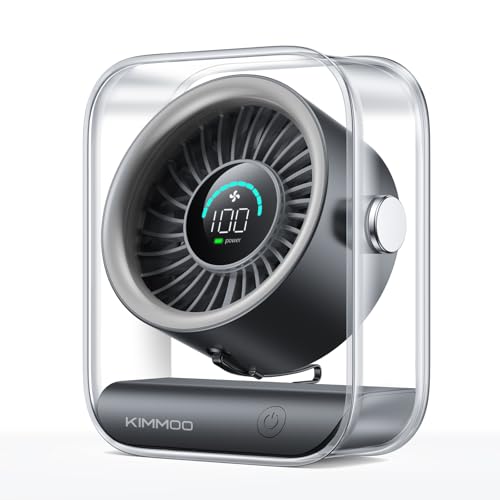
WHATOOK Rechargeable Mini Desk Fan
A still bedroom or cramped workspace can feel uncomfortable long before the room itself becomes seriously hot. Large fans take up valuable space, while basic USB models keep you tethered to an outlet or power bank. The WHATOOK enters the best mini desk fan conversation with a rechargeable 2000mAh battery, unusually detailed speed control, and a compact body designed for close-range airflow. Its appeal is easy to grasp: portable cooling without the constant cable clutter, plus enough adjustment to move from a faint bedtime breeze to stronger outdoor airflow.
WHATOOK Small Rechargeable Desk Fan
The standout feature is the 100-level speed system, which offers far more adjustment than the usual low, medium, and high arrangement. Levels 1 through 20 are described as quieter settings suited to sleep and office use, while levels 50 through 100 push a larger volume of air for warmer conditions. That wide range lets the fan sit in the background during calm tasks, then work harder once the room turns stuffy. The fine speed control is useful because comfort often falls somewhere between the fixed settings offered by simpler mini fans.
One hundred levels sound impressive, though they may feel like overkill for someone who wants a single button and three obvious choices. Moving through many increments can take longer than tapping directly between low and high, depending on how the controls are arranged. Still, small changes matter during sleep, reading, or close desk work, where one setting may feel weak and the next too sharp. The adjustable airflow range favors careful tuning rather than instant simplicity.
The 2000mAh version is listed for up to 10 hours of operation, giving it enough claimed endurance for a work session, an evening beside the bed, or portions of a travel day. Actual runtime will naturally depend on the selected speed, since stronger airflow asks more from the battery. A low setting should stretch the available charge farther than the upper end of the range. The rechargeable battery removes the outlet dependency found on corded desk fans, but high-speed use will require more frequent charging.
Battery Display and Cord-Free Convenience
An LED display shows the remaining battery level after airflow adjustments, taking some guesswork out of portable use. That small detail can prevent the familiar annoyance of carrying a fan outdoors only to have it stop soon afterward. A visible reading also makes charging habits easier to manage before bedtime or travel. The battery status display brings practical value because rechargeable gadgets are far less convenient when their remaining runtime is a mystery.
The fan can operate while charging, so a low battery doesn’t automatically end the cooling session. Plugging it in at a desk turns it into a more traditional USB-powered fan, while unplugging restores the freedom to move it elsewhere. That hybrid approach works well for a changing routine, especially when the same fan shifts between a workstation, nightstand, and packed bag. The use-while-charging function keeps the fan useful even after the battery indicator starts running low.
WHATOOK’s description also mentions a 5000mAh version rated for up to 25 hours, but that figure applies to a different battery configuration rather than the 2000mAh model named here. Keeping those versions separate matters because otherwise the expected runtime can become confusing. The reviewed model should be judged around its stated 2000mAh capacity and up-to-10-hour claim. Anyone needing multi-day cordless operation would need to pay close attention to the specific battery version rather than assuming every unit carries the larger cell.
Quiet Airflow for Work and Sleep
Lower speed levels are intended to produce softer airflow with restrained operating noise. That makes sense for a nightstand, study area, or desk where a strong motor hum would quickly wear on the nerves. A little white noise can even help cover distant traffic or household sounds without becoming the main event. The quiet low-speed range is likely to be the sweet spot for long sessions where constant comfort matters more than maximum air movement.
Noise expectations should stay realistic, though. A compact fan working near the upper end of 100 speed levels will generally sound more noticeable than it does at level 10 or 20. Stronger airflow requires faster blade movement, and no small desktop fan can completely sidestep that relationship. The useful part is the sound-versus-airflow control, allowing a quieter setting for calls or sleep and a stronger one when heat becomes the bigger irritation.
Soft wind also reduces the dry, prickly feeling that direct high-speed airflow can create around the eyes and face. Placed a short distance away, the fan can maintain gentle movement without blasting papers or making skin feel chilled. That’s especially helpful during long stretches at a screen, where an aggressive stream becomes distracting fast. The gentler breeze settings support steady comfort rather than forcing the fan to run at one blunt intensity.
Adjustable Positioning Around the Room
The fan offers a 180-degree adjustable angle, giving the airflow a broad vertical aiming range. It can sit flat on a desk or bedside table, then tilt toward the face, upper body, or another nearby spot. That freedom helps compensate for different furniture heights without stacking the fan on books or leaning it against whatever happens to be nearby. The 180-degree adjustment makes a small housing easier to position in real rooms where outlets, shelves, and sleeping angles rarely line up neatly.
Hanging is another listed option, which expands where the fan can be used. A hanging setup may help near a bunk, tent, shelf, or compact sleeping space where no clear tabletop is available. Stability will depend on how securely it is placed, so swinging or loosely supported positions won’t be as comfortable as a firm surface. The flat-or-hanging design adds useful flexibility, though sensible placement remains important around moving blades and charging cables.
The display is described as soft and low-light, a thoughtful detail for nighttime use. Bright screens can become surprisingly irritating in a dark bedroom, especially when they face the bed all night. A subdued readout offers battery information without turning the fan into a tiny bedside lamp. The low-light display supports sleep-friendly use, although people who are extremely sensitive to any illumination may still prefer to angle it away.
Safety, Materials, and Daily Handling
The housing uses pure ABS material and is described as odor-free. That matters with a device positioned close to the face, since a strong plastic smell can make a new fan unpleasant during its first days of use. ABS also keeps the body light enough for travel while providing a rigid shell for normal handling. The sturdy ABS construction suits a portable fan that may be moved often between rooms, bags, and temporary setups.
Denser, smaller grille gaps are designed to prevent fingers from reaching the blades. That’s a meaningful feature for a fan placed on a low table, crowded desk, or surface where hands may brush against it accidentally. No grille should be treated as permission to handle the fan carelessly, yet tighter spacing reduces an obvious risk. The finger-resistant guard gives the design a safer everyday feel without adding a bulky outer cage.
A denser grille can collect dust faster, particularly in bedrooms, pet-friendly homes, or rooms with open windows. Built-up debris may weaken airflow and make the fan look tired even if the motor remains fine. The provided description doesn’t state whether the cover is removable, so cleaning convenience shouldn’t be assumed. This maintenance uncertainty is worth remembering, since narrow guard openings may require a soft brush, compressed air, or careful wiping.
Realistic Strengths and Tradeoffs
Portability is the clearest advantage over a corded mini fan. The battery lets the WHATOOK move from a desk to a bedside table, patio seat, campsite, or travel bag without needing continuous access to a USB port. Its 180-degree adjustment and hanging capability support that freedom rather than limiting it to one tabletop position. The combination of cordless operation and flexible placement solves the everyday nuisance of dragging adapters and cables from room to room.
The control range is another genuine strength, particularly for anyone bothered by the big jumps between traditional fan speeds. A precise low setting can produce just enough movement for sleep, while higher levels are available when outdoor heat or poor ventilation calls for more force. Yet 100 settings may create unnecessary fiddling for those who value quick, no-thought operation. The 100-speed system is best viewed as fine control with a learning curve, not an automatic advantage in every routine.
Battery capacity places a natural boundary around the fan’s freedom. The stated up-to-10-hour runtime is useful, but maximum output won’t preserve the charge as long as a restrained setting. Extended camping trips or repeated full-day use may call for a nearby power bank or regular access to charging. The 2000mAh battery limitation doesn’t undermine the design, though it keeps expectations grounded for heavy use away from outlets.
The product information mentions replacement support within one year through the WHATOOK brand. That can provide some reassurance if a covered problem appears during the stated period, but the exact terms, exclusions, and process aren’t included in the supplied description. Keeping purchase details and reviewing the applicable policy would matter if service becomes necessary. The one-year replacement statement adds a useful ownership consideration without changing the fan’s day-to-day performance.
Where This Mini Fan Fits Best
A quiet desk setup is a natural home for this model. Lower speed levels can keep air moving near a keyboard without creating a harsh stream, while the battery allows the fan to sit where the airflow feels right rather than where a cable happens to reach. The display helps track remaining power during a long work block. For close-range cooling, the compact rechargeable format addresses space and cord clutter at the same time.
Bedside use may be even more convincing. Soft airflow, low-level white noise, a dim display, and adjustable tilt all speak directly to nights when the room feels stale but a large fan is too loud or too forceful. Running at a restrained level should also make better use of the available battery than pushing near maximum output. The sleep-friendly features line up well, though charging discipline still matters if the fan is expected to last through the night.
Outdoor and travel situations benefit from the cordless body, but open-air conditions can expose the limits of any mini fan. Natural wind, high humidity, and greater distance from the face can make compact airflow feel less powerful than it does indoors. Higher speed settings help, at the expense of shorter battery life and more noticeable sound. The WHATOOK remains a credible best mini desk fan option for personal cooling, particularly where flexible speed control and rechargeable operation matter more than room-wide circulation.
Honeywell TurboForce HT900 Air Circulator
Stuffy air can make a normal work session feel twice as long, especially in a room where the cooling never seems to reach the desk. The Honeywell TurboForce HT900 approaches that problem with more ambition than the typical palm-sized fan, pushing focused airflow across a wider distance while still fitting on a table, floor, or wall. That broader reach gives it a credible place in the best mini desk fan conversation, though it behaves more like a compact air circulator than a tiny personal breeze maker. Its strongest appeal lies in powerful directional airflow, flexible placement, and a straightforward three-speed setup.
Honeywell TurboForce HT900
The HT900 uses an aerodynamic turbo design intended to move air with more force than a basic desktop fan. Honeywell states that the airflow can be felt from up to 25 feet away, a substantial distance for a unit sized for tables, desks, floors, or wall mounting. That reach matters in small to medium rooms where a narrow personal fan would lose effectiveness after only a few feet. The longer air throw allows the fan to sit out of the way while still sending noticeable movement toward a bed, chair, or workstation.
Strong airflow changes how the fan can be used. Placed near an air-conditioning vent, it can help move cooled air farther into the room instead of letting it collect around one corner. Pointed across a doorway, it may also encourage circulation between nearby spaces, though results will depend on the room layout and temperature difference. The air circulation focus makes this model more useful for general room comfort than fans designed only to blow directly at one person.
That extra power brings a different footprint and feel from truly miniature USB fans. The HT900 is compact by room-fan standards, yet it isn’t intended to disappear beside a mouse pad or fit inside a small travel pouch. It suits a desk with some breathing room, a nightstand, a shelf, or a spot on the floor near a chair. The compact circulator design offers greater coverage, but space-conscious setups should account for its deeper housing and broader base.
Three Speeds for Different Cooling Needs
Three speed settings keep operation simple. Low provides gentler air movement for long periods, medium adds more presence without jumping straight to full force, and high delivers the strongest cooling effect. This familiar arrangement avoids the fiddling that can come with dozens of tiny increments. The three-speed control makes the fan easy to adjust by feel, which is handy during work, sleep, or changing afternoon temperatures.
Low speed will likely make the most sense in close quarters. A powerful circulator positioned only a few feet away can feel overly direct on high, particularly if it points toward the face or hands for hours. Medium creates a useful middle ground for daytime use, while high is better suited to moving air across the room or quickly clearing a stagnant pocket. The adjustable airflow intensity gives the HT900 enough range to serve both personal cooling and broader circulation.
The speed dial is built around practicality rather than decorative controls or digital displays. There’s no app, timer, battery meter, or elaborate interface to learn. That simplicity can be refreshing in a product meant to do one job reliably. The straightforward operation reduces distractions, although anyone wanting remote control or scheduled shutoff will need to look elsewhere.
Pivoting Head and Flexible Placement
The 90-degree pivoting head is one of the fan’s most useful features. It can send air forward from a desk, upward from the floor, or toward a higher bed or chair without forcing the entire unit into an awkward position. Small changes in angle can dramatically alter comfort, especially with airflow this concentrated. The 90-degree adjustment helps prevent the common problem of a fan blowing beneath the desk or directly into the eyes.
Floor placement opens up another practical use. Aiming the fan upward can encourage cooler air near the floor to mix with warmer air above, reducing the layered, stagnant feeling that often develops in bedrooms and offices. The effect won’t replace whole-room climate control, but it can make existing cooling feel more evenly distributed. That vertical air movement is where the HT900 starts to feel like an air circulator rather than a simple desk fan.
Wall mounting adds a space-saving option for crowded rooms. A mounted fan can stay clear of paperwork, bedside clutter, pets, and foot traffic while directing air downward or across the room. Installation details and hardware requirements should be checked before committing to that setup, since the supplied description doesn’t explain the mounting process. Still, the tabletop, floor, or wall-mounted flexibility gives this model more placement freedom than most compact fans.
Noise Level and Everyday Comfort
Honeywell describes the TurboForce as 25 percent quieter than comparable fans. That statement suggests noise reduction was part of the design, though the supplied information doesn’t identify the exact comparison models or provide decibel measurements. In real-world terms, the key question is whether the sound blends into the room or becomes distracting at close range. The quieter operating claim is encouraging, but expectations should still account for the greater airflow produced by a compact circulator.
Low speed is the safest choice for reading, sleeping, or working near a microphone. High speed will naturally create more blade and air noise, especially when the fan sits directly on a hollow desk that amplifies vibration. Placing it on a stable surface and avoiding loose objects nearby can help reduce rattles. The noise-versus-power tradeoff is reasonable: more airflow brings more sound, while lower settings preserve a calmer atmosphere.
A steady fan hum can be less bothersome than irregular clicking or vibration. The HT900’s simple mechanical design avoids some of the electronic beeps and display lights found on feature-heavy models. That makes it easier to use in a dark room or quiet office without extra visual distractions. The uncomplicated sound profile may suit sleep better than a fan with bright controls, though individual noise sensitivity always varies.
Cooling Reach and Energy-Saving Use
The fan’s ability to move air across a room supports more than immediate cooling. Used alongside air conditioning, it can help spread cooled air so the system doesn’t have to fight hot and cold pockets as aggressively. Honeywell presents this as a way to give the air conditioner a break and potentially reduce energy use. The supportive cooling role makes sense, although actual savings will depend on thermostat settings, room insulation, climate, and daily habits.
A fan doesn’t lower room temperature on its own. It cools through air movement and can help distribute conditioned air more efficiently, but it can’t replace an air conditioner during extreme heat. That distinction matters because strong airflow can feel dramatic while the underlying temperature remains unchanged. The HT900’s practical benefit is improved comfort and circulation, not independent refrigeration.
Placement has a big influence on efficiency. A fan jammed against a wall or blocked by furniture can’t draw and push air as effectively as one with open space around it. Positioning it near a cool-air source or across a clear path usually makes better use of the airflow. The 25-foot reach claim becomes more relevant when the fan has room to move air rather than fighting clutter and corners.
Strengths, Weaknesses, and Best Fit
The HT900’s biggest strength is that it does more than provide a narrow breeze at arm’s length. Its turbo design, adjustable head, and claimed long-distance airflow make it useful across a bedroom, office, or small living space. Three speeds keep the controls approachable, while multiple placement options improve flexibility. The combination of strong circulation and simple operation gives it an edge over weaker miniature fans that only feel effective from inches away.
Its size is also a limitation, depending on the intended setup. Someone seeking a truly tiny USB fan for a laptop bag may find the HT900 too bulky and too dependent on standard indoor placement. It lacks rechargeable operation, travel-focused dimensions, and the whisper-light airflow of smaller bedside models. The main weakness is that it sacrifices extreme portability in exchange for greater room reach.
The non-oscillating design may be another consideration. A pivoting head lets the airflow angle change, but the fan doesn’t sweep automatically across multiple positions. That focused stream works well for directing air toward one seat or across a room, though shared spaces may benefit from an oscillating model. The directional airflow is deliberate and strong, yet it won’t distribute air from side to side without manual repositioning.
The Honeywell TurboForce HT900 fits best where a small personal fan feels too weak but a full-size floor fan would be excessive. It suits a home office, bedroom, dorm, workshop corner, or compact living area where strong circulation matters more than cordless mobility. As a best mini desk fan candidate, it stands out by acting like a scaled-down room circulator rather than an ordinary tabletop fan. That distinction is its real advantage, provided the available space and focused airflow match the room.
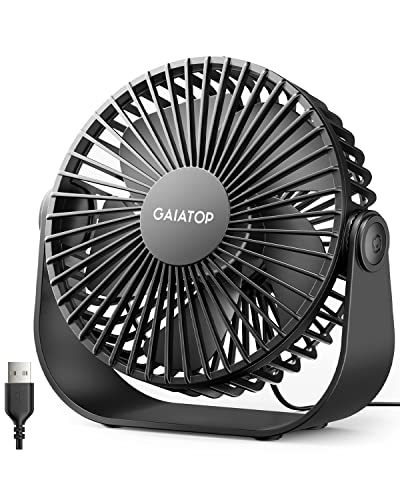
Gaiatop 5-Inch Desk Air Circulator
A small room can feel stale even when the thermostat says the temperature is reasonable. Air gets trapped around a desk, beside a bed, or in a kitchen corner, and a weak personal fan barely nudges it. The Gaiatop model enters the best mini desk fan discussion with a compact 5-inch frame, three manual speeds, and an airflow-focused design meant to do more than cool one narrow spot. Its real strength is small-scale circulation, though the AC-only power setup makes it better suited to fixed indoor use than travel.
Gaiatop 5-Inch Desk Fan
The housing measures about 5.59 by 5.65 by 4.33 inches and weighs roughly 0.73 pounds, so it takes up little room on a desk, shelf, or nightstand. That footprint leaves space for a keyboard, lamp, notebooks, or the usual tangle of chargers without making the surface feel cramped. Compact size alone isn’t enough, of course, but the Gaiatop pairs it with deep-pitched blades and an aerodynamic structure intended to push air with more authority than a basic mini fan.
The listed maximum air speed reaches 6.2 meters per second, which suggests a fairly concentrated stream from such a small body. That level of airflow makes more sense for close cooling and short-range circulation than for replacing a full-size room fan. Set a few feet away, it should move enough air to break up that sticky pocket around a chair or workstation. The strong directional breeze is useful, but the compact blade diameter still limits how broadly the air spreads.
Gaiatop describes the fan as suitable for bedrooms, offices, kitchens, bathrooms, and dorm rooms. Those spaces share one thing: limited surfaces and a need for airflow without bulky equipment. A small fan can sit near a sink, beside a monitor, or on a dresser where a pedestal fan would be absurdly oversized. The space-saving design fits those situations well, provided a standard AC outlet is within reach.
Three Speeds and Full Tilt Control
Three manual speed settings cover the usual range from light airflow to stronger cooling. Low is the sensible choice for long work sessions or nighttime use, medium adds a little muscle without going all out, and high is better for a warm kitchen or stuffy room. The control scheme is uncomplicated, which means fewer buttons to hunt for and no digital panel to decode. The three-speed adjustment keeps the experience direct, though it doesn’t offer the fine tuning found on models with many speed increments.
The head tilts through a full 360 degrees, giving the fan far more flexibility than fixed-angle desktop designs. Air can be directed upward from a low table, downward from a shelf, or straight across a room without moving the entire base. That range also helps avoid blowing directly into the eyes, a small irritation that becomes a big deal after several hours. The 360-degree tilt lets positioning do some of the work that oscillation would otherwise handle.
Full tilt doesn’t mean automatic movement from side to side. The fan stays aimed wherever it’s set, so shared spaces won’t get the sweeping coverage of an oscillating unit. Still, focused airflow can be an advantage when only one chair, bed, or work area needs cooling. The fixed directional stream wastes less air on empty parts of the room, but it requires manual adjustment whenever the preferred cooling zone changes.
Quiet Operation and Stable Placement
The upgraded motor is rated at about 30 dB under the stated operating conditions, which places the emphasis on restrained sound rather than a loud, high-pitched whine. That makes the fan easier to live with near a bed, during reading, or beside a computer microphone. Sound will vary by speed and surface, so high mode may still be noticeable in an otherwise silent room. The low-noise design is most convincing at close range, where motor buzz tends to be more distracting.
Four rubber pads sit under the base to reduce vibration and keep the fan from sliding. That detail matters more than it sounds because small, lightweight fans can creep across smooth desks or turn hollow furniture into a resonating box. The pads help isolate the motor from the surface while adding grip during speed changes or angle adjustments. The anti-slip base supports steadier operation, especially on laminate, tile, or polished wood.
Cable tension can still work against that stability. The attached 4.92-foot cord gives useful reach, but a tight bend or dangling cable may tug the fan backward or sideways. Leaving a little slack helps the rubber feet stay planted and prevents the housing from shifting as the head is tilted. The long fixed cable is convenient for placement, though it adds one more cord to manage on a crowded surface.
AC Power and Energy Use
This model runs from a 120V AC plug and draws 6.8 watts according to the supplied specifications. That setup provides steady power without worrying about battery capacity, charging time, or reduced output as a battery drains. It suits a permanent desk, bedroom, or kitchen location where an outlet is already nearby. The continuous AC operation is dependable, but it gives up the cordless freedom offered by rechargeable mini fans.
The 6.8-watt rating keeps power demand modest compared with larger cooling appliances. Used alongside air conditioning, the fan can help move cooled air toward a desk, bed, or room corner instead of letting it sit near a vent. That may improve comfort without lowering the thermostat as aggressively, though actual energy savings depend on the room, climate, and appliance settings. The low power draw supports efficient circulation rather than acting as a substitute for mechanical cooling.
The undetachable cable is both practical and limiting. It can’t be misplaced, and there’s no need to match the fan with a separate adapter or USB charger. On the other hand, the cord can’t be swapped for a shorter one, packed separately, or replaced easily if damaged. The fixed AC cord favors everyday indoor reliability over modularity and travel convenience.
Cleaning and Long-Term Maintenance
The front cover can be removed, giving direct access to the blades and grille. Dust buildup is one of the most common reasons a small fan starts feeling weaker or sounding rougher over time. Easier access means the blade edges can be wiped instead of poked at through narrow openings. The detachable front grille turns routine cleaning into a manageable task rather than a fiddly chore.
Cleaning should be done with the fan unplugged and the motor housing kept dry. A soft cloth or brush is enough for loose dust, while stubborn debris may need careful wiping around the blade surface and guard. The removable cover doesn’t make the entire fan washable, and forcing the clips could damage the fit. The easy-clean design helps, but gentle handling still matters.
Regular maintenance also supports quieter operation. Uneven dust on the blades can increase vibration, and lint caught in the grille can restrict airflow. A quick cleaning every so often is less work than waiting until the fan looks gray and starts buzzing. The accessible blade area gives the Gaiatop a practical edge over sealed models that hide every surface behind a fixed cage.
Strengths, Weaknesses, and Best Use
The strongest part of this fan is the way its features work together. A compact body, three speeds, 360-degree tilt, and a claimed 6.2 m/s maximum air speed create a useful mix of power and placement control. The rubber feet and detachable cover address the less glamorous details that often decide whether a fan stays pleasant after months of use. The main strength is focused indoor cooling without the bulk of a larger circulator.
The biggest weakness is portability in the practical sense. At 0.73 pounds, it’s easy to carry from room to room, but it can’t run without a nearby 120V outlet. It’s also less suitable for international travel where voltage standards differ, and the fixed cord can be awkward in luggage. A rechargeable or USB-powered fan offers more freedom, while this one trades that flexibility for steady plug-in performance.
This Gaiatop makes the most sense on a home-office desk, beside a bed, on a kitchen counter, or in another indoor spot that needs direct airflow throughout the day. It won’t cool a large room evenly, and it won’t follow anyone outdoors without AC power. Still, as a best mini desk fan candidate, it stands out for buyers who care more about strong airflow, quiet operation, and easy cleaning than cordless convenience.

Best Quiet Ceiling Fan For Bedroom 2026 Ultimate Comfort Picks

Best Ceiling Fan For Master Bedroom 2026 With Ultimate Comfort

Best White Ceiling Fan With Light For Bedroom 2026 Top Picks

Best Quorum Medallion Ceiling Fan 2026 With Style & Breeze
Best Outdoor Fan For Pergola 2026 Comfort Boost

Best Ceiling Fan For Great Room 2026 With Ultimate Comfort

Best Outdoor DC Ceiling Fans 2026 For Breezy Comfort
Best ceiling exhaust bath fan with light and heater 2026





