Best Portable USB Rechargeable Fan 2026 Picks

A stuffy desk, warm bedroom, or crowded travel bag can make personal cooling feel harder than it should. The best portable USB rechargeable fan solves that problem with focused airflow, cordless operation, and a body small enough to move without much fuss. A useful model should feel stable on a table, simple to control, and strong enough to cool the person sitting nearby rather than merely stirring warm air. Size matters, but shrinking the housing too far can reduce blade span, airflow, and battery capacity.
Battery life deserves a close look because advertised runtime usually covers several speed settings, not one constant result. Lower speeds may last through a workday, while maximum power can drain the battery much sooner. That tradeoff isn't necessarily bad, since a strong setting is often needed only for brief bursts after walking outside, cooking, or sitting in a parked vehicle. Still, a larger battery makes more sense when wall outlets aren't nearby or charging breaks are easy to forget.
USB charging flexibility can make a small fan far more convenient. Models using USB-C fit more naturally into a modern charging setup, while older Micro-USB ports may require carrying an extra cable. Some fans can operate while charging, which helps during long desk sessions, though constant plugged-in use reduces the value of portability. A power bank can also keep the fan running during camping trips, outages, or long waits in places where the air barely moves.
Noise is another practical concern, especially beside a laptop, bed, or microphone. A fan doesn't need to be silent, but the motor tone shouldn't become more distracting than the heat. Wider blades and a well-balanced housing often produce a softer airflow sound than tiny blades spinning at very high speed. At full power, though, nearly every compact fan becomes noticeable, so realistic expectations matter.
Adjustable airflow makes the fan easier to live with across changing conditions. Three or more speed levels offer better control than a basic on-and-off switch, while a tilting head helps direct air toward the face, hands, or upper body. Some designs add oscillation, timers, clips, or folding stands, but each extra feature can increase weight and create another part that may loosen over time. A simple fan with a sturdy hinge often outlasts a feature-packed model built with thin joints.
Portability also depends on shape, not just weight. A slim folding fan slips into a backpack pocket, while a broad desktop base takes more room but usually feels steadier on uneven surfaces. Handheld models are handy in lines or outdoor seating areas, yet they can become tiring during longer use unless they include a stand. Clip-on designs save desk space, though the clamp must open wide enough and hold firmly without damaging delicate surfaces.
The strongest pick balances airflow, runtime, charging convenience, and build stability rather than chasing one impressive number. A huge battery can make the fan bulky, and extreme speed can bring extra noise. Likewise, the smallest model may travel beautifully but struggle in humid rooms or direct afternoon heat. Good personal cooling comes from matching those tradeoffs to the places where the fan will actually be used.
![Warmco 10000mAh Portable Travel Fan 7-inch, [10-24H Runtime] Ultra-thin Digital Display Mini Desk Battery Operated Fan for Bedroom, Camping, Cruise Essentials 2025](https://m.media-amazon.com/images/I/41lT9WEGigL._SL160_.jpg "Warmco 10000mAh Portable Travel Fan 7-inch, [10-24H Runtime] Ultra-thin Digital Display Mini Desk Battery Operated Fan for Bedroom, Camping, Cruise Essentials 2025")
- LFR Score9.4
LFR Score is a ranking system developed by lightfansreviews.com. LFR Score has no relationship or impact from any manufacturers or sales agent websites. Learn more
- BrandWarmco

- LFR Score9.4
LFR Score is a ranking system developed by lightfansreviews.com. LFR Score has no relationship or impact from any manufacturers or sales agent websites. Learn more
- BrandHonesorn
- LFR Score9.2
LFR Score is a ranking system developed by lightfansreviews.com. LFR Score has no relationship or impact from any manufacturers or sales agent websites. Learn more
- BrandGaiatop

- LFR Score9.2
LFR Score is a ranking system developed by lightfansreviews.com. LFR Score has no relationship or impact from any manufacturers or sales agent websites. Learn more
- BrandTevelecin
- LFR Score9.0
LFR Score is a ranking system developed by lightfansreviews.com. LFR Score has no relationship or impact from any manufacturers or sales agent websites. Learn more
- BrandOtlonpe
- LFR Score9.0
LFR Score is a ranking system developed by lightfansreviews.com. LFR Score has no relationship or impact from any manufacturers or sales agent websites. Learn more
- BrandKoonie

- LFR Score9.0
LFR Score is a ranking system developed by lightfansreviews.com. LFR Score has no relationship or impact from any manufacturers or sales agent websites. Learn more
- BrandKorbot

- LFR Score8.8
LFR Score is a ranking system developed by lightfansreviews.com. LFR Score has no relationship or impact from any manufacturers or sales agent websites. Learn more
- BrandFRIZCOL

- LFR Score8.8
LFR Score is a ranking system developed by lightfansreviews.com. LFR Score has no relationship or impact from any manufacturers or sales agent websites. Learn more
- BrandAVV

- LFR Score7.6
LFR Score is a ranking system developed by lightfansreviews.com. LFR Score has no relationship or impact from any manufacturers or sales agent websites. Learn more
- BrandBGYUA
Last update on 2026-08-20 / Affiliate links / Images, Product Titles, and Product Highlights from Amazon Product Advertising API
Warmco 10000mAh Portable Travel Fan
A warm bedroom can turn a decent night’s sleep into a long wrestling match with the sheets, while a stuffy desk makes even simple work feel oddly draining. Full-size fans solve the airflow problem but bring their own baggage, including outlet dependence, bulky frames, and awkward storage. The Warmco 10000mAh Portable Travel Fan takes a more flexible route, combining a slim 7-inch body with a rechargeable battery, four speed levels, and a foldable stand. Within the crowded best portable USB rechargeable fan category, its most interesting promise isn’t raw wind power alone, but practical cooling that can move from a nightstand to a campsite without demanding a new setup.
Warmco 10000mAh Travel Fan Review
The Warmco fan is built around a 10000mAh rechargeable battery, which gives it a clear advantage over tiny handheld models with limited capacity. The stated runtime ranges from 10 to 24 hours, depending on the selected speed and operating conditions. That range makes sense because the highest setting naturally asks more from the battery than a gentle bedside breeze. Still, the ability to cover an extended work session, overnight rest, or a good portion of a camping day reduces the constant hunt for an available outlet.
Four speed settings create enough separation for different situations without cluttering the controls. The lower levels suit quiet reading, sleeping, or close-range desk use, while the upper settings offer more noticeable airflow during humid afternoons or outdoor breaks. Its five-blade design aims to move air efficiently without requiring an oversized housing. No compact fan will cool an entire room like a standing fan, but focused airflow can make a meaningful difference when it’s directed toward one chair, sleeping area, or work surface.
The built-in display adds more value than it might seem at first glance. Small rechargeable fans often rely on blinking lights that leave battery status open to guesswork, and that gets old fast during travel. Warmco’s digital display shows the active speed and remaining battery level, making it easier to decide whether to lower the setting or recharge before heading out. That bit of visibility prevents the annoying surprise of a fan shutting down halfway through a warm night.
Cooling Power Without The Usual Bulk
Portability depends on shape as much as weight, and the Warmco keeps its profile unusually slim at roughly 1.6 inches deep. Its listed dimensions are 7 inches wide and 8.4 inches tall, so it offers a broader airflow surface than pocket-size fans while remaining manageable in a backpack or carry-on. At about 0.89 pounds, it isn’t featherlight, but the larger battery accounts for some of that weight. The tradeoff feels reasonable for longer runtime, especially where charging access may be limited.
The foldable stand helps the fan shift between storage and daily use without needing a separate base. Folded down, it takes up less room beside clothing, chargers, or camping supplies. Opened for use, the stand creates a stable desktop format that fits naturally on a dresser, picnic table, office desk, or cruise cabin shelf. A compact footprint also matters in cramped spaces where a traditional circular fan would swallow valuable surface area.
Its 7-inch format sits in a useful middle ground. Smaller handheld fans can be convenient while walking, but holding one for long stretches gets tiresome, and their narrow airflow often cools only a small patch of skin. Larger rechargeable fans provide wider coverage but become harder to pack. The Warmco’s ultra-thin frame offers broader personal airflow without crossing into bulky appliance territory, which is where this design earns its keep.
Quiet Operation For Work And Sleep
Fan noise can be surprisingly irritating in a quiet bedroom, particularly when the motor produces a sharp whine rather than a steady airflow sound. Warmco lists its operating noise at under 40dB, supported by a brushless motor. That doesn’t mean absolute silence, especially at the highest speed, but it suggests a sound level intended for close-range use without dominating the room. Lower settings should be the more sensible choice for sleep, calls, reading, or concentrated work.
The brushless motor matters for more than noise control. This motor style generally reduces friction compared with brushed alternatives, which can support smoother operation and lower mechanical wear. The real benefit shows up in ordinary moments: fewer distracting vibrations on a desk, less buzzing beside a bed, and a calmer sound profile during long sessions. Those details aren’t flashy, yet they often determine whether a portable fan gets used daily or ends up forgotten in a drawer.
Placement still affects the experience. A compact fan sitting inches from a microphone may be audible during calls, while the same unit positioned farther away can provide airflow without becoming the main character in the recording. The adjustable speed range gives some room to balance cooling and sound rather than accepting one fixed level. For quiet spaces, controlled airflow is usually more useful than maximum power running nonstop.
USB-C Charging And Power Sharing
The Warmco uses a USB-C port that supports 5V/2.4A input and output, giving the fan a useful dual role. It can recharge through common USB power sources, including compatible adapters and power banks, while also supplying power to other USB devices. That output feature won’t replace a dedicated high-capacity power station, but it can provide a backup charge when a phone or small electronic device is running low. On trips, one device handling both airflow and emergency charging can trim a little clutter from the bag.
An included 2-in-1 charging cable supports USB-A to USB-C and USB-C to USB-C connections. This is a practical touch because charging setups aren’t always consistent across hotels, vehicles, older adapters, and newer power banks. Rather than carrying two separate cables, the supplied design covers both common port arrangements. Cable flexibility sounds minor until the only available charger uses the connector left at home.
Charging another device from the fan will naturally reduce the battery reserved for cooling. That’s the key tradeoff, and it’s worth keeping in mind before using the fan as a routine power bank. The feature makes the most sense as a temporary backup rather than the main charging plan. Warmco’s battery display helps here because the remaining power can be checked before deciding whether to share it.
Everyday Comfort And Travel Practicality
This fan’s strongest use cases involve places where full-room cooling isn’t available, practical, or worth the cost. A home office may already have air conditioning, yet one corner can remain stubbornly warm near a sunny window. A bedroom can feel comfortable overall but still need light airflow around the pillow. The Warmco provides personal cooling without forcing the entire room to run colder.
Travel creates a different set of frustrations. Cruise cabins, tents, RV spaces, hotel rooms, and outdoor seating areas don’t always provide airflow where it’s needed. The foldable body and long battery estimate make the Warmco easier to position near a bed, chair, or table without searching for a wall socket. Its portable stand design is particularly useful where clip-on fans have nowhere secure to attach.
The slim build can also help around indoor plants during stagnant summer conditions, though the fan should provide gentle circulation rather than blasting leaves at close range. Constant harsh airflow may dry foliage or potting mix faster than expected, so a lower setting and sensible distance are better. For broader household air movement, ceiling-mounted designs serve a different purpose, and a neutral reference on budget fixtures appears in ceiling fans with lights. The Warmco remains better suited to targeted, movable cooling rather than whole-room circulation.
Strengths Worth Paying Attention To
The biggest strength is the pairing of a large-capacity battery with a relatively thin body. Many portable fans lean heavily toward either runtime or compactness, but this model tries to balance both. Its stated 10-to-24-hour range provides flexibility for lighter overnight use or shorter periods at stronger speeds. That balance makes the fan more adaptable than models designed solely for brief handheld cooling.
The digital battery readout is another practical win. Knowing the remaining charge reduces unnecessary top-offs and makes planning easier before leaving home. The speed display also confirms the selected setting at a glance, which is useful in dim rooms or shared spaces where repeated button presses can become confusing. Simple information, clearly shown, improves the experience more than a decorative feature would.
Noise control, foldability, and USB-C support round out the stronger parts of the package. The listed sub-40dB operation suits close-range environments, while the folding stand keeps setup uncomplicated. USB input and output add flexibility during travel, outages, or long outdoor days. Taken together, these practical features solve routine annoyances rather than padding the design with gimmicks.
Weaknesses And Realistic Tradeoffs
The 10000mAh battery adds useful endurance, but it also prevents the fan from being truly pocketable. At 0.89 pounds and over 8 inches tall, the Warmco fits better in a backpack, tote, suitcase, or larger purse than in a jacket pocket. Anyone expecting a tiny handheld fan may consider it too large. The larger footprint is the price paid for wider airflow and longer operation.
Maximum-speed runtime will sit closer to the lower end of the stated range than the upper end. That isn’t a defect, just ordinary battery behavior under heavier demand. Strong airflow, device charging, and frequent high-speed use will consume power faster, so the 24-hour figure shouldn’t be treated as a constant result across every setting. The runtime range is most useful when viewed as a flexible estimate rather than a fixed promise.
The fan also remains a personal cooling device, not a substitute for a ceiling fan, tower fan, or air conditioner. It can move air around a desk or bed, but it won’t lower room temperature or distribute airflow evenly across a large space. Its best performance comes from thoughtful positioning and a reasonable distance from the body. For focused comfort, the Warmco’s portable cooling setup makes sense; for whole-room airflow, a larger appliance remains the better tool.
Honesorn 20000mAh Rechargeable Camping Fan
A muggy tent can turn a quiet night outdoors into hours of shifting pillows, opening vents, and wondering why the air feels glued in place. Power outages create a similar headache indoors, especially after the room loses circulation and phone batteries begin dropping at the same time. The Honesorn 20000mAh Rechargeable Camping Fan tackles both problems with a large battery, adjustable airflow, a built-in lantern, and device-charging ports. Among models competing for the best portable USB rechargeable fan label, this one clearly leans toward long stays, overnight cooling, and situations where a tiny desk fan simply won’t cut it.
Honesorn Rechargeable Camping Fan Review
The headline feature is the 20000mAh rechargeable battery, which is substantially larger than the batteries found in many compact personal fans. Honesorn lists an operating range of 16 to 60 hours per charge, with actual runtime depending on fan speed, lighting use, oscillation, and device charging. The fan requires about seven to eight hours for a full recharge, so it rewards a little planning before a trip. That longer charging period is the obvious tradeoff for carrying enough stored power to cover extended use.
A broad runtime range can look confusing at first, but it reflects how differently the four speed settings draw power. Low speed may suit sleeping, reading, or keeping air moving inside a small tent, while the strongest setting is better reserved for hot afternoons or quick cooling. Running the LED lamp, oscillation, and phone charging at the same time will also reduce the available runtime. The useful part is choice: long endurance is available when gentle airflow is enough, while stronger cooling remains on hand when comfort matters more than conserving battery.
The dual-port setup includes USB-C and USB-A connections, allowing the fan’s battery to supply power to phones, tablets, and other compatible electronics. That reverse-charging function gives the unit a second job during outages or remote trips where a wall outlet isn’t part of the picture. It shouldn’t replace a dedicated power bank for heavy daily charging, since every percentage sent to another device leaves less energy for airflow. Still, as an emergency reserve, it’s a sensible feature rather than decorative padding.
Airflow That Adjusts To Awkward Spaces
Outdoor cooling rarely happens on a neat, level desk, so positioning matters almost as much as motor strength. The Honesorn offers 90-degree oscillation to spread air across a wider area instead of blowing toward one fixed spot. Its head also tilts manually through a stated 270-degree range, making it easier to aim airflow upward, downward, or across a sleeping area. That flexibility helps inside tents, beside a cot, under a canopy, or on a crowded office surface where the fan can’t sit directly in front of the person using it.
The integrated hanging hook changes how the fan fits into a campsite. It can hang from a tent ceiling, branch, shelter frame, or another secure support, keeping the floor clear of gear and moving the breeze from above. That overhead position can distribute air more naturally across sleeping bags than a low fan pointed at someone’s feet. The hanging design also reduces the chance of the unit being kicked, buried under clothing, or blocked by bags during the night.
Four speed settings provide more control than a simple low-and-high switch. Honesorn states a maximum air speed of up to 3.9 meters per second, supported by a five-blade arrangement and motor designed for focused airflow. That figure describes air velocity rather than whole-room cooling, so expectations should stay grounded. This is still a portable fan, but its stronger settings are better suited to a tent, bedside area, workstation, or nearby seating zone than a tiny handheld model.
Remote Control And Timer Convenience
Reaching across a tent in the dark to adjust a fan gets old in a hurry. The included remote control works from a stated distance of up to 18 feet, allowing changes without climbing out of a sleeping bag or leaving a chair. Base-mounted controls remain available when the remote isn’t nearby, which prevents the entire fan from depending on one small accessory. That combination is practical because remotes have a habit of disappearing into blankets, gear bins, and couch cushions.
The timer supports one, two, four, or eight-hour intervals, giving the fan a clear stopping point instead of letting it run until morning. A one-hour setting may be enough to settle into sleep, while four or eight hours can cover much of an overnight stretch. Timed operation can also preserve battery during trips where recharging opportunities are limited. It’s a straightforward feature, but one that directly reduces wasted power.
Sleep mode switches off the indicator lights, solving a small annoyance that becomes surprisingly noticeable in a dark bedroom or tent. Bright status lights can bounce off fabric walls or sit directly in the line of sight, even when the fan itself is quiet. With indicator-free operation, the unit can keep running without adding an unwanted glow near the bed. That attention to nighttime use makes the controls feel designed around real sleeping conditions rather than daytime demonstrations.
Quiet Cooling For Rest And Focus
Honesorn lists the fan’s operating noise at below 30dB, although perceived sound will still vary by speed, distance, and surface placement. Lower settings should be the natural fit for sleep, reading, calls, or desk work where steady motor noise can become irritating. The five-blade design is intended to deliver airflow without relying on an especially harsh, high-pitched motor tone. At maximum speed, some airflow noise should still be expected because moving more air is never completely silent.
Anti-slip pads underneath the housing help limit vibration on hard tables, desks, and shelves. A motor may be reasonably quiet on its own yet become bothersome once its vibration transfers into a hollow surface. The stable base reduces that problem while helping the unit remain planted during oscillation. Outdoors, the pads also add grip on picnic tables or smooth camping furniture, though uneven ground still calls for careful placement.
The combination of quiet operation and directed airflow makes this model useful beyond camping. A warm bedroom can benefit from low-speed circulation near the bed, while a home office may need targeted cooling without adding a loud background hum to calls. It can also help during a power outage when central air stops and opening a window isn’t enough. The fan’s cordless operation matters most in those moments because cooling isn’t tied to the nearest live outlet.
Built-In Lantern For Camps And Outages
The integrated LED lantern offers three brightness levels, ranging from softer ambient light to brighter tent illumination. A low setting can provide enough visibility for settling in without flooding the entire shelter, while the higher level is more useful for organizing gear or dealing with an unexpected problem. Combining light and airflow in one housing saves space compared with packing separate devices. It also reduces the number of batteries, cables, and controls scattered around a small campsite.
Lantern placement benefits from the hanging hook just as much as the fan does. Suspended near the center of a tent, the light can spread more evenly than a flashlight resting on the floor. The fan can continue moving air from the same overhead position, creating a tidy setup with fewer items underfoot. This two-in-one arrangement feels especially practical in compact tents where every flat surface is already occupied.
Indoor outages present another useful scenario. The lantern can illuminate a bedroom, hallway, or desk while the fan keeps air moving, and the USB ports can provide a limited phone charge if needed. Using every function at once will shorten runtime, so priorities matter during a long interruption. Even so, having light, airflow, and backup power in one rechargeable unit can simplify a stressful evening.
Outdoor Build And Safety Features
The housing uses rugged ABS material with a drop-resistant design intended for outdoor handling. That doesn’t make the fan indestructible or suitable for careless exposure to rain, but it should tolerate routine bumps better than a delicate desktop model. Camping equipment gets packed tightly, shifted around in vehicles, and placed on less-than-perfect surfaces. A sturdier shell makes sense for that kind of use.
Built-in protection covers overcharging, over-discharging, and short circuits, according to the supplied product details. Those safeguards matter in a device carrying a large-capacity rechargeable battery and serving as a power source for other electronics. They don’t remove the need for proper charging habits, dry storage, and a compatible power adapter. Still, the protective circuitry adds reassurance during long charging sessions or overnight operation.
Honesorn also states that the fan comes with two-year service. That information is more meaningful as a support commitment than as proof of long-term durability, since actual coverage depends on the seller’s terms and the specific issue involved. Keeping order information and reviewing the service conditions would be sensible before relying on it. The product details support the presence of the service period, but they don’t provide enough information to judge claim handling or response speed.
Where This Fan Fits Best
This model makes the strongest case in situations where runtime, adjustable placement, and multiple functions matter more than minimal weight. A 20000mAh battery adds bulk, so the Honesorn won’t feel as effortless to carry as a palm-size fan. That extra size buys longer cordless use, stronger positioning options, and emergency device charging. It fits naturally in camping gear, an RV cabinet, an outage kit, or a vehicle packed for a weekend outdoors.
Bedroom use also makes sense, especially where a wall outlet is inconvenient or indicator lights disturb sleep. The timer, remote, quiet rating, and sleep mode address common nighttime annoyances without forcing repeated trips across the room. For larger permanent spaces, though, a portable fan can’t replace broader overhead circulation. A related room-scale reference appears in ceiling fans for large bedrooms, while the Honesorn remains focused on movable, close-range comfort.
Office use is possible, but the orange camping-oriented body and larger battery may feel more substantial than a slim desk fan. The remote and oscillation are handy in a shared workspace, yet the lantern and hook may go unused there. That isn’t a flaw, just a sign that the design favors outdoor flexibility over minimalist desktop styling. A smaller model may suit a permanent workstation better, while this one earns its space by moving easily between several roles.
Strengths That Carry Real Weight
The most convincing strength is the large battery capacity paired with a stated runtime that stretches well beyond a typical afternoon. That endurance reduces charging anxiety during multi-day travel, overnight camping, and utility outages. Dual USB output also gives the stored energy a second purpose when another device needs help. Few features feel wasted because each one addresses a common problem away from reliable electricity.
Positioning is another major advantage. Oscillation, manual tilt, a stable base, and a hanging hook create several ways to direct the breeze without awkward improvisation. A fixed-head fan can be surprisingly frustrating inside a tent because beds, bags, poles, and walls limit where it can sit. The Honesorn’s adjustable airflow system handles those cramped arrangements more gracefully.
Nighttime features round out the stronger side of the design. Quiet operation, multiple timers, remote control, sleep mode, and adjustable lantern brightness all reduce fiddling after the lights go out. None of those features is dramatic by itself, but together they create a calmer routine. The product feels built for overnight practicality, not merely daytime airflow.
Weaknesses And Sensible Expectations
The battery’s size brings a predictable downside: long recharge time. Seven to eight hours is manageable overnight, but it isn’t convenient when the fan is nearly empty shortly before departure. Carrying a suitable charger and topping it off ahead of time will be part of owning it. Anyone who routinely forgets to recharge gear may prefer a smaller battery that fills faster, even if it doesn’t run as long.
Using the lantern, oscillation, high fan speed, and reverse charging together will pull the runtime toward the lower end of the stated range. The 60-hour figure shouldn’t be treated as a universal result under heavy use. Battery claims always depend on settings, and this model has several functions competing for the same stored energy. The 16-to-60-hour range is best understood as a flexible window rather than a single expected outcome.
The fan also asks for more packing room than a simple travel fan. Its hook, oscillating body, lantern, remote, and large battery create a capable package, but not a tiny one. A backpacker counting every ounce may consider the extra functions unnecessary, while car campers or outage preparation kits are less likely to mind. The Honesorn’s feature-heavy design pays off only when those functions will actually be used.
Gaiatop Portable Rechargeable Clip-On Fan
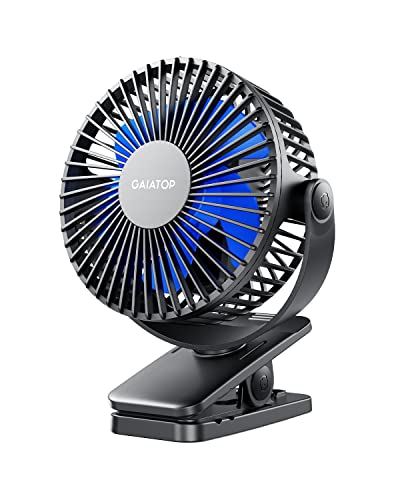
Limited desk space has a funny way of making even a small cooling device feel like one more thing in the way. A fan with a wide base can crowd a nightstand, disappear beneath paperwork, or slide around in a moving vehicle. The Gaiatop Portable Rechargeable Clip-On Fan avoids that mess by attaching directly to a stroller frame, shelf, desk edge, tent pole, or similar surface. Its compact proportions, rotating head, and rechargeable design give it a practical place among contenders for the best portable USB rechargeable fan, especially where focused airflow matters more than cooling a whole room.
Gaiatop Rechargeable Clip-On Fan Review
The Gaiatop uses a 2000mAh rechargeable battery with stated runtimes of about 2.5, 4.5, or 9 hours, depending on the selected speed. That range clearly shows the tradeoff between stronger airflow and longer cordless operation. High speed suits short bursts of relief during a hot walk or afternoon outside, while the lowest setting makes more sense for a longer nap, desk session, or stroller ride. The fan can also run while charging, so a nearby USB source can keep it working after the internal battery runs low.
Three speed settings keep the controls simple without locking the fan into one airflow level. A gentle setting can move air quietly near a sleeping area, while the stronger levels provide a more noticeable breeze during humid weather. The supplied details describe an upgraded blade and grille design shaped around aerodynamic airflow, paired with a brushless motor. That combination is meant to push useful air without producing the rough buzzing that sometimes comes from inexpensive miniature fans.
This model is better understood as a close-range personal fan than a room-circulation appliance. Its compact blades work best when aimed toward a face, upper body, stroller seat, or small workspace. Placing it several feet away and expecting it to cool an entire bedroom would stretch the design beyond its purpose. Used at the right distance, though, the concentrated breeze can take the edge off heat without taking over the surrounding space.
A Clip That Frees Up Valuable Space
The clamp opens to grip surfaces up to one inch thick, covering many desk edges, bed frames, shelves, stroller bars, and camping fixtures. A clip-based setup keeps the fan off crowded surfaces and allows it to sit closer to the spot where air is actually needed. That becomes useful in tight rooms, small offices, vehicle interiors, or tents where every flat area already has another job. Instead of rearranging everything, the fan simply borrows an edge.
A sponge pad lines the inner part of the clamp, helping reduce scratches and pressure marks on furniture or painted surfaces. That small detail matters because a strong bare-plastic clip can leave scuffs after repeated repositioning. The padded gripping surface also adds friction, which may help the fan remain steady while the head is angled. Care is still sensible around delicate finishes, but the pad is a welcome buffer.
The clamp’s strength carries a minor tradeoff. A firm grip helps prevent slipping, yet opening a sturdy spring-loaded clip may require more hand pressure than a loose clamp. That’s generally preferable to a fan that slowly droops or falls after a few minutes. The secure attachment matters most on strollers, camping gear, or moving vehicles, where a weak connection becomes more than a small annoyance.
Flexible Rotation Without Moving The Clip
The fan head offers 360-degree horizontal rotation and 360-degree vertical rotation, creating plenty of freedom after the clamp is attached. This means the mounting point doesn’t have to sit directly in front of the desired airflow path. The head can turn around a stroller canopy support, angle down from a shelf, or aim upward from a low desk edge. That flexibility reduces the constant unclipping and reclipping that wears on both the clamp and the surface beneath it.
Rotation also helps in shared spaces. The fan can be redirected toward another chair without moving the entire base, or tilted away temporarily when the breeze feels too direct. A fixed clip fan often forces an awkward choice between a secure mounting spot and a useful airflow angle. The Gaiatop’s dual-axis adjustment does a better job of separating those two decisions.
The rotating joints should still be handled with a little restraint. Forcing the head past its natural range or repeatedly twisting it with one hand while the clamp is under pressure may strain the mechanism. Smooth repositioning is the smarter approach, especially with a small plastic housing. The design offers generous movement, but it isn’t meant to be treated like a heavy-duty metal hinge.
Compact Enough For Daily Carry
The fan measures about 5.11 by 1.54 by 6.77 inches and weighs roughly 0.71 pounds. Those dimensions make it small enough for a backpack, stroller organizer, tote, or camping bin without demanding a separate storage plan. It isn’t a pocket fan, partly because the clamp adds shape and weight. Still, compared with a conventional desk fan, it occupies very little room.
The narrow body is particularly useful around electronics and work gear. A bulky base can compete with keyboards, charging docks, notebooks, and coffee cups, while this fan can attach to the side of the desk and leave the surface open. That space-saving arrangement suits small workstations and temporary setups where furniture can’t be rearranged. It also keeps the power cable out of the main work area when the fan is charging.
Travel convenience depends on protecting the clip and rotating head while packed. Tossing the fan beneath heavy luggage could put unnecessary pressure on the joints or grille, so placing it near lighter items would be sensible. The compact shape helps, but compact doesn’t mean crushproof. Its portable size supports frequent movement as long as the fan isn’t treated like a rugged tool.
Quiet Airflow For Close-Range Use
The built-in brushless motor is intended to provide steady operation with lower mechanical noise and reduced wear. That matters because this fan will often sit close to a desk, stroller, bed, or seat rather than across the room. A harsh motor whine becomes difficult to ignore at arm’s length, even when the airflow is helpful. The design aims for a calmer sound profile that fits personal spaces more naturally.
No specific decibel figure is included in the provided details, so it would be unfair to label the fan silent. Blade noise will rise on stronger settings, and surface vibration can change depending on what the clip is attached to. A hollow shelf may amplify sound more than a padded stroller bar, for example. The quiet-operation claim is most reasonably viewed as relative to its size and motor design rather than a promise of inaudibility.
Lower speed should be the natural starting point for naps, calls, reading, or close desk work. Stronger airflow may be worth the added sound during outdoor heat or in a parked vehicle, but running full power constantly isn’t always necessary. The three settings let the fan settle into the situation instead of forcing one compromise. That speed flexibility is more valuable than simply chasing the strongest possible breeze.
Safety Details Around Small Fingers
The front grille uses stated 5.5mm gaps, designed to reduce the chance of small fingers reaching the blades. That detail is especially relevant around strollers, play areas, and bedside setups where curious hands may get close to the housing. A tighter grille does more than look tidy; it adds a physical barrier between the moving parts and nearby fingers. Adult supervision and sensible placement still matter, but the narrow openings address a genuine concern.
The clip also helps keep the fan above grabbing height when a suitable mounting point is available. Attaching it to a canopy frame or higher shelf can create airflow without leaving the unit loose on a seat or floor. That elevated placement reduces clutter and makes accidental contact less likely. The fan should remain firmly secured, since a falling device can create a different hazard even if the grille itself is protective.
Airflow around a stroller should stay gentle and indirect rather than blasting continuously at close range. Rotating the head slightly past the seat can create circulation without making the breeze uncomfortable. The fan’s adjustable speeds and broad rotation make that easier to manage. Its child-conscious grille design is useful, but thoughtful positioning remains part of safe everyday use.
Battery Life And Charging Tradeoffs
The stated runtime breaks down by speed at approximately 2.5, 4.5, and 9 hours. That makes the battery suitable for shorter outings, work sessions, naps, or portions of a travel day rather than several days of nonstop use. Anyone planning long camping stretches without power may need a power bank or a larger-capacity fan. The 2000mAh battery keeps the body compact, but it can’t deliver the endurance of much heavier models.
Pass-through operation helps offset that limitation. The fan can continue running while connected to USB power, allowing it to function like a regular corded desk fan when an outlet, laptop, vehicle adapter, or power bank is available. This use-while-charging feature prevents downtime during long stationary sessions. It also means the internal battery can be saved for moments when cords become inconvenient.
Charging flexibility doesn’t erase the need to plan around higher speeds. Full power can use the battery in a relatively short window, so a long outdoor afternoon may call for alternating between settings. A gentle breeze during cooler periods and stronger airflow during the hottest stretch can make the charge last longer. The fan rewards that kind of practical adjustment rather than careless all-day use at maximum speed.
Useful Around Desks Strollers And Campsites
Desk use plays to the fan’s strengths because the clamp clears the work surface and the rotating head provides precise airflow. It can attach beside a monitor, under a shelf, or near the edge of a table without competing for room. The focused cooling also avoids blowing papers around as aggressively as a larger fan placed directly in front of them. For video calls, keeping the speed lower may help balance comfort with background noise.
Strollers and car-seat areas benefit from cordless operation, compact weight, and flexible aiming, though the fan should be attached only where it won’t interfere with straps, handles, or movement. The padded clamp helps protect the mounting surface, while the small grille gaps add another layer of reassurance. In a vehicle, the fan can supplement weak rear-seat airflow, but it shouldn’t obstruct visibility or become loose during travel. The clip-on format is handy precisely because it can be positioned away from crowded seating surfaces.
Camping use suits short trips or locations where USB charging is available. The fan can grip a tent pole, cot frame, chair, or table edge, delivering air without occupying the ground. Its runtime is more modest than large camping fans with oversized batteries, so it fits day outings and overnight use better than extended off-grid trips. For fixed household ventilation on a larger scale, a separate reference appears in bathroom ceiling fan lights, while the Gaiatop stays focused on portable, close-range airflow.
Strengths That Make Daily Use Easier
The 360-degree rotation is one of the most useful parts of the design because it makes imperfect mounting spots workable. A fan attached off to the side can still aim toward the correct area without bending the clamp or crowding nearby objects. That freedom feels especially valuable in strollers and tents, where bars and supports rarely sit exactly where airflow is wanted. The feature solves a positioning problem rather than adding needless complexity.
The combination of a firm clamp, sponge padding, and a small footprint creates another clear strength. The fan stays off valuable surfaces while reducing the risk of scratches at the attachment point. Its compact clip system suits rooms and travel setups where a traditional base feels clumsy. Keeping the fan close to the body also means lower speeds may provide enough relief, which can help stretch battery life.
Safe grille spacing, brushless operation, and use-while-charging round out the practical advantages. None of these features demands much attention during use, and that’s part of their appeal. The fan simply attaches, rotates, and runs without a complicated control panel or oversized battery housing. Its straightforward design makes sense for quick cooling rather than elaborate campsite management.
Weaknesses And Honest Limits
The most obvious limitation is the 2000mAh battery capacity. Maximum speed can reduce cordless use to the stated 2.5-hour range, which may feel brief during a full day outdoors. A charging cable or power bank becomes important for extended use. The smaller battery keeps weight and bulk down, but endurance is the price of that portability.
The one-inch clamp limit may also rule out thick tabletops, heavy bed frames, or wide outdoor rails. Before relying on the fan for a particular setup, the mounting surface needs to fall within that opening range and provide a stable grip. Rounded or slippery bars may behave differently from flat edges even when they technically fit. The mounting restriction is manageable, but it shouldn’t be overlooked.
Focused airflow is another built-in boundary. The fan can cool a nearby person effectively, yet it won’t circulate air through a large room or spacious tent. Its best results come from careful placement within close range, not from setting it in a distant corner. The Gaiatop’s small-scale cooling approach is useful and efficient, provided expectations stay tied to personal comfort rather than whole-space ventilation.
Tevelecin 7-Inch Rechargeable Desk Fan
A warm desk can drain patience faster than expected, especially when papers, cables, and coffee already occupy every useful inch. Large fans move plenty of air, but they can feel clumsy in a dorm room, hotel, cruise cabin, or compact office. The Tevelecin 7-Inch Rechargeable Desk Fan takes a simpler path with a folding body, three speeds, USB operation, and a built-in 2000mAh battery. Its balance of quiet personal cooling and portable size gives it a reasonable place in the best portable USB rechargeable fan discussion, provided expectations stay focused on close-range airflow.
Tevelecin Rechargeable Desk Fan Review
The Tevelecin uses a 2000mAh rechargeable battery and can also run from a USB power source. That dual-power setup suits both stationary and mobile routines because the fan can stay plugged in at a desk, then continue working from its battery when moved elsewhere. The supplied runtime figures are 12 hours on speed one, 8.5 hours on speed two, and 4.5 hours on speed three. Those numbers show a sensible tradeoff between airflow strength and operating time rather than suggesting one runtime applies across every setting.
Low speed makes the most sense for reading, studying, or sitting close to the fan for several hours. Medium speed offers a stronger breeze without cutting battery life as sharply as the highest setting. High speed is better suited to short periods of stubborn heat, such as settling into a warm hotel room or cooling down after walking outside. The three-speed control keeps operation straightforward while still offering enough adjustment for changing conditions.
This is a personal fan, not a full-room air mover. Its 7-inch frame can direct useful airflow across a desk, bed, chair, or small sleeping area, but it won’t replace a ceiling fan or air conditioner in a large room. Positioning it within a few feet should produce a better experience than placing it in a distant corner. That close-range focus is worth remembering before judging the fan against much larger appliances.
Battery Life That Matches Everyday Routines
The stated 12-hour runtime on the lowest setting gives the fan enough endurance for a long workday, overnight use, or a full stretch of quiet studying. Moving up to medium speed reduces that estimate to 8.5 hours, which still covers many common routines without requiring a midday recharge. At high speed, the listed 4.5-hour runtime is shorter but understandable given the increased motor demand. The clearly separated runtime estimates make it easier to plan around the setting that will actually be used.
A 2000mAh battery keeps the unit lighter and easier to pack than models built around much larger power cells. The downside is limited off-grid endurance if maximum airflow is needed all day. A power bank can extend operation during camping or travel, while a wall adapter can keep the fan running continuously in an office or hotel room. This compact battery approach favors portability over multi-day operation.
The ability to work while connected to USB power reduces pressure on the internal battery. At a permanent desk, the fan can remain plugged in and save cordless operation for power outages, outdoor seating, or moving between rooms. That arrangement also avoids repeated charge-and-discharge cycles during ordinary stationary use. The included USB cable supports the basic setup, though the supplied details don’t specify the connector type or charging speed.
Quiet Airflow For Study And Sleep
Tevelecin describes the upgraded blade design as 25 percent quieter than its earlier configuration, with minimum noise listed near 25dB. That figure applies to the quietest operating condition rather than every speed, since stronger airflow naturally creates more blade and motor noise. Low speed should be the better fit for late-night reading, focused work, or placement near a bed. The reduced-noise blade design matters most because a compact fan usually sits much closer than a full-size floor model.
Sound quality can matter as much as sound level. A steady rush of air often fades into the background, while rattling plastic or a sharp motor whine becomes irritating within minutes. The supplied information emphasizes quiet operation but doesn’t provide detailed measurements for all three speeds. So, the fairest expectation is a subdued low setting with more noticeable airflow noise as speed increases.
Surface placement can change the sound as well. A lightweight desk, hollow shelf, or loose tray may amplify vibration even if the fan itself runs smoothly. Setting the fan on a stable surface or hanging it securely can reduce that secondary noise. The quiet personal airflow should suit offices and bedrooms best when the fan is positioned thoughtfully rather than pressed against objects that can buzz.
Folding Stand And 180-Degree Adjustment
The 180-degree swivel stand gives the Tevelecin more placement flexibility than a rigid desktop fan. It can sit upright on a table, tilt toward a bed, or angle upward from a low shelf. The stand can also support hanging use where a suitable mounting point is available. That adjustable positioning helps direct air toward the person using it instead of wasting power on an awkward fixed angle.
The folding design makes storage easier in tight rooms and travel bags. A conventional fan with a fixed base can occupy an annoying amount of suitcase space, even when the fan head itself is small. Folding the stand closer to the body creates a flatter shape that fits more neatly beside clothes, chargers, or books. This space-saving frame suits dorms, cruise cabins, hotel rooms, and summer camps where storage tends to be limited.
The adjustable stand still has practical boundaries. It offers broad tilt control, but it doesn’t provide automatic oscillation or the full directional freedom of a multi-axis clip fan. Repositioning may be needed when moving from a desk to a bed or sharing the airflow with someone nearby. The simpler mechanism has fewer moving parts, though, which can be a benefit for packing and routine use.
Three Speeds With A Clear Purpose
Low speed is the sensible default for quiet spaces. It stretches battery life, produces the least noise, and works well when the fan sits close to the face or upper body. Medium speed adds more noticeable cooling without immediately dropping to the shortest runtime. The balanced middle setting will likely handle the widest range of ordinary desk and bedside situations.
High speed is there for moments when comfort matters more than conserving charge. A warm dorm after afternoon sun, a stuffy hotel before the air conditioning catches up, or a humid campsite can justify the extra airflow. The listed 4.5-hour runtime means that setting is better treated as a stronger short-term mode rather than an all-day default. That limitation isn’t unusual for a compact battery fan.
Three levels are enough for simple use, though people who prefer very fine airflow adjustment may want more steps. The control layout isn’t described in detail, so no claims can be made about button feel, indicator visibility, or memory settings. Based on the supplied information, the main advantage is easy speed selection without menus, remotes, or unnecessary controls. Straightforward operation fits the fan’s travel-friendly character.
Practical Fit For Work Travel And Small Rooms
Office use is one of the strongest matches for this model. Its compact body takes less space than a traditional desk fan, and the low-noise design is intended to limit distraction while working or studying. USB operation also pairs naturally with a wall charger, powered hub, or other compatible source. The small desktop footprint helps where monitors, notebooks, and accessories already crowd the surface.
Travel brings out a different set of strengths. The folding stand makes the fan easier to pack, while battery operation allows cooling in transit, beside a hotel bed, or near a campsite table. Cruise cabins and dorm rooms can have limited outlet placement, so the ability to move the fan without dragging a cord across the room is useful. Its portable 7-inch design offers more airflow coverage than a tiny handheld fan without becoming a bulky luggage item.
Whole-room circulation remains outside its intended role. A small rechargeable fan can improve comfort around a desk or bed, but it won’t move air evenly through a large bedroom. A neutral reference for broader overhead circulation appears in 52-inch flush mount ceiling fans, while the Tevelecin stays better suited to focused, movable cooling. Keeping those jobs separate prevents unrealistic expectations.
Strengths That Stand Out In Daily Use
The strongest feature is the combination of USB operation and rechargeable power. A fan that works only from its battery eventually creates downtime, while a cord-only model loses much of its travel value. Tevelecin supports both routines without forcing a choice between them. That flexibility makes the fan easier to use across a desk, dorm, hotel, and campsite.
Runtime is another practical strength, particularly at low and medium speeds. Twelve hours on the first setting and 8.5 hours on the second cover many real schedules without constant charging. The figures also appear specific to each setting rather than presenting one vague maximum. This speed-based battery guidance helps set realistic expectations before leaving the fan unplugged.
The folding stand and 180-degree tilt complete the more convincing parts of the design. They solve ordinary placement and storage problems without adding a complicated mechanism. A compact fan becomes far more useful when it can aim toward the right spot instead of merely sitting upright. The Tevelecin’s simple adjustable frame supports that everyday practicality.
Weaknesses And Realistic Tradeoffs
The 2000mAh battery is modest compared with larger camping fans. High-speed use is limited to a stated 4.5 hours, so extended outdoor cooling may require a power bank or access to USB power. That capacity keeps the fan portable, but it won’t suit someone expecting several days of cordless operation. The smaller battery is both a weight advantage and an endurance limitation.
The lack of oscillation may also matter in shared areas. A fixed fan cools one direction at a time, and the head must be adjusted manually when the seating position changes. For individual desk or bedside use, that isn’t a serious drawback. In a wider space with several people, though, the focused airflow pattern won’t spread air as broadly as an oscillating design.
Blade color is randomly dispatched in either transparent white or a color matching the fan casing. That detail won’t change cooling performance, but it removes certainty for anyone trying to coordinate a specific appearance. The supplied package includes the fan, USB cable, and user guide, yet no wall adapter is mentioned. These small purchasing caveats don’t undermine the core function, but they’re worth knowing before the box arrives.
Otlonpe F16 Rechargeable Portable Desk Fan
Heat rarely arrives at a convenient moment. It creeps into a crowded workspace, lingers beside the bed, or follows along during a trip where outlets are scarce and luggage space is tighter still. The Otlonpe F16 Rechargeable Portable Desk Fan answers that everyday nuisance with a slim folding body, four airflow settings, a 4000mAh battery, and emergency phone charging. Those features give it a practical footing among models described as the best portable USB rechargeable fan, particularly for people who want longer cordless use without carrying a bulky camping unit.
Otlonpe F16 Portable Desk Fan Review
The Otlonpe F16 combines three useful roles in one compact housing: USB-powered fan, battery-operated fan, and backup power bank. That mix makes the device more adaptable than a basic desktop model tied permanently to a cable. It can remain plugged in during a workday, switch to battery power beside a bed, and provide emergency energy to a phone when needed. None of those functions is unusual by itself, but fitting all three into a 1.5-inch-thick body gives the fan a clear practical identity.
A built-in 4000mAh battery supports a stated operating range of 7.5 to 23 hours per full charge. The wide range reflects the four airflow levels, since stronger speeds draw more power than a mild breeze. That means the longest runtime should be associated with lighter use rather than maximum output. Even so, the stated lower end is substantial enough for many work sessions, travel days, or overnight routines.
The fan can also operate from USB power for continuous use, which helps preserve the battery during stationary periods. At a desk or hotel nightstand, keeping it connected avoids spending stored power unnecessarily. Once unplugged, the battery takes over without turning the fan into dead weight. This dual-power flexibility is one of the more convincing reasons to choose it over a cord-only personal fan.
Slim Dimensions With Useful Battery Capacity
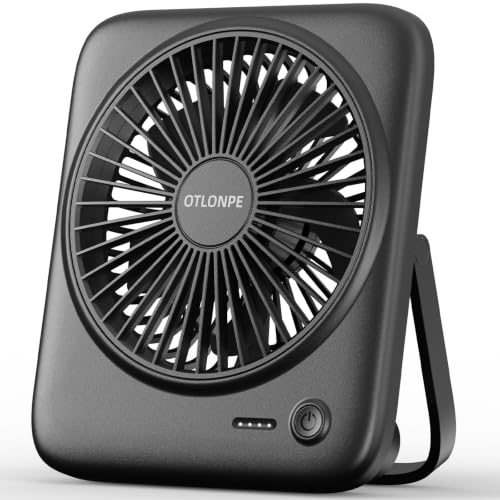
The fan measures approximately 6.6 by 5.6 by 1.5 inches and weighs about 9.3 ounces. Those proportions create a flatter profile than many round desktop fans with fixed bases. It should slip into a backpack, work bag, suitcase, or deep drawer without demanding much room. The balance is appealing because the 4000mAh battery provides more endurance than many tiny fans while keeping the overall package manageable.
A folding bracket helps the body pack more neatly and doubles as the support during use. Once opened, the bracket holds the fan upright on a desk, bedside table, shelf, or outdoor table. Folded against the housing, it reduces awkward protrusions that could snag on clothing or cables inside a bag. The foldable stand isn’t merely a storage trick; it also makes the fan easier to position in cramped spaces.
Portability still requires a little common sense. A slim body can be easier to pack, but the grille and folding mechanism shouldn’t sit underneath heavy luggage or rigid equipment. The fan is better treated like a small electronic device than a rugged campsite tool. Its lightweight construction supports frequent travel, though careful packing will likely help the frame and stand stay aligned.
Four Speeds For Different Kinds Of Heat
The four-speed system provides more adjustment than the usual low, medium, and high arrangement. Gentle airflow can suit reading, sleeping, or working at close range, while the stronger settings are available for warm rooms and outdoor breaks. Each step lets the user trade battery life for increased cooling without committing to an all-or-nothing setting. That broader speed range makes the fan easier to adapt as temperatures and surroundings change.
The fourth setting uses variable-frequency airflow intended to feel closer to natural wind. Rather than maintaining one rigid stream, it changes the breeze pattern to create a less mechanical sensation. Some people prefer that variation during long use because a constant blast can feel drying or tiring at close range. The variable wind mode gives the Otlonpe a distinct option beyond simply making the motor run faster.
No specific air-speed measurement is provided, so claims about distance or room coverage would be guesswork. Its 6.5-inch format suggests focused cooling around a desk, chair, bed, or small seating area rather than full-room circulation. Positioning it close enough to feel the breeze will matter more than expecting raw power from across the room. The four settings improve flexibility, but they don’t turn a compact fan into a large household appliance.
Quiet Enough For Shared And Restful Spaces
Otlonpe lists the maximum operating noise at less than 35dB. That figure suggests the fan is designed for environments where motor noise can become distracting, including meetings, study sessions, bedrooms, and shared offices. Stronger airflow will still produce more audible blade noise than the lowest setting. The useful point is that the stated upper noise limit remains relatively restrained for close-range operation.
Quiet performance matters more with a personal fan because the device usually sits within arm’s reach. A distant floor fan may blend into the room, while a sharp buzz beside a laptop can wear on concentration quickly. The F16’s slim body and subdued noise claim support placement near a keyboard, book, or pillow. Its low-noise design is therefore tied directly to comfort rather than serving as a decorative specification.
The surface beneath the fan may still influence what the user hears. Lightweight shelves and hollow tables can amplify vibration, while a solid desk tends to remain calmer. Keeping the stand fully opened and the fan clear of loose objects should reduce rattling. Even a quiet motor can sound rough if the grille touches a cable or paper, so stable placement remains part of the experience.
Runtime That Rewards Sensible Speed Choices
The stated cooling window spans 7.5 to 23 hours, giving the fan enough flexibility for several kinds of use. Low-speed operation should sit closer to the upper end, while stronger settings will shorten the available time. That range can cover a long desk session, an evening beside the bed, or portions of a weekend trip. It also reduces the need to carry a charger everywhere for brief outings.
Maximum airflow all day is where expectations need restraint. The 4000mAh battery is generous for a slim desk fan, but constant high-speed use will consume the charge far sooner than gentle cooling. Alternating between lower speeds indoors and stronger output during the hottest periods can stretch the battery more effectively. The adjustable power draw lets the user decide whether endurance or stronger airflow deserves priority.
USB operation removes that compromise when a power source is nearby. The fan can run continuously while plugged in, making battery capacity largely irrelevant during regular office or home use. Saved battery power then remains available for a commute, outdoor meal, outage, or hotel room with awkward outlet placement. This cordless backup approach is more practical than draining the battery every time the fan sits beside a wall socket.
Emergency Charging Adds A Useful Second Role
The built-in power-bank function allows the fan’s battery to provide emergency phone charging. That feature can help during travel, outages, or long days away from a dependable power source. It isn’t positioned as a replacement for a dedicated large-capacity power bank, and using it will reduce the energy left for cooling. Still, a modest charge can matter when a phone battery is nearly empty and communication takes priority over airflow.
Power sharing works best as a backup rather than a daily habit. A 4000mAh internal battery must serve the fan first, so frequent device charging would quickly undermine the long-runtime advantage. The tradeoff is straightforward: every bit of power sent to a phone is no longer available to spin the blades. The dual-purpose battery is valuable because it offers a choice during an inconvenient moment, not because it replaces separate charging gear.
This function may be especially useful in a travel bag where every device competes for cable space. Carrying one compact fan that can also provide emergency power reduces the number of single-purpose items needed for short trips. For longer journeys, a separate power bank still offers more predictable charging capacity. The Otlonpe’s backup charging role fits best as a safety net rather than the center of a mobile power setup.
Detachable Grille Makes Cleaning Less Awkward
Dust builds up quickly on small fan blades, particularly when the device spends hours on a desk or beside a bed. The Otlonpe uses a detachable fan frame, allowing better access to the blades and interior grille. That feature addresses a common weakness of compact fans whose sealed covers make routine cleaning frustrating. Easier access can help maintain airflow and prevent a visible layer of dust from becoming part of the furniture.
Cleaning should still be handled with the fan switched off and disconnected from power. A dry or lightly dampened cloth can address loose dust, while excess moisture around the motor and charging components should be avoided. The detachable frame simplifies access but doesn’t make the entire unit washable. Its serviceable front cover mainly removes the need to force cleaning tools through narrow grille openings.
Reassembly matters just as much as removal. The frame should sit securely before the fan is started again, since a loose cover may vibrate or interfere with the blades. Following the included instructions will be more reliable than twisting the grille aggressively. The cleaning design is convenient, though it still calls for ordinary care around moving and electrical parts.
Everyday Use At Work Home And On The Road
A small workstation is an obvious fit for the F16. Its slim footprint leaves more room for a keyboard, notebook, charging dock, and other daily clutter. Low or medium speed can provide direct cooling without sending loose papers flying across the desk. The quiet desktop format also suits video meetings and focused tasks better than a louder, oversized fan placed nearby.
Bedside use benefits from the long low-speed runtime and subdued noise rating. The folding bracket allows the airflow angle to be set toward the sleeping area, while battery power removes the need to stretch a cable across the floor. Variable-frequency wind may also feel less repetitive during extended nighttime use. The fan won’t lower the room temperature, but steady personal airflow can make a warm sleeping space feel less stagnant.
Travel is where the flat profile earns extra credit. The fan can move between a hotel room, cruise cabin, summer camp, office, or outdoor table without taking over the bag. For permanent overhead circulation, a related household reference appears in hidden ceiling fan lights, while the Otlonpe remains designed for movable close-range relief. Those two categories solve different airflow problems and shouldn’t be judged by the same standard.
Strengths That Solve Familiar Problems
The strongest part of the Otlonpe F16 is its balance of size and runtime. A 4000mAh battery in a body only 1.5 inches thick gives it more endurance than many miniature fans without drifting into heavy camping-fan territory. That balance suits daily carry, business travel, and rooms where storage is limited. It offers enough battery to feel useful while remaining easy to move.
Four speeds add meaningful control rather than simply inflating the feature list. The variable-frequency fourth mode gives users a different airflow pattern, while the lower settings preserve battery and reduce noise. Combined with USB operation, the fan can shift from efficient cordless cooling to continuous desk use. This adaptable airflow system handles changing routines better than a single-speed design.
The detachable frame and emergency charging function round out the practical strengths. One simplifies maintenance, while the other provides a small reserve of power during an inconvenient moment. Neither feature changes the basic cooling job, yet both make the fan easier to live with over time. The F16’s multifunctional design feels grounded in common problems rather than novelty.
Weaknesses And Fair Expectations
The power-bank feature is limited by the same 4000mAh battery that runs the fan. Charging a phone can leave noticeably less runtime, especially if the fan is operating at the same time. Anyone expecting repeated full phone charges will need a dedicated power bank instead. This function is best reserved for emergencies, not routine device management.
The fan’s compact size also limits its effective cooling area. It can provide a useful breeze around one person, but it won’t distribute air evenly across a large bedroom, office, or outdoor gathering. Higher speed may extend the felt airflow somewhat, though that comes with greater battery use and more audible blade noise. The personal cooling range is a defining boundary, not a hidden defect.
The supplied details don’t mention oscillation, a remote, a battery display, or precise charging time. Buyers who value those features may prefer a larger and more elaborate model, even if it weighs more. The Otlonpe instead emphasizes slim storage, long low-speed runtime, and straightforward controls. Its simpler feature set makes sense for portability, but it won’t satisfy every preference.

Best Quiet Ceiling Fan For Bedroom 2026 Ultimate Comfort Picks

Best Ceiling Fan For Master Bedroom 2026 With Ultimate Comfort

Best White Ceiling Fan With Light For Bedroom 2026 Top Picks

Best Quorum Medallion Ceiling Fan 2026 With Style & Breeze
Best Outdoor Fan For Pergola 2026 Comfort Boost

Best Ceiling Fan For Great Room 2026 With Ultimate Comfort

Best Outdoor DC Ceiling Fans 2026 For Breezy Comfort
Best ceiling exhaust bath fan with light and heater 2026