Best Rechargeable Fan for Car 2026: Cooler Rides

A parked vehicle can turn stuffy fast, and the built-in air conditioning doesn’t help much unless the engine is running. A best rechargeable fan for car setup adds focused airflow without forcing the vehicle to idle or leaving a cable stretched across the console. That matters during lunch breaks, roadside stops, school pickup lines, camping trips, or any moment when trapped heat makes the cabin feel heavier than it should. The fan won’t replace air conditioning on a scorching afternoon, but it can keep air moving and make a noticeable difference in comfort.
Battery capacity deserves more attention than flashy speed claims. A larger battery usually supports longer sessions, though it can also add weight and increase charging time. Adjustable speed settings help balance airflow and runtime, since full power isn’t always necessary in a shaded parking spot or during mild weather. A clear battery indicator is useful too, because guessing how much charge remains gets old quickly.
Mounting design can make or break the experience. A sturdy clip works well on headrests, door pockets, grab handles, or seat edges, but a weak clamp may slide once the road gets bumpy. Suction mounts offer clean windshield or dashboard placement, yet hot glass and textured surfaces can reduce their grip. A stable base is simpler, though it takes up cup-holder, console, or dashboard space that may already be crowded.
Flexible airflow control matters more than raw fan size inside a compact cabin. A rotating head can aim air toward the driver, a child seat, a pet carrier, or the back row without moving the whole unit. Dual-head designs spread air across a wider area, but they’re bulkier and may create more noise at higher speeds. Smaller single-head fans are easier to store and position, although their cooling reach is usually narrower.
Noise is another practical tradeoff. Strong airflow often brings a noticeable hum, especially from compact motors working at maximum speed. That may be fine during highway driving, but it can become distracting during phone calls, naps, or quiet rest stops. A well-designed car cooling fan should provide a useful low setting for steady circulation and a stronger mode for the first few minutes after opening a hot vehicle.
Charging flexibility keeps the fan useful beyond the car. USB-C is generally more convenient than older charging ports because the same cable may already serve a phone, tablet, or power bank. Some models can run while charging, which helps during long drives, though constant high-speed use may charge the battery slowly or not at all. A removable battery can extend operating time, but only when replacement cells are easy to find and properly protected.
Safety shouldn’t be an afterthought. The grille should keep fingers, loose hair, charging cords, and small objects away from the blades. The mount must stay clear of airbags, steering controls, mirrors, and the driver’s field of view. Also, rechargeable devices shouldn’t be stored for long periods inside a closed car during extreme heat, since cabin temperatures can rise well beyond comfortable operating conditions.
The right rechargeable car fan is the one that fits the cabin rather than the one with the longest feature list. Compact cars benefit from a slim fan with a dependable clip, while larger vehicles may need oscillation or two adjustable heads. Battery life, mounting stability, noise, and charging convenience all matter in everyday use. Get those basics right, and the fan becomes a practical comfort tool instead of another gadget rolling around under the seat.

- LFR Score9.2
LFR Score is a ranking system developed by lightfansreviews.com. LFR Score has no relationship or impact from any manufacturers or sales agent websites. Learn more
- BrandGaiatop
- LFR Score9.2
LFR Score is a ranking system developed by lightfansreviews.com. LFR Score has no relationship or impact from any manufacturers or sales agent websites. Learn more
- BrandGaiatop

- LFR Score9.0
LFR Score is a ranking system developed by lightfansreviews.com. LFR Score has no relationship or impact from any manufacturers or sales agent websites. Learn more
- BrandKoonie

- LFR Score8.8
LFR Score is a ranking system developed by lightfansreviews.com. LFR Score has no relationship or impact from any manufacturers or sales agent websites. Learn more
- BrandGlovion

- LFR Score8.8
LFR Score is a ranking system developed by lightfansreviews.com. LFR Score has no relationship or impact from any manufacturers or sales agent websites. Learn more
- BrandFRIZCOL
- LFR Score8.6
LFR Score is a ranking system developed by lightfansreviews.com. LFR Score has no relationship or impact from any manufacturers or sales agent websites. Learn more
- BrandDealswin

- LFR Score8.4
LFR Score is a ranking system developed by lightfansreviews.com. LFR Score has no relationship or impact from any manufacturers or sales agent websites. Learn more
- BrandHayousui

- LFR Score8.2
LFR Score is a ranking system developed by lightfansreviews.com. LFR Score has no relationship or impact from any manufacturers or sales agent websites. Learn more
- BrandXOOL
- LFR Score8.0
LFR Score is a ranking system developed by lightfansreviews.com. LFR Score has no relationship or impact from any manufacturers or sales agent websites. Learn more
- BrandTrustnice
Last update on 2026-07-31 / Affiliate links / Images, Product Titles, and Product Highlights from Amazon Product Advertising API
Gaiatop Mini Portable Stroller Fan
A hot car can feel uncomfortable within minutes, especially when the dashboard vents don’t send enough air toward a rear-facing seat or the back row. The best rechargeable fan for car should solve that airflow gap without taking over the cabin, tangling cords around the console, or creating a noisy distraction. Gaiatop’s compact fan approaches the problem with a flexible tripod, rechargeable power, and a small fan head that can be aimed with more precision than most fixed dashboard models. It isn’t meant to replace the vehicle’s air conditioner, but it can help move cooled air toward spots the factory vents struggle to reach.
Gaiatop Mini Stroller Fan
The Gaiatop fan is built around a simple idea: make the mounting system adaptable enough for more than one location. Its three flexible legs can wrap around a headrest post, stroller bar, crib rail, treadmill handle, or similar support. That gives the tripod design an edge over a conventional clip in spaces where flat gripping surfaces are scarce. Still, getting a firm hold depends on wrapping the legs carefully rather than giving them a quick twist and hoping for the best.
The fan measures approximately 5.61 by 2.51 by 6.49 inches and weighs about 0.52 pounds, so it won’t dominate a small car interior. That compact body is easier to move between a car seat area, desk, stroller, or travel bag than a full-size vehicle fan. The tradeoff is fairly obvious: a smaller fan head creates a more focused breeze instead of filling an entire SUV cabin. For close-range circulation, though, focused airflow can be exactly what’s needed.
The removable fan head is a thoughtful detail rather than a flashy extra. It can be detached for charging without forcing the tripod legs to be unwrapped and repositioned every time the battery runs low. That saves a bit of hassle when the legs have already been adjusted around an awkward headrest or rail. Easy charging access sounds minor on paper, but repeated setup is often what turns a useful travel accessory into something left at home.
Flexible Mounting Inside The Car
Car interiors rarely offer the neat, level mounting surfaces shown in product photos. Headrests are curved, seat backs move, and a fan mounted too loosely may droop after a few bumps. The upgraded tripod uses a food-grade silicone shell and an optimized fixing method intended to improve durability and reduce slipping. Wrapped firmly around a stable support, it can direct air toward a seat without occupying a cup holder or cluttering the dashboard.
The broad adjustment range makes placement less fussy. Gaiatop lists 360-degree horizontal rotation and 210-degree vertical rotation, allowing the fan head to be angled after the base is secured. That’s useful because the safest mounting point isn’t always directly in line with the spot that needs airflow. A quick tilt or rotation can correct the direction without rebuilding the whole setup.
Placement still calls for common sense. The legs and fan head should remain clear of airbags, seat-belt hardware, door controls, and the driver’s view. Loose mounting near a child seat can also create an avoidable distraction if the fan shifts during travel. The compact mounting system offers plenty of freedom, but that flexibility works best when paired with a firm attachment point and a little patience during setup.
Battery Life And Everyday Charging
The built-in 2000 mAh rechargeable battery supports cordless use, which is the main reason this model makes sense in a vehicle. Gaiatop states an operating range of roughly 3.5 to 10 hours, depending on the selected speed. That spread is realistic for a three-speed fan because the highest setting demands considerably more power than a gentle low-speed breeze. Anyone planning a full day away from an outlet should expect runtime to vary with usage rather than treating the maximum figure as guaranteed.
USB operation adds another layer of flexibility. The fan can be powered from a suitable car USB port, wall adapter, computer, or portable power bank, and it can operate while charging. That helps during long drives when the battery is low but continued airflow is still useful. The downside is that running at a stronger speed while charging may not restore the battery as quickly as charging the fan while it’s switched off.
Three speed levels make the battery easier to manage. Low speed suits quiet circulation at close range, while higher settings can push air more assertively after the vehicle has been sitting in warm weather. Adjustable speed control also prevents the usual all-or-nothing problem found on simpler portable fans. There’s no reason to burn through the battery at maximum output when a softer setting already keeps the air from feeling stagnant.
Airflow, Noise, And Safety Details
Gaiatop uses a brushless motor and upgraded blade design to balance airflow with quieter operation. A small fan won’t be silent at full power, since moving more air inevitably creates some blade and motor noise. Even so, the low-noise design should be easier to live with during naps, phone calls, or quiet drives than a harsh, rattling motor. The lower settings are likely to be the better fit whenever steady circulation matters more than maximum wind.
The front cover uses gaps measuring about 5.5 millimeters, designed to help keep small fingers from reaching the blades. That feature is especially relevant when a portable fan sits near a stroller, crib, or car seat. It doesn’t remove the need for supervision or careful positioning, but the narrow grille spacing adds a sensible physical barrier. Hair, straps, cords, and loose fabric should still be kept away from both sides of the fan.
Strong airflow is relative to the fan’s size. At close range, the Gaiatop can provide targeted relief and help circulate conditioned air toward an area the vehicle vents barely reach. Across several rows of seats, its effect will naturally fade. The focused cooling approach makes more sense for one seat or a compact zone than for cooling an entire parked cabin.
Practical Strengths And Tradeoffs
The biggest strength is versatility without much bulk. A single unit can move from a rear headrest to a stroller, desktop, treadmill, tent, or bedside rail, and the removable head keeps charging fairly painless. Its multi-purpose tripod is more adaptable than a basic clamp, particularly around round bars and narrow supports. That versatility also means the legs need occasional reshaping, especially after being packed tightly in a bag.
Battery capacity is adequate for short drives, errands, workouts, or portions of a travel day, but it isn’t enormous. Frequent high-speed use may require midday charging or help from a power bank. The fan’s small proportions also limit how far the breeze travels, so expectations need to stay grounded. Portable size improves storage and placement, while naturally sacrificing the wider airflow of a larger vehicle fan.
Heat exposure is another consideration with any rechargeable device. Leaving the fan inside a sealed car for extended periods during very hot weather isn’t a wise storage habit, even if the unit is normally used there. Taking it along after parking may be mildly inconvenient, but it protects the battery and keeps the silicone legs from sitting in extreme cabin temperatures. Responsible storage matters just as much as charging habits for preserving a small battery-powered accessory.
How It Fits A Car Cooling Setup
This model earns its place through precise placement rather than brute force. It can sit closer to the area that needs airflow, run without keeping the engine on, and change angles without requiring a rigid dashboard mount. Those qualities address common frustrations around weak rear ventilation and cluttered charging cables. The best rechargeable fan for car isn’t necessarily the largest one; often, it’s the one that stays securely positioned and gets used consistently.
The Gaiatop is less convincing for anyone expecting whole-cabin cooling or long, uninterrupted operation at maximum speed. A larger dual-head fan may cover more space, while a model with a bigger battery may suit overnight camping better. Gaiatop’s advantage lies in being small, adjustable, and easy to relocate. That balance makes it more of a targeted comfort tool than a substitute for the vehicle’s climate system.
Ceiling-fan design follows a different set of airflow priorities, yet blade configuration remains an interesting point of reference in three-blade ceiling fans. Inside a car, the more immediate concerns are stable positioning, safe clearance, and a breeze directed toward the right spot. The Gaiatop handles those basics with a practical tripod, narrow safety grille, and multiple speed settings. Its limitations are easy to understand, and within those limits, the design feels purposeful rather than overloaded.
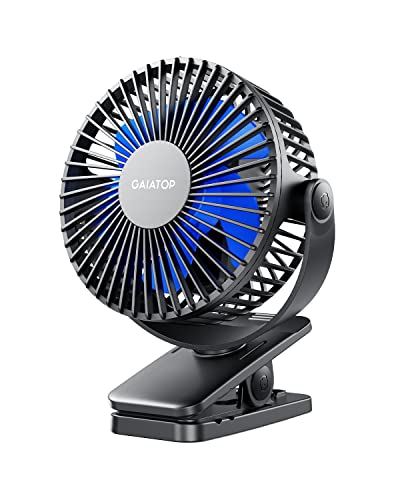
Gaiatop Portable Clip-On Fan
Rear-seat air can feel stubbornly still even while the dashboard vents are blasting away up front. That mismatch becomes more noticeable during school pickups, road-trip breaks, stroller transfers, or quiet time in a parked vehicle. The Gaiatop Portable Clip-On Fan takes a focused approach to the best rechargeable fan for car problem, using a compact head, a padded clamp, and cordless power to place airflow where the vehicle’s ventilation falls short. It won’t cool the cabin like air conditioning, but it can keep chilled air circulating around one seat instead of letting it stall several feet away.
Gaiatop Mini Clip-On Fan
Gaiatop keeps this model fairly lean, measuring about 5.11 by 1.54 by 6.77 inches and weighing roughly 0.71 pounds. That footprint is small enough for a travel bag, glove compartment, desk corner, or stroller basket without eating up much room. Compact proportions also make the fan less awkward around headrests and seat edges. The tradeoff, plain and simple, is a narrower cooling zone than a larger dual-head vehicle fan can provide.
The built-in 2000 mAh battery supports cordless use at three fan speeds. According to the supplied specifications, expected runtime is approximately 2.5 hours on the strongest setting, 4.5 hours at the middle speed, and 9 hours on low. Those figures make the speed selector more than a comfort control because it also acts as a practical battery-management tool. A quick, forceful burst may help at the start of a warm drive, while low speed stretches circulation through a longer afternoon.
USB power adds flexibility once the battery starts running low. The fan can operate while charging, so a suitable vehicle USB port or portable power bank can keep it moving during extended trips. Use-while-charging support is especially useful because a car fan that must stop completely for charging tends to become dead weight at the least convenient moment. Charging while the unit is turned off may still restore power faster than running it continuously at the highest speed.
Clamp Design And Car Placement
The clamp opens wide enough to grip objects up to 1 inch thick, giving it several possible mounting points around a vehicle. Depending on the cabin layout, that may include a headrest post, seat pocket edge, sturdy door pocket, console lip, or another solid surface outside the airbag zones. The clamp’s straightforward mechanism is easier to reposition than a flexible tripod with several legs to wrap and reshape. Even so, the mounting surface needs enough depth and rigidity to keep the fan steady over bumps.
A sponge pad lines the inside of the clip, reducing the chance of scratches on smooth furniture, stroller frames, or vehicle trim. That’s a welcome detail because bare plastic jaws can leave marks or slide on polished surfaces. The padded clamp also creates a little extra friction, which may help the fan hold its angle after adjustment. Soft padding can’t compensate for a shallow grip, though, so the clip should sit fully on the chosen support rather than hanging from its outer edge.
Clip placement deserves a careful look before the car starts moving. The fan should remain clear of side-curtain airbags, seat belts, mirrors, door handles, and the driver’s line of sight. It also shouldn’t be attached where a passenger’s knee, shoulder, or bag can knock it loose. Secure positioning matters more than squeezing the fan into the closest available spot, particularly near a child seat.
A conventional clip has one practical advantage over a freestanding base: it doesn’t steal a cup holder or slide across the dashboard during a turn. On the other hand, not every interior has a suitable one-inch edge facing the right direction. Some rounded headrests and thick padded surfaces may be awkward for the clamp. That limitation isn’t a design failure, but it does mean the cabin should be checked for a realistic mounting point before relying on the fan for daily use.
Rotation And Focused Airflow
Both horizontal and vertical adjustment extend through 360 degrees, so the fan head can be redirected after the clamp is secured. This broad rotation range helps solve a common annoyance with fixed car fans: the safest mounting location may sit above, below, or beside the area needing air. A swivel can bridge that gap without forcing the whole clamp into an unstable angle. Small adjustments also make it easier to keep air off the face while still circulating it around a seat.
The three-speed setup gives the fan distinct working modes rather than a single blast of air. Low speed can maintain a soft breeze during a nap or quiet drive, while the middle setting offers a balance between runtime and airflow. High speed is better suited to short periods when the cabin feels stuffy or cooled air needs a stronger push toward the back. Three-level airflow makes the fan more adaptable, although maximum speed will naturally bring more sound and shorter battery life.
Gaiatop describes the fan as using a brushless motor with blades and a cover shaped around aerodynamic principles. That combination is intended to deliver stronger airflow without turning the unit into a buzzing nuisance. No compact fan is completely silent, particularly at full output, but a smoother motor can make the sound less harsh during close-range use. At lower speeds, the noise should be easier to blend into road hum, office chatter, or outdoor background sound.
Air movement needs realistic expectations. This fan is built to cool a small personal area, not lower the temperature of an entire parked car. Its strongest role is circulating air toward a rear seat, stroller, desk chair, or sleeping area where a fixed vent can’t aim effectively. The focused breeze is a strength at close range and a limitation across a large SUV cabin.
Battery Performance In Daily Use
The listed runtime figures reveal a clear tradeoff between power and endurance. Roughly 2.5 hours on high may cover several errands or part of a road trip, but it won’t carry a full day without charging. The estimated nine-hour low-speed runtime is far more suitable for steady background circulation. Actual use can vary with battery condition, charging habits, surrounding temperature, and whether the fan runs while connected to power.
A 2000 mAh battery keeps the housing compact, though it’s smaller than the packs found in bulkier camping fans. That decision makes sense for portability but leaves less reserve for repeated high-speed sessions. Carrying a power bank can extend practical use away from the car, especially at a campsite, beach shelter, or outdoor table. Moderate battery capacity fits short-to-medium sessions better than uninterrupted overnight cooling.
Hot-car storage is worth treating seriously with any rechargeable device. A sealed vehicle can expose batteries and plastic parts to severe heat, even when the fan itself isn’t running. Removing the unit after parking for long periods may be inconvenient, but it can help protect the battery and preserve the clamp padding. Cool, dry storage is the smarter routine than leaving the fan on a sun-baked dashboard between trips.
Safety Grille And Close-Range Use
The grille openings measure about 5.5 millimeters, creating a narrow barrier intended to keep small fingers from reaching the blades. That feature suits the fan’s stroller and car-seat positioning, where curious hands may be nearby. The cover adds a meaningful layer of protection, but it doesn’t make careless placement safe. Hair, ribbons, straps, cords, and loose fabric still need enough distance from both the front and rear openings.
Quiet airflow can also matter around a sleeping child, a shared office, or a campsite after dark. The motor and blade design aim to reduce mechanical noise while maintaining useful wind. At close range, low or middle speed may provide enough circulation without the sharper sound produced by full power. Noise control is therefore tied closely to placement because a fan mounted inches from the ear will sound more prominent than one positioned farther away.
The compact housing reduces obstruction, yet the fan head still needs room to rotate without striking a seat, window, or passenger. A tight mounting point can cancel out the benefit of full rotation if the body bumps into nearby trim. Leaving a small clearance zone lets the adjustment mechanism do its job. That little bit of setup discipline improves both airflow direction and mounting stability.
Strengths That Matter On The Road
The clearest advantage is the blend of portability and targeted placement. At 0.71 pounds, the fan is light enough to move between a car, stroller, desk, and campsite without feeling like specialized equipment. Its padded one-inch clamp gives it a simpler mounting method than suction cups that may loosen on hot glass. A compact size also makes storage less of a headache once cooler weather arrives.
Full rotation is another useful strength because vehicle interiors rarely provide a straight path between a stable mounting point and the desired cooling area. The head can turn in either direction and tilt through a complete circle, reducing the need to reclip the base repeatedly. That saves time and prevents wear on delicate trim. Flexible aiming may prove more valuable in daily use than an extra speed setting or decorative feature.
The fan also works beyond the vehicle, which keeps it from becoming a one-season accessory. It can attach to a desk edge during work, a stroller bar during a walk, or suitable camping equipment during warm evenings. This broader usefulness helps justify keeping the battery charged instead of forgetting the unit in the trunk. Multi-location use is practical, though the clip still needs an edge thin enough to accept its one-inch capacity.
Weaknesses And Sensible Expectations
The battery is useful rather than enormous. High-speed runtime of about 2.5 hours may feel short during all-day outings, particularly when no charging source is nearby. Running the fan at medium or low speed extends the session, but the breeze becomes gentler. That compromise is normal for a small rechargeable fan, yet it should be weighed honestly against the length of the intended trip.
The clamp is sturdy by design, but it isn’t universal. Thick padded rails, broad dashboard panels, and rounded surfaces may sit outside its practical grip. A flexible tripod can wrap around some shapes that a clamp can’t hold, while a clamp is usually quicker to attach to a clean, flat edge. The one-inch opening limit is therefore both a clear specification and the main compatibility checkpoint.
Whole-cabin cooling also lies beyond this model’s reach. The small fan head can push a concentrated stream of air, yet it won’t replace rear climate vents or a larger circulation system. Drivers expecting the entire back row to feel evenly cooled may need a wider dual-fan setup. The Gaiatop makes more sense where personal airflow matters more than broad coverage.
How The Gaiatop Fits The Keyword
A strong candidate for the best rechargeable fan for car needs more than a battery and spinning blades. It should mount without blocking controls, direct air precisely, run quietly enough for close seating, and remain easy to move. Gaiatop checks those practical boxes with a padded clip, complete two-axis rotation, and three speed levels. The design feels focused on solving a local airflow problem rather than pretending to replace the car’s cooling system.
The model is best understood as a compact circulation tool for one nearby area. Its battery figures are clearly separated by speed, its grille gaps address close-range safety concerns, and its dimensions support travel-friendly storage. Those details make the product easier to evaluate without vague promises. Clear operating limits are a plus because they help set expectations before the first hot drive.
Large indoor spaces require a very different airflow strategy, and that contrast becomes clearer through references such as industrial garage ceiling fans, where broad coverage and fixed installation matter more than portability. Inside a vehicle, compact mounting and precise direction carry far more weight. The Gaiatop’s clamp, battery, and rotating head suit that smaller scale well. Its strongest case rests on convenience, not oversized airflow claims.
Koonie 8-Inch Rechargeable Clip-On Fan
Weak rear vents can turn a comfortable front seat into a muggy back-row ride, and a tiny personal fan often runs out of steam before the day is half over. The Koonie model tackles that frustration with an 8-inch fan head, a substantial rechargeable battery, and a clamp designed for thicker mounting points. As a contender for the best rechargeable fan for car, it leans toward longer runtime and broader airflow rather than pocket-size portability. That makes it especially useful during extended drives, golf-cart trips, camping stops, or parked breaks where cords would only get in the way.
Koonie Portable Clip-On Fan
The most striking specification is the 10000mAh battery, which is considerably larger than the battery found in many compact clip fans. Koonie states that the fan can operate for up to 24 hours on a full charge, though actual runtime depends heavily on the selected setting. Lower speeds should stretch the battery much farther than maximum airflow. That’s the usual give-and-take, but the larger capacity provides more breathing room before a charging cable becomes necessary.
Koonie combines a clip fan and desk fan in one body, allowing it to stand on a flat surface or attach to a suitable edge. This two-in-one design matters during travel because a mounting point isn’t always available where airflow is needed. The base can sit on a picnic table, nightstand, workbench, or stable vehicle surface when clipping isn’t practical. Naturally, an 8-inch model takes up more room than a palm-size fan, so storage requires a little planning.
Three conventional speed settings are joined by an energy-saving mode, giving the fan four operating choices. The gentler setting can maintain air movement without draining the battery as quickly, while the stronger modes suit hot, stagnant conditions. That flexibility helps the fan serve different jobs across a single day. A soft breeze may be enough during a quiet drive, then a stronger burst can move cooled air toward the rear seats after the cabin heats up.
Battery Capacity And Charging
A large battery changes how a portable fan fits into everyday routines. Frequent charging gets old fast, especially during weekend travel or outdoor use, so the extended operating capacity is a practical advantage rather than a decorative specification. The listed maximum of 24 hours gives the fan the potential to cover several shorter sessions between charges. Running it continuously on high will cut that figure, of course, and expectations should stay tied to the chosen speed.
The fan supports 5V-2A charging and is listed as reaching a full charge in about six hours. That isn’t instant, but it’s reasonable for a 10000mAh battery and can fit into an overnight charging routine. A Type-C port keeps the setup more convenient than older proprietary connectors. Compatible power sources include laptops, phone adapters, USB chargers, and portable power banks, provided they deliver suitable power.
Charging flexibility is particularly useful inside a vehicle because the fan can move between cordless and powered use without a specialized adapter. A USB connection from the car can preserve battery power during long drives, while the internal battery keeps the fan running during rest stops or outdoor breaks. The cord-free option also reduces clutter around seat rails and cup holders. Still, cables should be routed away from pedals, seat controls, and walking paths whenever the fan is connected.
A battery this large adds weight and bulk compared with smaller personal fans. That’s the price paid for longer runtime, and there’s no getting around it. The Koonie model is better suited to deliberate placement than constant handheld use. Its endurance-first design makes sense where the fan will stay clipped or standing for hours rather than being carried from room to room every few minutes.
Clamp Strength And Placement
The clamp opens to approximately 3 inches, creating more mounting possibilities than the narrow clips used on miniature fans. It can attach to a desk edge, treadmill frame, nightstand, golf-cart support, camping table, or compatible vehicle surface. A wider opening is handy around thicker structures, although maximum clamp width doesn’t guarantee a secure grip on every shape. Rounded, slippery, or heavily padded surfaces may still need careful positioning.
Inside a car, the best attachment point is one that stays firm without interfering with safety equipment. Headrest supports, sturdy console edges, and certain seat structures may work, depending on their thickness and orientation. The sturdy clamp should never block an airbag, mirror, seat belt, window control, or the driver’s view. A strong grip is valuable, but safe placement carries more weight than convenience.
The fan also works as a desk unit, which helps when the cabin doesn’t offer a sensible place to clip it. A flat, stable base can be useful in a camper, tent, office, garage, or hotel room after the drive ends. This dual-purpose format keeps the fan relevant beyond warm-weather car trips. The main limitation is space because an 8-inch fan head needs more clearance than a compact stroller fan.
Road vibration can expose a weak mounting setup quickly. The clamp should sit fully on the support rather than catching only the outer edge, and the fan head needs enough clearance to rotate without hitting nearby trim. A quick shake test before driving can reveal whether the setup is likely to shift. The larger fan body produces more leverage on the clamp than a lightweight mini fan, so a solid attachment point is essential.
Airflow And Noise Balance
Three 8-inch blades give this model a broader airflow footprint than small fans designed for close facial cooling. The larger diameter can push air across more of a seat area, which is useful when factory vents don’t reach the back row effectively. Koonie describes the airflow as strong while keeping operating noise low. Without supplied sound measurements, the fairest reading is that the design aims to balance higher air movement with a less distracting motor tone.
Noise depends on distance and speed. A fan mounted near an ear will sound more noticeable than the same unit positioned several feet away, even if the motor itself runs smoothly. Low or energy-saving mode should suit work, sleep, and quiet conversation better than full power. The four-speed control lets the fan trade raw airflow for a calmer background sound when the situation calls for it.
Maximum speed has a clear role during the first few minutes after entering a warm vehicle. It can help move conditioned air toward a rear seat or reduce the heavy feeling caused by stagnant cabin air. Once the temperature becomes more manageable, dropping to a lower setting can preserve battery life and reduce noise. This staged approach uses the fan’s strong airflow without burning through its battery unnecessarily.
The Koonie still moves existing air rather than refrigerating it. That distinction matters because even a strong portable fan can’t make a sealed, sun-heated cabin genuinely cool on its own. Its job is circulation, not temperature reduction. Paired with open windows, shade, or the vehicle’s air conditioning, the wide airflow pattern becomes far more useful.
Rotation And Direction Control
The fan head rotates through 360 degrees vertically and horizontally, offering a broad range of adjustment after mounting. That flexibility can compensate for awkward clamp positions because the base doesn’t have to face directly toward the desired cooling zone. A fan attached beside a seat can still aim forward, upward, or across the cabin. Precise direction also prevents wasting airflow against a seat back or window.
Large adjustment ranges sound simple, yet they make a noticeable difference in cramped spaces. Vehicle interiors rarely provide a neat, square surface exactly opposite the passenger who needs air. The rotating head lets the clamp occupy the safer, sturdier location while the breeze travels elsewhere. This independent aiming ability is one of the product’s strongest practical features.
The wider fan head needs enough room to complete those movements. Mounting it tightly between a seat and door may restrict rotation, even though the joint itself can turn fully. A few inches of clearance help preserve the benefit of the flexible head. The 360-degree movement is most useful when surrounding trim, passengers, and loose items aren’t crowding the housing.
Everyday Strengths And Limitations
Long battery life is the clearest reason to consider the Koonie over a smaller clip fan. The 10000mAh capacity reduces charging anxiety during long drives, camping weekends, golf-cart rides, or outdoor work sessions. Four speed choices add control over that stored power instead of forcing the fan to run harder than necessary. For extended use, that combination is more practical than chasing the smallest possible footprint.
The 3-inch clamp and desk-ready base also give the fan a wider range of placement options. It can shift from a vehicle to a campsite, office, treadmill, or bedside table without extra hardware. That flexibility helps justify the larger body because the fan isn’t locked into one narrow role. The two-way mounting design is especially useful when travel plans involve both driving and stationary activities.
Bulk is the obvious compromise. An 8-inch fan won’t disappear into a glove compartment, and its larger battery adds weight compared with compact 2000mAh models. It may be excessive for a cramped compact car where only a gentle breeze is needed near one seat. The size-versus-runtime tradeoff favors endurance, so storage space and mounting clearance deserve a realistic check.
The charging time is another detail worth planning around. Six hours is manageable overnight, but a nearly empty battery won’t be restored during a short lunch stop. Keeping the fan topped up between trips avoids that problem, and Type-C compatibility makes routine charging less awkward. The fast-charging support is useful within the limits of the battery’s substantial capacity.
How It Serves Car Cooling Needs
The Koonie’s larger blade span gives it a different personality from tiny stroller-style fans. Rather than producing a narrow stream inches from the grille, it aims for broader circulation across a nearby area. That makes it a plausible best rechargeable fan for car candidate where rear-seat airflow, battery endurance, and mounting strength matter more than compact storage. It’s still a personal fan, but one with more reach and staying power.
Golf carts, camper vans, work vehicles, and larger cabins may benefit most from its blend of clamp width and airflow. A miniature fan can be easier to tuck away, yet it may struggle to move enough air across an open or spacious area. The Koonie takes the opposite route with a larger cooling surface and a battery built for longer sessions. That choice won’t suit every cabin, but the design priorities are easy to understand.
Indoor fixtures handle air movement on a much broader scale, and the contrast is visible in references such as fandelier ceiling fans, where permanent installation and room-wide circulation shape the design. The Koonie focuses instead on movable airflow, flexible charging, and localized placement. Its clamp and rotating head allow the breeze to follow the activity rather than staying fixed in one room. That portability is the real difference, even more than the number of speed settings.
Safety and storage still require sensible habits. Rechargeable devices shouldn’t remain on a sun-baked dashboard for extended periods, and the fan must stay clear of airbags, controls, loose fabric, and the driver’s sightline. The larger head also needs a particularly stable grip before the vehicle starts moving. Used within those boundaries, the Koonie Portable Clip-On Fan offers a practical balance of long runtime, adjustable airflow, and flexible mounting without pretending to replace the car’s climate system.
Glovion Clip-On USB Mini Desk Fan
Still air inside a parked car gets uncomfortable fast, and a bulky fan can create almost as much trouble as the heat itself. Glovion takes a smaller, more adaptable route with a clip-on base, bendable neck, rechargeable power, and an emergency USB output. Those features place the Glovion Clip-On USB Mini Desk Fan in the conversation around the best rechargeable fan for car, especially where tight space and directional airflow matter. It won’t replace air conditioning, but it can push air toward a seat, sleeping area, or work surface that fixed vents barely reach.
Glovion Flexible Neck Clip Fan
The Glovion combines a clip fan and desk fan in one compact body, so it isn’t tied to a single mounting method. The base can grip a suitable edge or rest on a stable, flat surface when clipping isn’t practical. That flexibility matters inside cars, dorm rooms, offices, tents, and small kitchens where the available setup changes from one hour to the next. A two-way base also keeps the fan useful after the drive ends instead of leaving it as a one-purpose accessory.
Its rechargeable internal battery supports cordless operation, cutting down on cables around cup holders, seat rails, and center consoles. Glovion also provides a USB-C charging port, which can connect to common 5V USB power sources such as a car charger, wall adapter, computer port, or power bank. The battery isn’t replaceable, so long-term care depends on sensible charging and storage habits. That sealed design is convenient day to day, but it removes the option of swapping in a fresh cell once the original battery eventually loses capacity.
Three speed settings give the fan enough range for quiet circulation, everyday cooling, or a stronger burst of air. The lower setting makes sense during sleep, phone calls, or long periods of close-range use, while the highest setting suits warm, stagnant conditions. Adjustable airflow also helps conserve battery because full power isn’t necessary every time the fan is switched on. That simple choice between comfort and endurance makes the fan easier to live with across a full day.
Flexible Neck And Airflow Direction
The defining feature is a 360-degree flexible gooseneck that bends toward the area needing air. Instead of rotating only at a small hinge, the neck can be shaped around awkward angles and repositioned without moving the base. That’s handy in a car because the safest attachment point may sit above, beside, or behind the desired cooling zone. A carefully bent neck can direct the breeze around a headrest, toward a passenger, or across a console without forcing the clip into a shaky position.
Flexible necks bring more freedom than rigid pivots, though they also need thoughtful handling. Repeatedly folding the arm into sharp bends may place unnecessary stress on the internal structure over time. A broad curve is usually more sensible than twisting the neck tightly at one point. The bendable arm works best as an adjustable support, not something to knot or coil aggressively.
Directional control can make a modest fan feel more effective because less airflow is wasted against a window, dashboard, or seat back. The Glovion can sit closer to the problem area and aim its breeze where the vehicle’s built-in vents fall short. This focused approach is particularly useful for one seat or a compact personal zone. The localized airflow becomes less noticeable across an entire SUV cabin, so expectations should remain grounded.
The neck also improves desk and bedside use. A rigid fan often requires books, boxes, or awkward base placement to achieve the right angle, while this model can bend upward or sideways from the same spot. That makes the Glovion more adaptable on crowded tables and narrow shelves. Still, the base needs a stable foothold because an extended neck can create leverage that makes poor placement easier to tip or shift.
Clip And Desktop Setup
The integrated clip gives the fan a way to stay off crowded surfaces. It can attach to a suitable desk edge, headboard, shelf, tent support, or compatible section of a vehicle interior. The clip-on mounting is especially practical where a cup holder is already occupied and dashboard space is limited. A firm grip matters, though, because vehicle movement can expose a weak attachment faster than stationary desk use.
Car placement requires more judgment than simply clipping the fan to the nearest edge. The unit should remain clear of airbags, seat-belt hardware, window controls, mirrors, and the driver’s line of sight. It also needs enough room for the neck and fan head to move without bumping a passenger or nearby trim. Safe positioning takes priority over getting the fan a few inches closer.
The desk configuration is useful whenever there’s no reliable clipping point. Resting the base on a stable surface turns the product into a small personal fan for an office, dorm, bedside table, or camping setup. This two-in-one structure reduces the need to carry a separate stand or mounting accessory. The catch is that a lightweight base can be more sensitive to knocks when the neck is extended far forward.
Clamping onto rounded, soft, or slick surfaces may not feel as secure as gripping a flat, rigid edge. The product information doesn’t provide an exact maximum clip opening, so compatibility shouldn’t be assumed for thick rails or heavily padded supports. A quick stability check before use can prevent the fan from shifting unexpectedly. That’s especially important in a moving vehicle, where a loose accessory can become a distraction.
Noise And Five-Blade Performance
Glovion uses a five-blade fan design intended to produce useful airflow from a small housing. More blades can help create a smoother stream of air, though motor design, blade pitch, and fan speed also affect the result. The listed operating sound is under 40 dB, according to the supplied product details. That figure suggests an emphasis on close-range comfort where harsh motor noise would quickly become annoying.
Quiet performance matters during naps, remote work, studying, or overnight camping. A fan positioned near the face can sound louder than the same unit placed several feet away, so mounting distance still plays a role. Low speed should be the calmer choice for steady background circulation. The stronger settings may create more audible blade noise, which is normal as airflow increases.
Three speeds let the fan shift between different routines without becoming complicated. A soft setting can keep air from feeling stale, the middle speed can handle ordinary warm conditions, and high speed can provide a brief cooling push. That range suits a personal fan better than a single fixed output. The speed control also helps balance noise, battery use, and comfort instead of treating every situation the same.
The fan moves air rather than lowering its temperature, a distinction worth keeping in mind during hot weather. Inside a sun-heated car, circulating very warm air won’t create the effect of refrigerated cooling. The Glovion becomes more useful when paired with shade, open windows, or the vehicle’s climate system. Its role is to direct and circulate air, not cool an entire sealed cabin by itself.
Rechargeable Power And USB-C Charging
USB-C charging makes the fan easier to power from equipment already carried during travel. A compatible phone adapter, car charger, laptop, computer port, or power bank can recharge the built-in battery through a standard 5V output. The universal charging approach reduces dependence on a rare proprietary cable. It also makes the fan easier to move between a car, office, hotel room, and campsite.
The supplied details don’t state the battery capacity or exact runtime, so endurance can’t be judged by a precise hour figure. Speed selection, battery age, surrounding temperature, and use of the USB output can all influence how long the fan operates. That missing specification is a genuine information limitation, particularly for long camping trips or all-day travel. Keeping a charging source nearby would be the sensible approach until its real-world routine is understood.
The internal battery can’t be replaced, which simplifies the housing but creates a long-term tradeoff. Rechargeable cells naturally lose capacity through repeated cycles and exposure to heat. Leaving the fan inside a closed car for extended periods may speed that wear because cabin temperatures can climb sharply in direct sun. Cool storage and moderate charging habits are likely to matter more here than they would with a model using removable batteries.
Cordless operation remains a practical benefit despite that drawback. The fan can be positioned away from the vehicle’s USB port without stretching a wire across passengers or controls. That freedom is valuable around the back seat, camping gear, or temporary work areas. A cable can still be connected when convenient, but it doesn’t dictate where the fan must sit every time it runs.
Emergency Power Bank Function
A USB output allows the Glovion to serve as an emergency power bank for another small device. This feature can be useful when a phone needs enough power for a call, message, map, or boarding pass and no regular battery pack is available. It adds practical backup value without requiring a second gadget in the bag. Still, the fan’s battery capacity isn’t provided, so expectations for phone charging should remain modest.
Power shared with another device is power no longer available for the fan motor. Charging a phone while running the fan may shorten cooling time, particularly at higher speeds. That creates a straightforward choice between maintaining airflow and preserving communication power. The dual-purpose battery is best viewed as an emergency resource rather than a replacement for a dedicated high-capacity power bank.
The USB output broadens the fan’s role during camping, beach trips, dorm living, or travel delays. A small boost to a device can matter when outlets are scarce and the main charger is buried in luggage. This added function doesn’t improve airflow, but it can make the fan more useful in the bag. The tradeoff is that battery status deserves closer attention so the emergency feature doesn’t leave the fan empty when cooling is still needed.
Practical Strengths In A Car
The Glovion’s strongest quality is placement flexibility. A clip, stable base, and bendable neck provide several ways to aim air without occupying a fixed dashboard position. That setup can help route conditioned air toward the rear or provide a close breeze during a parked break. Compact personal cooling often depends more on direction than raw fan size, and this model clearly favors direction.
USB-C support is another sensible strength because modern travel setups often include several compatible charging sources. The fan can move from a car charger to a laptop or power bank without requiring unusual equipment. Its cordless operation also keeps the cabin tidier while the battery has charge. Fewer loose wires mean less clutter around seats, consoles, and bags.
The quiet five-blade design suits close placement better than a harsh, rattling motor would. A personal fan may sit near a sleeping area, desk chair, or passenger’s head for hours, so sound quality matters. The listed sub-40 dB operation supports the product’s focus on low-disruption airflow. Actual perceived noise will still rise with speed and decrease with distance.
Multi-purpose use keeps the fan relevant outside the car. It can move to a desk, dorm room, kitchen counter, campsite, beach shelter, or headboard once the trip is over. This portable versatility makes storage space easier to justify because the product doesn’t spend most of the year waiting in a trunk. Its usefulness depends on accepting personal airflow rather than expecting room-wide cooling.
Weaknesses And Realistic Tradeoffs
The lack of stated battery capacity and runtime is the most noticeable weakness in the provided information. Buyers planning long cordless sessions can’t easily estimate whether the fan will last through a workday, overnight camp, or extended road trip. The unknown endurance makes access to USB charging more important. A model with published runtime figures may be easier to plan around for demanding use.
The nonreplaceable battery creates another compromise. Once its capacity declines, the fan can’t simply accept a fresh battery and continue as before. Careful storage may slow that process, but it won’t remove normal battery aging. The sealed power system favors simplicity over long-term serviceability.
A flexible neck is useful, yet it may be less compact than a fan head that folds flat against its base. The arm also needs enough clearance to bend without rubbing against a window, seat, or dashboard. In cramped interiors, that can limit otherwise convenient mounting points. The gooseneck design rewards thoughtful setup rather than rushed placement.
The emergency power feature sounds appealing, but it shouldn’t overshadow the fan’s primary job. Without a listed battery capacity, there’s no basis for assuming it can substantially recharge a modern phone. A short emergency boost is a more realistic expectation. Using that output frequently may also reduce the fan’s available runtime at exactly the moment cooling is needed.
Where The Glovion Fits Best
The Glovion makes the most sense where space is tight, airflow needs to be aimed precisely, and charging sources are usually nearby. Its clip and flexible neck suit personal cooling around a car seat area, desk, dorm bed, tent, or compact kitchen workspace. The best rechargeable fan for car isn’t always the model with the biggest battery or widest blades. Sometimes the better fit is the fan that can reach an awkward spot without taking over the cabin.
Long, outlet-free trips expose the product’s biggest uncertainty because no runtime or battery-capacity figure is supplied. A larger fan with published endurance may suit multi-day camping or all-night use more confidently. Glovion instead emphasizes adaptability, quiet operation, and emergency power. That balance is more compelling for shorter sessions and mixed indoor-outdoor use.
Compact cooling products take many forms, and a related look at small-scale styling appears in cute desk fans, where footprint and everyday placement often matter as much as airflow. The Glovion follows a more functional route with its clip, gooseneck, and USB output. Its design is less about decorative appeal and more about reaching a specific angle. That practical focus suits cars and crowded workspaces where every inch counts.
Used carefully, the fan can fill the gap between fixed vents and personal comfort without adding much fuss. Safe mounting, moderate expectations, and protection from extreme vehicle heat will matter throughout its life. The Glovion Flexible Neck Clip Fan stands out for directional control and multi-function power rather than documented endurance. That distinction makes its strengths clear and its limitations fairly easy to live with.
FRIZCOL 3-in-1 Camping Fan Portable Rechargeable Fan
Hot afternoons inside a parked vehicle can turn even a short break into an uncomfortable wait. Limited airflow, rising cabin temperatures, and noisy portable fans often create more frustration than relief. That's where the best rechargeable fan for car category becomes especially valuable, and the FRIZCOL 3-in-1 Camping Fan approaches that challenge with an unusually flexible design that works well beyond camping trips. Instead of focusing on one situation, it blends long battery endurance, portable cooling, and practical convenience into a single package that adapts to changing environments.
FRIZCOL Camping Fan
Versatility stands out almost immediately. Although marketed as a camping fan, the overall design fits naturally inside SUVs, RVs, pickup trucks, family vehicles, workshops, and temporary outdoor setups. The detachable battery concept gives it a practical edge because the fan continues serving a purpose even when cooling isn't needed.
The removable battery pack doubles as an emergency power bank, which adds meaningful value during road trips or long drives. A drained phone can become a real inconvenience while traveling, so having a backup power source already attached to the fan eliminates the need to carry another separate accessory. That small design decision makes the product feel much more thoughtful than a standard rechargeable fan.
Build quality also leaves a reassuring impression. The ABS housing feels intended for transportation rather than permanent desk placement. Instead of appearing fragile, the body is designed to tolerate frequent packing, moving, and occasional bumps that naturally happen during travel.
Even the overall size strikes a sensible balance. A 9-inch fan provides noticeably more airflow than compact handheld models without becoming awkward to move from the vehicle to a campsite or picnic table.
Battery Capacity And Emergency Convenience
The feature most people notice first is undoubtedly the 24000mAh detachable battery. Rather than relying on a permanently sealed battery pack, FRIZCOL separates the power module from the fan body, making replacement and emergency use considerably more practical.
The advertised runtime of approximately 20 to 140 hours depends on operating speed and additional functions such as the LED light. Instead of promising unrealistic performance under every condition, the multiple speed settings naturally influence overall endurance. That's a much more believable approach than suggesting maximum airflow can last for several days continuously.
During vehicle travel, battery life matters because charging opportunities aren't always available. Long scenic routes, camping weekends, fishing trips, or outdoor sporting events often involve extended periods away from reliable power sources. Extended endurance reduces the need to constantly monitor remaining battery percentage.
A related reference discussing lighting combinations appears naturally in led ceiling fan with light, although it serves a different installation purpose than this portable cooling solution.
Airflow Performance And Noise Balance
Cooling ability means little if a fan becomes distracting after several hours. FRIZCOL attempts to balance air movement with quiet operation by combining a premium motor with relatively thin fan blades designed to improve efficiency.
The listed maximum rotational speed of 2950 RPM and airflow reaching approximately 3.8 m/s suggest respectable circulation for its size. Rather than creating an aggressive blast of air, this level of output appears intended to maintain continuous movement inside confined spaces such as tents or vehicle cabins.
Noise remains another practical consideration. Portable fans often become irritating overnight because motor vibration gradually dominates an otherwise quiet environment. FRIZCOL specifies operation below 30 dB, indicating an emphasis on maintaining comfort during sleeping hours or peaceful outdoor evenings.
Balanced airflow often proves more comfortable than maximum speed alone. Gentle circulation across the cabin helps reduce the stuffy feeling inside parked vehicles without producing excessive wind directly toward passengers.
Flexible Controls Improve Everyday Use
Several small features combine to improve day-to-day usability. None of them individually redefine the experience, but together they make the fan noticeably easier to live with over time.
The remote control deserves particular attention. Once the fan is mounted inside a larger vehicle, RV, or tent, reaching physical buttons isn't always convenient. Remote adjustment makes speed changes or timer activation much simpler without interrupting what you're doing.
Three timer settings also help conserve battery life. Instead of accidentally leaving the fan running throughout the night or after leaving the vehicle, users can allow it to shut itself off automatically. That practical feature extends usable runtime while requiring almost no effort.
The vertically adjustable head expands placement possibilities as well. Whether positioned on a dashboard, picnic table, camping shelf, or suspended overhead using the hidden hook, directing airflow precisely where it's needed becomes straightforward. Flexible positioning often matters just as much as raw airflow.
LED Lighting Adds Practical Value
Portable fans frequently include lights, yet their usefulness varies considerably depending on implementation. Here, the two-level LED lighting system complements the fan rather than distracting from it.
A softer brightness setting works well for reading, organizing camping equipment, or locating items inside a vehicle without overwhelming nearby occupants. The brighter option becomes more useful while preparing meals outdoors or setting up camp after sunset.
Instead of carrying separate lanterns for every short outdoor activity, integrating illumination into one device simplifies packing. Space-saving functionality becomes increasingly valuable when trunk space is already filled with travel gear.
The lighting feature also increases flexibility during roadside emergencies or unexpected power outages. Having both airflow and illumination available from one rechargeable unit creates a practical combination that extends beyond recreational use.
Stability And Durability
Portable equipment inevitably experiences rough handling. Bags shift inside vehicle cargo areas, camping gear gets stacked together, and equipment occasionally slips from tables. FRIZCOL acknowledges those realities by using a sturdy ABS housing with an anti-drop design philosophy.
Non-slip pads underneath the base improve stability on smooth vehicle consoles, folding tables, or workshop benches. While they won't prevent movement during aggressive driving, they help reduce unwanted vibration during normal stationary use.
The hidden hanging hook further increases installation options. Instead of occupying valuable tabletop space, the fan can suspend from tent ceilings or overhead supports, allowing air to circulate downward more naturally across sleeping areas.
Although durable construction improves reliability, it's still worth remembering that electronic products benefit from sensible handling. Heavy impacts or prolonged exposure to severe weather remain situations better avoided.
Practical Tradeoffs Worth Knowing
No portable fan satisfies every situation equally well, and recognizing the tradeoffs helps establish realistic expectations. A larger battery naturally adds weight compared with smaller travel fans. Some users prioritizing the lightest possible backpack setup may notice that difference during extended hikes.
The 9-inch size delivers stronger airflow than many compact alternatives, yet it also requires slightly more storage room inside luggage or vehicle compartments. That compromise generally favors people who value cooling performance over absolute portability.
The detachable battery introduces extra versatility, although it also means remembering to reinstall it securely after using it separately as a power bank. That's a minor consideration rather than a significant drawback, but it's part of everyday ownership.
Overall practicality remains the strongest aspect of this design. Rather than concentrating exclusively on airflow specifications, FRIZCOL combines battery flexibility, adjustable controls, quiet operation, lighting, and durable construction into a package that suits vehicle travel, camping, fishing, job sites, and countless situations where reliable portable cooling simply makes the day more comfortable.

Best Quiet Ceiling Fan For Bedroom 2026 Ultimate Comfort Picks

Best Ceiling Fan For Master Bedroom 2026 With Ultimate Comfort

Best White Ceiling Fan With Light For Bedroom 2026 Top Picks

Best Quorum Medallion Ceiling Fan 2026 With Style & Breeze
Best Outdoor Fan For Pergola 2026 Comfort Boost

Best Ceiling Fan For Great Room 2026 With Ultimate Comfort

Best Outdoor DC Ceiling Fans 2026 For Breezy Comfort
Best ceiling exhaust bath fan with light and heater 2026