
Best Small Desk Fan 2026, Tiny Cooling That Matters

A best small desk fan earns its spot by doing one quiet job well: moving air where a full-size fan feels clumsy. Small rooms, crowded desks, plant shelves, bedside tables, and hobby corners all have the same problem. Heat builds up fast, but space disappears even faster. A compact fan can make that little pocket of air feel less stale without turning the whole room into a wind tunnel.
Size matters, but not in the obvious way. A tiny fan that rattles, slides around, or blasts air in one narrow stream gets old pretty quickly. The better picks usually balance stable airflow, a firm base, simple controls, and a head that tilts enough to aim the breeze where it’s actually needed. That’s the difference between cooling your face and drying out your eyes all afternoon.
Noise is the dealbreaker more often than power. A fan can be strong on paper and still feel annoying beside a keyboard, laptop mic, or reading lamp. Quiet operation matters most during calls, late-night work, and plant care routines where constant background buzzing starts to grate. A soft hum is fine, but harsh motor noise makes even a good breeze feel like a bad trade.
Desk fans also need to fit real habits. Some people want USB power because wall outlets are already packed. Others need a clip-on design for a shelf, grow rack, dorm bed, or tiny counter. Battery-powered models can be handy, but they bring charging routines and shorter runtime into the picture. So, the smart move is matching the power style to the spot instead of chasing the smallest body possible.
For plant setups, airflow should feel gentle rather than aggressive. Herbs, seedlings, and small houseplants often benefit from mild circulation, especially in humid rooms or corners with weak ventilation. Still, a fan blowing too close can dry soil faster and stress tender leaves. A small adjustable fan works best when it can sit off to the side, moving air around the area instead of hammering one pot.
Build quality shows up in little ways. A heavier base keeps the fan from creeping across the desk. A removable grille makes dust cleanup less of a headache. Simple buttons beat fussy controls when hands are wet from watering plants or busy with cables. The best small desk fan should feel easy to live with, not like another gadget demanding attention.
Expect limits, though. A compact fan won’t cool a large room or replace an air conditioner during a brutal heat wave. It’s better as a personal comfort tool, a circulation helper, or a small-space air mover. That honest role is exactly why it works so well. Used in the right spot, a compact desk fan can make warm, cramped areas feel far more manageable.

- LFR Score9.2
LFR Score is a ranking system developed by lightfansreviews.com. LFR Score has no relationship or impact from any manufacturers or sales agent websites. Learn more
- BrandHoneywell
- LFR Score9.2
LFR Score is a ranking system developed by lightfansreviews.com. LFR Score has no relationship or impact from any manufacturers or sales agent websites. Learn more
- BrandGaiatop
- LFR Score9.2
LFR Score is a ranking system developed by lightfansreviews.com. LFR Score has no relationship or impact from any manufacturers or sales agent websites. Learn more
- BrandHoneywell
- LFR Score9.2
LFR Score is a ranking system developed by lightfansreviews.com. LFR Score has no relationship or impact from any manufacturers or sales agent websites. Learn more
- BrandSWEETFULL

- LFR Score9.2
LFR Score is a ranking system developed by lightfansreviews.com. LFR Score has no relationship or impact from any manufacturers or sales agent websites. Learn more
- BrandTriPole
- LFR Score9.2
LFR Score is a ranking system developed by lightfansreviews.com. LFR Score has no relationship or impact from any manufacturers or sales agent websites. Learn more
- BrandVornado
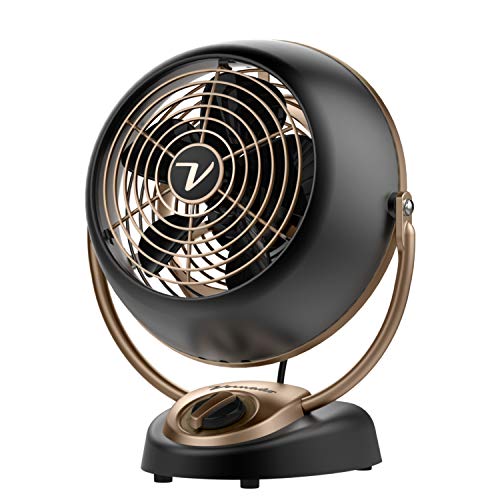
- LFR Score9.0
LFR Score is a ranking system developed by lightfansreviews.com. LFR Score has no relationship or impact from any manufacturers or sales agent websites. Learn more
- BrandVornado

- LFR Score8.8
LFR Score is a ranking system developed by lightfansreviews.com. LFR Score has no relationship or impact from any manufacturers or sales agent websites. Learn more
- BrandVornado

- LFR Score8.6
LFR Score is a ranking system developed by lightfansreviews.com. LFR Score has no relationship or impact from any manufacturers or sales agent websites. Learn more
- BrandHoneywell
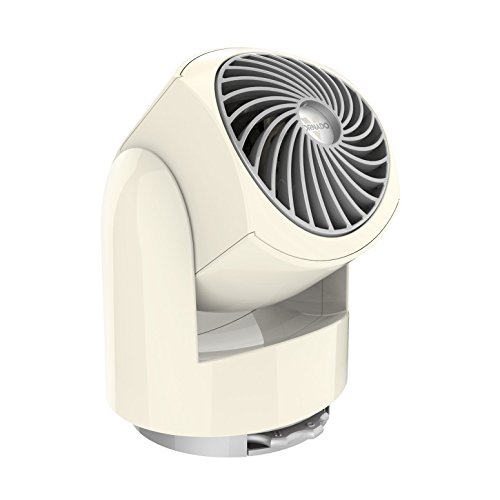
- LFR Score8.6
LFR Score is a ranking system developed by lightfansreviews.com. LFR Score has no relationship or impact from any manufacturers or sales agent websites. Learn more
- BrandVornado

- LFR Score8.6
LFR Score is a ranking system developed by lightfansreviews.com. LFR Score has no relationship or impact from any manufacturers or sales agent websites. Learn more
- BrandAntarctic Star

- LFR Score8.2
LFR Score is a ranking system developed by lightfansreviews.com. LFR Score has no relationship or impact from any manufacturers or sales agent websites. Learn more
- BrandVornado
Last update on 2026-06-30 / Affiliate links / Images, Product Titles, and Product Highlights from Amazon Product Advertising API
Honeywell TurboForce HT900 Desk Fan Review
A crowded desk can make even a small heat problem feel bigger than it is, especially with a warm laptop, a lamp, and barely enough elbow room. The best small desk fan needs to move air without acting like a bulky floor fan pretending to be compact. Honeywell TurboForce HT900 fits that lane with a small tabletop body, a black finish, and a head that pivots so the breeze doesn’t hit one awkward spot all day. It’s built for personal cooling, small-room airflow, and those sticky corners where still air hangs around too long.
Honeywell TurboForce HT900
The Honeywell TurboForce HT900 has a practical shape that makes sense on a desk, table, shelf, or even mounted on a wall. That flexibility matters because small rooms rarely offer the neat, open placement a bigger fan needs. A 90-degree pivoting head lets the airflow aim upward, straight ahead, or somewhere in between. For a small desk fan, that kind of adjustment is more useful than fancy controls.
The fan’s aerodynamic turbo design is meant to push air with more focus than a basic personal fan. Honeywell says the airflow can be felt from up to 25 feet away, which gives this little unit more reach than its size suggests. Still, placement matters. Set it too close and the breeze may feel stronger than expected, but angle it across a room and the air circulation feels more balanced.
Noise is one of the big reasons this model keeps showing up in small-space cooling conversations. The provided details say it is 25% quieter than comparable fans, which makes it easier to live with near a bed, office chair, or reading spot. Quiet doesn’t mean silent, of course. It still moves air with a motor and blades, but the goal is a steady sound that doesn’t bully the room.
Three speed settings keep the setup simple, and honestly, that’s a good thing. Low speed can soften a stuffy desk area, medium gives more everyday airflow, and high is there when the room feels stubbornly warm. No app, no complicated menu, no odd guessing game. The 3-speed control feels right for a fan that’s supposed to be grabbed, aimed, and used without fuss.
Airflow That Fits Real Desk Life
The HT900 works best where personal comfort and room circulation overlap. A small office, bedroom corner, dorm desk, craft table, or plant shelf area can all benefit from a compact fan that doesn’t hog the surface. The TurboForce airflow gives it a stronger personality than many tiny USB fans. That extra push helps when the air feels trapped instead of just warm.
For plant corners, the adjustable head can be surprisingly handy. Gentle airflow helps reduce stale, humid pockets around leaves and soil, especially on shelves where pots sit close together. The trick is not blasting tender foliage at close range. A side angle with indirect air movement usually makes more sense than pointing the fan straight at seedlings or thin leaves.
Desk comfort has its own little annoyances. A breeze aimed directly at your face can dry eyes, scatter papers, or make a microphone pick up more background sound. Pivoting the head upward or across the workspace gives the fan a better rhythm. That small adjustment turns focused cooling into something that feels less harsh and more natural.
The wall-mount option adds another layer of usefulness for tight spaces. A small fan sitting on a crowded desk still takes up room, even if it’s compact. Mounting it nearby can free up surface space while keeping airflow close. For renters or temporary setups, though, the mounting setup may require more planning than simply placing it on a table.
Quiet Cooling With Practical Limits
The quiet personal fan angle is one of the HT900’s strongest selling points, especially for bedrooms and workspaces. A fan that cools well but drones beside your ear gets annoying fast. This model leans toward strong airflow with a more manageable sound profile, based on the provided product details. That balance suits long sessions at a desk better than short bursts of loud cooling.
Still, expectations need to stay grounded. This is not an air conditioner, and it won’t lower the actual room temperature by itself. It helps your body feel cooler by moving air and can support air circulation when paired with AC. That makes the energy-saving support angle realistic, as long as you see it as a helper rather than a replacement.
The energy-savings pitch makes sense in the right home routine. A portable indoor fan can help spread cooled air around a small or medium-sized room, so the AC doesn’t have to feel like the only tool doing the work. During mild heat, the fan alone may be enough for a desk or bedside setup. During hotter spells, the air conditioner relief comes from using both more thoughtfully.
A limitation shows up if you want oscillation. The HT900 pivots, but it doesn’t sweep side to side like an oscillating fan. That means it’s better for directed airflow than sharing breeze across several seats. For one desk, one bed, or one plant shelf zone, directed airflow can actually be the better fit.
Build, Placement, And Everyday Use
The black tabletop design keeps the fan visually simple, which works well in offices and bedrooms where loud colors can feel out of place. Its small body makes it easy to place on a shelf, desk, nightstand, or floor. That said, a small fan still needs breathing room behind it. Give the air intake a bit of space, and the performance feels more consistent.
The 90-degree pivoting head gives the HT900 a useful advantage over flat, fixed personal fans. You can aim it at your upper body, toward the ceiling, or across a room to stir still air. That matters in rooms with uneven cooling, especially where one corner always feels warmer. The adjustable head makes the fan less picky about placement.
Cleaning should be part of the buying decision, even if it’s the boring part. Desk fans collect dust, pet hair, pollen, and little bits of everyday life. That buildup can affect airflow and make a fan look tired before its time. Keeping the grille and blades reasonably clean helps preserve steady airflow without pretending maintenance never exists.
For outdoor crowds, a separate cooling reference sits in portable fan for concert, where portability matters more than room circulation. The HT900 is better understood as a home or office air circulator rather than a pocket-friendly travel fan. It has a compact footprint, but its strength comes from placed airflow, not carry-anywhere convenience. That distinction keeps the best small desk fan label honest.
Strengths, Tradeoffs, And Best Use Cases
The biggest strength is the mix of small size and stronger airflow. Many personal fans feel cute but weak, especially once they sit more than a foot or two away. The HT900 has a more forceful design, so it can serve as both a desk fan and a small-room circulation tool. That gives it more range than a typical tiny personal fan.
The simple controls also help. Three speeds are enough for most situations, and the pivoting head handles the fine-tuning. No one wants to fight with controls during a hot afternoon or a groggy night. The easy adjustment makes the fan feel practical instead of overdesigned.
The tradeoff is that stronger airflow in a compact fan can feel too direct if it’s placed too close. Sensitive eyes, light papers, or delicate plants may need a softer angle. That doesn’t make the fan worse, but it does mean setup matters. A little distance turns the powerful breeze into smoother circulation.
The HT900 makes the most sense for small desks, bedrooms, home offices, plant areas, and medium-sized rooms that need better air movement. It may not satisfy someone who wants wide oscillation or whisper-level stillness at every speed. But for a compact fan with a focused breeze, adjustable direction, and simple daily use, the Honeywell TurboForce HT900 feels like a practical pick with real staying power.
Gaiatop USB Desk Fan Review
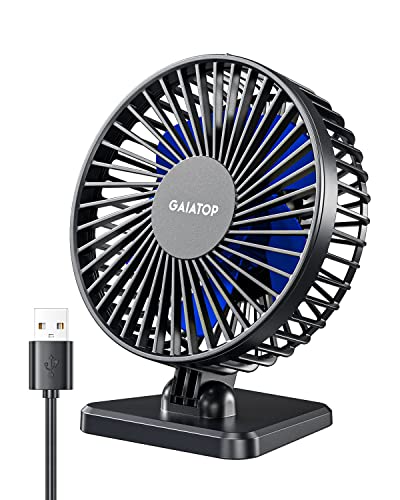
Desk heat has a sneaky way of showing up at the worst possible time, right as the laptop warms up, the window light shifts, or the room starts feeling a little stale. The best small desk fan doesn’t need to dominate the space to make a difference. Gaiatop USB Desk Fan leans into that idea with a compact body under 8 ounces, USB power, and three speeds packed into a little blue desktop fan. It’s the kind of fan that feels more like a daily comfort tool than another bulky appliance begging for room.
Gaiatop USB Desk Fan
The Gaiatop USB Desk Fan keeps things simple, and that’s honestly part of its charm. A small desk already has enough going on with cables, notebooks, plant cuttings, mugs, and maybe a charger hanging off the edge. This fan takes up little space, so it can sit near a monitor, on a narrow shelf, or beside a car console without turning the area into a clutter trap. For a compact personal fan, that tiny footprint is a real advantage.
Its classic design doesn’t try to look flashy or overly engineered. That matters more than it sounds, because small fans often end up visible all day. The blue finish adds a bit of personality without screaming for attention. The fan feels better suited for home office cooling, travel bags, and casual indoor setups than for someone wanting a large-room air mover.
Weight is another point worth noticing. At less than 8 ounces, this fan is easy to move from a desk to a nightstand, from a home office to a car, or from one plant shelf to another. Light gear can be a blessing during travel, but it also means placement deserves a little care. A lightweight fan should sit on a stable surface where cords won’t tug it around.
The fan’s biggest appeal is its easygoing portability. It doesn’t ask for a permanent corner, a complicated setup, or much storage space. Tossing it into a bag feels realistic, especially for warm commutes, shared rooms, or quick desk changes. That kind of portable cooling works best for personal comfort, not whole-room airflow.
Small Size With Everyday Airflow
The Gaiatop fan is described as small but powerful, which puts it in the sweet spot for personal cooling. It won’t replace a full-size fan, and it shouldn’t be judged like one. Instead, it aims to cool the immediate area around a desk, bed, car seat, or work surface. That makes the mini table fan useful when the air feels trapped close to you.
Three speed settings give it more flexibility than a single-speed mini fan. Low speed can take the edge off a stuffy desk while staying easy on the ears. Medium feels better for warmer rooms, and high gives stronger airflow when the heat starts getting stubborn. The three-speed control keeps the experience straightforward, with repeated button presses handling the adjustment.
The 0 to 30-degree vertical adjustment is useful, though it’s not huge. It gives enough angle control to aim the breeze toward your hands, face, upper body, or a nearby plant shelf. Still, anyone expecting a wide pivot range may want to keep that limit in mind. A 30-degree tilt is practical for small spaces, but it’s not the same as a fully adjustable circulator head.
Airflow direction matters in real life. A fan pointed straight at your face can dry your eyes, annoy your skin, or rustle every loose receipt on the desk. Tilting it slightly upward or across the surface can make the breeze feel softer. That little tweak helps the adjustable wind feel more comfortable during long work sessions.
Quiet Operation For Focused Rooms
Noise can make or break a small fan, especially when it sits inches from a keyboard or microphone. The provided details say this model stays under 50dB even while producing strong wind. That gives it a more office-friendly personality than louder compact fans that buzz like a tiny machine shop. A quiet desk fan feels easier to keep running through calls, reading, or late-night work.
Quiet doesn’t mean invisible, though. Any fan pushing air will make some sound, especially on higher speed. The better question is whether the noise fades into the room or keeps pulling attention back to itself. Based on the description, the Gaiatop aims for comfortable background sound rather than harsh rattling.
That quiet profile also helps in bedrooms and shared spaces. A loud fan can turn into a small argument waiting to happen, especially after midnight. This one is positioned as a calmer companion for rest and work, which fits its personal-size design. The low-noise operation makes the most sense on low or medium speed when steady comfort matters more than maximum blast.
For plant areas, sound matters less than airflow, but gentle operation still helps if the shelf sits in a living room or office. Mild circulation can reduce damp, still pockets around small pots, especially in humid corners. The fan should not sit too close to tender leaves, though. Indirect airflow is usually kinder to seedlings, herbs, and small houseplants.
USB Power And Placement Flexibility
USB power is a big part of this fan’s everyday usefulness. It can work with PCs, laptops, power banks, AC adapters, car chargers, and other USB-supported supplies. That makes it easier to use in places where a wall outlet is awkward or already packed. The USB-powered design fits modern desks full of devices and tangled charging routines.
Power flexibility also makes the fan easier to move. A power bank can help outdoors, in a parked setup, or during travel, while a laptop connection works fine at a desk. The catch is simple: the fan depends on an external power source. Unlike a rechargeable fan, this USB desk fan needs to stay plugged in while running.
Car use is another practical angle. A small USB fan can help with personal airflow in a vehicle, especially for passengers or parked moments where direct cooling feels uneven. It won’t replace the car’s climate system, of course. But as a personal portable fan, it can make warm seats and stale air feel less annoying.
Outdoor use deserves realistic expectations. Light wind, uneven surfaces, and power-bank placement can all affect the experience. A fan under 8 ounces is easy to carry, but that same light body may need a sheltered spot. The travel-friendly size is helpful, as long as the setup stays stable.
Strengths, Limits, And Best-Fit Situations
The strongest part of the Gaiatop fan is the mix of portability, simple controls, and quiet personal airflow. It’s small enough for cramped desks but still offers three speeds, which keeps it from feeling too basic. The under-8-ounce body makes moving it around almost effortless. For the best small desk fan category, that balance matters more than oversized power claims.
The main limitation is coverage. This fan is built for close-range comfort, not cooling a full living room or moving air across a medium-sized space. Anyone expecting deep room circulation may feel underwhelmed. But for a desk, nightstand, plant shelf, car, or travel setup, personal cooling is exactly the right lane.
The 30-degree vertical adjustment is useful but modest. It lets you fine-tune the breeze, yet it won’t offer the same range as a larger pivoting fan. That tradeoff makes sense for a mini desktop design. A smaller body brings space-saving comfort, but it also narrows the adjustment range.
The fan’s USB compatibility gives it a practical edge for busy routines. It pairs well with laptops, power banks, adapters, and car chargers, which keeps it from being tied to one room. Just remember, the cord is part of the setup, so cable placement matters. The Gaiatop USB Desk Fan feels most useful for people who need a small, quiet breeze that can move with them without making the desk feel crowded.
Honeywell HT-904 TurboForce Fan Review
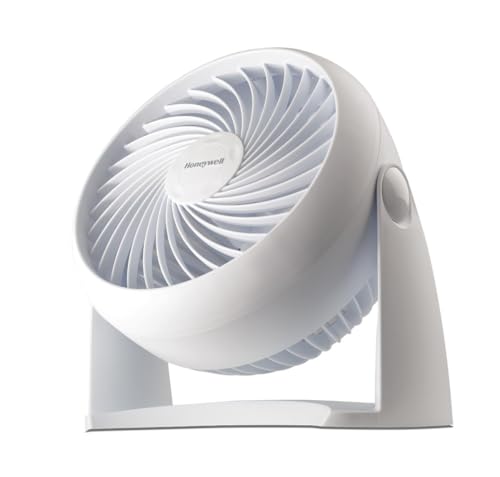
Warm corners don’t always need a giant fan stomping into the room and stealing every inch of floor space. Sometimes the smarter fix is a compact air mover that can sit on a desk, perch on a table, or mount to a wall without making the setup feel crowded. The best small desk fan should feel strong enough to matter, quiet enough to ignore, and flexible enough to aim where the air actually feels stuck. Honeywell HT-904 TurboForce Fan brings that mix with 3 speeds, a 90-degree pivoting head, and a small white body built for home, bedroom, or office airflow.
Honeywell HT-904 TurboForce Fan
The Honeywell HT-904 TurboForce Fan has the kind of compact shape that fits into real rooms, not just clean product photos. A desk with a monitor, charger, coffee mug, notebook, and maybe a small plant doesn’t leave much room for bulky cooling gear. This fan keeps its footprint modest while still aiming for small to medium-room circulation. That balance makes it feel more practical than a tiny decorative fan that barely moves air.
The white finish gives it a softer look than the usual black utility fan. That may sound minor, but color can matter when the fan sits on a nightstand, office shelf, or visible tabletop all day. It blends a bit better into lighter rooms and simple workspaces. The small tabletop design keeps the fan from feeling like an appliance takeover.
Its wall-mount option adds another useful wrinkle. Not every desk has open space, and not every bedroom corner has a spare table. Mounting the fan can lift airflow above clutter and free up the surface below. For cramped spaces, that wall-mounted flexibility can be more valuable than extra buttons or flashy extras.
The fan’s purpose is clear: move air with focus. It’s not pretending to be a tower fan, a ceiling fan, or a whole-house solution. It’s a personal air circulator that can help a warm desk, stuffy room, or sleepy bedroom corner feel less trapped. That honesty works in its favor.
Airflow That Feels Bigger Than The Body
The HT-904 uses Honeywell’s TurboForce aerodynamic design, which is meant to push air with more power than its size suggests. The provided details say the breeze can be felt from up to 25 feet away. That gives this small unit a reach that feels useful beyond arm’s length. For a small desk fan, reach matters because close-range airflow can get annoying fast.
A fan this size works best when it’s placed with intention. Set it across the room, angle it toward a warm pocket, or point it upward to stir air instead of blasting one person directly. That’s where the 90-degree pivoting head earns its keep. It lets the fan behave like a small circulation tool instead of a one-note face blower.
Three speed options also help keep the airflow from feeling too aggressive. Low speed can handle mild stuffiness while staying calmer near a bed or keyboard. Medium gives a steady everyday breeze, and high is there for those sticky afternoons when the room refuses to cooperate. The 3-speed control keeps the experience simple without feeling bare-bones.
There is a tradeoff, naturally. A directed fan can feel too focused if it sits too close or points straight at your eyes, papers, or delicate plant leaves. A little distance makes a big difference. The adjustable airflow feels best when it’s aimed across the space rather than straight into your face all day.
Quiet Cooling For Work And Rest
Noise can ruin a fan faster than weak airflow. The HT-904 is described as a quiet personal fan, which matters in bedrooms, offices, and shared spaces where every hum seems louder after an hour. A quiet operation profile helps the fan fade into the background while still moving air. That’s the sweet spot for long writing sessions, video calls, reading, or sleeping.
Quiet does not mean silent, and that distinction matters. Any fan with real airflow will make some sound, especially at higher speeds. The question is whether that sound feels steady and tolerable or sharp and irritating. This model aims for cooling comfort without the grating buzz that makes people shut a fan off before the room even cools down.
Bedroom use is where the small size and pivoting head make a nice pairing. The fan can sit on a nightstand, dresser, or floor and still aim the breeze where it’s needed. A direct blast may feel too much while sleeping, but angling the head upward can soften the airflow. That makes the personal fan design more adaptable than a fixed mini fan.
Office use has its own quirks. Papers move, microphones pick up noise, and dry eyes can turn a helpful breeze into a nuisance. A slight angle change can solve more than people expect. The pivoting fan head lets the airflow skim the workspace instead of turning the desk into a wind tunnel.
Energy-Saving Support Without Big Claims
The provided description frames this fan as a way to give the air conditioner a break. That idea makes sense when the fan is used to improve circulation in a room that already feels partly cooled. Moving air can help comfort feel more even, especially around desks, beds, and corners where cooled air doesn’t settle well. The energy-saving support is practical when expectations stay realistic.
This fan won’t lower room temperature by itself like an air conditioner. It helps people feel cooler by moving air across the skin and by reducing stagnant pockets. That difference is important because disappointment usually starts with the wrong job description. The air circulation role is where the HT-904 makes the most sense.
Small to medium-sized rooms are a better fit than large open areas. A compact fan can stir air effectively in tighter spaces, but it has limits in big rooms with high ceilings or heavy heat buildup. Placing it near a doorway, desk, or AC airflow path can make it more useful. The small-room cooling angle feels believable because the fan isn’t being asked to do impossible work.
Home maintenance topics sometimes overlap with fan ownership, especially when airflow issues involve ceiling fixtures instead of tabletop models. A related household reference sits naturally in fix light switch on ceiling fan for situations where the cooling problem comes from a ceiling fan control rather than a desk fan. The HT-904 stays in a different lane as a portable indoor fan. That separation keeps the product fit clear.
Placement, Plant Corners, And Practical Tradeoffs
Plant shelves and sunny window corners often get stuffy before the rest of the room does. Gentle airflow can help reduce damp, still air around leaves and soil, especially where pots sit close together. The HT-904 can help in those spaces if it’s not aimed too aggressively. Indirect airflow is the safer move for herbs, seedlings, and thin-leaf houseplants.
The fan’s stronger airflow may dry small pots faster if it sits too close. That’s not a flaw, just a setup detail worth respecting. Soil moisture can shift quickly when a fan runs for long stretches near shallow containers. A side angle gives better air movement without turning plant care into a watering guessing game.
Desk placement needs the same kind of common sense. The fan should have room behind it to pull air properly, and cords should stay out of the way. Since it can sit on a floor or tabletop, it’s flexible enough to move around until the airflow feels right. The portable indoor fan design makes that experimenting easy.
The main limitation is the lack of side-to-side oscillation in the provided details. The fan pivots vertically, but it doesn’t promise sweeping coverage across a room. For one desk, one bed, or one plant shelf zone, that’s usually fine. For multiple people spread around a room, a non-oscillating fan may feel too focused.
Strengths, Weak Spots, And Daily Use Notes
The strongest feature is the combination of compact size and serious airflow. Many small fans win on convenience but lose once the room gets truly warm. This model feels built to push more air while still fitting on a desk or table. That makes the Honeywell HT-904 TurboForce Fan a strong fit for personal cooling with a bit of room circulation added in.
The 90-degree pivoting head is another standout because it changes how the fan can be used. A flat mini fan has one basic angle, and that gets old quickly. This one can send air upward, forward, or somewhere between, which makes it more forgiving in odd room layouts. The adjustable head adds real usefulness without complicating the fan.
The weak spot depends on expectations. Anyone wanting broad oscillation, battery power, or whisper-level silence at every speed may want a different style of fan. The HT-904 is wired, directed, and built around focused airflow. That makes it practical, but not the right answer for every cooling setup.
For everyday use, the fan feels best in small rooms, home offices, bedrooms, and tight work areas where air needs a push. It’s also useful near plant shelves as long as the breeze stays indirect and the soil doesn’t dry too quickly. The best small desk fan should solve the warm-spot problem without creating new clutter, and this Honeywell model mostly stays on that sensible path. It’s compact, adjustable, and strong enough to feel like more than a desk accessory.
SWEETFULL 6.5 Inch USB Desk Fan Review
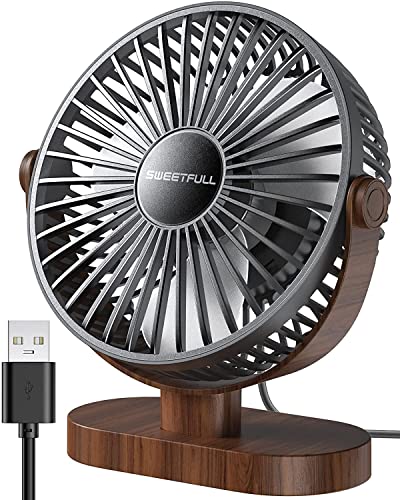
A tiny work surface can turn messy fast, especially once cables, notebooks, seed trays, a water glass, and a warm laptop all fight for the same few inches. The best small desk fan has to cool without barging into that already crowded little world. SWEETFULL 6.5 Inch USB Desk Fan takes a quieter, more polished route with a compact body, wood grain plastic base, and a 360-degree adjustable head that gives the breeze room to behave. It feels built for people who want personal airflow without the clunky look or harsh buzz that small fans sometimes bring along.
SWEETFULL USB Desk Fan
The SWEETFULL USB Desk Fan starts with a practical size: 6.5 x 2.5 x 7.4 inches and only 10 ounces. That makes it easy to move between a desk, bedside table, plant shelf, car setup, or camping table without feeling like another bulky appliance. The black wood grain base gives it a warmer look than the usual plain plastic mini fan. Small detail, sure, but desk-friendly design matters when something sits in plain sight every day.
The fan’s biggest personality trait is quiet operation. The provided details say it runs under 25 dB, which is notably calm for a small desktop fan. That softer sound profile helps during work, reading, sleep, or quiet plant-care routines where a buzzing fan can get old in a hurry. A quiet portable fan feels more useful when it can stay on without constantly reminding you it’s there.
Its 360-degree vertical adjustment gives this fan more aiming freedom than many compact models. Instead of settling for a narrow tilt range, the head can rotate vertically from 0 to 360 degrees. That means the breeze can point toward your hands, face, ceiling, plant shelf, or across the desk. The full-angle adjustment makes the fan easier to fit into odd little spaces.
The anti-slip rubber base also earns its place. Lightweight fans can sometimes creep, vibrate, or rattle against a hard desk, especially on higher speeds. This base helps reduce noise and vibration while keeping the fan steadier during daily use. For a small desktop fan, stability is not glamorous, but it’s absolutely noticeable.
Quiet Cooling Without Desk Drama
Noise is often the hidden dealbreaker with compact fans. A fan can look cute, move decent air, and still become annoying once it sits beside a keyboard for three hours. SWEETFULL’s under-25 dB operation gives it a calmer role in spaces where focus matters. The low-noise performance suits bedrooms, offices, reading corners, and late-night desk setups.
The fan still has three speeds, so it’s not locked into one gentle breeze. Low speed fits light airflow near a laptop or seedling tray, medium handles regular warm-room comfort, and high helps when the air feels stubborn. Pressing the power button repeatedly to change speeds keeps the control scheme simple. The 3-speed adjustment gives enough flexibility without making the fan fussy.
A quieter fan also makes more sense around indoor plants than many people expect. Plant shelves often need gentle air movement, especially where humidity lingers around leaves and soil. Loud circulation can make a living room or work area feel like a utility space, which gets old fast. The quiet airflow helps keep air moving without turning the corner into a noisy grow station.
Still, soft sound does not mean unlimited cooling power. This fan is compact, so its best role is personal airflow rather than full-room circulation. It can take the edge off a warm desk or help stir air near plants, but it won’t replace a larger air circulator in a hot room. That’s the honest tradeoff behind portable cooling.
360-Degree Adjustment In Real Use
The 360-degree vertical rotation is the feature that separates this fan from simpler mini models. A fixed-angle fan can feel awkward because the breeze hits wherever the body happens to point. This one gives more freedom to aim air above the desk, toward a chair, or across a shelf. The adjustable wind direction helps prevent that sharp, direct blast that dries eyes and scatters paper.
For desk work, that adjustability makes a big difference. Pointing the fan straight at your face can feel good for five minutes and irritating after an hour. Angling it upward or sideways creates a softer cooling effect that feels less pushy. The personal mini fan becomes easier to live with because the breeze can be shaped around the task.
Plant care brings its own quirks. Small herbs, seedlings, and leafy houseplants often like gentle circulation, but direct wind can dry soil too quickly or stress delicate growth. A 360-degree fan head helps aim airflow around the plants rather than straight into them. That makes indirect air movement easier to manage on narrow shelves or crowded windowsills.
Outdoor and camping use benefits from the same flexibility, though expectations should stay grounded. A lightweight USB fan can help at a picnic table, tent area, or parked car setup, but wind and uneven surfaces can change the experience. The anti-slip base helps, yet it still needs a steady spot. The portable desk fan is easy to bring along, but it’s happiest when placed thoughtfully.
USB Power And Everyday Convenience
The SWEETFULL fan runs through a 4.7-foot USB cable, which gives it a useful amount of reach on desks and bedside tables. It works with desktops, laptops, power banks, AC adapters, car chargers, and similar USB power sources. That broad compatibility makes it easier to use in places where a wall outlet isn’t close. The USB-powered design fits modern spaces filled with chargers and devices.
The no-battery setup is both a strength and a limitation. There’s no battery to age, charge, or forget before leaving the house. At the same time, the fan needs a connected power source whenever it runs. That makes corded USB operation reliable for desks and car chargers, but less carefree than a rechargeable fan during long outdoor use.
The 4.7-foot cable gives more placement flexibility than very short USB cords. You can move the fan around a monitor, across a small table, or closer to a plant shelf without immediately needing an extension. Cable management still matters, though, especially around watering cans, notebooks, and crowded work areas. A clean cord path keeps desktop cooling from becoming another tangle.
Household fan questions sometimes drift into ceiling fan territory, especially when the issue is fixture quality rather than small desk airflow. A separate reference for that kind of topic appears in fanimation ceiling fan quality, while this SWEETFULL model stays focused on compact USB cooling. The distinction matters because a desk fan solves a close-range comfort problem. It doesn’t do the same job as a ceiling fixture.
Cleaning, Maintenance, And Tradeoffs
The detachable front cover is a practical upgrade, not just a throwaway detail. Small fans collect dust quickly, especially near plant shelves, windows, pet areas, and busy desks. Being able to remove the front cover makes cleaning less annoying and helps preserve steady airflow. The easy-clean design matters more after a few weeks than it does on day one.
Dust buildup can affect both looks and performance. A fan covered in fine dust may push weaker airflow and make a clean desk feel neglected. Around plants, soil particles and leaf debris can add to the mess even faster. The detachable cover helps keep airflow maintenance simple enough that it might actually get done.
The stylish base is a nice touch, but it should not be confused with heavy-duty construction. At 10 ounces, the fan is made for portability and easy movement, not rough handling. That lighter build makes it pleasant to carry, but it also means placement should be stable. The lightweight body is a convenience with a little responsibility attached.
The best fit is a personal cooling setup where quietness, compact size, and flexible aiming matter most. It may feel too small for large rooms, shared spaces, or heavy heat buildup. It also won’t satisfy anyone who needs cordless operation, since no battery is included. For a best small desk fan candidate, though, the SWEETFULL model makes a convincing case through calm sound, smart adjustability, USB flexibility, and easy cleaning.
TriPole USB Desk Fan Review
Crowded desks have a way of making heat feel personal, especially once a laptop, charger, notebook, and coffee mug are all fighting for the same small patch of space. A best small desk fan has to cool the immediate area without acting like a clunky room fan. TriPole USB Desk Fan keeps the idea simple with a 4.5-inch diameter, USB power, three speeds, and a 360-degree rotating head. It’s built for close-range cooling, not big-room bragging, and that honest little role is where it makes the most sense.
TriPole USB Desk Fan
The TriPole USB Desk Fan lands in that practical middle ground between a tiny novelty fan and a larger air circulator. Its 4.5-inch diameter keeps it compact enough for a desktop, nightstand, office table, or travel setup. That smaller body helps when space is already tight and every inch counts. For a portable desk fan, the size feels easy to live with rather than awkward to arrange.
The design focuses on plug-in reliability instead of rechargeable convenience. It uses a 5V USB-A port, so it can connect to a USB charger, computer, power bank, or similar power source. That setup is handy for desks and travel because USB power is usually nearby. The tradeoff is clear: this USB powered fan must stay plugged in while running.
The 4.9-foot cable is a small detail that solves a real annoyance. Short cords can make a mini fan feel trapped beside a laptop port or wall adapter. This longer cable gives more room to place the fan where the breeze actually helps. A longer USB cable matters on messy desks, bedside tables, and temporary travel setups.
The wide base helps keep the fan steady, which is easy to overlook until a lighter fan tips or slides around. Four silicone pads on the bottom reduce vibration and help cut down noise during use. That makes the fan feel more settled on a hard desktop or nightstand. For a small personal fan, stability can be just as important as airflow.
Airflow Control For Small Spaces
Three wind modes give this fan more flexibility than a single-speed mini model. Low speed can handle mild stuffiness during work, medium suits warmer desk sessions, and high gives a stronger breeze when the room starts feeling stubborn. The button on the back controls the fan, keeping operation simple and direct. A 3-speed setting is enough for most personal cooling needs without adding clutter.
The 360-degree up-and-down rotation is one of the fan’s most useful features. A fixed fan can become annoying when the air hits your eyes, papers, or keyboard too directly. This one lets you aim the breeze toward your face, hands, upper body, or across the desk. The adjustable angle helps turn sharp airflow into something more comfortable.
That rotation also makes the fan easier to use around plants. A small plant shelf can collect stale, humid air, especially when pots sit close together near a window. Direct wind can dry soil too quickly, though, so the smarter setup is usually angled and indirect. The 360-degree rotation helps move air around leaves without blasting tender growth.
Strong breeze sounds nice, but close-range cooling needs restraint. A fan this compact is best used within a personal zone, not across a large room. Set nearby, angled properly, it can make a warm desk feel noticeably less sticky. Asked to cool a big space, the mini fan size will naturally show its limits.
USB Power With A Useful Caveat
The USB setup makes this fan easy to pair with common devices. A laptop, USB charger, desktop computer, or power bank can keep it running without hunting for a special adapter. That’s useful at home, in an office, or during travel where outlets and voltage standards can get annoying. The 5V USB-A power keeps the fan simple and broadly compatible.
The provided note about current matters more than it may seem. The fan needs 0.8A while working, and if the third speed doesn’t run properly, the details suggest using a charger that supports 5V/1A output. That’s not a flaw so much as a practical reminder. The high-speed mode needs enough power to perform as intended.
Power banks can make the fan useful away from a wall outlet, but runtime will depend on the power bank itself. Since no battery is built into the fan, there’s no separate fan charging routine to manage. Still, the cord remains part of the experience. A plug-in USB fan works best when the power source sits close enough to keep the setup tidy.
Travel use benefits from the compact body and USB input. The fan can fit into a bag more easily than a larger tabletop model, and the cable length gives more placement freedom in hotel rooms or temporary work areas. Overseas travel also feels less fussy because USB power is widely available through chargers and power banks. The travel-friendly design is practical, as long as a power source is part of the plan.
Noise, Stability, And Desk Comfort
The fan’s silicone pads help reduce vibration, which matters during long desk sessions. A fan that buzzes against a wooden table can become more irritating than the heat it’s supposed to solve. The wide base helps keep things calm and grounded. That gives the quiet plug-in fan a better chance of fading into the background.
Noise depends on speed and surface, so placement still matters. A stable desk or nightstand will usually feel better than a wobbly shelf or uneven outdoor table. Higher speed will naturally sound more noticeable than low speed, especially in a quiet room. The vibration-reducing base helps, but it doesn’t erase normal fan sound.
Desk comfort is about direction as much as power. A breeze pointed straight at your face can dry eyes, move loose paper, or create microphone noise during calls. Tilting the head slightly upward or sideways often feels better over a long stretch. The adjustable airflow gives you room to fine-tune that little comfort zone.
The detachable cover adds a maintenance advantage that many small fans skip. Dust, lint, pet hair, and bits of dry soil can gather on the fan mask and blades over time. Regular cleaning helps keep the airflow fresher and less dusty. The detachable front cover makes that chore less of a pain.
Plant Corners And Everyday Tradeoffs
Indoor plant setups often need a little airflow, not a roaring blast. Herbs, seedlings, and small leafy plants can struggle in stale corners where humidity hangs around the leaves. A compact fan like this can help keep air moving near shelves or windowsills. The small desk fan format works best when airflow stays gentle and indirect.
Watering habits may need a small adjustment if the fan runs near plants for hours. Moving air can dry shallow pots faster, especially in warm rooms or under bright light. That isn’t bad, but it changes the rhythm of care. A steady breeze should support healthier circulation without turning soil moisture into a guessing game.
For office and bedroom use, the fan’s footprint is its biggest comfort advantage. It doesn’t need a wide table, a floor corner, or much storage space. The compact body can sit beside a monitor, on a shelf, or near a nightstand lamp without crowding everything else. That space-saving design makes it easier to keep close.
The limitations are straightforward. There’s no built-in battery, the fan depends on USB power, and its room coverage is naturally smaller than a full air circulator. The third speed may need a proper 5V/1A power source to work smoothly. Those tradeoffs are reasonable for a mini personal fan, but they’re worth knowing before expecting too much.
Strengths, Weaknesses, And Practical Fit
The TriPole fan’s strongest points are compact sizing, three speeds, a stable base, and full vertical rotation. Those features line up well with daily desk use, especially in tight spaces where a bigger fan feels like overkill. The longer cable also gives it more placement freedom than many USB fans. As a best small desk fan candidate, it feels sensible and focused.
The weakness is not poor design, but narrow purpose. This is a personal cooling fan, not a whole-room machine. It works best close by, aimed carefully, and paired with a suitable USB power source. That keeps the personal cooling experience useful without pretending the fan can handle every heat problem.
The detachable cover gives it a nice edge for real-world use. Small fans gather dust quickly, especially near windows, plant shelves, craft tables, and bedrooms. Easier cleaning helps maintain the breeze and keeps the fan from looking tired after a few weeks. That kind of maintenance-friendly design matters more than flashy extras.
Household cooling topics sometimes branch into larger fixture decisions, and a separate neutral reference fits naturally in best ceiling fan brand when the issue is room-wide air movement rather than desktop comfort. TriPole USB Desk Fan stays in a smaller lane: close airflow, compact placement, and plug-in simplicity. It’s most convincing on a desk, nightstand, travel table, or plant shelf where a modest breeze can make the space feel easier to use. The TriPole USB Desk Fan works because it doesn’t try to be bigger than its job.

Best Quiet Ceiling Fan For Bedroom 2026 Ultimate Comfort Picks

Best Ceiling Fan For Master Bedroom 2026 With Ultimate Comfort

Best White Ceiling Fan With Light For Bedroom 2026 Top Picks

Best Quorum Medallion Ceiling Fan 2026 With Style & Breeze
Best Outdoor Fan For Pergola 2026 Comfort Boost

Best Ceiling Fan For Great Room 2026 With Ultimate Comfort

Best Outdoor DC Ceiling Fans 2026 For Breezy Comfort
Best ceiling exhaust bath fan with light and heater 2026





