
Best Table Fan for Bedroom 2026: Quiet Top Picks

A stuffy bedroom can turn a normal night into hours of flipping pillows, kicking off blankets, and listening to an air conditioner cycle on and off. The best table fan for bedroom use should move enough air to ease that trapped, heavy feeling without rattling across a nightstand. Strong airflow matters, but raw power isn’t the whole story. A harsh motor hum, bright control lights, or clicking buttons can become more irritating than the heat itself once the room goes quiet.
Low-noise operation deserves close attention because manufacturer labels don’t always tell the full story. A fan may sound soft at its lowest setting yet develop a noticeable whine at medium speed, which is often the setting needed on warm nights. Blade shape, motor design, and grille construction all affect the character of the sound. A steady whoosh usually fades into the background more easily than pulsing, buzzing, or mechanical chatter.
Size creates another practical tradeoff. A compact fan leaves room for a lamp, phone, water glass, and alarm clock, but tiny blades may produce a narrow stream of air that only cools one shoulder. Larger tabletop models spread air more evenly, though they need a deeper surface and can look bulky beside the bed. The sweet spot is a stable, space-conscious design with enough grille width to circulate air around the sleeping area rather than blasting one fixed point.
Controls should feel simple in the dark. Knobs and clearly separated buttons are easier to handle with sleepy hands than glossy touch panels that require several taps. A remote control can save the hassle of leaning across the bed, while a timer helps prevent the fan from running until morning after the room has cooled. Still, remotes are easy to misplace, and some timer systems use bright indicator lights, so convenience can come with a small nighttime annoyance.
Oscillation helps in shared bedrooms or spaces where cool air needs to reach more than one side of the mattress. Fixed airflow feels more direct, but it can dry the eyes or throat if the fan sits close to the pillow. Adjustable tilt adds flexibility by sending air above the bed or toward a wall for softer circulation. That indirect approach often creates a more comfortable breeze without making sheets flutter all night.
Cleaning shouldn’t be an afterthought, either. Dust gathers quickly on blades and grilles, especially in rooms with open windows, pets, rugs, or fabric-heavy bedding. A removable front grille makes routine care less of a chore and helps preserve consistent airflow. Models with sealed housings may look cleaner at first, but wiping through narrow grille gaps gets old fast.
The strongest bedroom table fan isn’t automatically the smartest buy. A model that balances quiet sound, usable speed levels, steady construction, and easy cleaning will usually feel better night after night. Compact fans suit tight bedside setups, while broader oscillating designs make more sense for larger rooms or shared beds. Real comfort comes from matching airflow and noise to the room instead of chasing the highest speed setting on the box.

- LFR Score9.8
LFR Score is a ranking system developed by lightfansreviews.com. LFR Score has no relationship or impact from any manufacturers or sales agent websites. Learn more
- Brandincihic

- LFR Score9.2
LFR Score is a ranking system developed by lightfansreviews.com. LFR Score has no relationship or impact from any manufacturers or sales agent websites. Learn more
- BrandDREO

- LFR Score9.2
LFR Score is a ranking system developed by lightfansreviews.com. LFR Score has no relationship or impact from any manufacturers or sales agent websites. Learn more
- BrandWHATOOK

- LFR Score9.2
LFR Score is a ranking system developed by lightfansreviews.com. LFR Score has no relationship or impact from any manufacturers or sales agent websites. Learn more
- BrandHoneywell
- LFR Score9.2
LFR Score is a ranking system developed by lightfansreviews.com. LFR Score has no relationship or impact from any manufacturers or sales agent websites. Learn more
- BrandHoneywell
- LFR Score9.2
LFR Score is a ranking system developed by lightfansreviews.com. LFR Score has no relationship or impact from any manufacturers or sales agent websites. Learn more
- BrandDREO

- LFR Score8.8
LFR Score is a ranking system developed by lightfansreviews.com. LFR Score has no relationship or impact from any manufacturers or sales agent websites. Learn more
- BrandKopBeau

- LFR Score8.8
LFR Score is a ranking system developed by lightfansreviews.com. LFR Score has no relationship or impact from any manufacturers or sales agent websites. Learn more
- BrandBEYOND BREEZE

- LFR Score8.6
LFR Score is a ranking system developed by lightfansreviews.com. LFR Score has no relationship or impact from any manufacturers or sales agent websites. Learn more
- BrandAmazon Basics

- LFR Score8.6
LFR Score is a ranking system developed by lightfansreviews.com. LFR Score has no relationship or impact from any manufacturers or sales agent websites. Learn more
- BrandHoneywell

- LFR Score7.8
LFR Score is a ranking system developed by lightfansreviews.com. LFR Score has no relationship or impact from any manufacturers or sales agent websites. Learn more
- BrandSP Space Player
Last update on 2026-07-08 / Affiliate links / Images, Product Titles, and Product Highlights from Amazon Product Advertising API
Best Table Fan For Bedroom With 100-Speed Control
Warm, motionless air can ruin a night long before the room feels unbearably hot. A narrow burst of air may cool one spot, but it won't fix the heavier problem of stale air collecting around the bed. This rechargeable model approaches the best table fan for bedroom role with wide automatic movement, unusually detailed speed control, and cordless operation. Those features sound ambitious for a desk-size unit, though the real appeal lies in how they can reduce the small irritations that make ordinary fans frustrating after dark.
Rechargeable Oscillating Bedroom Fan
The standout feature is the fan's two-direction automatic oscillation. It can sweep up to 120 degrees horizontally while also moving through a 90-degree vertical range, allowing the airflow to travel across a much broader area than a fixed desk fan. That movement can help in bedrooms where cool air needs to reach both sides of a bed, circulate around furniture, or move toward a sleeping loft. Instead of pointing the grille at one shoulder all night, the fan can spread the breeze around the room.
The product description lists a maximum air speed of 6.2 meters per second, supported by what the manufacturer calls turbo-boost technology. That figure suggests the fan can provide a concentrated stream at its upper settings, but stronger isn't always better beside a pillow. High airflow may feel refreshing from several feet away, while the same setting can become harsh at close range. The broad speed range matters here because it gives the stronger motor more room to settle into a gentler nighttime rhythm.
Automatic vertical movement is less common on small tabletop fans, and it's practical for more than showing off. Tilting the airflow upward can encourage whole-room circulation without directing a constant draft at the face. A lower angle may feel better when the fan sits on a tall dresser, while a higher sweep can move warm air that gathers above the bed. Still, anyone who prefers an absolutely fixed breeze will need to rely on the controls to stop the motion at a comfortable position.
Wide oscillation also asks for a little planning. A crowded desk, narrow shelf, or nightstand pressed against a wall may limit the benefit of the 120-degree sweep. The fan needs enough open space around its housing to move freely and send air where it's useful. Set up properly, though, the omnidirectional airflow can feel less aggressive and more balanced than a small fan blasting straight ahead.
One Hundred Speeds Without Endless Button Tapping
A hundred speed levels sounds excessive at first glance. Most people won't remember whether level 43 or level 47 felt better last Tuesday, and they shouldn't have to. The control system makes the large range more manageable by letting a quick tap jump through preset levels of 1, 20, 40, 60, 80, and 100. Holding the button then provides gradual adjustment, which is useful when a preset feels slightly too weak or a touch too forceful.
This setup solves a familiar bedroom-fan problem: the lowest setting barely moves air, while the next setting suddenly feels like a wind tunnel. Fine adjustment allows the fan to sit somewhere between those extremes. A soft setting can keep air from feeling stagnant during sleep, and higher levels can help cool a room after the door has been closed all afternoon. The granular speed control is especially useful because distance, room size, and personal comfort can change the ideal airflow from night to night.
The digital display shows both speed and remaining battery information. Clear readings remove the guesswork that comes with tiny blinking indicators, especially when the fan is running cordless. On the flip side, any illuminated display deserves scrutiny in a dark bedroom. The description says the screen remains visible at night, which is handy for adjustments, but people bothered by small light sources may want to position the display away from direct sight.
A remote control is included, and that small detail can make the fan far easier to live with. Reaching across a bed to change the speed or stop oscillation gets old quickly, particularly after the room has gone dark. The remote operation keeps adjustments within reach, though it adds one more small object that can disappear beneath blankets or furniture. Giving it a regular spot on the nightstand would save some fumbling.
Quiet Cooling And The Reality Of Bedroom Noise
The stated operating noise is 25 dB, a level intended for sleep, focused work, and other quiet settings. That specification is promising, but it should be read alongside the fan's broad speed range. Noise usually rises as airflow increases, so the quietest performance is most likely associated with lower settings rather than level 100. The useful question isn't whether the fan is silent, because moving air always creates sound, but whether its tone stays smooth enough to fade into the background.
Bedroom comfort depends heavily on the character of the noise. A steady rush of air may work like mild background sound, while motor whining, clicking, or changing pitch can keep a light sleeper alert. The product description emphasizes noise-reduction technology, yet it doesn't provide separate measurements for each speed. Realistic expectations matter: gentle overnight airflow should be easier on the ears than maximum output used for rapid cooling.
The fan's numerous speed levels offer a practical way to manage that tradeoff. Instead of accepting a loud medium setting because the low setting is too weak, the fan can be nudged upward in smaller increments. That flexibility may help preserve sleep-friendly airflow while still easing a warm, stuffy room. It also makes the unit more adaptable for reading, remote work, or naps, where the acceptable noise level can differ.
The claim that the airflow avoids discomfort or headaches should be treated as a comfort-oriented statement rather than a guarantee. Direct air can still bother dry eyes, sensitive skin, or sinuses, especially from close range. Angling the fan away from the face and using oscillation can reduce that concentrated effect. The hardware provides useful control, but comfortable placement remains just as important as the motor design.
Battery Life For Bedside And Cordless Use
A built-in 10,000mAh battery gives this fan more flexibility than a model tied to a wall outlet. The stated runtime ranges from 10 to 18 hours, while a full charge takes about four hours. Actual runtime will naturally depend on speed, oscillation, display use, and battery condition. Lower settings should stretch the charge farther, whereas continuous movement and high-speed airflow will use energy more quickly.
That range can cover a full night's sleep under favorable settings, which is useful when outlets are scarce or already occupied by lamps and phone chargers. Cordless use also removes a cable from the immediate bedside area. In a power outage, the battery can keep air moving without requiring a separate inverter. The rechargeable design won't cool an entire home, of course, but localized airflow can make a hot room easier to tolerate.
USB power support widens the charging options. The fan can connect to a laptop, power bank, car charger, or suitable USB power source, and the included cable is listed at 4.92 feet long. That length should offer more placement freedom than a very short charging lead. A wall adapter isn't mentioned in the package contents, so buyers may need to use an adapter they already own.
Portability adds value beyond the bedroom, but size and weight aren't provided in the description. It can move between a home office, bedside table, vehicle, or campsite without depending on a nearby socket. Still, a large-capacity battery generally adds some weight compared with a basic plug-in desk fan. The tradeoff makes sense for cordless freedom, though ultralight packing may not be this model's strongest use case.
Timer And Controls For Overnight Comfort
The timer can be set for up to 10 hours, matching the way many people use a bedroom fan. A timed shutdown prevents the unit from running deep into a cool morning after it was only needed at bedtime. It can also conserve battery during cordless use. Instead of waking up chilly and reaching for the remote, the fan can stop on its own after the chosen period.
Long timer coverage is more useful than a short two-hour limit, especially on humid nights when a room takes time to settle. Still, the best duration will vary with room temperature and airflow placement. A fan aimed directly at the bed may need a shorter schedule than one circulating air from across the room. The adjustable timer supports both habits without forcing a single preset routine.
Digital controls provide precision, but they can be less intuitive than a basic dial during the first few uses. The preset speed jumps help shorten that learning curve, and the remote should handle routine adjustments once the button layout becomes familiar. Keeping the manual nearby at first would be sensible, particularly for combining oscillation, timer, and speed settings. After that, the controls should feel less like programming and more like ordinary bedside adjustments.
The included package is straightforward: the fan, remote control, USB cable, and user manual. A one-year satisfaction guarantee with a replacement policy is also stated in the supplied description. Warranty terms can depend on seller procedures and eligibility, so retaining the order details and packaging information is a sensible precaution. No external link is included because the provided instruction specifically says not to create one.
Practical Strengths And Honest Tradeoffs
The strongest advantage is the combination of wide oscillation and precise airflow control. Many small fans force a choice between narrow direction and basic three-speed operation. This model offers considerably more adjustment, making it easier to soften the breeze for sleep or increase circulation during the hottest part of the day. The remote and timer add genuine convenience rather than serving as decorative extras.
Battery capacity is another clear strength, particularly for rooms with awkward outlet placement. A claimed 10-to-18-hour runtime provides useful cordless potential, though running the fan at high speed with both oscillation axes active may shorten that window. Charging for roughly four hours also requires some planning. The USB charging system is flexible, but overnight reliability depends on starting with enough battery or leaving the fan connected to power.
The specification list also carries a few unanswered questions. Physical dimensions, weight, display-dimming controls, and cleaning access aren't included in the supplied details. Those points matter for a crowded nightstand and for long-term maintenance, since dust eventually settles on every fan grille and blade. The absence of those details doesn't make the fan unsuitable, but it limits how confidently its space efficiency and upkeep can be judged.
One hundred speeds may be a blessing for fine-tuning and a bit of overkill for anyone who wants three obvious buttons. The preset jumps keep the system from becoming tedious, yet simpler controls can still feel more natural in the middle of the night. Likewise, two-axis oscillation is valuable in a larger bedroom but unnecessary when the fan sits close and only needs to cool one spot. The product makes the most sense where customizable circulation matters more than bare-bones simplicity.
How It Fits The Best Table Fan For Bedroom Search
The best table fan for bedroom should handle low-speed comfort before showing off maximum power. This model supports that priority with a 100-level range, broad directional control, and a stated 25 dB operating figure. Its features are aligned with nighttime use rather than limited to daytime desk cooling. A remote and 10-hour timer further reduce the need to touch the fan after settling into bed.
Room arrangement will decide how much value the oscillation adds. Positioned across the bedroom, the wide horizontal and vertical sweep can circulate air without keeping a hard stream fixed on one sleeper. Placed inches from a pillow, the same movement may feel unnecessary, and a very low stationary setting could be more comfortable. The adjustable airflow pattern gives both approaches room to work.
Expectations should remain grounded. A compact air circulator can move air and improve perceived comfort, but it doesn't lower room temperature the way an air conditioner does. It may help distribute cooled air more evenly or make warm conditions feel less oppressive against the skin. That distinction is crucial because the fan's value lies in personal cooling and circulation, not whole-room refrigeration.
For bedrooms that need quiet, flexible airflow without a permanent power cord stretched across the furniture, the feature set is thoughtfully matched to the problem. Stronger settings, detailed control, cordless runtime, and automatic movement give it more range than a basic tabletop unit. The tradeoffs are added control complexity, uncertain cleaning access, and battery performance that will vary with use. Those are manageable limits, provided the priority is adaptable bedside comfort rather than the simplest fan possible.
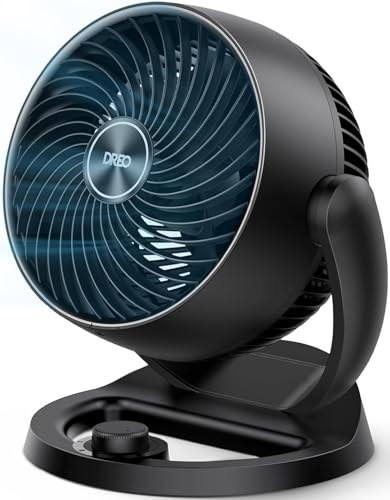
DREO 11-Inch Bedroom Air Circulator Fan
Stale air has a sneaky way of making an otherwise comfortable bedroom feel stuffy, especially after the door has been closed for hours. A small fan may stir the air near a nightstand, yet weak reach often leaves the far side of the room untouched. The DREO model takes a broader approach to the best table fan for bedroom search by combining long-distance airflow, controlled oscillation, and low-noise operation in an 11-inch frame. Its strongest case isn't flashy complexity, but a practical mix of circulation, sleep-friendly controls, and easier cleaning.
DREO 11-Inch Air Circulator Fan
The headline figure is the stated 65-foot airflow reach, backed by a claimed 750 CFM output and the brand's TurboSilent system. Those numbers point to a fan designed for circulation rather than a weak breeze that fades a few steps from the grille. In a bedroom, that extra reach can help move air from a dresser, desk, or corner without requiring the fan to sit inches from the pillow. The benefit is less about blasting one person and more about keeping warm pockets from lingering around the room.
The airfoil-inspired design is meant to shape a stronger, more focused stream. That matters in rooms where furniture interrupts airflow or where cool air from a vent needs help reaching the bed. A narrow personal fan often creates comfort only in one spot, while this unit aims for whole-room air movement. Still, no tabletop fan lowers the actual room temperature, so the realistic gain is better circulation and stronger evaporative cooling against the skin.
An 11-inch body sits between tiny USB fans and bulky floor circulators. That middle size gives the blades enough room to move meaningful air, though it asks for more surface space than a palm-size desk model. A deep nightstand crowded with books, lamps, chargers, and water glasses may feel cramped once the fan is added. On a dresser or small side table, however, the compact circulation design makes more sense and gives the airflow room to develop.
The simple appearance also fits a bedroom better than an industrial-looking high-velocity fan. Nothing in the supplied details suggests decorative finishes or elaborate styling, so function clearly takes the lead. That may sound plain, but plain is often welcome in a room meant for rest. The bigger concern is placement, because the fan's stronger airflow deserves a clear path instead of being boxed in by furniture.
Wide Airflow Without Constant Repositioning
Horizontal movement covers up to 90 degrees of oscillation, allowing the fan to sweep across a wider portion of the room. Shared bedrooms benefit from that range because the airflow doesn't stay locked on one side of the mattress. Oscillation also softens the sensation of a direct draft, which can become irritating during long periods of sleep. Rather than hammering one spot, the breeze passes through and moves on.
Vertical direction is adjusted manually through a 120-degree tilt range. That isn't as hands-off as automatic vertical movement, but it offers plenty of flexibility once the fan is positioned. Tilting upward can help circulate warm air that gathers higher in the room, while a flatter angle sends cooling more directly across the bed. The manual design also means the vertical angle stays where it is instead of moving when a fixed path feels more comfortable.
The difference between manual tilt and automatic oscillation is worth keeping straight. Horizontal motion can be changed from the controls, while vertical direction requires a physical adjustment at the fan. That tradeoff keeps operation simpler, but it may be inconvenient if the fan sits across the room or high on a shelf. Once the angle is dialed in, though, the adjustable airflow path should cover most everyday bedroom layouts.
Room shape will influence how effective the sweep feels. A long, narrow bedroom may benefit more from a carefully aimed fixed stream, while a square room can make better use of the oscillating arc. Furniture can also block lower airflow, so placing the fan above mattress height may improve distribution. The hardware provides useful range, but smart positioning still does a fair share of the work.
Quiet Performance Built Around Sleep
The stated minimum operating noise is 25 dB, which places quiet operation near the center of the product's design. Low noise matters because fan sound changes character after midnight, when every rattle or motor pulse becomes easier to notice. A steady airflow sound may fade into the background, while an uneven hum can keep a light sleeper alert. The supplied information points toward a blade design intended to reduce that disturbance.
Noise will likely vary across the four speed settings. The lowest level should offer the softest experience, while maximum airflow naturally creates more sound from both the motor and moving air. That doesn't undermine the 25 dB claim, but it does mean the quietest specification shouldn't be assumed at every setting. The real advantage is having four usable speed levels that let airflow and sound be balanced instead of forcing an all-or-nothing choice.
The LED display includes a 60-second automatic screen-off function, a small feature with outsized value in a dark bedroom. Bright control lights can be surprisingly distracting, especially when reflected off glossy furniture or aimed toward the bed. Automatic shutoff keeps the settings available during adjustment without leaving the display glowing all night. A button press can bring the information back when needed, then the room returns to darkness.
Sleep comfort also depends on where the fan is aimed. Even quiet airflow can dry the eyes or throat if it blows directly at the face for hours. Oscillation, lower speeds, and upward tilt can reduce that concentrated effect. The fan offers enough control to soften the breeze, but thoughtful placement remains the better fix than simply turning the motor down and hoping for the best.
Four Speeds And Two Wind Modes
Control is intentionally simpler than models that advertise dozens of tiny speed increments. This DREO fan provides four speed settings, which should cover gentle overnight circulation, moderate desk use, and stronger room movement. Fewer choices make adjustments faster in the dark and reduce button tapping. The downside is less fine-tuning if one setting feels slightly weak and the next feels a bit too forceful.
Two wind modes add another layer of flexibility without making the control panel overly busy. The supplied description doesn't name or define those modes, so their exact airflow patterns shouldn't be assumed. Even so, having a second operating style can help separate steady cooling from a more varied breeze. The dual-mode operation may prove useful across sleeping, lounging, and focused work, provided the differences are noticeable in practice.
The remote control handles speed, modes, oscillation, and timer adjustments from across the room. That convenience is easy to underestimate until the fan is running after the lights are off and the blankets are settled. Reaching for a remote is far easier than leaning over furniture or getting out of bed. Of course, the remote can vanish under pillows or beside the bed, so giving it a predictable resting spot avoids a midnight scavenger hunt.
A control panel on the fan provides backup when the remote is out of reach or missing. That dual-control setup prevents the product from becoming awkward to use if the remote battery runs down. Clear, limited functions should also shorten the learning curve compared with a crowded interface. The overall control scheme favors quick everyday adjustments rather than endless customization.
Eight-Hour Timer For Nighttime Routines
The built-in eight-hour timer lines up naturally with overnight use. A timed shutdown can keep the fan from running after the room cools in the early morning, reducing unnecessary noise and electricity use. It also helps avoid waking up chilly after falling asleep during the warmest part of the night. For shorter naps or evening reading, the same timer adds hands-off control.
Eight hours will cover many sleep schedules, though longer sleepers may prefer continuous operation. The ideal setting depends on room temperature, bedding, and how quickly the air settles after sunset. A fan circulating cooled air from an air conditioner may only need a few hours, while a stuffy upstairs room could benefit from running until morning. The adjustable timer function supports different routines without demanding manual shutoff.
Timer controls are especially valuable when the fan sits beyond arm's reach. The remote lets the duration change without interrupting a comfortable position, which sounds minor until it becomes part of the nightly routine. A screen that shuts off automatically also prevents timer indicators from creating a new annoyance. Together, these features show more attention to bedtime use than a basic desk fan with a simple on-and-off switch.
The timer doesn't replace sensible airflow choices. High speed aimed directly at the bed can still feel uncomfortable long before the scheduled shutoff. Pairing a moderate setting with oscillation and an upward tilt will usually create softer circulation. That combination makes the overnight control package more useful than any single feature working alone.
Cleaning Access That Makes Practical Sense
Dust is the quiet enemy of every fan. It collects on the front grille, clings to blade edges, and gradually turns a clean breeze into air passing over a gray film. This model addresses that issue with a detachable front grille and removable blades. Easier access can shorten maintenance and reduce the temptation to ignore buildup for months.
Removable parts also allow more thorough cleaning than wiping through narrow grille openings. A soft cloth can reach the blade surfaces, while the grille can be cleaned separately according to the instructions. The motor housing still needs to stay dry, of course, and all parts should be fully reassembled before operation. The benefit is straightforward: accessible maintenance helps preserve airflow and keeps dust from accumulating in hard-to-reach corners.
Frequent cleaning matters more in bedrooms with rugs, fabric bedding, open windows, or shedding pets. Fine particles can settle quickly, even when the room looks tidy at a glance. A grille that's annoying to remove often turns a five-minute job into one that gets postponed. DREO's detachable design reduces that barrier, which is a practical advantage rather than a decorative specification.
There is still a tradeoff. Removable components involve clips, tabs, or fasteners that need careful handling, and repeated rough removal can wear plastic parts over time. The supplied description doesn't explain the exact mechanism, so ease of disassembly can't be judged in detail. Even with that uncertainty, the cleanable blade assembly is more reassuring than a sealed fan that traps dust behind a fixed guard.
Strengths And Limits For Bedroom Use
The strongest part of this fan is its balance of long-reach airflow and quiet operation. A 65-foot stated reach and 750 CFM claim suggest enough force for circulation across a room, while the 25 dB minimum targets sleep-sensitive settings. That combination is more useful than raw power alone. A bedroom fan needs to move air without sounding like workshop equipment beside the bed.
Oscillation, tilt, and remote control further support everyday comfort. The horizontal sweep can reduce hot spots, and the wide manual tilt provides flexibility for different furniture heights. Four speeds keep operation simple, while two modes add some variety. The eight-hour timer and auto-dimming display make the feature set feel tailored to nighttime use rather than borrowed from a generic office fan.
The limitations are mostly about control depth and placement. Four speeds may not satisfy someone who wants extremely fine airflow adjustment, and manual vertical tilt requires walking over to the unit. An 11-inch frame also needs more table space than a mini fan, so very narrow nightstands may not be the right home for it. These aren't deal breakers, but they shape where the fan fits best.
The supplied details don't include the unit's physical dimensions, weight, power consumption, or cord length. Those omissions make it harder to judge portability and exact bedside fit. No battery is listed, so it should be treated as a powered home fan rather than a cordless travel model. Its strongest role is stationary room circulation, especially where an outlet and a stable surface are already available.
How It Fits The Best Table Fan For Bedroom Search
The best table fan for bedroom duty should remain useful at low speed, stay unobtrusive in darkness, and move air beyond the edge of a nightstand. This DREO model addresses those needs with a stated 25 dB minimum, automatic display shutoff, and whole-room airflow claims. The remote reduces nighttime interruptions, while the timer keeps operation from dragging on longer than needed. Those details matter more in daily use than an oversized list of rarely touched features.
Its circulation-first design also separates it from small personal fans. Rather than directing a weak breeze toward one narrow spot, the 90-degree sweep and 120-degree tilt range can distribute air around furniture and across a shared room. The claimed 750 CFM airflow gives it a stronger starting point for that job. Actual comfort will still depend on distance, speed, and obstacles, but the design is clearly aimed beyond arm's-length cooling.
Quiet claims deserve realistic expectations. Twenty-five decibels likely reflects the softest operating condition, and stronger settings will make more airflow noise. Even so, four speeds give enough room to step down for sleep and ramp up during hotter periods. The TurboSilent design appears intended to keep motor and blade noise controlled rather than pretending powerful airflow can be completely silent.
The fan is most convincing where cleaning, darkness, and room-wide circulation all matter. Its removable grille and blades address long-term upkeep, the screen-off function tackles light sensitivity, and the remote handles adjustments without breaking a comfortable routine. A tiny nightstand or a need for cordless operation would point elsewhere. For a stable dresser, desk, or bedside surface with enough room, the DREO 11-inch air circulator brings a sensible mix of reach, restraint, and practical control.
WHATOOK Rechargeable Mini Desk Fan
A bulky air circulator can cool a room, but it can also swallow half a nightstand and send papers flying across a desk. This compact WHATOOK model takes a more personal approach, pairing a small frame with 100 speed levels, a rechargeable battery, and an adjustable head. Those traits place it naturally in the best table fan for bedroom conversation, especially where space is tight and a soft bedside breeze matters more than cooling every corner. It isn't built like a large whole-room fan, though, and understanding that distinction keeps expectations sensible.
WHATOOK Rechargeable Mini Fan
The small footprint is the first practical advantage. Nightstands already tend to collect lamps, phones, water bottles, books, and charging cables, so a fan that demands a wide base can become a nuisance fast. This model is designed as a personal desktop fan, making it easier to place close to the bed without rearranging the entire surface. Its compact shape also suits desks, hotel tables, and other spots where a full-size fan would feel clumsy.
Portability adds another layer of usefulness. The fan can move from a bedroom to a home office, then slip into travel gear without being treated like a piece of furniture. A rechargeable design removes the need to stay beside an outlet during every use. That cordless flexibility is handy during a power interruption, on a warm balcony, or anywhere a charging cable would get in the way.
The supplied information doesn't include the fan's exact dimensions or weight, so its packing convenience can't be judged down to the inch. Still, the product is described as a mini travel fan rather than a room circulator. That label suggests its strongest role is cooling one nearby spot, not pushing air across a large bedroom. Used at arm's length, the focused airflow should make more sense than expecting it to replace a floor fan.
Its housing is made from pure ABS material, according to the description, with an emphasis on a sturdy structure and no noticeable material odor. ABS is common in compact appliances because it keeps the housing light while offering reasonable rigidity. The denser grille is designed with gaps narrow enough to help keep fingers away from the blades. That safer front guard is reassuring on a bedside table where the fan may be adjusted in low light.
One Hundred Speeds In A Palm-Sized Fan
A hundred speed settings sounds almost comical on a fan this small. Yet the broad range has a clear purpose: levels 1 through 20 are described as quieter settings for sleep and office use, while levels 50 through 100 provide stronger airflow for hotter conditions. This split gives the controls more nuance than the usual low, medium, and high arrangement. The fine speed adjustment can help avoid that annoying jump from barely moving air to blowing too hard.
Bedside comfort often lives in the gaps between standard settings. A low speed may feel fine at bedtime but too weak once humidity settles in, while the next preset can dry the eyes or stir loose hair across the face. Smaller increments allow the airflow to move up gradually. That flexibility makes the 100-level control less of a gimmick than it first appears, provided the buttons remain easy to operate.
The product description doesn't explain whether speed changes happen one level at a time, through preset jumps, or by holding a control. That missing detail matters because tapping a button dozens of times would get old in a hurry. The fan may offer a quicker adjustment method, but it isn't stated in the supplied information. Without assuming extra functions, the safest assessment is that the large range provides precision while the exact control experience remains unclear.
Higher settings are presented as suitable for outdoor cooling and travel, but the fan's compact blade size still sets a natural limit. Strong personal airflow is plausible at close range, while broad room coverage is less likely. The fan should feel more useful pointed toward a pillow, chair, or laptop area than placed across a large bedroom. Its personal cooling focus is a strength when used as intended and a weakness when stretched beyond that role.
Quiet Airflow For Sleep And Focus
The lower speed range is described as quiet enough for sleeping and office work. Rather than claiming absolute silence, the product information mentions soft airflow and light white noise. That wording feels more realistic because every fan produces some sound as air passes through the grille. A smooth, steady hum can fade into the background, while clicking or motor pulsing would be more distracting.
No decibel rating is provided, so quietness can't be measured against larger bedroom fans on paper. The useful clue is the dedicated level 1-to-20 range intended for low-noise operation. Keeping the fan near the bed at a modest setting should reduce both motor sound and the rush of air. The gentle low-speed range may be particularly helpful when a full-size fan feels too loud or too forceful.
Soft airflow also reduces the chance of waking with dry eyes or an irritated throat. A small fan placed close to the face can become uncomfortable even when the room remains warm. Pointing it slightly above the pillow or allowing the breeze to pass across the body rather than directly at the nose can help. The fan's adjustable angle makes that setup easier than a fixed desktop model.
White noise can be welcome, but preferences differ. Some sleepers like a consistent background sound that masks traffic or voices in another room, while others notice every change in pitch. The broad speed range offers room to hunt for a setting that feels steady without becoming intrusive. Still, anyone highly sensitive to mechanical noise should remember that no specific sound measurement is supplied.
Battery Runtime And Charging Tradeoffs
The listed version uses a 2,000mAh battery with a stated runtime of up to 10 hours. That capacity can potentially cover a night of low-speed use, although battery life will vary with speed and battery condition. Running near the top of the range should drain power faster than operating at a gentle bedside level. The 10-hour figure is best viewed as an upper operating estimate rather than a promise under every setting.
The description also mentions a 5,000mAh version capable of up to 25 hours, but the named product specifically identifies the 2,000mAh model. That distinction matters because the longer runtime shouldn't be attributed automatically to this unit. For this review, the relevant claim remains up to 10 hours of battery life. Clear model selection is essential because similar-looking versions may carry very different battery capacities.
The fan can operate while charging, which softens the main limitation of a smaller battery. It can stay connected during long desk sessions, then run cordless beside the bed or during travel. That arrangement also reduces the risk of the fan stopping halfway through a hot night. The use-while-charging feature gives the unit some of the dependability of a plug-in fan without sacrificing portability.
A battery display shows the remaining charge after airflow adjustments. That information is more useful than a vague blinking light because it helps prevent surprise shutdowns. The display is described as soft and low-light, an important detail for bedroom placement. A bright panel can turn a useful fan into an unwanted night-light, so the dim battery readout is a thoughtful match for sleep-focused use.
Flexible Placement Beside The Bed
The fan head can adjust through 180 degrees, allowing airflow to point upward, forward, or toward a lower position. That wide range helps when the fan sits on furniture at a different height from the mattress. A unit on a tall dresser can angle downward, while one on a low table can send air above blankets. The adjustment also makes indirect circulation possible when a direct breeze feels too harsh.
Flat placement is the obvious setup, but the description also mentions hanging the fan. That option can free precious table space and position airflow from a different angle. The exact hanging mechanism isn't explained, so mounting stability and compatible locations can't be evaluated from the provided details. Even so, multiple placement options make the fan more adaptable than a model limited to one upright position.
A hanging setup needs careful attention. The fan should remain secure, clear of loose fabric, and positioned where its controls and charging cable aren't strained. A bedside curtain, blanket, or dangling cord can interfere with airflow or create unnecessary clutter. The compact design helps, but stable positioning matters more than squeezing the fan into the smallest possible gap.
The 180-degree hinge also introduces a mechanical part that will be adjusted repeatedly. The supplied information calls the structure simple and sturdy, though no hinge material or durability details are provided. Gentle repositioning should help preserve the joint over time. The benefit is worthwhile because fixed-angle mini fans often require books, boxes, or other makeshift stands to aim the breeze correctly.
Safety And Everyday Maintenance
Narrower grille gaps are intended to prevent fingers from reaching the blades. That design is useful around a bedside surface where the fan may be moved while running or touched without full attention. A denser guard can also reduce contact with larger objects that might otherwise reach the spinning blades. The protective grille structure adds practical peace of mind without requiring a bulky outer cage.
Dense grilles have one downside: dust can collect between the openings. Bedrooms generate plenty of lint from bedding, rugs, clothing, and open windows, and fan blades tend to gather it quickly. The provided details don't say whether the front grille or blades are removable. That means cleaning access is uncertain, and maintenance may rely on careful wiping or a soft brush.
Regular cleaning helps preserve airflow and keeps dust from blowing back toward the bed. Before maintenance, the fan should be turned off and disconnected from charging power. Moisture shouldn't enter the motor housing, and narrow tools shouldn't be pushed through the guard near the blades. A compact fan may need only brief upkeep, but its small grille openings could make neglected buildup more noticeable over time.
The material is described as odor-free pure ABS. That claim addresses a common annoyance with inexpensive plastic devices, especially when used close to the face in a warm room. Still, material odor can vary with storage and manufacturing conditions, so it shouldn't be treated as an absolute guarantee for every unit. The stated focus on clean material and sturdy construction is positive, though long-term durability isn't documented in the supplied details.
Useful Strengths And Noticeable Limits
The strongest feature is the combination of compact size and detailed airflow control. A mini fan that offers 100 levels can adapt more precisely than a basic three-speed travel model. Quiet lower settings suit nighttime use, while stronger settings provide extra force during hotter periods. That flexibility lets one small device shift between a desk, nightstand, and travel bag without feeling locked into a single job.
Battery operation is another meaningful advantage. Up to 10 hours may cover overnight use at favorable settings, and the ability to run while charging removes some anxiety around capacity. The power display also makes charging decisions less of a guessing game. Still, the 2,000mAh battery is modest compared with larger portable fans, so frequent high-speed use will likely require regular charging.
The absence of oscillation is a practical limitation based on the information provided. A manually adjustable head can aim air precisely, but it won't sweep a breeze across a shared bed or circulate air around the room automatically. This fan is better suited to one nearby position than broad cooling. The fixed directional airflow may actually be preferable for personal use, though it offers less coverage than an oscillating table fan.
Several specifications remain unlisted, including exact dimensions, weight, charging time, charging-port type, and cleaning method. Those gaps prevent a complete assessment of packing convenience and daily upkeep. No timer or remote control is mentioned either, so operation appears more hands-on than feature-heavy bedroom models. The fan trades automation for portability and straightforward personal cooling.
Fit For The Best Table Fan For Bedroom Search
The best table fan for bedroom isn't always the model with the widest oscillation or the largest blade. In a small sleeping space, a compact fan that creates a gentle breeze without dominating the nightstand can be the more practical tool. WHATOOK's mini fan leans into that role with quiet lower settings, a dim display, and a flexible 180-degree angle. Those features address the small nightly irritations that often matter more than headline power.
Its battery makes placement easier because the fan doesn't have to remain beside an outlet. A shelf, bedside table, or temporary hanging point can become a cooling spot without stretching a cord across the room. The stated 10-hour runtime is promising for nighttime use, especially at moderate levels. Running while charging provides a backup when the battery is low or continuous airflow is needed.
Whole-room circulation isn't the goal here. The compact housing, personal-fan label, and lack of stated oscillation point toward close-range use. A larger bedroom with trapped heat in several corners will need a stronger air circulator or an oscillating model. This WHATOOK unit fits better where targeted bedside airflow, easy transport, and minimal surface use outweigh broad coverage.
The overall feature set is refreshingly focused: adjustable speed, rechargeable power, a battery display, safer grille spacing, and flexible positioning. It won't satisfy someone who wants remote operation, a sleep timer, or automatic sweeping movement. For a small nightstand, travel setup, dorm room, or work surface, however, the WHATOOK rechargeable mini fan offers a practical way to keep nearby air moving without bringing a bulky appliance into the space.
Honeywell TurboForce HT900 Air Circulator
Heat rarely stays polite and evenly distributed. It settles near the bed, lingers around a desk, and turns a closed room into a pocket of stale air. The Honeywell TurboForce HT900 enters the best table fan for bedroom conversation with a compact frame, three straightforward speeds, and airflow that the manufacturer says can be felt from as far as 25 feet away. It skips digital displays, timers, and remote controls in favor of a simple design built around direct, adjustable circulation.
Honeywell TurboForce HT900 Fan
The HT900 is small enough to sit on a nightstand, dresser, desk, or even the floor without looking wildly out of place. Its compact body is especially useful where surface space is already claimed by a lamp, phone charger, alarm clock, and the usual bedside clutter. Despite the modest footprint, Honeywell positions it for small to medium-sized rooms rather than strictly close-range cooling. That gives it a broader role than a tiny personal fan that only feels useful from a few feet away.
Placement flexibility is one of the unit's quieter strengths. The fan can work on a tabletop, rest on the floor, or be mounted on a wall, according to the supplied description. A wall-mounted setup frees up furniture space and can send air across the room from a higher angle. The three-position versatility makes it easier to work around awkward layouts, though wall installation requires a secure location and suitable hardware handling.
The black housing keeps the appearance understated. It isn't trying to pass as bedroom decor, and the industrial curve of the grille puts function ahead of style. That may suit an office or practical sleeping space just fine, but a carefully coordinated room might call for something softer-looking. The compact utilitarian design is easy to place, even if it won't disappear visually on a pale nightstand.
A power cord is implied by its indoor tabletop design, and no rechargeable battery is included in the supplied details. That means the fan needs access to an outlet and won't serve as a cordless camping or outage fan. On the upside, there is no battery level to watch, charge cycle to plan, or runtime limit to manage. The plug-in operation favors dependable stationary use over portability away from household power.
Turbo Airflow With A Focused Reach
Honeywell describes the fan's internal layout as an aerodynamic turbo design intended to maximize air movement. The stated airflow can be felt from up to 25 feet away, giving the HT900 enough reach to sit across a bedroom instead of crowding the pillow. That distance claim is useful for people who dislike a fan blowing directly against their face. Positioning it farther away can create a broader, less abrasive breeze while still keeping air moving.
The concentrated airflow also helps redistribute cooled air from an air conditioner. A window unit or vent often chills one section of a room while leaving another corner warm and heavy. A small circulator can push that cooler air toward the bed or move it through a doorway. This air-circulation role may let the air conditioner run less aggressively, although actual energy savings will depend on room conditions and cooling habits.
Raw airflow comes with a tradeoff. A focused stream can feel strong at close range, particularly on the highest of the three settings. Aiming the fan slightly above the mattress or toward a nearby wall may create softer circulation than pointing it directly at a sleeper. The 25-foot stated reach is most valuable when used to gain distance, not merely to blast the nearest spot harder.
The fan doesn't oscillate, so it won't sweep air automatically from side to side. That limits coverage across a wide bed or a room shared by two people who prefer equal airflow. Its strength is a steady, fixed stream aimed exactly where it's needed. The non-oscillating design feels predictable and direct, but anyone wanting a moving breeze will need a different style of fan.
Three Speeds Without Control-Panel Fuss
Three speeds keep operation refreshingly simple. There is no app, no menu, and no need to scroll through dozens of tiny increments to reach a comfortable setting. Low can support gentler nighttime airflow, medium can handle everyday circulation, and high can move warm air more aggressively. The basic three-speed control is easy to understand even in a dark room.
Simplicity also means less precision. The jump between settings may feel larger than it does on fans with five, ten, or a hundred speed levels. If low feels too soft and medium feels slightly strong, there is no in-between option. That limited adjustment range is the price paid for straightforward controls and may matter to sleepers who are particularly sensitive to airflow.
No remote control is mentioned in the product details. Speed changes therefore require reaching the fan itself, which is easy if it sits beside the bed but less convenient across the room or on a wall. The lack of a remote also means there is one less accessory to lose or replace. Still, manual control only can feel dated after the lights are off and the room suddenly becomes cooler than expected.
A timer is also absent from the supplied feature list. The HT900 will continue running until it is switched off or connected to an external timing solution. That can be perfectly fine for all-night circulation, but it won't automatically stop after the room cools before dawn. The always-on simplicity suits people who prefer uninterrupted airflow, while timed sleepers may miss that layer of convenience.
Pivoting Head And Practical Air Direction
The fan head pivots through 90 degrees, allowing the airflow to move from a forward-facing direction toward a much higher angle. This range matters when the fan sits below mattress height or needs to send air above furniture. Aiming upward can encourage room circulation without creating a hard draft across the face. The adjustment is manual, but once set, the head stays focused on the chosen path.
Floor placement benefits especially from the pivoting design. A fan sitting low can direct air toward the bed, ceiling, or an air-conditioning stream rather than wasting its output against the base of furniture. On a dresser, the angle can be lowered or aimed across the room. The adjustable airflow path gives the small unit more placement freedom than a fixed-head desk fan.
The 90-degree movement should not be confused with automatic vertical oscillation. The head doesn't continually sweep up and down; it is repositioned by hand. That keeps the mechanism simple and prevents unwanted movement during sleep. The drawback is obvious, though: direction changes require physical adjustment, so the fan needs to remain accessible.
A fixed angle can actually be preferable for targeted circulation. Automatic movement sometimes sends the breeze away at the exact moment relief is needed, then swings back after the room feels warm again. The HT900 keeps air trained on one area, which works well for a bed, desk chair, or doorway. Its focused character is less useful for broad shared coverage but stronger for consistent personal airflow.
Quiet Operation With Realistic Expectations
Honeywell states that the TurboForce is 25 percent quieter than comparable fans. That comparison suggests noise reduction was part of the design, though the supplied details don't name the competing models or provide a decibel measurement. Without a fixed sound rating, the claim is best treated as relative rather than absolute. The fan may be quieter than similar high-output units, but it shouldn't be assumed silent.
Air movement itself creates sound, especially at higher speeds. Low will likely provide the gentlest acoustic profile, while high should produce a more noticeable rush of air. A steady whoosh can be soothing and may help cover distant traffic, hallway movement, or household sounds. The quiet personal-fan positioning is promising for sleep, but individual tolerance still plays a large role.
Mechanical tone matters just as much as volume. Smooth fan noise tends to blend into the room, whereas rattling, pulsing, or sharp motor sounds draw attention. The supplied information doesn't describe the sound character, so it would be unfair to promise a particular experience. The quieter turbo design gives the HT900 a sleep-friendly intention, while real comfort will depend on speed and placement.
Distance can make the fan easier to live with at night. Since the airflow is stated to reach up to 25 feet, the unit doesn't need to sit directly beside the pillow. Moving it several feet away can soften both sound and breeze intensity. That pairing of longer reach and flexible placement may be more valuable than chasing the lowest possible noise number on paper.
Energy Use And Air-Conditioner Support
A table fan doesn't cool the room's air in the same way an air conditioner does. It improves comfort by moving air across the skin and redistributing cooler pockets around the space. Honeywell specifically presents the HT900 as a way to give an air conditioner a break. The circulation-focused design can support a cooling system, but it can't replace refrigeration during severe heat.
Using the fan alongside air conditioning may allow a more moderate thermostat setting while keeping the sleeping area comfortable. Cooler air that would otherwise collect near a vent can be pushed toward warmer parts of the room. This is especially handy in bedrooms with uneven airflow or a window unit positioned far from the bed. Any energy-saving benefit will vary, so it shouldn't be treated as a guaranteed reduction in a particular utility bill.
The fan may also be useful without air conditioning during mild weather. Open-window air often needs a nudge to travel through the room, and a strategically aimed circulator can help. Pointing it inward may pull cooler evening air toward the bed, while outward placement can help exhaust warm indoor air in some layouts. The focused 25-foot airflow provides several practical setups without adding another large appliance.
Continuous plug-in operation suits long sessions, whether the fan runs overnight or beside a desk through the afternoon. There is no recharge downtime and no battery capacity limiting the highest speed. The tradeoff is dependence on outlet placement and another cord near the furniture. For a permanent bedroom setup, consistent wired power is often more convenient than managing a portable battery.
Cleaning And Long-Term Practicality
Fan grilles attract dust. Bedrooms add lint from blankets, rugs, clothing, and open windows, so buildup can become visible faster than expected. The provided description doesn't state whether the grille or blades detach for cleaning. That makes maintenance access one of the less certain parts of the HT900's design.
A soft brush, microfiber cloth, or vacuum attachment can help clear surface dust while the fan is unplugged. Moisture should stay away from the motor housing, and objects shouldn't be pushed through the grille toward the blades. Regular light cleaning is easier than waiting for a thick layer to form. The compact grille structure may require a little patience around tighter openings.
Simple controls and a plug-in motor reduce several long-term concerns found on more elaborate fans. There is no display to dim, remote to malfunction, or rechargeable battery to lose capacity over time. Fewer electronic extras don't guarantee durability, but they do reduce the number of features that can become troublesome. The HT900's straightforward mechanical approach favors routine operation over feature-heavy convenience.
Honeywell's broader fan lineup is mentioned in the description, but that doesn't provide product-specific durability evidence for this exact model. Ratings, review totals, and lifespan claims aren't supplied here and shouldn't be invented. The safest judgment comes from the listed construction and features alone. Its simple operating layout should appeal where easy use matters more than digital control.
Strengths And Compromises In A Bedroom
The strongest argument for the HT900 is its airflow-to-size balance. It remains compact enough for a table or floor while claiming reach up to 25 feet. The pivoting head extends its usefulness across different furniture heights and room layouts. That makes the fan adaptable without relying on a large pedestal or tower body.
Quiet-focused operation is another worthwhile strength. The manufacturer describes it as 25 percent quieter than comparable fans, and its lower settings are likely the natural choice for sleep. A fan that can sit farther from the bed may further reduce perceived sound. The combination of distance, lower speed, and directional control offers several ways to soften the nighttime experience.
The compromises are equally clear. There is no oscillation, remote, timer, battery, or display listed in the supplied details. Three speeds may feel limiting beside newer models with finer control, and manual adjustments require keeping the fan within reach. These omissions make the feature set deliberately basic, which will feel either refreshing or restrictive depending on the room routine.
Wall mounting widens the placement options, though it turns a portable table fan into a more fixed installation. A wall position can clear crowded furniture and improve airflow direction, but it also makes the manual speed control less accessible. Floor placement is easier and more flexible, yet it may collect dust faster. Each setup highlights a different practical tradeoff rather than offering one universally better arrangement.
How It Fits The Best Table Fan For Bedroom Search
The best table fan for bedroom duty doesn't always require a digital panel or a long list of modes. Strong reach, manageable sound, stable placement, and simple adjustment can matter more after weeks of daily use. The Honeywell HT900 focuses squarely on those basics. It moves air from a compact body and lets the head pivot toward the area that needs relief.
Small and medium rooms are the stated operating environment, which fits bedrooms, compact offices, and similar indoor spaces. Its claimed 25-foot airflow reach gives more placement freedom than a weak personal fan. A dresser across the room or a low floor position can still be useful if the airflow path remains clear. Large open rooms, however, may demand wider coverage or automatic oscillation.
Light sleepers may appreciate the quieter design, but the lack of a decibel figure leaves some uncertainty. The lowest speed and greater placement distance should offer the calmest setup, while high speed is better reserved for rapid circulation or daytime use. No auto-dimming screen is needed because there is no display to glow in the dark. That screen-free simplicity quietly solves a problem that many modern bedroom fans create.
The HT900 fits best where direct airflow and uncomplicated operation take priority over remote convenience. It won't sweep across a shared bed, turn itself off after several hours, or run during a power outage. What it does offer is a compact form, three usable speeds, a 90-degree pivoting head, and focused circulation with stated reach across the room. For a stable tabletop, floor, or wall-mounted setup, the Honeywell TurboForce HT900 keeps the proposition clear: move more air without filling the room with a bulky fan.
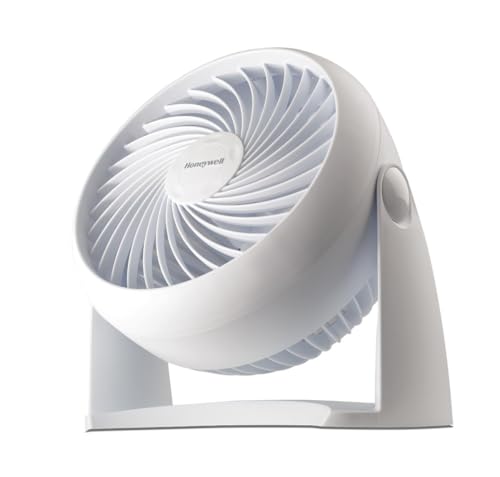
Honeywell HT-904 TurboForce Tabletop Fan
A warm bedroom can feel twice as uncomfortable when the air sits still around the bed. Strong cooling helps, but a giant floor fan often takes up too much space and creates more noise than anyone wants at night. The Honeywell HT-904 approaches the best table fan for bedroom role with a compact body, three simple speeds, and a pivoting head that directs air where it is actually needed. Its design is straightforward, almost old-school, yet that simplicity is exactly what makes it practical for small and medium-sized rooms.
Honeywell HT-904 TurboForce Fan
The HT-904 is built for flexible placement rather than one permanent spot. It can sit on a nightstand, desk, dresser, or floor, and the supplied description also allows for wall mounting. That compact mounting flexibility helps in bedrooms where furniture is already crowded with lamps, phones, chargers, and books. A wall position can free the entire tabletop, while floor placement works well when air needs to travel upward toward the mattress.
Its white housing gives the fan a lighter, less industrial appearance than darker air circulators. That may fit more naturally beside pale furniture or in a room where a black appliance would stand out. The shape is still functional rather than decorative, so it won't pass as an accent piece. Even so, the small white frame is easier to blend into a bedroom than a bulky pedestal fan.
The fan is described as suitable for small to medium-sized rooms. That places it above tiny personal fans designed only for arm's-length use, but below larger circulators intended for broad open spaces. A bedroom, compact home office, or dorm room falls neatly within that range. The room-size positioning feels realistic, provided the airflow path isn't blocked by tall furniture or thick curtains.
No rechargeable battery is listed, so this should be treated as a plug-in indoor fan. That removes concerns about battery runtime, recharging, or declining battery capacity after repeated use. The tradeoff is dependence on a nearby outlet and one more cord around the furniture. For a stable bedside setup, continuous wired power can be more dependable than a portable battery that might quit before morning.
Airflow That Reaches Beyond The Nightstand
Honeywell states that the HT-904 can produce noticeable airflow from up to 25 feet away. That distance gives the fan more placement freedom than a weak desktop model that needs to sit inches from the face. It can remain on a dresser across the room or on the floor near a doorway while still contributing to personal comfort. Greater distance also softens the breeze, which helps reduce the dry-eye feeling caused by direct airflow during sleep.
The TurboForce design uses an aerodynamic structure intended to maximize air movement. Rather than spreading a faint breeze in every direction, the fan focuses air along a more concentrated path. This turbo airflow design can help push cool air from an air conditioner toward warmer sections of the room. It also works well for moving evening air through an open window when the outdoor temperature finally drops.
A focused stream has limits, of course. The HT-904 doesn't oscillate, so it won't sweep air across both sides of a wide bed. Once aimed, the breeze stays on that path until the fan is repositioned manually. The fixed airflow direction works well for one sleeping area or a specific warm corner, but shared coverage may call for an oscillating model.
High airflow can also feel too intense if the fan sits close to the pillow. The strongest setting makes more sense across the room, where the air has space to spread before reaching the bed. Lower speeds are better suited to short distances and overnight use. This distance-and-speed balance matters more than simply running the fan at full power every time the room feels warm.
Three Speeds Keep Operation Simple
Three speed settings cover the basics without turning the control panel into a small puzzle. Low can provide gentle air movement for sleep, medium suits ordinary room circulation, and high offers stronger cooling during the hottest part of the day. The simple three-speed layout is easy to operate without reading a manual or staring at a display. That simplicity is refreshing in a bedroom, especially after the lights are off.
Fewer speeds also mean wider jumps between settings. Low may feel slightly too soft while medium feels stronger than expected, and there is no setting between the two. Fans with finer adjustment offer more precision, but they often require repeated button presses or digital controls. The HT-904 favors quick manual adjustment over detailed customization.
No remote control is included in the supplied information. Anyone placing the fan beside the bed can reach the controls without much trouble, but a dresser or wall-mounted position makes adjustments less convenient. The absence of a remote also eliminates batteries, pairing issues, and the familiar problem of losing it under the bed. Still, hands-on operation is a real limitation for anyone who regularly changes speed during the night.
A timer isn't mentioned either. The fan will continue operating until it is switched off, which suits uninterrupted overnight airflow but offers no automatic shutdown. Rooms that cool sharply before sunrise may feel chilly if the fan keeps running at the same speed. The no-timer design is easy to understand, though it lacks the set-it-and-forget-it convenience found on newer bedroom fans.
Pivoting Head Adds Useful Direction Control
The head pivots through 90 degrees, giving the fan a broad vertical adjustment range. It can aim straight ahead, angle upward, or settle somewhere between those positions. That flexibility lets a low fan send air toward the bed instead of into the side of a dresser. It also allows indirect circulation by aiming the stream above the sleeping area rather than directly at the face.
Floor placement becomes much more practical with the pivoting head. A fixed fan sitting near the carpet might waste airflow against furniture, but the HT-904 can direct it upward through the room. On a table, the head can be tilted toward a chair, doorway, or ceiling. The adjustable vertical airflow makes the small housing useful across several positions.
The pivot is manual, not motorized. Changing the angle requires touching the fan and moving the head by hand. That isn't a problem during setup, yet it becomes less convenient when the unit is wall-mounted or placed across the room. The benefit is a steady fixed angle that won't drift away from the bed during use.
Automatic vertical movement can sometimes feel distracting, especially when the breeze repeatedly leaves and returns. The HT-904 avoids that pattern by holding one chosen direction. This works nicely for focused circulation, though it doesn't provide the broader coverage of a two-axis fan. The design favors precise aiming rather than constantly changing airflow.
Quiet Operation Without A Digital Glow
The product description emphasizes quiet operation, which is essential for a fan intended for bedrooms and home offices. No decibel figure is supplied, so the sound level can't be measured against models that advertise a specific number. Speed will also affect noise, with the lowest setting likely producing the softest experience. The fan shouldn't be assumed silent, but its design is clearly intended to keep sound manageable.
A steady airflow sound can help cover hallway noise, distant traffic, or voices from another room. Some people sleep better with that mild background hum, while others notice every shift in motor tone. Since the fan offers only three speeds, the available sound profiles are limited. The low-speed white noise may be pleasant, but individual sensitivity will still shape the experience.
The lack of a digital display has an unexpected bedroom benefit. There is no bright LED panel to shine toward the bed, reflect off furniture, or require an automatic screen-off feature. Controls remain mechanical and visible without producing a nighttime glow. That screen-free design quietly solves a problem that many feature-heavy fans create.
Placement can reduce perceived sound as much as the fan's internal design. The stated 25-foot reach means the unit doesn't have to sit close to the pillow to remain useful. Moving it farther away can soften both the motor noise and the rush of air. The combination of longer airflow reach and simple speed control provides several ways to build a calmer nighttime setup.
Supporting An Air Conditioner More Efficiently
A fan doesn't lower room temperature like an air conditioner, but it can make cooled air travel farther. Cold air often pools near a vent or window unit while the bed remains warm on the opposite side. The HT-904 can push that air across the room, reducing uneven temperature pockets. This air-distribution role may allow the cooling system to work at a less aggressive setting.
Honeywell presents fan-assisted circulation as a way to reduce energy consumption and cooling costs. Actual savings will depend on climate, room insulation, thermostat habits, and how long both appliances operate. No specific reduction is supplied, so a guaranteed dollar figure would be unrealistic. The sensible benefit is that moving conditioned air can improve comfort without immediately lowering the thermostat again.
Mild evenings create another useful scenario. An open window may bring in cooler air, yet that breeze can stall near the opening. The fan can direct it toward the bed or help move warm indoor air toward an exit. Its focused 25-foot reach is useful for these simple circulation setups, especially in smaller rooms.
Running a fan alone during moderate weather also uses a different cooling approach than air conditioning. Air movement increases evaporation from the skin, which can make the room feel more tolerable even though the actual air temperature stays the same. That distinction prevents unrealistic expectations. The HT-904 provides personal comfort through circulation, not refrigerated cooling.
Wall Mounting And Space-Saving Potential
Wall mounting can be a real advantage in a cramped bedroom. It clears the nightstand, keeps the fan away from loose bedding, and gives airflow a higher starting point. A properly placed wall fan can send air across the mattress without taking up any floor space. The mountable compact body gives the HT-904 more installation flexibility than many tabletop-only models.
That setup comes with a control tradeoff. Since there is no remote, wall placement needs to remain low enough for comfortable access or stay on one preferred speed most of the time. Mounting the fan too high may make every adjustment a nuisance. The manual controls work best when convenience is considered before installation.
A floor setup is easier to change and doesn't require mounting work. It also places the fan closer to dust, pet hair, and carpet fibers, which may increase cleaning frequency. Tabletop placement offers a middle ground with better access and less exposure to floor debris. Each arrangement changes the fan's airflow angle and maintenance needs.
The supplied details don't list mounting hardware or installation instructions. Wall compatibility is stated, but the exact attachment method shouldn't be assumed. A secure surface and correct installation are essential because a vibrating fan needs stable support. The space-saving wall option is valuable, though the practical setup depends on the room and the provided hardware.
Cleaning And Everyday Upkeep
Dust buildup is unavoidable with any air circulator. Bedding fibers, clothing lint, open windows, and household dust eventually coat the grille and blade edges. The product information doesn't say whether the front grille or blades are removable. That leaves deep-cleaning access uncertain compared with models designed for tool-free disassembly.
Surface cleaning should begin with the fan unplugged. A soft brush, microfiber cloth, or vacuum attachment can remove loose dust from the grille without pushing debris farther inside. Moisture should stay away from the motor housing, and rigid objects shouldn't be inserted through the guard. Regular light maintenance is less frustrating than dealing with heavy buildup after months of neglect.
The white finish may reveal dust sooner than a black housing. Oddly enough, that can be useful because buildup becomes visible before it grows thick enough to reduce airflow. The downside is that scuffs and marks may also show more easily. The light-colored exterior looks softer in a bedroom but may call for more frequent wiping.
Simple mechanical controls reduce several maintenance concerns found on digital fans. There is no display panel, rechargeable battery, or remote to manage. Fewer electronics don't prove that the fan will last indefinitely, but they reduce the number of secondary components that can fail. The straightforward operating design keeps daily care focused on dust removal and basic handling.
Clear Strengths And Honest Weaknesses
The biggest strength is the compact airflow reach. A small fan that can send air up to 25 feet provides far more placement freedom than a weak USB model. The 90-degree pivot adds another layer of control, allowing airflow to move upward from the floor or across the room from a dresser. Those features address real bedroom layout problems without requiring a bulky fan.
Quiet operation and the absence of display lighting strengthen its nighttime appeal. The fan won't leave a glowing screen beside the bed, and lower speeds should provide gentler sound. Plug-in power also allows continuous operation without worrying about charge level. The simple overnight reliability is easy to appreciate during long stretches of warm weather.
The weaknesses come from that same simplicity. Three speeds offer limited fine-tuning, and there is no oscillation, remote control, timer, or cordless battery. A shared bed may not receive even coverage from a fixed airflow path. The basic feature set feels sensible for direct cooling but sparse beside modern bedroom fans with automated controls.
The fan also needs a clear outlet and suitable placement. Wall mounting can save space, yet manual controls become harder to reach. Floor placement improves aiming flexibility but exposes the unit to more dust. These placement tradeoffs aren't unusual, though they deserve thought before deciding where the fan will live.
Best Table Fan For Bedroom Practical Fit
The best table fan for bedroom use doesn't have to offer dozens of settings. A stable breeze, manageable sound, useful reach, and an adjustable head can handle the nightly job without adding control-panel clutter. The Honeywell HT-904 focuses on exactly those fundamentals. Its 25-foot stated reach makes it more capable than its small body initially suggests.
Small and medium-sized rooms are the natural fit. A dresser, desk, wall, or open patch of floor can support the fan, provided the air path stays clear. Its 90-degree pivoting head helps work around low surfaces and awkward furniture heights. Large open areas or wide shared bedrooms may benefit more from oscillation and broader airflow.
Sleep-focused shoppers will appreciate the quieter positioning and lack of LED light, though the missing timer and remote may be noticeable. Leaving the fan close solves the control issue, while placing it farther away softens noise and airflow. That creates a small balancing act between convenience and comfort. The three-speed operation keeps the choices limited but easy to remember.
The HT-904 makes the most sense where uncomplicated circulation matters more than automation. It won't move side to side, shut itself off, or run during an outage, but it can direct a strong stream across a room from a compact platform. The white housing blends more gently into many bedrooms, and the wall-mounting option saves valuable surface space. As a focused personal circulator, the Honeywell TurboForce HT-904 delivers a practical mix of reach, direction, and no-nonsense control.

Best Quiet Ceiling Fan For Bedroom 2026 Ultimate Comfort Picks

Best Ceiling Fan For Master Bedroom 2026 With Ultimate Comfort

Best White Ceiling Fan With Light For Bedroom 2026 Top Picks

Best Quorum Medallion Ceiling Fan 2026 With Style & Breeze
Best Outdoor Fan For Pergola 2026 Comfort Boost

Best Ceiling Fan For Great Room 2026 With Ultimate Comfort

Best Outdoor DC Ceiling Fans 2026 For Breezy Comfort
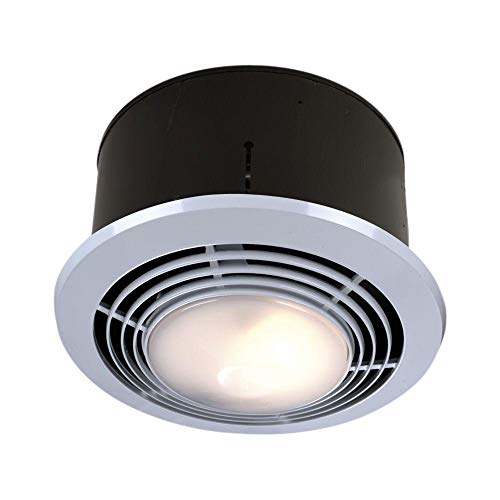
Best ceiling exhaust bath fan with light and heater 2026





