
Best Tiny Desk Fan 2026: Small Fans That Deliver

A best tiny desk fan should cool the person sitting nearby without turning loose papers into confetti or swallowing half the workspace. That sounds simple, yet many compact fans miss the mark by producing a thin stream of air, rattling at higher speeds, or creeping across a smooth desk. Size alone doesn't make a fan practical. The real value comes from focused airflow, steady footing, sensible controls, and a sound level that won't compete with calls, music, or late-night sleep.
Small desks leave little room for bulky bases, trailing cords, and awkward control panels. A fan with a narrow footprint can sit beside a monitor, keyboard, lamp, or stack of notebooks without making the surface feel cramped. Still, an extremely small housing may limit blade size and air reach. A balanced model sends enough air toward the face and upper body while staying compact enough to move with one hand.
Noise control deserves close attention because tiny fans often sit only a foot or two away. A faint, consistent hum can fade into the background, but buzzing motors, clicking bearings, and changing pitch quickly become irritating. Lower speed settings usually suit focused work and bedtime, while stronger settings help after a warm commute or during a stuffy afternoon. More speed choices give better control, though three well-spaced levels can be more useful than several that feel nearly identical.
Power options change how and where the fan fits into daily life. A USB-powered desk fan works neatly beside a computer, power bank, or wall adapter, but cable length and port availability can become small annoyances. Rechargeable models cut the cord and travel easily between a desk, kitchen counter, patio table, or nightstand. Battery operation adds convenience, yet higher speeds drain power faster, so realistic runtime matters more than an oversized number printed on a product page.
Airflow direction can make a modest fan feel far more capable. A tilting head sends air above a laptop screen or down toward hands without forcing the whole unit to balance on a book. Some designs include automatic oscillation, which spreads air across a wider area but also adds bulk, moving parts, and sometimes extra noise. For personal cooling at arm's length, a fixed fan with a broad tilt range often does the job with fewer complications.
Cleaning is easy to overlook until dust gathers along the grille and blade edges. A removable front cover makes routine maintenance quicker and helps preserve clean, consistent airflow. Sealed grilles may look tidy, but narrow openings can be frustrating to reach with a cloth or brush. Also, tightly spaced guards offer helpful finger protection, especially on surfaces where curious hands, charging cables, or loose objects may get close.
Tradeoffs are unavoidable. Stronger airflow can create more noise, larger batteries add weight, and ultra-compact bodies may sacrifice reach. The smartest pick isn't simply the smallest or most powerful model. It’s the fan that stays put, points where needed, runs at a comfortable volume, and doesn't become another desk accessory that gets shoved into a drawer after a week.

- LFR Score9.4
LFR Score is a ranking system developed by lightfansreviews.com. LFR Score has no relationship or impact from any manufacturers or sales agent websites. Learn more
- BrandSWEETFULL

- LFR Score9.2
LFR Score is a ranking system developed by lightfansreviews.com. LFR Score has no relationship or impact from any manufacturers or sales agent websites. Learn more
- BrandTriPole

- LFR Score9.2
LFR Score is a ranking system developed by lightfansreviews.com. LFR Score has no relationship or impact from any manufacturers or sales agent websites. Learn more
- BrandWHATOOK
- LFR Score9.0
LFR Score is a ranking system developed by lightfansreviews.com. LFR Score has no relationship or impact from any manufacturers or sales agent websites. Learn more
- BrandGaiatop

- LFR Score9.0
LFR Score is a ranking system developed by lightfansreviews.com. LFR Score has no relationship or impact from any manufacturers or sales agent websites. Learn more
- BrandRJVW
- LFR Score9.0
LFR Score is a ranking system developed by lightfansreviews.com. LFR Score has no relationship or impact from any manufacturers or sales agent websites. Learn more
- BrandKIMMOO

- LFR Score8.8
LFR Score is a ranking system developed by lightfansreviews.com. LFR Score has no relationship or impact from any manufacturers or sales agent websites. Learn more
- BrandIRIS USA

- LFR Score8.8
LFR Score is a ranking system developed by lightfansreviews.com. LFR Score has no relationship or impact from any manufacturers or sales agent websites. Learn more
- BrandJISULIFE

- LFR Score8.8
LFR Score is a ranking system developed by lightfansreviews.com. LFR Score has no relationship or impact from any manufacturers or sales agent websites. Learn more
- BrandAecooly
Last update on 2026-07-08 / Affiliate links / Images, Product Titles, and Product Highlights from Amazon Product Advertising API
SWEETFULL USB Small Desk Fan Review
A cramped desk gets uncomfortable fast once a laptop starts throwing off heat and the room air barely moves. Large fans solve one problem while creating another, taking up valuable space, disturbing papers, or adding a steady mechanical drone beside the keyboard. The best tiny desk fan should provide close-range relief without dominating the workspace, and the SWEETFULL model approaches that job with a five-inch frame, four airflow settings, and USB power. Its appeal rests on practical details rather than flashy extras, though the lack of a built-in battery creates a clear limitation for anyone expecting completely cordless use.
SWEETFULL USB Small Desk Fan
The SWEETFULL fan measures 5.67 by 2.60 by 6.06 inches, so its footprint stays narrow enough for a crowded desk, small nightstand, or shallow shelf. At 0.61 pound, it’s also easy to shift from one spot to another without treating the move like a household project. That compact size matters in real settings where a monitor stand, coffee mug, charging dock, and notebook are already fighting for elbow room. Still, the housing isn’t so tiny that it looks like a novelty gadget with barely noticeable airflow.
Portability here means lightweight construction and manageable dimensions, not cordless freedom. The fan can slip into a work bag or suitcase, but it needs access to a USB power source once it reaches the destination. A computer port, USB charger, power bank, or car charger can keep it running, which gives the design plenty of flexibility despite the missing battery. The USB-powered setup works especially well in places where an outlet is nearby but a bulky AC plug would be annoying.
The 4.9-foot cable offers more placement freedom than a short lead that forces the fan against a laptop or wall socket. It can sit farther across a desk, reach a bedside charger, or connect to a power bank tucked out of sight. On the flip side, the cable is always part of the arrangement, and there’s no battery mode for carrying the fan between rooms while it’s spinning. That tradeoff keeps the fan light and simple, but it may frustrate anyone who equates portable cooling with completely wire-free operation.
Airflow That Fits Different Desk Routines
Four speed settings give this small fan more range than basic models with only low and high controls. The gentler levels suit tasks where a light breeze is enough, such as reading, typing, or leaving the fan running beside the bed. Higher settings increase the airflow for warmer afternoons or quick cooling after coming in from outside. The stated maximum air speed of 5.2 meters per second suggests that the stronger airflow setting is designed for personal cooling at close range rather than circulating air through a whole room.
The seven curved blades are intended to move air smoothly instead of producing a harsh, choppy stream. That can make the breeze feel less distracting when the fan is aimed toward the face for an extended stretch. A personal fan shouldn’t make eyes feel dry within minutes or send every receipt on the desk flying, so having several levels helps dial in a more comfortable balance. The four-speed control also avoids the all-or-nothing feel common with inexpensive compact fans.
Control is handled through a simple button, which keeps the body uncluttered and reduces the learning curve to almost nothing. Repeated presses cycle through the available speeds, so there’s no separate dial or remote to keep track of. Simple controls are handy at arm’s length, though a single-button layout can require several presses when moving from a higher setting back to a lower one. Even so, the straightforward operation fits the fan’s purpose: quick cooling without menus, displays, or unnecessary electronics.
Airflow expectations need to stay grounded. This isn’t a replacement for an air conditioner, ceiling fan, or larger circulator, and it won’t push cool air evenly across a spacious room. Its strength lies in creating a personal breeze around a desk chair, pillow, reading spot, or passenger seat. Used within that scope, the focused cooling makes more sense than judging it by the standards of a full-size table fan.
Quiet Operation Without Overselling Silence
The product information lists operating noise as low as 25 dB, which applies to the quietest operating condition rather than every speed. Low settings should be the natural fit for study sessions, video calls, reading, or sleep, where tonal buzzing can become more irritating than the heat itself. The brushless motor is a sensible choice because this motor type is commonly used to support smoother operation and reduced mechanical friction. The key benefit is low-speed quietness, not the unrealistic promise that maximum airflow will be completely silent.
Higher speed almost always brings more audible air movement, even when the motor itself remains controlled. That’s physics, not a flaw unique to this fan. The upper settings are better treated as short bursts for stronger cooling, while the lower levels make more sense for long stretches beside a keyboard or pillow. This distinction helps frame the noise and airflow tradeoff honestly instead of pretending every speed behaves the same.
Close placement makes sound quality especially important because a desk fan may sit only a foot or two from the ears. A steady hum tends to disappear into background noise more easily than clicking, rattling, or fluctuating pitch. The supplied description emphasizes quiet operation, but it doesn’t provide detailed sound measurements for all four settings. So, the most reasonable expectation is gentler sound at lower speeds with more noticeable airflow noise as the fan works harder.
Bedrooms create another practical test. A fan that seems quiet across an office can sound more obvious in a still room after the lights go out. The lowest setting should be the starting point for naps or overnight use, especially for light sleepers. Since there’s no timer mentioned, the fan will continue running until switched off or disconnected, making manual nighttime control part of the routine.
Flexible Tilt And Everyday Positioning
The 360-degree adjustable head is one of the most useful parts of the design because personal airflow depends heavily on direction. The fan can angle upward from a low desk, point across a nightstand, or tilt toward someone lying down without requiring the whole base to be propped on a book. That flexibility also helps keep the breeze off sensitive eyes while still moving air around the neck and upper body. A broad adjustable tilt range can make a compact fan feel more capable than a larger model with a fixed head.
The stationary base means the fan directs air where it’s aimed rather than sweeping automatically from side to side. That suits personal cooling because the breeze remains focused instead of disappearing every few seconds during an oscillation cycle. It also means there’s no oscillating motor adding bulk, noise, or another moving part that could wear over time. Still, shared cooling is limited, and the fixed airflow direction won’t cover two people as evenly as an oscillating design.
Placement flexibility improves further with the long USB cable, but stability still matters on smooth desks and narrow bedside surfaces. The listed specifications don’t describe a clamp, wall mount, or specialized anti-slip mechanism, so it should be treated as a standard freestanding desktop fan. A level surface will provide the most dependable setup, especially at the highest speed. The lightweight body is convenient to carry, though it naturally won’t feel as planted as a heavier metal fan.
Cleaning Access And Long-Term Practicality
Dust buildup is a quiet performance killer in small fans. Lint and fine debris collect on blade edges and grille openings, gradually reducing airflow while making the fan look neglected. SWEETFULL addresses that problem with a detachable rear cover that provides access to the blades and interior. The removable cover is a practical feature because wiping reachable surfaces is far easier than trying to push a cotton swab through narrow grille slots.
Routine cleaning should be done with the fan unplugged, using a soft dry cloth or gentle brush around the blades and housing. Moisture shouldn’t be allowed near the motor or USB connection, and the blades shouldn’t be forced while the unit is powered. Regular light cleaning is usually easier than waiting until a thick layer of dust has formed. That bit of maintenance helps preserve steady airflow and reduces the chance of loose debris contributing to unwanted noise.
The detachable design also comes with a small responsibility: the cover needs to be secured correctly before the fan runs again. Protective grilles aren’t decorative; they help keep fingers, cables, and nearby objects away from the moving blades. A cover that’s misaligned or loosely attached could create vibration or unnecessary risk. Careful reassembly supports safe daily use, especially on desks where charging cords and stationery tend to wander.
Strengths, Weaknesses, And Best Use Cases
The strongest part of this fan is the way several useful features fit into a genuinely small package. Four speeds, a 360-degree tilt range, quiet low-speed operation, and a detachable cleaning cover all address common frustrations with basic mini fans. The unit also accepts power from several familiar USB sources, making it adaptable across offices, bedrooms, cars, hotels, and cruise cabins. Those practical strengths matter more than decorative lighting or app controls that would add complexity without improving the breeze.
The main weakness is equally clear: there’s no built-in battery. A power bank can create a portable setup, but that means carrying and connecting another device. The fan also lacks stated features such as oscillation, a timer, remote control, or adjustable height. Those omissions keep the design compact, though they make the feature set less suitable for anyone who wants automated room coverage or cordless bedside use.
Desk work, studying, reading, travel, and close-range nighttime cooling are the situations where the SWEETFULL design makes the most sense. It should sit near the person using it, aimed directly with the adjustable head, rather than being expected to cool an entire office or bedroom. The lower speeds prioritize comfort and reduced noise, while the upper settings offer a stronger burst of air when heat becomes harder to ignore. That focused role gives the best tiny desk fan category its purpose: personal relief in spaces where larger equipment would be awkward.
Realistic expectations keep this model appealing. It’s small, corded, manually controlled, and designed around a direct breeze rather than broad circulation. Those boundaries won’t suit every setup, yet they also prevent the fan from becoming bulky or needlessly complicated. For a workstation, nightstand, travel bag, or compact cabin, the SWEETFULL USB Small Desk Fan offers a sensible mix of adjustable airflow, low weight, and easy cleaning without pretending to be a full-room cooling appliance.
TriPole USB Small Desk Fan Review
Heat builds up in small work areas faster than most people expect, especially beside a laptop, monitor, lamp, or sunny window. A large fan can feel like overkill there, taking over the desk while blowing papers around and adding more noise than relief. The TriPole model approaches the best tiny desk fan category with a 4.5-inch body, three speed settings, USB power, and a head that rotates through a full 360 degrees. Its setup is intentionally simple, but the need for a compatible power source deserves just as much attention as the fan’s compact size.
TriPole USB Desk Fan
The 4.5-inch diameter gives this fan a noticeably small presence on a desktop or nightstand. That matters on surfaces already crowded with a keyboard, coffee mug, phone stand, chargers, and notebooks. The compact footprint leaves more usable room while still creating a personal stream of air at close range. It’s also easier to pack for a trip than a conventional table fan with a deep housing or oversized base.
Small dimensions don’t mean the fan can run anywhere by itself. The TriPole uses a fixed USB cable and has no built-in battery, so a charger, computer, power bank, or another powered USB-A connection must remain nearby. Its 4.9-foot cord helps soften that restriction because the fan doesn’t need to sit directly beside the port. Even so, corded operation is a real tradeoff for anyone hoping to move it around while it’s running.
The longer cable also gives the fan more freedom around awkward desk layouts. It can sit on the far side of a monitor, reach a wall adapter below a table, or connect to a power bank placed out of the way. That sounds like a minor detail, but short cables often turn compact fans into frustrating little puzzles. The 4.9-foot power cord makes positioning easier without adding another extension lead to the setup.
Three Speeds For Close-Range Cooling
Three wind settings keep airflow adjustment straightforward. The lowest level suits quieter periods such as reading, typing, or leaving the fan beside a bed, while the middle speed offers a firmer breeze without immediately jumping to maximum output. The highest mode is there for warmer moments when subtle airflow just won’t cut it. This three-speed control gives enough range for personal comfort without filling the fan with complicated settings.
A button on the back cycles through the available speeds. The placement keeps the front clean, though reaching behind the fan may be less convenient if it’s tucked against a monitor or wall. One-button operation also means moving from the highest setting back to the lowest may require several presses rather than a quick dial adjustment. Still, the simple rear control reduces clutter and is easy to understand after the first use.
Airflow expectations should stay realistic because the fan is only 4.5 inches across. It’s designed to cool a face, hands, or upper body from nearby, not circulate air through a large bedroom or office. Placed within arm’s reach, the breeze can take the edge off a warm workstation without disturbing everything on the desk. The personal cooling focus is the whole point here, and judging it as a room fan would miss that purpose.
Three speeds also help manage the usual balance between airflow and sound. Lower settings are naturally better suited to quiet work, while stronger airflow will produce more audible wind movement. The product details describe quiet operation but don’t supply exact noise measurements, so claims beyond that would be guesswork. A sensible expectation is quieter low-speed use with more noticeable sound at the top setting.
Power Requirements Need A Closer Look
The fan uses a 5V USB-A connection and requires 0.8A while operating. TriPole specifically notes that the third speed may not function properly if the connected charger can’t provide enough current. A 5V/1A power source is recommended for troubleshooting that issue, which is useful information rather than fine print to ignore. The power compatibility directly affects whether the fan can reach its strongest setting.
Older computer ports, low-output hubs, and certain travel adapters may supply less power than expected. The fan might start normally on a lower speed yet struggle once the motor is asked to run faster. Switching to a known 5V/1A charger can help separate a power-source problem from an actual fan fault. That practical distinction makes the 0.8A requirement worth checking before assuming something has broken.
USB power remains convenient despite that caveat. A standard charger works at home, a computer port suits office use, and a power bank can provide temporary portability during travel. The 5V format also avoids the need for a dedicated high-voltage adapter when moving between countries, though the wall charger itself still needs to match local outlets. The USB-A connection gives the fan broad compatibility without pretending that every weak port will perform identically.
No battery also means there’s nothing inside the fan that needs charging or eventually loses runtime capacity. That keeps the design lighter and removes the wait associated with recharging a cordless model. On the other hand, the fan stops the instant its cable is disconnected, so it can’t continue through a brief power interruption or move freely between rooms. The battery-free design favors simplicity over cordless convenience.
A Stable Base For Busy Desks
Lightweight fans often creep across smooth surfaces as vibration builds, especially at their highest speed. TriPole counters that tendency with a wide base and four silicone pads underneath. Those pads help grip the desk while also reducing the transfer of vibration into wood, glass, or laminate surfaces. The stable base is particularly useful beside a keyboard, where constant tapping can already shake smaller accessories.
Silicone feet can also soften some of the buzzing that occurs when hard plastic rests directly against a tabletop. They won’t eliminate motor or airflow sound, but they can reduce the hollow resonance created by a vibrating base. That difference is easy to overlook until a fan sits beside the ears for several hours. The vibration-dampening pads support a calmer setup without adding bulk.
The wide base still needs a level surface. It isn’t a clamp fan, and the supplied information doesn’t describe wall-mounting hardware or an attachment for narrow shelf edges. A flat desk, bedside table, countertop, or similar surface remains the natural home for it. The freestanding design is dependable within that role, but it won’t replace a clip-on model where surface space is nearly nonexistent.
Full Rotation Improves Air Direction
The fan head rotates 360 degrees up and down, allowing the airflow to point well above or below its resting position. That helps when the unit sits beneath monitor height, beside a bed, or on a shelf that doesn’t line up neatly with the face. Instead of stacking books under the base or twisting the whole fan sideways, the head can be aimed directly. The 360-degree adjustment makes a small fan far easier to place in imperfect spaces.
A fixed-direction fan can also feel more consistent than an oscillating one during personal use. The breeze stays where it’s aimed rather than sweeping away every few seconds. That works well for one desk chair or sleeping position, though it provides less coverage for two people sharing the same area. The lack of oscillation is both a strength for focused airflow and a limitation for wider cooling.
The rotating joint should be adjusted with a steady hand rather than forced abruptly. A compact housing gives less leverage than a large fan, so gentle repositioning helps keep the setup controlled. Once aimed correctly, the head can direct air toward the face, shoulders, hands, or another warm spot without moving the base. This flexible airflow angle adds more practical value than decorative features would.
Bedside use shows why the tilt range matters. A fan sitting below mattress height can point upward, while a unit placed on a taller shelf can angle down toward the pillow. The same flexibility helps keep direct air away from dry eyes during computer work. Fine-tuning the airflow direction can make a modest breeze feel much more comfortable over long periods.
Cleaning Access Keeps Dust Under Control
Fan grilles attract dust, hair, and lint surprisingly quickly. That buildup narrows the openings, coats the blades, and can make airflow feel weaker over time. TriPole includes a detachable cover so the fan mask and blades can be cleaned more directly. The removable grille turns maintenance into a manageable task instead of a tedious attempt to reach through narrow slots.
Cleaning should always begin with the USB cable disconnected. A soft brush or dry cloth can remove loose dust from the cover and blade surfaces without pushing moisture toward the motor. The blades shouldn’t be spun aggressively by hand or cleaned while the fan remains powered. Basic care supports cleaner airflow and may help prevent debris from contributing to extra vibration.
The cover needs to be reattached securely before the fan runs again. A protective grille helps keep fingers, charging wires, and small desk items away from the moving blades, so it’s more than a cosmetic piece. Loose installation could also create rattling that wasn’t present before cleaning. Careful reassembly preserves both safety and quieter operation.
Practical Strengths And Clear Limitations
The strongest part of the TriPole design is its balance of small size and useful positioning. A 4.5-inch body, three speeds, a wide supported base, silicone pads, and full head rotation address the everyday hassles that make some tiny fans annoying. The long USB cable also gives it more placement freedom than models tied to a short lead. Together, those core strengths make it well suited to direct cooling at a desk, nightstand, hotel room, or travel workspace.
The power requirement is the detail most likely to cause confusion. A weak USB port may run the lower settings but fail to support the third speed, which can look like a fan problem even when the power source is responsible. Using a charger rated for 5V/1A gives the unit enough headroom above its stated 0.8A operating need. That charger dependency isn’t a deal breaker, but it should be understood before relying on an old USB hub.
The absence of a battery, timer, oscillation feature, remote, and adjustable stand height keeps expectations grounded. None of those extras appear in the supplied details, so the fan should be viewed as a focused, manually controlled desktop appliance. Its appeal comes from being small, steady, adjustable, and easy to clean rather than loaded with automation. The main weakness is reduced freedom away from powered USB connections.
A warm workstation, compact bedside table, travel desk, or cruise cabin fits the fan’s strengths better than a large open room. It can provide a direct breeze without taking over the surface, and the rotating head helps compensate for awkward placement. But it won’t replace broad room circulation, nor will it operate cordlessly on its own. Within those limits, the TriPole USB Desk Fan offers practical personal cooling with fewer moving parts and fewer surprises than a feature-heavy design.
TriPole USB Small Desk Fan Review
Heat builds up in small work areas faster than most people expect, especially beside a laptop, monitor, lamp, or sunny window. A large fan can feel like overkill there, taking over the desk while blowing papers around and adding more noise than relief. The TriPole model approaches the best tiny desk fan category with a 4.5-inch body, three speed settings, USB power, and a head that rotates through a full 360 degrees. Its setup is intentionally simple, but the need for a compatible power source deserves just as much attention as the fan’s compact size.
TriPole USB Desk Fan
The 4.5-inch diameter gives this fan a noticeably small presence on a desktop or nightstand. That matters on surfaces already crowded with a keyboard, coffee mug, phone stand, chargers, and notebooks. The compact footprint leaves more usable room while still creating a personal stream of air at close range. It’s also easier to pack for a trip than a conventional table fan with a deep housing or oversized base.
Small dimensions don’t mean the fan can run anywhere by itself. The TriPole uses a fixed USB cable and has no built-in battery, so a charger, computer, power bank, or another powered USB-A connection must remain nearby. Its 4.9-foot cord helps soften that restriction because the fan doesn’t need to sit directly beside the port. Even so, corded operation is a real tradeoff for anyone hoping to move it around while it’s running.
The longer cable also gives the fan more freedom around awkward desk layouts. It can sit on the far side of a monitor, reach a wall adapter below a table, or connect to a power bank placed out of the way. That sounds like a minor detail, but short cables often turn compact fans into frustrating little puzzles. The 4.9-foot power cord makes positioning easier without adding another extension lead to the setup.
Three Speeds For Close-Range Cooling
Three wind settings keep airflow adjustment straightforward. The lowest level suits quieter periods such as reading, typing, or leaving the fan beside a bed, while the middle speed offers a firmer breeze without immediately jumping to maximum output. The highest mode is there for warmer moments when subtle airflow just won’t cut it. This three-speed control gives enough range for personal comfort without filling the fan with complicated settings.
A button on the back cycles through the available speeds. The placement keeps the front clean, though reaching behind the fan may be less convenient if it’s tucked against a monitor or wall. One-button operation also means moving from the highest setting back to the lowest may require several presses rather than a quick dial adjustment. Still, the simple rear control reduces clutter and is easy to understand after the first use.
Airflow expectations should stay realistic because the fan is only 4.5 inches across. It’s designed to cool a face, hands, or upper body from nearby, not circulate air through a large bedroom or office. Placed within arm’s reach, the breeze can take the edge off a warm workstation without disturbing everything on the desk. The personal cooling focus is the whole point here, and judging it as a room fan would miss that purpose.
Three speeds also help manage the usual balance between airflow and sound. Lower settings are naturally better suited to quiet work, while stronger airflow will produce more audible wind movement. The product details describe quiet operation but don’t supply exact noise measurements, so claims beyond that would be guesswork. A sensible expectation is quieter low-speed use with more noticeable sound at the top setting.
Power Requirements Need A Closer Look
The fan uses a 5V USB-A connection and requires 0.8A while operating. TriPole specifically notes that the third speed may not function properly if the connected charger can’t provide enough current. A 5V/1A power source is recommended for troubleshooting that issue, which is useful information rather than fine print to ignore. The power compatibility directly affects whether the fan can reach its strongest setting.
Older computer ports, low-output hubs, and certain travel adapters may supply less power than expected. The fan might start normally on a lower speed yet struggle once the motor is asked to run faster. Switching to a known 5V/1A charger can help separate a power-source problem from an actual fan fault. That practical distinction makes the 0.8A requirement worth checking before assuming something has broken.
USB power remains convenient despite that caveat. A standard charger works at home, a computer port suits office use, and a power bank can provide temporary portability during travel. The 5V format also avoids the need for a dedicated high-voltage adapter when moving between countries, though the wall charger itself still needs to match local outlets. The USB-A connection gives the fan broad compatibility without pretending that every weak port will perform identically.
No battery also means there’s nothing inside the fan that needs charging or eventually loses runtime capacity. That keeps the design lighter and removes the wait associated with recharging a cordless model. On the other hand, the fan stops the instant its cable is disconnected, so it can’t continue through a brief power interruption or move freely between rooms. The battery-free design favors simplicity over cordless convenience.
A Stable Base For Busy Desks
Lightweight fans often creep across smooth surfaces as vibration builds, especially at their highest speed. TriPole counters that tendency with a wide base and four silicone pads underneath. Those pads help grip the desk while also reducing the transfer of vibration into wood, glass, or laminate surfaces. The stable base is particularly useful beside a keyboard, where constant tapping can already shake smaller accessories.
Silicone feet can also soften some of the buzzing that occurs when hard plastic rests directly against a tabletop. They won’t eliminate motor or airflow sound, but they can reduce the hollow resonance created by a vibrating base. That difference is easy to overlook until a fan sits beside the ears for several hours. The vibration-dampening pads support a calmer setup without adding bulk.
The wide base still needs a level surface. It isn’t a clamp fan, and the supplied information doesn’t describe wall-mounting hardware or an attachment for narrow shelf edges. A flat desk, bedside table, countertop, or similar surface remains the natural home for it. The freestanding design is dependable within that role, but it won’t replace a clip-on model where surface space is nearly nonexistent.
Full Rotation Improves Air Direction
The fan head rotates 360 degrees up and down, allowing the airflow to point well above or below its resting position. That helps when the unit sits beneath monitor height, beside a bed, or on a shelf that doesn’t line up neatly with the face. Instead of stacking books under the base or twisting the whole fan sideways, the head can be aimed directly. The 360-degree adjustment makes a small fan far easier to place in imperfect spaces.
A fixed-direction fan can also feel more consistent than an oscillating one during personal use. The breeze stays where it’s aimed rather than sweeping away every few seconds. That works well for one desk chair or sleeping position, though it provides less coverage for two people sharing the same area. The lack of oscillation is both a strength for focused airflow and a limitation for wider cooling.
The rotating joint should be adjusted with a steady hand rather than forced abruptly. A compact housing gives less leverage than a large fan, so gentle repositioning helps keep the setup controlled. Once aimed correctly, the head can direct air toward the face, shoulders, hands, or another warm spot without moving the base. This flexible airflow angle adds more practical value than decorative features would.
Bedside use shows why the tilt range matters. A fan sitting below mattress height can point upward, while a unit placed on a taller shelf can angle down toward the pillow. The same flexibility helps keep direct air away from dry eyes during computer work. Fine-tuning the airflow direction can make a modest breeze feel much more comfortable over long periods.
Cleaning Access Keeps Dust Under Control
Fan grilles attract dust, hair, and lint surprisingly quickly. That buildup narrows the openings, coats the blades, and can make airflow feel weaker over time. TriPole includes a detachable cover so the fan mask and blades can be cleaned more directly. The removable grille turns maintenance into a manageable task instead of a tedious attempt to reach through narrow slots.
Cleaning should always begin with the USB cable disconnected. A soft brush or dry cloth can remove loose dust from the cover and blade surfaces without pushing moisture toward the motor. The blades shouldn’t be spun aggressively by hand or cleaned while the fan remains powered. Basic care supports cleaner airflow and may help prevent debris from contributing to extra vibration.
The cover needs to be reattached securely before the fan runs again. A protective grille helps keep fingers, charging wires, and small desk items away from the moving blades, so it’s more than a cosmetic piece. Loose installation could also create rattling that wasn’t present before cleaning. Careful reassembly preserves both safety and quieter operation.
Practical Strengths And Clear Limitations
The strongest part of the TriPole design is its balance of small size and useful positioning. A 4.5-inch body, three speeds, a wide supported base, silicone pads, and full head rotation address the everyday hassles that make some tiny fans annoying. The long USB cable also gives it more placement freedom than models tied to a short lead. Together, those core strengths make it well suited to direct cooling at a desk, nightstand, hotel room, or travel workspace.
The power requirement is the detail most likely to cause confusion. A weak USB port may run the lower settings but fail to support the third speed, which can look like a fan problem even when the power source is responsible. Using a charger rated for 5V/1A gives the unit enough headroom above its stated 0.8A operating need. That charger dependency isn’t a deal breaker, but it should be understood before relying on an old USB hub.
The absence of a battery, timer, oscillation feature, remote, and adjustable stand height keeps expectations grounded. None of those extras appear in the supplied details, so the fan should be viewed as a focused, manually controlled desktop appliance. Its appeal comes from being small, steady, adjustable, and easy to clean rather than loaded with automation. The main weakness is reduced freedom away from powered USB connections.
A warm workstation, compact bedside table, travel desk, or cruise cabin fits the fan’s strengths better than a large open room. It can provide a direct breeze without taking over the surface, and the rotating head helps compensate for awkward placement. But it won’t replace broad room circulation, nor will it operate cordlessly on its own. Within those limits, the TriPole USB Desk Fan offers practical personal cooling with fewer moving parts and fewer surprises than a feature-heavy design.
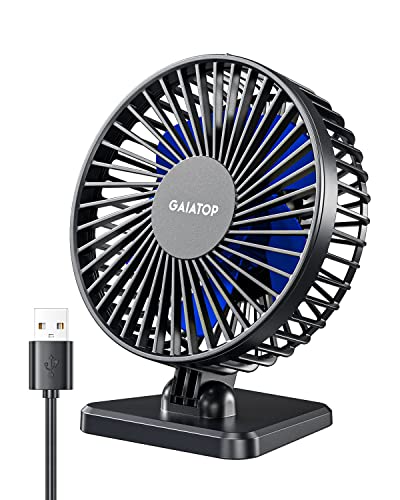
Gaiatop USB Small Desk Fan Review
A warm laptop, a crowded desk, and barely moving air can turn a normal afternoon into a sticky little endurance test. A full-size fan often creates more trouble than it fixes, especially when papers start fluttering and valuable surface space disappears under a wide base. The Gaiatop model enters the best tiny desk fan category with a body weighing less than eight ounces, three airflow settings, USB power, and a modest vertical adjustment range. It keeps the formula refreshingly simple, though that simplicity also brings a few limits that deserve a straight answer.
Gaiatop USB Small Desk Fan
The first thing that stands out is the fan’s compact, lightweight build. Weighing less than eight ounces, it’s easy to move from a desk to a nightstand, car console, kitchen counter, or temporary travel setup. It won’t claim the same surface area as a traditional table fan, which matters when a keyboard, mouse, phone stand, and coffee cup are already elbowing one another. Small size doesn’t guarantee strong cooling, of course, but it does make daily placement far less of a headache.
The classic circular design avoids flashy lighting, oversized controls, and decorative parts that add bulk without improving airflow. That plain approach suits workspaces where the fan should blend in rather than become the center of attention. The blue housing adds a little personality, yet the overall shape remains practical and familiar. Nothing about it suggests a complicated setup, and that’s probably the point.
Portability here refers to size and weight, not cordless operation. The Gaiatop fan needs a powered USB connection, so it won’t run independently in the middle of a room or outdoors without a power bank. That distinction is easy to miss because many small fans now include rechargeable batteries. The USB-only design keeps the body light, but it ties every cooling session to a nearby power source.
Three Speeds Keep Airflow Simple
Low, medium, and high settings cover the basic range most people expect from a personal fan. The lowest mode makes sense during focused work, reading, or quiet evening use, while the middle level offers a firmer breeze without jumping straight to maximum output. High speed is there for warmer moments when a gentle puff just isn’t getting it done. The three-speed system favors quick decisions over endless adjustment.
A single power button cycles through the speed levels. That keeps the controls easy to understand, though it also means several presses may be needed to move from high speed back to low. There’s no dial to turn and no separate button for each setting. The one-button operation is tidy and dependable, but anyone who likes direct control may find it a bit bare-bones.
Three settings also create noticeable gaps between airflow levels. Some people prefer many smaller increments because the jump from low to medium can feel larger than expected at close range. Others would rather tap a button twice and get on with their day. The Gaiatop’s simple airflow control clearly leans toward the second camp.
Strong airflow claims need to be kept in proportion to the fan’s physical size. This is a personal cooling device, not a room circulator, and it’s most useful within a short distance. A breeze aimed toward the face, neck, or hands can make a workstation feel less stuffy without trying to change the temperature of the entire room. That close-range cooling is where a tiny fan earns its keep.
Quiet Enough For Work, With A Caveat
The supplied specifications state that noise remains below 50 dB even while the fan provides stronger airflow. That gives a useful ceiling, but it doesn’t mean every setting is whisper-soft or impossible to notice. Motor tone, blade noise, and distance all affect how the sound feels in real use. The sub-50 dB rating suggests controlled operation, though quiet is still a relative term.
Lower speed should be the natural choice for video calls, reading, or concentrated computer work. A steady fan sound often fades into the background more easily than an irregular rattle or high-pitched whine. The product information doesn’t describe the exact sound character, so it would be unfair to promise a perfectly smooth hum. A realistic expectation is less intrusive noise at lower speed and more audible air movement as output increases.
High speed creates more wind noise because faster-moving air has to pass through the grille and around the blades. That’s a normal tradeoff rather than evidence of poor design. The important question is whether the extra sound remains tolerable at arm’s length, and the stated noise limit suggests that Gaiatop has tried to keep it under control. Still, the airflow versus noise balance will matter more in a silent bedroom than in a busy office.
Sleep use calls for a little caution. Less than 50 dB may feel perfectly acceptable during the day yet more noticeable after the room becomes quiet. There’s also no timer mentioned in the supplied details, so the fan should be treated as a manually operated device. The lack of a stated sleep timer means it will continue running until switched off or disconnected.
A Limited But Useful Tilt Range
The fan head moves vertically from 0 to 30 degrees. That’s enough to raise the airflow from a low desktop position or make a small adjustment toward the upper body. It won’t provide the sweeping flexibility of a 180-degree or fully rotating head, but it does prevent the fan from being locked into one rigid angle. The 30-degree vertical adjustment is modest, practical, and easy to understand.
Angle control matters because compact fans often sit below face level. A slight upward tilt can keep air from hitting only the hands or chest, especially when the unit rests beside a keyboard. That little change may improve comfort more than moving the whole fan repeatedly. The adjustable airflow direction helps compensate for imperfect desk height without requiring makeshift stands.
The limited range becomes more noticeable on tall shelves, deep nightstands, or unusual mounting positions. The fan can’t point sharply downward, turn sideways through its frame, or rotate through a full circle. Repositioning the entire unit may still be necessary in some setups. That’s a clear directional limitation, particularly beside beds or in vehicles where surfaces don’t always line up neatly.
No oscillation feature is included in the supplied description. Focused airflow can actually be preferable for one person because the breeze doesn’t keep sweeping away. Shared use is another story, since a fixed fan won’t distribute air evenly between two seats. The stationary airflow pattern suits personal comfort better than broad coverage.
USB Power Fits More Than One Setup
The fan works with USB-compatible sources such as computers, laptops, power banks, AC adapters, and car chargers. That range makes it easy to move between common environments without carrying a proprietary power brick. A laptop can power it at a desk, while a car adapter can support it during a parked break or road trip stop. The broad USB compatibility is one of the fan’s most practical strengths.
Travel overseas becomes simpler because the fan itself relies on USB rather than a region-specific wall plug. A suitable USB adapter is still required for the local outlet, but the fan doesn’t need a separate voltage-specific power supply. That reduces one layer of packing confusion. The 5V-style USB arrangement is convenient, though the exact electrical requirements aren’t listed in the provided details.
A power bank gives the fan a form of portable operation, but the battery remains a separate object. That means another cable, another device to charge, and more weight in a bag. It’s still useful for a picnic table, parked car, campsite, or temporary workspace without an outlet. The external power-bank option adds flexibility without turning the fan itself into a rechargeable model.
The absence of an internal battery has a few upsides. There’s no built-in cell gradually losing capacity, no waiting for the fan itself to recharge, and no uncertainty about remaining runtime once a reliable USB source is connected. The downside is immediate and obvious: unplug the cable, and the airflow stops. The corded power model favors consistency over total freedom.
Desk, Car, And Travel Use
A small office desk is probably the most natural home for this fan. Its low weight and compact body make it easy to fit beside a monitor without blocking the screen or crowding the mouse area. The three speeds allow a soft breeze during calls and a stronger setting during a warm afternoon. That combination gives the Gaiatop small desk fan a sensible role in close, personal workspaces.
Car use is possible through a USB-compatible charger, but placement needs thought. A lightweight fan should sit on a stable, flat surface where braking or turning won’t send it sliding. It shouldn’t obstruct controls, visibility, or airbag zones. The car-friendly USB power is useful, though secure positioning matters more than simply plugging it in.
Travel exposes both the fan’s strongest and weakest traits. Less than eight ounces is easy to pack, and the compact frame won’t eat up much suitcase space. But a power source must always come along, whether that’s a charger, laptop, or battery pack. The lightweight travel design earns points for portability while giving some of them back through cord dependence.
Outdoor use follows the same pattern. With a power bank, the fan can provide a personal breeze at a table, tent entrance, or shaded rest area. Open air quickly disperses airflow, though, so the fan needs to remain close to be useful. The personal outdoor cooling works best as a direct breeze rather than an attempt to cool a broad space.
Strengths That Matter In Daily Use
The compact body is more than a marketing detail because desk space is often the first thing a personal fan gets wrong. A smaller footprint leaves room for work while making the unit easier to store between seasons. The low weight also reduces the hassle of moving it around the house or carrying it during travel. These space-saving benefits are simple, but they solve a real everyday problem.
Three speeds offer enough adjustment for changing conditions without creating control overload. Low speed suits quieter moments, medium handles ordinary warmth, and high provides the strongest available breeze. That familiar layout makes the fan easy to operate without a manual nearby. The straightforward speed range is especially appealing where shared equipment needs to be understood quickly.
USB compatibility is another practical win. Computers, wall adapters, power banks, and car chargers cover many of the places where a small fan might be used. No specialized connector is mentioned, which keeps replacement power options easier to manage. The flexible USB support helps the fan move between home, office, vehicle, and travel routines.
Weaknesses Worth Knowing Beforehand
The limited 30-degree tilt range is the most obvious mechanical compromise. It can improve the airflow angle, but it won’t match the flexibility of a fan that rotates through 180 or 360 degrees. Awkward bedside tables and elevated shelves may require repositioning the entire base. This restricted tilt range matters more in unusual spaces than on a normal desk.
No internal battery means the fan is never truly cordless. A power bank can mimic cordless placement, but that setup still involves a cable and a second device. Anyone wanting a fan that can move instantly from room to room while running may feel boxed in. The lack of rechargeable power is a clear limitation, not a hidden footnote.
The supplied information doesn’t mention a timer, oscillation, detachable grille, remote control, battery display, or multiple mounting options. Those features shouldn’t be assumed simply because other small fans include them. Gaiatop has kept the design focused on airflow, size, noise control, and USB compatibility. The basic feature set keeps things simple but may feel sparse beside more elaborate models.
This fan makes the most sense where direct airflow, low weight, and minimal desk use matter more than automation. It won’t cool a whole room, run without external power, or aim through a dramatic range of angles. What it does offer is a portable USB-powered breeze with three straightforward speeds and a restrained sound profile. Within those boundaries, the Gaiatop USB Small Desk Fan stays practical, honest, and refreshingly uncomplicated.
RJVW 4-Inch USB Desk Fan Review
Desk space disappears quickly once a laptop, monitor, mug, phone, and a pile of notes settle in for the day. A bulky cooling appliance only adds to the clutter, yet sitting through stale summer air isn’t exactly a treat either. The RJVW model approaches the best tiny desk fan role with a four-inch frame, a 0.37-pound body, three speeds, and a fully rotating head. It’s built for close-range cooling rather than whole-room circulation, and that distinction shapes nearly every strength and limitation in this review.
RJVW 4-Inch USB Desk Fan
The fan’s 0.37-pound weight makes it easy to shift around without rearranging the entire desk. It can sit beside a keyboard during work, move to a nightstand for reading, and slip into a travel bag once the day is done. That kind of portability sounds ordinary until a heavier fan starts feeling like permanent furniture. Small, light, and uncomplicated, the RJVW is meant to follow the breeze rather than anchor one spot.
Its four-inch size helps preserve room on narrow desks, dorm shelves, and crowded computer stations. A larger grille may move more air, but it also blocks sightlines and crowds nearby accessories. The RJVW takes the opposite approach by keeping its desktop footprint modest and focusing airflow on the person sitting close by. That makes it better suited to a face, hands, or upper body than to an entire office.
The supplied USB cable measures 3.9 feet, which offers reasonable reach for a nearby laptop, wall adapter, or power bank. Still, it isn’t unusually long, so placement may become awkward if the power source sits under a deep desk or across a wide nightstand. A cable extension or closer adapter might be needed in those situations. The 3.9-foot cord is adequate for compact setups but less forgiving than longer five-foot leads.
Three Speeds Without The Fuss
Low, medium, and high settings give the fan a familiar range of airflow choices. Low speed suits quiet desk work or reading, medium adds a firmer breeze for ordinary warmth, and high provides the strongest available cooling at close range. The three-speed adjustment won’t satisfy anyone who wants dozens of tiny increments, but it keeps daily use quick. Press, choose, move on.
Simple controls often make more sense on a fan this small. There’s no display, remote, app, or elaborate mode system mentioned in the supplied details. That reduces clutter and removes features that could feel silly on a four-inch desktop appliance. The straightforward speed control fits the fan’s practical personality, though exact button placement isn’t specified.
Three settings also create wider jumps between airflow levels than a continuously adjustable fan. Low may feel too gentle during a hot afternoon, while medium could be a little stronger than desired at very close range. Moving the unit farther away can soften the breeze, but that takes up more placement room. The limited speed range is easy to operate, yet less precise than models with finer control.
High speed should be viewed as personal cooling, not a substitute for an air conditioner or room circulator. A four-inch fan simply doesn’t have the blade area or housing depth needed to move air evenly through a large bedroom. Kept within arm’s reach, however, it can create a focused breeze where heat feels most distracting. That close-range airflow is the realistic standard to use here.
Five Blades And A Brushless Motor
The fan uses five blades along with a brushless motor. That combination is intended to produce steady airflow while keeping power use and mechanical noise under control. The product details call the fan ultra-quiet, but no exact decibel figure is provided. The safest takeaway is that the brushless motor is designed for calmer personal use, not that every speed will be silent.
Blade count alone doesn’t determine cooling performance. Blade shape, motor speed, grille resistance, and distance from the fan all affect how the breeze feels. Five blades can support a smoother stream of air, but the four-inch diameter still sets a physical limit on total output. The compact blade system favors focused comfort over wide circulation.
Lower settings should naturally produce less wind noise than the highest mode. Even a quiet motor can’t remove the sound of faster air moving through the grille, so high speed will be more noticeable in a silent bedroom. Office chatter, keyboard taps, and normal household noise may mask it more easily. The noise and airflow tradeoff is normal for a small fan and shouldn’t be mistaken for a defect.
Low electricity use is another stated benefit of the motor design. No exact wattage is supplied, so specific energy-cost claims would be guesswork. Still, USB operation and a small motor generally suit long desk sessions better than running a large room fan solely for one chair. The low-power format supports personal cooling without pretending to change the temperature of the whole space.
USB Power Offers Broad Compatibility
The RJVW fan can draw power from laptops, power banks, car USB ports, USB sockets, and standard USB adapters. That broad compatibility makes it easy to move between a home desk, office computer, vehicle, hotel room, or temporary outdoor setup. There’s no special wall brick mentioned, which reduces the number of proprietary accessories to remember. The USB-powered design is flexible as long as a functioning port remains nearby.
No built-in battery is included. That point deserves emphasis because the fan is described as portable, and portable doesn’t automatically mean cordless. It can travel easily due to its size and weight, but it stops the moment the USB cable loses power. The battery-free construction keeps the unit light while limiting true wire-free freedom.
A power bank can bridge that gap during travel, outdoor sitting, or a power outage. The fan can run from the external battery while remaining easy to reposition, although the cable and power bank still need a place to sit. That setup adds another item to carry and charge. The external battery option works, but it isn’t as tidy as an integrated rechargeable design.
Battery-free operation also has a practical upside. There’s no internal cell to age, lose capacity, or sit empty after months in storage. Connected to a reliable USB source, the fan can continue running without waiting for a recharge cycle. The continuous powered use makes sense for a permanent desk, even if it feels less convenient during frequent room-to-room moves.
Full Rotation Solves Awkward Placement
The head can rotate through 360 degrees, giving the airflow a much wider directional range than a fan with a limited tilt hinge. It can point upward from a low desk, angle toward a bed, or redirect air without forcing the base into an unstable position. That flexibility is useful when the nearest USB port and the most comfortable airflow angle don’t line up. The 360-degree rotation is one of the RJVW fan’s clearest advantages.
A fully adjustable head also makes indirect cooling easier. Direct airflow toward the eyes can become uncomfortable during long computer sessions, so aiming the breeze slightly above or beside the face may feel better. The same trick helps at night when constant air on the skin becomes chilly. The directional control gives this small fan more usable placement options than its size suggests.
Rotation isn’t the same as oscillation. The head can be positioned around its frame, but the supplied details don’t say that it sweeps automatically from side to side. Airflow therefore stays focused where it’s aimed. That fixed personal breeze works well for one position but won’t distribute air evenly between several seats.
Frequent angle changes also put more attention on base stability. A fan that tips or slides every time the head moves becomes annoying in a hurry. RJVW adds a non-slip pad underneath to help the base stay planted during adjustment. The non-slip foundation supports practical use on smooth desks, though a level surface is still the sensible choice.
A Stable Base For Small Surfaces
Lightweight fans can vibrate across polished furniture if their feet don’t provide enough grip. The RJVW’s bottom pad is designed to reduce that movement and keep the unit from falling easily during angle changes. It may also soften some vibration transferred into wood, glass, or laminate. The non-slip mat is a small detail with a noticeable effect on everyday usability.
Stability matters around laptops, drinks, charging cables, and stacks of paper. A fan that creeps toward the edge of a desk becomes a distraction rather than a comfort tool. The pad helps the light body behave more like a settled appliance instead of a loose travel accessory. Still, the 0.37-pound construction won’t feel as anchored as a heavier metal fan.
Outdoor tables and car interiors introduce uneven or moving surfaces that demand extra caution. The fan should sit where sudden movement, wind, or braking won’t knock it over or send it sliding. A non-slip pad helps, but it can’t compensate for unsafe placement. The lightweight base is convenient to carry and naturally more vulnerable in unstable surroundings.
Quiet Cooling For Work And Rest
A small fan often sits only a foot or two from the ears, so sound quality matters as much as raw airflow. The brushless motor is intended to keep operation controlled, particularly on the lower settings. No exact sound measurement is provided, which means claims about whisper-level performance would go beyond the supplied information. The quiet motor design is promising, but expectations should remain tied to speed and distance.
Low mode is the sensible starting point for calls, studying, reading, or late-night use. A soft and consistent hum can blend into the room more easily than buzzing or rattling. The fan’s non-slip pad may also reduce vibration noise against the desktop. Together, the low-speed airflow and supported base should create the calmest operating setup.
High speed will sound more obvious because stronger air movement produces its own noise. That doesn’t contradict the fan’s quiet positioning; it simply reflects the tradeoff between cooling force and sound. Moving the fan slightly farther away may make the breeze feel gentler while reducing the sound heard at close range. The highest-speed setting is better suited to quick cooling than silent rest.
No timer or sleep mode is mentioned. The fan should therefore be treated as a manually controlled device that runs until it’s switched off or unplugged. That may be perfectly fine beside a computer, but it leaves no automatic shutdown for naps or overnight use. The absence of a stated timer is worth noting for bedside routines.
Travel Convenience With A Cord Attached
At only 0.37 pound, this fan adds little weight to an office bag, backpack, or suitcase. Its small frame can fit into spaces that would never accommodate a standard table fan. That makes it practical for dorm rooms, temporary workstations, hotel desks, and compact travel setups. The lightweight portability is real, even though the fan itself isn’t rechargeable.
The 3.9-foot cable is manageable in a bag and less likely to become a tangled mess than a very long lead. On the other hand, it may limit positioning in rooms where outlets sit behind furniture or far from a table. A USB wall adapter, laptop, or power bank still has to be available. The corded travel setup stays simple but requires a bit of planning.
Outdoor use depends almost entirely on a portable power source. Connected to a power bank, the fan can provide a personal breeze at a picnic table, campsite, or shaded waiting area. Open air disperses airflow quickly, so it needs to remain fairly close to be effective. The outdoor cooling role is narrow and personal rather than broad.
A car USB port expands its usefulness during parked breaks or warm passenger moments. Safe placement is essential because the fan must not block controls, visibility, vents, or airbag areas. Its low weight makes it easy to move but also easier to dislodge. The car-compatible power is useful only when the fan can sit securely.
Maintenance And Daily Care
Dust naturally collects on fan grilles and blade edges, gradually narrowing airflow paths. The provided description doesn’t mention a detachable cover, so cleaning access shouldn’t be assumed. A soft brush or dry cloth can handle visible buildup through the grille while the fan is unplugged. Regular attention supports cleaner airflow without risking moisture near the motor.
The fan should never be cleaned while connected to power. Liquids, sprays, and wet cloths can reach electrical parts through grille openings, especially on a housing this small. Gentle surface cleaning is safer than trying to force tools deep into the blade area. The USB electrical design calls for the same basic care as other compact electronics.
Cable condition matters too. Repeated bending near the connector can weaken a fixed cord, so the fan shouldn’t be stored with the cable wrapped tightly around the housing. Loose coiling places less stress on the connection point. That simple habit helps protect the 3.9-foot USB cable during frequent travel.
Strengths, Weaknesses, And Realistic Expectations
The RJVW fan’s strongest qualities are easy to identify: low weight, small size, three simple speeds, full rotational adjustment, broad USB compatibility, and a non-slip base. Each feature solves a practical annoyance without adding much bulk. The unit can sit on a busy desk, travel in a small bag, and aim airflow from a wide range of positions. Those core strengths fit the daily needs of personal cooling better than decorative extras would.
The main weakness is the lack of a built-in battery. Portability is limited by the need for a USB source, and the 3.9-foot cable may not reach every convenient location. Three speeds provide less precision than continuously adjustable models, while no oscillation or timer is stated. These functional limitations keep the fan simple but narrow its usefulness in certain setups.
The gift-focused description leans heavily on the fan’s cute size and practical purpose. A small cooling device can be useful during warm weather, yet suitability depends on whether corded USB operation fits the recipient’s routine. Someone expecting cordless use may be disappointed, while a desk-bound setup may benefit from the straightforward power arrangement. The gift appeal comes from portability and simplicity rather than luxury presentation.
RJVW also states that customer service is available around the clock for product questions. That claim comes from the supplied product details, and no independent response-time evidence is provided here. Support can be reassuring if the unit arrives damaged or develops an issue, but the exact remedy and process may depend on the seller’s terms. The stated service availability is a useful inclusion, though it shouldn’t overshadow the fan’s physical features.
This model belongs beside one person, not in the center of a room. It can cool a workstation, reading spot, bedside area, dorm desk, or travel table without taking over the surface. It won’t run independently, sweep air across multiple seats, or replace larger cooling equipment. Framed honestly, the RJVW 4-Inch USB Desk Fan is a compact and flexible option for direct airflow where size matters more than cordless freedom.

Best Quiet Ceiling Fan For Bedroom 2026 Ultimate Comfort Picks

Best Ceiling Fan For Master Bedroom 2026 With Ultimate Comfort

Best White Ceiling Fan With Light For Bedroom 2026 Top Picks

Best Quorum Medallion Ceiling Fan 2026 With Style & Breeze
Best Outdoor Fan For Pergola 2026 Comfort Boost

Best Ceiling Fan For Great Room 2026 With Ultimate Comfort

Best Outdoor DC Ceiling Fans 2026 For Breezy Comfort
Best ceiling exhaust bath fan with light and heater 2026





