
Best Ventilation Fan for Garage 2026: Cleaner Air

A closed garage can turn uncomfortable fast. Summer heat collects near the ceiling, damp air hangs around after a storm, and odors from paint, fuel, lawn equipment, or a running vehicle may linger much longer than expected. The best ventilation fan for garage spaces tackles those problems by exchanging trapped indoor air with fresher outdoor air instead of simply pushing the same hot air from one corner to another.
Airflow capacity deserves the first look because an undersized fan may run constantly without making the room feel noticeably better. Fan output is commonly expressed in cubic feet per minute, often shortened to CFM, and the right capacity depends on the garage volume rather than floor area alone. A tall two-car garage holds far more air than a compact single-car space, so ceiling height can change the result quite a bit. Bigger isn’t automatically better, though, since excessive airflow may create pressure issues, pull conditioned air from an attached home, or make lightweight doors rattle.
A practical setup also needs a clear path for replacement air. An exhaust fan can’t move air efficiently if every door, window, and vent is sealed tight, much like trying to drink through a pinched straw. Intake vents, wall louvers, door grilles, or a slightly opened window allow fresh air to enter while the fan removes heat and contaminants from the opposite side. Placing the exhaust point high on a wall helps capture rising heat, while lower intake openings encourage a more complete sweep across the room.
Noise matters more than it seems, especially when the garage doubles as a workshop, home gym, hobby room, or storage area beside a bedroom. A powerful industrial fan may move plenty of air, but a harsh motor hum or vibrating shutter can become irritating during long projects. Look beyond raw CFM and consider sound ratings, balanced blades, solid mounting hardware, and insulated wall construction. Rubber isolation pads can also reduce the buzzing that travels through framing, which is a small detail that often makes a big difference.
Controls shape the daily experience, too. A basic switch keeps things simple, while a thermostat can start the fan automatically when heat builds past a chosen point. Humidistats are useful where condensation, wet vehicles, or seasonal humidity create musty conditions, and timers help clear odors without leaving the motor running all night. Smart controls sound convenient, but they’re only worthwhile when the added electronics suit the environment and won’t complicate an otherwise straightforward job.
Installation brings a few tradeoffs that shouldn’t be brushed aside. Wall-mounted exhaust fans usually offer direct outdoor venting, yet cutting through siding, masonry, or insulated walls may call for professional help. Ceiling-mounted models can work well when ducting has a short, unobstructed route outdoors, but long duct runs and sharp bends reduce effective airflow. A proper exterior shutter or backdraft damper also helps block rain, pests, and unwanted cold air when the fan is off.
Safety sits at the center of the decision. Standard ventilation can reduce ordinary heat, moisture, and mild odors, but it isn’t a substitute for approved equipment in areas where flammable vapors may accumulate. Gasoline, solvents, and certain finishes can create hazardous conditions, so electrical components and fan construction must match the actual risk. Also, a garage fan should never be treated as permission to idle a vehicle indoors, since carbon monoxide can reach dangerous levels quickly even with doors or vents open.
The strongest choice balances useful airflow, manageable noise, sensible controls, and dependable weather protection. It should fit the room’s volume, provide a real intake path, and exhaust directly outdoors without an unnecessarily complicated duct route. Maintenance should stay simple as well, because dusty blades, clogged screens, and sticky shutters gradually cut performance. Get those basics right, and the garage feels less like a sealed metal box and more like a space that’s comfortable enough to use year-round.

- LFR Score9.4
LFR Score is a ranking system developed by lightfansreviews.com. LFR Score has no relationship or impact from any manufacturers or sales agent websites. Learn more
- BrandiLiving

- LFR Score9.2
LFR Score is a ranking system developed by lightfansreviews.com. LFR Score has no relationship or impact from any manufacturers or sales agent websites. Learn more
- BrandiLiving

- LFR Score9.2
LFR Score is a ranking system developed by lightfansreviews.com. LFR Score has no relationship or impact from any manufacturers or sales agent websites. Learn more
- BrandVEVOR

- LFR Score9.2
LFR Score is a ranking system developed by lightfansreviews.com. LFR Score has no relationship or impact from any manufacturers or sales agent websites. Learn more
- BrandVEVOR
- LFR Score9.0
LFR Score is a ranking system developed by lightfansreviews.com. LFR Score has no relationship or impact from any manufacturers or sales agent websites. Learn more
- Brandaddlon

- LFR Score9.0
LFR Score is a ranking system developed by lightfansreviews.com. LFR Score has no relationship or impact from any manufacturers or sales agent websites. Learn more
- BrandiLiving

- LFR Score9.0
LFR Score is a ranking system developed by lightfansreviews.com. LFR Score has no relationship or impact from any manufacturers or sales agent websites. Learn more
- BrandVEVOR

- LFR Score8.8
LFR Score is a ranking system developed by lightfansreviews.com. LFR Score has no relationship or impact from any manufacturers or sales agent websites. Learn more
- BrandHG Power

- LFR Score8.8
LFR Score is a ranking system developed by lightfansreviews.com. LFR Score has no relationship or impact from any manufacturers or sales agent websites. Learn more
- Branddreamdragon
- LFR Score8.6
LFR Score is a ranking system developed by lightfansreviews.com. LFR Score has no relationship or impact from any manufacturers or sales agent websites. Learn more
- BrandAmico

- LFR Score8.6
LFR Score is a ranking system developed by lightfansreviews.com. LFR Score has no relationship or impact from any manufacturers or sales agent websites. Learn more
- BrandAmico

- LFR Score8.6
LFR Score is a ranking system developed by lightfansreviews.com. LFR Score has no relationship or impact from any manufacturers or sales agent websites. Learn more
- BrandAmico
Last update on 2026-07-08 / Affiliate links / Images, Product Titles, and Product Highlights from Amazon Product Advertising API
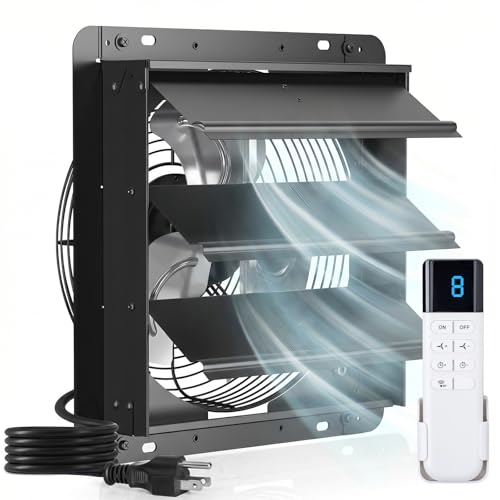
iLIVING 18-Inch Thermostat Exhaust Fan
Heat that settles near a garage ceiling can make even a short project feel longer than it should. Add paint fumes, damp air, sawdust, or the smell of stored equipment, and a basic floor fan often just moves the discomfort from one side of the room to the other. The iLIVING 18-Inch Thermostat Exhaust Fan takes a more direct approach by pushing stale indoor air outside through a wall-mounted shutter design. Its 1,736 CFM airflow, automatic shutters, and adjustable controls make it a serious fit for garages that need more than casual air circulation.
iLIVING 18-Inch Exhaust Fan
The core appeal is simple: this fan is built to exchange a large volume of air without relying on a complicated duct system. Its 18-inch steel blades use a deep pitch angle to move up to 1,736 cubic feet of air per minute, which gives it enough muscle for larger garages, workshops, greenhouses, and similar spaces. The listed coverage reaches up to 2,600 square feet, though actual results will still depend on ceiling height, intake airflow, wall placement, and how tightly the room is sealed. Put bluntly, the fan needs somewhere to pull replacement air from, or that impressive airflow figure won’t translate into equally impressive ventilation.
The direct-drive motor keeps the design relatively straightforward. There are fewer moving parts than belt-driven systems, and the permanently lubricated motor reduces the amount of routine attention the unit should require. Rated at 115 volts, 0.85 amps, 1/15 horsepower, and 1,075 RPM, it doesn’t demand an unusually heavy electrical setup for a fan of this size. Still, the wiring and wall opening deserve careful planning because this isn’t a plug-in desk fan that can be shifted around after installation.
The included automatic shutters are more useful than they may look in product photos. They open as the fan operates and close when airflow stops, helping limit rain, debris, insects, and outside air from drifting back into the garage. The aluminum shutters also keep weight manageable while resisting corrosion better than untreated steel parts might. That said, shutters can collect dust and grime over time, so they’ll need occasional cleaning if the fan is mounted near woodworking, lawn equipment, or other messy activity.
Thermostat And Variable Speed Control
Raw airflow is only half the story here. The included Thermospeed controller allows both temperature-based operation and variable speed adjustment, which makes the fan easier to live with than a single-speed industrial unit. The temperature control range runs from 32 to 130 degrees Fahrenheit, giving the system enough flexibility for seasonal changes, hot garages, and spaces that only need ventilation after temperatures climb past a chosen point. That automatic response can be especially handy when heat builds during the afternoon and nobody wants to keep walking back to a wall switch.
The speed control adds another layer of practicality. Full output makes sense when the garage is packed with heat or stale air, but maximum airflow may be unnecessary during mild weather or quieter tasks. Turning the speed down can reduce drafts, soften the sound, and avoid pulling more outside air into the space than needed. The adjustable ventilation also makes the unit more adaptable for workshops where temperature, dust, and noise priorities change throughout the day.
There is a tradeoff, though. Speed controls and thermostats add convenience, but they also introduce more setup decisions than a plain on-off fan. Placement of the temperature sensor matters because a controller mounted beside a hot exterior wall or directly in the fan’s airflow may not reflect the average garage temperature. Careful positioning helps the thermal control respond to the room rather than a small pocket of unusually hot or cool air.
The controller is most valuable when the fan is treated as part of a broader airflow plan. A cracked window, wall intake vent, or louver on the opposite side of the garage gives the exhaust fan a reliable source of replacement air. Without that path, the motor may run while airflow falls short of expectations. The result can feel a bit like trying to breathe through a straw, plenty of effort with less movement than the hardware should deliver.
Construction And Long-Term Durability
The frame uses industrial-grade galvanized steel, while the shutters and fan blades are aluminum. That material mix suits garages and workshops where humidity, temperature swings, and airborne dust can punish lighter household equipment. Galvanized steel helps protect the frame from corrosion, and aluminum keeps the moving components from becoming unnecessarily heavy. The overall construction feels aimed at permanent installation rather than occasional seasonal use.
The corrosion-resistant design is particularly relevant in garages that hold wet vehicles, lawn tools, fertilizers, or containers that bring moisture inside. Condensation and damp air can slowly attack exposed metal, especially in spaces that stay closed for long stretches. No exhaust fan is maintenance-free, but better materials reduce the odds of rust becoming an early nuisance. Wiping the shutters, checking the wire guard, and clearing dust from the blades should help preserve airflow over time.
The OSHA-compliant wire guards add a practical layer of protection around the moving blades. That matters in busy work areas where cords, storage bins, and long-handled tools tend to migrate toward walls. The protective guarding doesn’t replace sensible installation height or clearance, but it does reduce exposure to the fan mechanism. UL and cUL listing also provide a useful reference point for electrical construction without requiring buyers to take the manufacturer’s claims entirely on faith.
One realistic limitation is the wall-mount requirement. Cutting an opening for an 18-inch exhaust fan is a more involved job than hanging a small circulation fan from a bracket. Wall framing, siding, masonry, insulation, wiring, and weather sealing can all affect the installation. The fan itself may be straightforward, but the surrounding work can turn into the bigger part of the project.
Airflow Performance In A Garage
The listed 1,736 CFM output gives this model enough capacity to make a noticeable difference in many medium and large garages. Hot air naturally collects high in the room, so mounting the unit toward the upper section of an exterior wall can help remove that trapped layer more effectively. A lower intake opening across the space encourages cooler replacement air to travel through the occupied area before reaching the exhaust point. That crossflow pattern usually works better than placing the intake and exhaust close together.
Garage size alone doesn’t tell the full story. A tall ceiling, insulated walls, attached living space, and the number of exterior openings all shape the fan’s real-world effect. The stated 2,600-square-foot coverage is useful as a broad capacity reference, but it shouldn’t be treated as a guarantee for every building layout. Long, divided, or tightly sealed spaces may need more deliberate intake placement to avoid stagnant corners.
The fan is also described for dust extraction, though that phrase needs a little perspective. It can help remove airborne particles and stale workshop air, but it isn’t a substitute for a dedicated dust collector connected directly to saws, sanders, or planers. Fine dust is easier to control at the source than after it spreads across an entire garage. Used alongside local collection, the high-volume exhaust can help clear the remaining haze and improve overall air exchange.
Fumes require similar caution. The fan can reduce ordinary odors from paint, cleaning products, and stored equipment, yet it shouldn’t be treated as specialized protection for explosive or highly flammable vapor. Gasoline and solvent-heavy environments may require equipment designed and rated for hazardous locations. Also, no ventilation fan makes it safe to idle a vehicle inside a closed garage, since carbon monoxide can build rapidly and unpredictably.
Noise And Daily Comfort
The stated noise level is below 65 decibels, which is reasonable for a large wall-mounted exhaust fan but not whisper-quiet. At higher speeds, airflow through the shutter and vibration against the wall may be as noticeable as the motor itself. In a detached garage, that may be a minor concern. In an attached garage near a bedroom, office, or living room, installation quality becomes much more important.
Solid framing helps reduce rattling, while proper fasteners keep the housing from flexing under load. Rubber isolation material between the frame and mounting surface may also limit vibration traveling through the wall. The variable speed control provides another practical way to manage sound because the fan doesn’t always need to run flat out. Lower speed can be far easier on the ears during routine work, then full airflow remains available when heat or odors spike.
Shutter noise deserves attention as well. Lightweight blades can flutter if outdoor wind pushes against them, and accumulated grime may prevent smooth opening or closing. Keeping the shutters clean and checking that they move freely can prevent annoying chatter. A stable exterior wall location, protected from severe crosswinds where possible, will help the automatic shutters behave more predictably.
The overall sound level fits the fan’s industrial character. This isn’t a discreet bathroom ventilator, and expecting silent operation would set the wrong benchmark. Its purpose is to move a substantial amount of air through a relatively large opening. The better question is whether the noise feels justified by the airflow, and the adjustable controller gives this model a better chance of striking that balance.
Installation And Practical Tradeoffs
The wall-mounted format offers a direct exhaust route, which is one of the model’s strengths. There’s no need to snake a long duct through an attic if the garage has a suitable exterior wall. Shorter airflow paths reduce resistance and help the fan operate closer to its rated output. The wall exhaust design also keeps the setup visually simple once the opening, wiring, and exterior sealing are complete.
Installation accuracy matters because a poorly sized opening can cause vibration, air leaks, and weather problems. The frame should sit square, the shutters need enough clearance to open fully, and the exterior edges must be sealed against water intrusion. Electrical work should match local requirements and the fan’s 115-volt specification. Anyone uncomfortable with cutting through a wall or handling permanent wiring will probably be better served by hiring a qualified installer.
The fan’s size may also limit placement options. Storage racks, garage door tracks, wall studs, electrical runs, and exterior features can compete for the same upper-wall space. Measuring first sounds obvious, yet it’s easy to focus on the blade diameter and forget the full housing dimensions and shutter clearance. The 18-inch format needs a meaningful section of unobstructed wall, not just a small circular hole.
A related wall-mounted fan reference appears in wall fan options, where mounting style, room size, and airflow expectations can be viewed from a different angle. That comparison matters because a circulation fan and an exhaust fan solve different problems, even though both attach to a wall. One moves air around the room, while the other removes indoor air and depends on a replacement-air path. Mixing up those roles often leads to disappointing results.
Strengths And Weaknesses
The biggest strength is the combination of strong airflow and adjustable control. Many industrial exhaust fans provide plenty of output but little flexibility, while this model includes both variable speed and thermostat regulation. That makes it easier to tailor operation to changing weather, garage activity, and noise tolerance. The automatic shutters also keep daily use simple because there’s no manual vent panel to open before switching the fan on.
Durable materials are another clear advantage. The galvanized steel frame, aluminum blades, corrosion-resistant construction, and permanently lubricated motor suit a space that may be dusty, damp, or exposed to temperature swings. UL and cUL listing add reassurance around the electrical design. Local customer support is also mentioned, which can be useful if controller setup, mounting, or replacement parts raise questions.
The main weakness is that the fan demands permanent installation. It requires a large wall opening, weather sealing, reliable wiring, and enough intake ventilation elsewhere in the garage. That can add cost and effort beyond the fan itself. Renters or anyone unable to modify an exterior wall will probably need a less permanent approach.
Noise is another realistic compromise. A rating under 65 decibels is manageable for industrial ventilation, but the unit won’t disappear into the background at full speed. The thermostat and speed controller help soften that issue, though they can’t make an 18-inch high-airflow fan silent. For garages where conversation, recording, or quiet indoor work matters more than aggressive ventilation, a smaller or acoustically isolated setup may be easier to live with.
Best Use And Realistic Expectations
This model makes the most sense where heat, stale air, moisture, or workshop odors repeatedly build up and opening the garage door isn’t a complete solution. Its airflow capacity is better suited to meaningful air exchange than gentle circulation. A well-positioned intake can help the fan sweep air across the garage rather than creating a short loop near one wall. That setup becomes especially useful during hot weather or after activities that leave the room stuffy.
The thermostat is valuable for garages that heat up while unattended. Instead of waiting for someone to notice the temperature, the automatic temperature control can start ventilation within the selected range. Variable speed then prevents every situation from receiving the same full-power response. That combination offers more control over energy use, noise, and drafts than a basic single-speed shutter fan.
Expectations should stay grounded. The fan won’t cool below the outdoor temperature unless another cooling system is involved, and it won’t remove dust as effectively as source collection. It also can’t fix poor intake design, blocked shutters, or an unsuitable mounting location. What it can do is provide strong mechanical ventilation with enough adjustability to handle changing garage conditions.
The iLIVING unit earns its place through capacity, controls, and sturdy construction rather than flashy extras. Its best traits show up after the installation details are handled correctly: a clear exhaust route, adequate makeup air, secure mounting, and routine shutter cleaning. The drawbacks are mostly tied to the same industrial design that gives it power, namely noise, size, and the need for permanent wall work. For a garage that genuinely needs high-volume air exchange, those tradeoffs may be entirely reasonable.
iLIVING 12-Inch Thermostat Exhaust Fan
A garage can feel stale long before the temperature becomes unbearable. Heat collects overhead, damp air hangs around wet vehicles, and fumes from paint, fuel containers, or lawn equipment rarely disappear just because a portable fan is spinning nearby. The iLIVING 12-Inch Thermostat Exhaust Fan approaches the problem through active air exchange, moving indoor air outside at up to 960 CFM. Its smaller footprint, automatic shutters, and adjustable controller make it a practical candidate for garages that need steady ventilation without jumping to an oversized industrial unit.
iLIVING 12-Inch Exhaust Fan
The defining feature is the balance between size and airflow. A 12-inch blade assembly is easier to fit into a crowded wall than many larger exhaust fans, yet the unit is rated to exchange up to 960 cubic feet of air per minute. That output gives it enough breathing room for garages, workshops, greenhouses, and utility spaces where heat and stale air build steadily. The listed coverage reaches up to 1,400 square feet, though ceiling height, room shape, intake openings, and installation position will influence the actual result.
The fan runs on 115 volts and draws 0.6 amps, with a 1/20 horsepower motor operating at 1,650 RPM. Those figures point to a compact motor designed for meaningful ventilation rather than gentle room circulation. The direct-drive setup keeps the mechanical arrangement simple because there are no belts to tension or replace. A permanently lubricated motor also reduces routine upkeep, which matters when the fan is mounted high on a wall and isn’t easy to reach every week.
Automatic shutters give the unit a cleaner day-to-day routine. They open as the fan pushes air outdoors, then close after operation stops, helping limit rain, insects, leaves, and unwanted drafts from entering through the wall opening. The aluminum shutter construction keeps the moving pieces relatively light and resists corrosion better than untreated steel would. Dust can still settle around the hinges, so occasional cleaning is part of keeping those shutters moving freely.
This fan isn’t a substitute for every air-quality tool in a garage. It can reduce accumulated heat, moisture, and ordinary odors, but it won’t capture sawdust as effectively as a dust collector connected directly to a machine. It also shouldn’t be treated as specialized protection around concentrated flammable vapors. The best ventilation fan for garage use still needs to match the actual hazard, not just the room dimensions.
Thermospeed Control And Everyday Flexibility
The included Thermospeed controller separates this model from basic shutter fans that offer only an on-off switch. Its variable speed adjustment lets the fan run more gently during mild weather and ramp up when the garage becomes stuffy. That flexibility can make the unit easier to tolerate during longer work sessions because full airflow usually brings more sound and stronger drafts. Instead of choosing between silence and maximum output, the controller provides a useful middle ground.
Temperature regulation covers a range from 32 to 130 degrees Fahrenheit. Once configured, the thermal control can operate the fan according to changing conditions rather than waiting for someone to notice that the room has become uncomfortable. Afternoon heat can climb quickly in a closed garage, especially under a dark roof or direct sun. Automatic response helps prevent that trapped heat from lingering for hours after the outdoor temperature begins to fall.
Controller placement deserves careful thought. A thermostat mounted beside a sun-heated wall, near a drafty doorway, or directly in the outgoing air stream may read a localized temperature instead of the room’s broader condition. Mounting it in a representative area helps the temperature regulation behave more predictably. That small installation decision can determine whether the fan cycles sensibly or seems to start and stop at odd times.
Variable control also makes the fan more adaptable across seasons. Spring humidity may call for a modest, steady exhaust rate, while peak summer heat can justify higher airflow. Cooler months may require shorter operation so the fan doesn’t pull too much cold outdoor air inside. The adjustable operating range gives the system room to respond without forcing the same setting on every situation.
Airflow Design And Garage Performance
Airflow ratings sound impressive on paper, but the room must provide replacement air for the fan to perform properly. A sealed garage forces the motor to work against negative pressure, reducing the amount of air that actually moves outside. An intake vent, louvered door panel, cracked window, or other controlled opening gives the 960 CFM exhaust somewhere to draw fresh air from. Without that path, even a properly installed fan can feel weaker than expected.
Placement works best when the fan sits high on an exterior wall. Warm air rises, so an upper-wall exhaust point can remove heat that otherwise stays trapped near the ceiling. A lower intake on the opposite side encourages air to sweep through the occupied portion of the garage before leaving. This cross-ventilation pattern usually provides broader relief than positioning the intake and exhaust close together.
The listed 1,400-square-foot coverage should be viewed as a capacity guideline, not a promise for every layout. A long garage with partition walls may develop stagnant pockets, while a compact open room can exchange air more evenly. Tall ceilings also increase the total air volume even when the floor area stays the same. The room volume and airflow route matter just as much as the square-foot number printed in the specifications.
At 12 inches, the fan lands in a useful middle zone. It moves substantially more air than a small bathroom-style ventilator, yet it requires less wall space than many 18-inch or 24-inch industrial fans. That difference can matter when shelves, electrical panels, garage door tracks, and exterior features already occupy the obvious mounting locations. The compact wall footprint gives installers more flexibility without reducing the fan to light-duty circulation.
Build Quality And Maintenance Demands
The galvanized steel frame supports a fan intended for harsher spaces than a typical household room. Garages often deal with condensation, dust, temperature swings, and occasional moisture from wet vehicles or outdoor equipment. The corrosion-resistant frame is better suited to those conditions than thin painted metal that may chip and rust after repeated exposure. Aluminum blades and shutters also help keep corrosion from becoming an immediate concern.
The OSHA-compliant wire guard protects the blade area from accidental contact. Long-handled tools, extension cords, storage bins, and loose materials have a habit of drifting toward garage walls, so the protective guard serves a practical purpose beyond appearance. It doesn’t eliminate the need for safe mounting height and adequate clearance, but it adds another barrier around fast-moving components. The product is also listed as UL and cUL certified according to the supplied specifications.
Maintenance should remain manageable if the installation stays accessible. Dust buildup on blades can reduce efficiency and create imbalance, while grime around shutters may cause sticking or rattling. Periodic cleaning helps preserve the air movement and shutter response that make the fan useful in the first place. A permanently lubricated motor means there’s no regular oiling schedule to manage, which removes one more task from the list.
Direct-drive construction has its own practical appeal. Belt-driven fans can be effective, but belts eventually stretch, wear, or require adjustment. This unit avoids that layer of maintenance by connecting the motor directly to the fan assembly. The simpler drive system fits a garage where dependable operation matters more than mechanical complexity.
Noise, Vibration, And Comfort
The supplied noise rating is below 65 decibels, which is reasonable for an industrial-style exhaust fan but shouldn’t be mistaken for silent operation. At higher speeds, blade movement, shutter motion, and air rushing through the wall opening will all contribute to what the room sounds like. The variable speed controller helps because the fan can run below full output during quieter tasks. Lower speed won’t eliminate sound, but it can soften the mechanical presence.
Mounting quality plays a large role in perceived noise. A fan secured to weak framing can transfer vibration into the wall, turning a manageable motor hum into an irritating buzz. Firm supports, square alignment, and appropriate fasteners help the fan housing remain stable while the blades spin. Isolation material may also reduce vibration traveling into adjacent rooms, particularly in an attached garage.
The shutters can become another source of noise if they’re dirty, misaligned, or exposed to strong crosswinds. Lightweight aluminum panels may flutter when outdoor pressure changes, especially after dust collects around the pivot points. Keeping them clean helps the automatic shutters open and close without chattering. A protected wall location may also reduce wind-related movement while the fan is off.
Sound tolerance depends on how the garage is used. Brief operation after parking a wet vehicle may make noise a minor issue, while hours of woodworking, exercising, or hobby work bring comfort into sharper focus. The adjustable airflow makes this model more livable than a fixed-speed fan because daily operation doesn’t always have to mean maximum volume. Still, anyone expecting bedroom-level quiet will need to reset that expectation.
Installation Tradeoffs And Wall Requirements
Wall mounting creates a short, direct route outdoors, which helps preserve airflow. The design avoids a long duct run with multiple bends, each of which would add resistance and reduce effective performance. Once installed correctly, the direct exterior exhaust keeps the system visually simple and mechanically efficient. The tradeoff is that a permanent wall opening requires more planning than mounting a portable circulation fan.
Framing, siding, insulation, electrical wiring, and weather sealing all need attention. The fan housing must sit square so the shutters open without binding, and the exterior edges need protection against water intrusion. A proper installation also keeps the wall structure secure rather than cutting through supports without understanding their role. Professional help may be sensible where masonry, complex siding, or permanent wiring is involved.
The 12-inch label refers to the fan size, not necessarily the exact dimensions of the required opening or full housing. Measuring the available wall area before cutting prevents conflicts with shelves, studs, garage door hardware, and electrical runs. The installation clearance must also leave enough room for the shutters to open fully. A cramped placement can reduce airflow and create additional noise.
Mounting categories can overlap even when the intended airflow function differs, and a neutral style reference appears in indoor ceiling fans. A ceiling circulation fan keeps indoor air moving, while this iLIVING unit removes air through an exterior wall. The functional difference matters because circulation can improve comfort without actually exhausting heat, fumes, or moisture from the garage.
Strengths, Weaknesses, And Practical Limits
The strongest part of the package is the combination of 960 CFM airflow and adjustable control in a relatively compact housing. Automatic shutters simplify operation, while thermostat control reduces the need for constant manual switching. The galvanized frame, aluminum components, and permanently lubricated motor support long-term garage use. Those features work together rather than feeling like unrelated extras added to a basic fan.
Energy demand also stays modest based on the supplied 115-volt, 0.6-amp specification. That doesn’t establish an exact operating cost, since local electricity rates and run time vary, but it does show that the motor isn’t drawing the kind of current associated with much larger industrial equipment. The speed adjustment may further help avoid running at maximum output when the room only needs mild ventilation. Practical control often matters more than chasing the highest possible airflow number.
The biggest weakness is the permanent installation requirement. Cutting an exterior wall, sealing the opening, providing electrical service, and creating a reliable intake path can make the project more involved than the fan itself suggests. The wall-mount design won’t suit renters or garages where exterior modification isn’t possible. A portable or window-based solution may be easier in those cases, though it may offer less controlled ventilation.
Another limitation is the gap between ventilation and hazard control. The fan can move ordinary hot, damp, or stale air, but it isn’t described as explosion-proof equipment. The industrial airflow shouldn’t be interpreted as permission to handle concentrated flammable vapors carelessly or idle a vehicle indoors. Carbon monoxide and combustible fumes require dedicated safety practices beyond general exhaust ventilation.
Best Fit And Realistic Expectations
This iLIVING model fits garages where a larger exhaust fan would be awkward but a small household vent lacks enough airflow. Its 12-inch size works well where wall space is limited, while the 960 CFM rating provides meaningful air exchange for many open layouts. The thermostat is particularly useful in spaces that heat up while unattended. Automatic shutters also make repeated daily operation less fussy.
Workshops can benefit from the fan as a secondary ventilation tool. It can help clear lingering haze, heat, and odors after cutting, sanding, painting, or maintaining equipment. The garage exhaust function works best alongside source controls such as dust collection, open-air painting practices, and proper storage of chemicals. Expecting one wall fan to handle every contaminant would place too much responsibility on a general ventilation product.
Greenhouses and utility buildings may also make use of the temperature controller, though intake design remains essential in those settings. Plants, machinery, and stored materials can disrupt air paths, leaving warm pockets even with a capable exhaust fan. The controlled air exchange becomes more effective when replacement air enters from a thoughtful location. Fans move air along available paths, not necessarily through every corner that needs relief.
The product’s value rests on choosing it for the right scale of job. It won’t match the raw airflow of the larger 18-inch iLIVING model, but that difference can be an advantage in a smaller garage where excessive airflow, noise, and wall modification would create new problems. The balanced capacity, adjustable speed, and thermal control give this unit a clear role between light residential ventilation and oversized industrial exhaust. Installed with a proper intake and stable wall support, it offers a sensible way to manage recurring heat and stale air without overbuilding the system.
iLIVING 12-Inch Thermostat Exhaust Fan
A garage can feel stale long before the temperature becomes unbearable. Heat collects overhead, damp air hangs around wet vehicles, and fumes from paint, fuel containers, or lawn equipment rarely disappear just because a portable fan is spinning nearby. The iLIVING 12-Inch Thermostat Exhaust Fan approaches the problem through active air exchange, moving indoor air outside at up to 960 CFM. Its smaller footprint, automatic shutters, and adjustable controller make it a practical candidate for garages that need steady ventilation without jumping to an oversized industrial unit.
iLIVING 12-Inch Exhaust Fan
The defining feature is the balance between size and airflow. A 12-inch blade assembly is easier to fit into a crowded wall than many larger exhaust fans, yet the unit is rated to exchange up to 960 cubic feet of air per minute. That output gives it enough breathing room for garages, workshops, greenhouses, and utility spaces where heat and stale air build steadily. The listed coverage reaches up to 1,400 square feet, though ceiling height, room shape, intake openings, and installation position will influence the actual result.
The fan runs on 115 volts and draws 0.6 amps, with a 1/20 horsepower motor operating at 1,650 RPM. Those figures point to a compact motor designed for meaningful ventilation rather than gentle room circulation. The direct-drive setup keeps the mechanical arrangement simple because there are no belts to tension or replace. A permanently lubricated motor also reduces routine upkeep, which matters when the fan is mounted high on a wall and isn’t easy to reach every week.
Automatic shutters give the unit a cleaner day-to-day routine. They open as the fan pushes air outdoors, then close after operation stops, helping limit rain, insects, leaves, and unwanted drafts from entering through the wall opening. The aluminum shutter construction keeps the moving pieces relatively light and resists corrosion better than untreated steel would. Dust can still settle around the hinges, so occasional cleaning is part of keeping those shutters moving freely.
This fan isn’t a substitute for every air-quality tool in a garage. It can reduce accumulated heat, moisture, and ordinary odors, but it won’t capture sawdust as effectively as a dust collector connected directly to a machine. It also shouldn’t be treated as specialized protection around concentrated flammable vapors. The best ventilation fan for garage use still needs to match the actual hazard, not just the room dimensions.
Thermospeed Control And Everyday Flexibility
The included Thermospeed controller separates this model from basic shutter fans that offer only an on-off switch. Its variable speed adjustment lets the fan run more gently during mild weather and ramp up when the garage becomes stuffy. That flexibility can make the unit easier to tolerate during longer work sessions because full airflow usually brings more sound and stronger drafts. Instead of choosing between silence and maximum output, the controller provides a useful middle ground.
Temperature regulation covers a range from 32 to 130 degrees Fahrenheit. Once configured, the thermal control can operate the fan according to changing conditions rather than waiting for someone to notice that the room has become uncomfortable. Afternoon heat can climb quickly in a closed garage, especially under a dark roof or direct sun. Automatic response helps prevent that trapped heat from lingering for hours after the outdoor temperature begins to fall.
Controller placement deserves careful thought. A thermostat mounted beside a sun-heated wall, near a drafty doorway, or directly in the outgoing air stream may read a localized temperature instead of the room’s broader condition. Mounting it in a representative area helps the temperature regulation behave more predictably. That small installation decision can determine whether the fan cycles sensibly or seems to start and stop at odd times.
Variable control also makes the fan more adaptable across seasons. Spring humidity may call for a modest, steady exhaust rate, while peak summer heat can justify higher airflow. Cooler months may require shorter operation so the fan doesn’t pull too much cold outdoor air inside. The adjustable operating range gives the system room to respond without forcing the same setting on every situation.
Airflow Design And Garage Performance
Airflow ratings sound impressive on paper, but the room must provide replacement air for the fan to perform properly. A sealed garage forces the motor to work against negative pressure, reducing the amount of air that actually moves outside. An intake vent, louvered door panel, cracked window, or other controlled opening gives the 960 CFM exhaust somewhere to draw fresh air from. Without that path, even a properly installed fan can feel weaker than expected.
Placement works best when the fan sits high on an exterior wall. Warm air rises, so an upper-wall exhaust point can remove heat that otherwise stays trapped near the ceiling. A lower intake on the opposite side encourages air to sweep through the occupied portion of the garage before leaving. This cross-ventilation pattern usually provides broader relief than positioning the intake and exhaust close together.
The listed 1,400-square-foot coverage should be viewed as a capacity guideline, not a promise for every layout. A long garage with partition walls may develop stagnant pockets, while a compact open room can exchange air more evenly. Tall ceilings also increase the total air volume even when the floor area stays the same. The room volume and airflow route matter just as much as the square-foot number printed in the specifications.
At 12 inches, the fan lands in a useful middle zone. It moves substantially more air than a small bathroom-style ventilator, yet it requires less wall space than many 18-inch or 24-inch industrial fans. That difference can matter when shelves, electrical panels, garage door tracks, and exterior features already occupy the obvious mounting locations. The compact wall footprint gives installers more flexibility without reducing the fan to light-duty circulation.
Build Quality And Maintenance Demands
The galvanized steel frame supports a fan intended for harsher spaces than a typical household room. Garages often deal with condensation, dust, temperature swings, and occasional moisture from wet vehicles or outdoor equipment. The corrosion-resistant frame is better suited to those conditions than thin painted metal that may chip and rust after repeated exposure. Aluminum blades and shutters also help keep corrosion from becoming an immediate concern.
The OSHA-compliant wire guard protects the blade area from accidental contact. Long-handled tools, extension cords, storage bins, and loose materials have a habit of drifting toward garage walls, so the protective guard serves a practical purpose beyond appearance. It doesn’t eliminate the need for safe mounting height and adequate clearance, but it adds another barrier around fast-moving components. The product is also listed as UL and cUL certified according to the supplied specifications.
Maintenance should remain manageable if the installation stays accessible. Dust buildup on blades can reduce efficiency and create imbalance, while grime around shutters may cause sticking or rattling. Periodic cleaning helps preserve the air movement and shutter response that make the fan useful in the first place. A permanently lubricated motor means there’s no regular oiling schedule to manage, which removes one more task from the list.
Direct-drive construction has its own practical appeal. Belt-driven fans can be effective, but belts eventually stretch, wear, or require adjustment. This unit avoids that layer of maintenance by connecting the motor directly to the fan assembly. The simpler drive system fits a garage where dependable operation matters more than mechanical complexity.
Noise, Vibration, And Comfort
The supplied noise rating is below 65 decibels, which is reasonable for an industrial-style exhaust fan but shouldn’t be mistaken for silent operation. At higher speeds, blade movement, shutter motion, and air rushing through the wall opening will all contribute to what the room sounds like. The variable speed controller helps because the fan can run below full output during quieter tasks. Lower speed won’t eliminate sound, but it can soften the mechanical presence.
Mounting quality plays a large role in perceived noise. A fan secured to weak framing can transfer vibration into the wall, turning a manageable motor hum into an irritating buzz. Firm supports, square alignment, and appropriate fasteners help the fan housing remain stable while the blades spin. Isolation material may also reduce vibration traveling into adjacent rooms, particularly in an attached garage.
The shutters can become another source of noise if they’re dirty, misaligned, or exposed to strong crosswinds. Lightweight aluminum panels may flutter when outdoor pressure changes, especially after dust collects around the pivot points. Keeping them clean helps the automatic shutters open and close without chattering. A protected wall location may also reduce wind-related movement while the fan is off.
Sound tolerance depends on how the garage is used. Brief operation after parking a wet vehicle may make noise a minor issue, while hours of woodworking, exercising, or hobby work bring comfort into sharper focus. The adjustable airflow makes this model more livable than a fixed-speed fan because daily operation doesn’t always have to mean maximum volume. Still, anyone expecting bedroom-level quiet will need to reset that expectation.
Installation Tradeoffs And Wall Requirements
Wall mounting creates a short, direct route outdoors, which helps preserve airflow. The design avoids a long duct run with multiple bends, each of which would add resistance and reduce effective performance. Once installed correctly, the direct exterior exhaust keeps the system visually simple and mechanically efficient. The tradeoff is that a permanent wall opening requires more planning than mounting a portable circulation fan.
Framing, siding, insulation, electrical wiring, and weather sealing all need attention. The fan housing must sit square so the shutters open without binding, and the exterior edges need protection against water intrusion. A proper installation also keeps the wall structure secure rather than cutting through supports without understanding their role. Professional help may be sensible where masonry, complex siding, or permanent wiring is involved.
The 12-inch label refers to the fan size, not necessarily the exact dimensions of the required opening or full housing. Measuring the available wall area before cutting prevents conflicts with shelves, studs, garage door hardware, and electrical runs. The installation clearance must also leave enough room for the shutters to open fully. A cramped placement can reduce airflow and create additional noise.
Mounting categories can overlap even when the intended airflow function differs, and a neutral style reference appears in indoor ceiling fans. A ceiling circulation fan keeps indoor air moving, while this iLIVING unit removes air through an exterior wall. The functional difference matters because circulation can improve comfort without actually exhausting heat, fumes, or moisture from the garage.
Strengths, Weaknesses, And Practical Limits
The strongest part of the package is the combination of 960 CFM airflow and adjustable control in a relatively compact housing. Automatic shutters simplify operation, while thermostat control reduces the need for constant manual switching. The galvanized frame, aluminum components, and permanently lubricated motor support long-term garage use. Those features work together rather than feeling like unrelated extras added to a basic fan.
Energy demand also stays modest based on the supplied 115-volt, 0.6-amp specification. That doesn’t establish an exact operating cost, since local electricity rates and run time vary, but it does show that the motor isn’t drawing the kind of current associated with much larger industrial equipment. The speed adjustment may further help avoid running at maximum output when the room only needs mild ventilation. Practical control often matters more than chasing the highest possible airflow number.
The biggest weakness is the permanent installation requirement. Cutting an exterior wall, sealing the opening, providing electrical service, and creating a reliable intake path can make the project more involved than the fan itself suggests. The wall-mount design won’t suit renters or garages where exterior modification isn’t possible. A portable or window-based solution may be easier in those cases, though it may offer less controlled ventilation.
Another limitation is the gap between ventilation and hazard control. The fan can move ordinary hot, damp, or stale air, but it isn’t described as explosion-proof equipment. The industrial airflow shouldn’t be interpreted as permission to handle concentrated flammable vapors carelessly or idle a vehicle indoors. Carbon monoxide and combustible fumes require dedicated safety practices beyond general exhaust ventilation.
Best Fit And Realistic Expectations
This iLIVING model fits garages where a larger exhaust fan would be awkward but a small household vent lacks enough airflow. Its 12-inch size works well where wall space is limited, while the 960 CFM rating provides meaningful air exchange for many open layouts. The thermostat is particularly useful in spaces that heat up while unattended. Automatic shutters also make repeated daily operation less fussy.
Workshops can benefit from the fan as a secondary ventilation tool. It can help clear lingering haze, heat, and odors after cutting, sanding, painting, or maintaining equipment. The garage exhaust function works best alongside source controls such as dust collection, open-air painting practices, and proper storage of chemicals. Expecting one wall fan to handle every contaminant would place too much responsibility on a general ventilation product.
Greenhouses and utility buildings may also make use of the temperature controller, though intake design remains essential in those settings. Plants, machinery, and stored materials can disrupt air paths, leaving warm pockets even with a capable exhaust fan. The controlled air exchange becomes more effective when replacement air enters from a thoughtful location. Fans move air along available paths, not necessarily through every corner that needs relief.
The product’s value rests on choosing it for the right scale of job. It won’t match the raw airflow of the larger 18-inch iLIVING model, but that difference can be an advantage in a smaller garage where excessive airflow, noise, and wall modification would create new problems. The balanced capacity, adjustable speed, and thermal control give this unit a clear role between light residential ventilation and oversized industrial exhaust. Installed with a proper intake and stable wall support, it offers a sensible way to manage recurring heat and stale air without overbuilding the system.
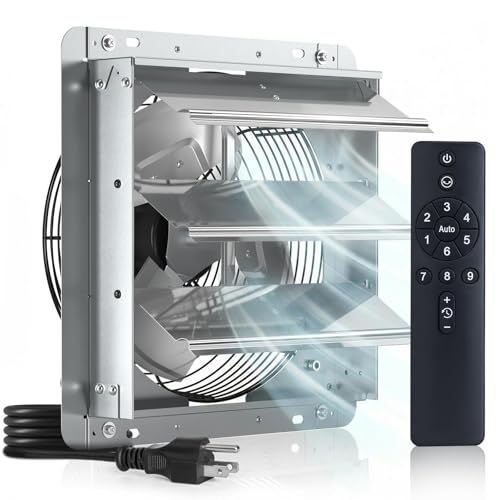
VEVOR 12-Inch Variable Speed Exhaust Fan
Stale garage air has a way of hanging around long after the messy work is finished. Heat settles near the ceiling, dampness follows a rain-soaked vehicle indoors, and odors from tools, paint, or stored equipment can make the room unpleasant within minutes. The VEVOR 12-Inch Variable Speed Exhaust Fan addresses those everyday frustrations with 1,100 CFM airflow, a wall-mounted steel housing, and an adjustable controller. It’s positioned as a practical best ventilation fan for garage candidate where steady exhaust matters more than merely circulating the same warm air.
VEVOR 12-Inch Shutter Exhaust Fan
The 12-inch format strikes a useful balance between wall space and air movement. VEVOR rates this model at 1,100 CFM, giving it enough capacity to move stale air from garages, sheds, workshops, greenhouses, and attic spaces without requiring the larger opening of an oversized industrial fan. That number sounds substantial, and it is, but room shape and ceiling height still influence how quickly the air changes. A tall garage with storage racks and partitioned corners may need more careful placement than an open rectangular room.
The fan runs with a 58-watt AC motor rated at 1,600 RPM. VEVOR also lists airflow speed up to 6.7 meters per second, which supports the fan’s role as an exhaust unit rather than a gentle circulation device. The motor is described as smooth and low noise, though the actual sound in a garage will also depend on wall rigidity, fasteners, and shutter movement. A loose panel can turn an otherwise reasonable motor hum into an irritating rattle, so installation quality matters quite a bit.
Wall mounting gives the air a short route outdoors. That direct path limits the resistance commonly created by long ducts, tight elbows, or narrow vent tubing. The exterior exhaust design also makes sense in garages where hot air naturally gathers near the upper wall and needs a clear escape point. Still, the room must provide replacement air through a vent, doorway gap, window, or other controlled opening, or the fan won’t reach its practical potential.
The compact housing can be easier to place than a larger 18-inch or 24-inch model. Garage door tracks, shelves, studs, electrical wiring, and exterior trim often crowd the most useful mounting areas. A 12-inch fan body leaves more options without dropping into the weak airflow range of tiny utility vents. The tradeoff is simple: it may need more run time than a larger fan in a very spacious or unusually hot garage.
Variable Speed Control In Daily Use
The included controller provides stepless speed adjustment rather than forcing the fan to operate at one fixed output. That feature is more useful than it might seem at first glance. Full power makes sense after painting, during peak afternoon heat, or when the garage feels especially stale, while lower airflow may be enough on a mild day. Being able to dial the fan down also helps reduce drafts and sound during longer workshop sessions.
Single-speed exhaust fans can feel a bit all-or-nothing. They either sit idle or move air at maximum force, even when the space only needs light ventilation. The VEVOR controller gives this unit a broader operating range, making the 1,100 CFM capacity available without demanding it every time the switch is turned on. That flexibility can be especially helpful in a garage used for several activities, such as exercise, woodworking, storage, and vehicle maintenance.
Speed adjustment can also help manage seasonal changes. Summer heat may justify strong exhaust, while cooler months call for a gentler setting that won’t pull cold outdoor air inside too quickly. During humid weather, a moderate continuous flow may be more comfortable than short bursts at full speed. The variable airflow makes the fan easier to adapt, although it doesn’t include the automatic thermostat control found on some competing models.
The absence of a temperature sensor is worth noting. Someone must still decide when to start the fan and how fast it should run, which adds a small layer of daily involvement. For a garage visited frequently, that may be no trouble at all. In an unattended attic or greenhouse, however, manual speed control may be less convenient than a thermostat-based system that reacts on its own.
Steel Construction And Weather Resistance
The housing uses all-metal steel construction, giving the fan more rigidity than a lightweight plastic frame. Garages and sheds expose equipment to dust, vibration, moisture, and wide temperature swings, so a stiff housing can help maintain alignment over time. VEVOR describes the structure as resistant to deformation and capable of handling damp conditions and rain exposure. Proper exterior sealing still matters because weather-resistant materials can’t compensate for water entering around a poorly finished wall opening.
Metal construction adds durability, but it also brings a little more weight to the installation. The wall framing needs to support the fan securely, especially once the blades reach full speed. Solid fasteners and a square mounting surface help the steel housing stay stable instead of transmitting vibration into siding or interior panels. On thin sheet-metal walls, extra bracing may be necessary to keep the unit from buzzing.
The black finish gives the fan a more subdued appearance than bare galvanized metal. In a workshop or dark-painted garage, it can blend into the wall rather than looking like unfinished industrial hardware. Appearance won’t affect airflow, of course, but a permanent wall fixture is easier to live with when it doesn’t look completely out of place. The black steel frame may also hide light dust better than a bright silver surface, though it will still need routine cleaning.
Maintenance should focus on the blades, shutter pivots, protective surfaces, and nearby wall opening. Airborne dirt can cling to moving components, gradually reducing airflow or creating imbalance. Wiping away buildup helps preserve the smooth motor operation and keeps the shutters from sticking. A quick inspection every so often is far easier than waiting until the fan becomes noisy or the louvers stop closing fully.
Automatic Shutters And Rain Protection
The built-in shutters open under powered airflow and close after the fan stops. That simple movement helps block rain, insects, leaves, and small debris from entering through the wall opening. The automatic shutter system also prevents the garage from being left with a permanently open vent after each use. There’s no separate panel to remember, which keeps operation pleasantly straightforward.
Closed shutters can reduce unwanted drafts while the fan is idle. They won’t create the same airtight seal as an insulated exterior door, but they offer more protection than an uncovered wall opening. That difference can matter during cold, windy, or wet weather. The rain guard function supports year-round installation, provided the exterior side is mounted and sealed according to the building’s conditions.
Shutters introduce their own maintenance tradeoff. Dust, overspray, grease, or fine workshop debris can settle around the hinges and prevent smooth movement. A sticky shutter reduces the open area, which can restrict airflow and add noise as the panels flutter. Keeping the louver assembly clean is a small job, but skipping it can quietly undermine the fan’s performance.
Strong outdoor wind may also move lightweight louvers while the motor is off. The amount of flutter depends on wall orientation, shelter, and local weather exposure. A protected mounting position can help, though the fan still needs a clear exhaust path. The shutters are useful protection, not a substitute for thoughtful placement and weatherproof installation.
Garage Airflow And Practical Performance
The fan’s 1,100 CFM output is well suited to removing accumulated heat, stale air, and routine odors from many residential garages. Mounting it high on an exterior wall lets it capture warm air that naturally rises and collects overhead. A lower intake opening on the opposite side can encourage cooler replacement air to cross the occupied part of the room. That pattern creates more useful ventilation than placing the intake directly beside the exhaust.
Air exchange depends on more than the fan rating. A tightly sealed garage can place the room under negative pressure, causing airflow to fall below expectations. Opening a window slightly or adding a dedicated intake vent gives the exhaust airflow a reliable supply of replacement air. Without that supply, the fan may sound busy while moving less air than the specifications suggest.
Floating dirt and workshop haze may clear faster with the fan running, but source control still comes first. A wall exhaust fan can’t replace a dust collector attached directly to a saw, sander, or planer. It can help remove what escapes into the room after the primary collection system has done its job. The high-volume ventilation is most effective as part of a layered approach rather than the only defense against airborne debris.
Odors deserve the same realistic treatment. The fan can exhaust ordinary smells from damp storage, lawn tools, paints, or cleaning work, yet it isn’t described as explosion-proof equipment. Concentrated gasoline or solvent vapors require stricter safety measures and equipment rated for that environment. No garage fan, regardless of airflow, makes it safe to idle a vehicle indoors because carbon monoxide can accumulate quickly.
Noise, Comfort, And Installation Limits
VEVOR describes the motor as low noise, but airflow itself will always create some sound. At full speed, air passing through a 12-inch opening and pushing the shutters outward won’t be silent. The variable speed controller helps here because lower settings can soften both motor sound and shutter movement. That makes the fan more manageable during conversations, repairs, exercise, or other activities that don’t require maximum exhaust.
Wall vibration can become more noticeable than motor noise if the frame isn’t properly supported. Thin panels, loose fasteners, or an uneven opening may amplify the fan’s movement. Secure framing helps keep the fan assembly stable and reduces the chance of humming through the surrounding structure. Rubber isolation material may also help where vibration transfers into an attached room.
Installation is the product’s biggest practical hurdle. A permanent exterior opening must account for studs, wiring, insulation, siding, water sealing, and shutter clearance. The wall-mounted format is efficient once installed, but it isn’t a casual weekend add-on for every building. Masonry walls, complicated siding, or uncertain electrical work may justify professional help.
Fan categories can look similar while serving very different purposes, and a separate design reference appears in small bedroom ceiling fans. Ceiling fans recirculate indoor air for comfort, while this VEVOR unit removes air from the building. That functional difference matters because moving warm air around a garage won’t clear moisture, odors, or airborne debris the way direct exhaust can.
Strengths, Weaknesses, And Best-Fit Conditions
The strongest feature is the combination of 1,100 CFM airflow and stepless speed control in a compact 12-inch format. The fan can move a serious amount of air, yet it doesn’t force full output during every use. Automatic shutters simplify weather protection, and the steel housing supports permanent installation in demanding spaces. Those features make the package feel focused rather than overloaded with gimmicks.
The 58-watt AC motor also keeps the power requirement modest relative to the listed airflow. Exact operating cost will depend on local electricity rates, selected speed, and run time, so there’s no honest universal number to attach to it. Still, adjustable output allows the fan to run below maximum when conditions are mild. That can reduce unnecessary noise and power use without giving up the ability to ventilate aggressively later.
The main weakness is the lack of automatic temperature regulation. The controller adjusts speed smoothly, but someone still needs to switch the fan on and choose the setting. A thermostat-equipped model may suit spaces where heat needs to be managed while nobody is present. The manual operation is simpler, though it asks for more attention.
This VEVOR fan fits best where garage heat, humidity, odors, or stale air appear often enough to justify a permanent wall exhaust. It’s less suitable for renters, lightly used spaces, or walls that can’t be modified. The best ventilation fan for garage use isn’t always the largest model available, and this 12-inch design offers a sensible middle ground between compact installation and substantial air movement. With a proper intake path, solid mounting, and clean shutters, its specifications line up well with medium-duty garage and workshop ventilation.
VEVOR 12-Inch Variable Speed Exhaust Fan
Stale garage air has a way of hanging around long after the messy work is finished. Heat settles near the ceiling, dampness follows a rain-soaked vehicle indoors, and odors from tools, paint, or stored equipment can make the room unpleasant within minutes. The VEVOR 12-Inch Variable Speed Exhaust Fan addresses those everyday frustrations with 1,100 CFM airflow, a wall-mounted steel housing, and an adjustable controller. It’s positioned as a practical best ventilation fan for garage candidate where steady exhaust matters more than merely circulating the same warm air.
VEVOR 12-Inch Shutter Exhaust Fan
The 12-inch format strikes a useful balance between wall space and air movement. VEVOR rates this model at 1,100 CFM, giving it enough capacity to move stale air from garages, sheds, workshops, greenhouses, and attic spaces without requiring the larger opening of an oversized industrial fan. That number sounds substantial, and it is, but room shape and ceiling height still influence how quickly the air changes. A tall garage with storage racks and partitioned corners may need more careful placement than an open rectangular room.
The fan runs with a 58-watt AC motor rated at 1,600 RPM. VEVOR also lists airflow speed up to 6.7 meters per second, which supports the fan’s role as an exhaust unit rather than a gentle circulation device. The motor is described as smooth and low noise, though the actual sound in a garage will also depend on wall rigidity, fasteners, and shutter movement. A loose panel can turn an otherwise reasonable motor hum into an irritating rattle, so installation quality matters quite a bit.
Wall mounting gives the air a short route outdoors. That direct path limits the resistance commonly created by long ducts, tight elbows, or narrow vent tubing. The exterior exhaust design also makes sense in garages where hot air naturally gathers near the upper wall and needs a clear escape point. Still, the room must provide replacement air through a vent, doorway gap, window, or other controlled opening, or the fan won’t reach its practical potential.
The compact housing can be easier to place than a larger 18-inch or 24-inch model. Garage door tracks, shelves, studs, electrical wiring, and exterior trim often crowd the most useful mounting areas. A 12-inch fan body leaves more options without dropping into the weak airflow range of tiny utility vents. The tradeoff is simple: it may need more run time than a larger fan in a very spacious or unusually hot garage.
Variable Speed Control In Daily Use
The included controller provides stepless speed adjustment rather than forcing the fan to operate at one fixed output. That feature is more useful than it might seem at first glance. Full power makes sense after painting, during peak afternoon heat, or when the garage feels especially stale, while lower airflow may be enough on a mild day. Being able to dial the fan down also helps reduce drafts and sound during longer workshop sessions.
Single-speed exhaust fans can feel a bit all-or-nothing. They either sit idle or move air at maximum force, even when the space only needs light ventilation. The VEVOR controller gives this unit a broader operating range, making the 1,100 CFM capacity available without demanding it every time the switch is turned on. That flexibility can be especially helpful in a garage used for several activities, such as exercise, woodworking, storage, and vehicle maintenance.
Speed adjustment can also help manage seasonal changes. Summer heat may justify strong exhaust, while cooler months call for a gentler setting that won’t pull cold outdoor air inside too quickly. During humid weather, a moderate continuous flow may be more comfortable than short bursts at full speed. The variable airflow makes the fan easier to adapt, although it doesn’t include the automatic thermostat control found on some competing models.
The absence of a temperature sensor is worth noting. Someone must still decide when to start the fan and how fast it should run, which adds a small layer of daily involvement. For a garage visited frequently, that may be no trouble at all. In an unattended attic or greenhouse, however, manual speed control may be less convenient than a thermostat-based system that reacts on its own.
Steel Construction And Weather Resistance
The housing uses all-metal steel construction, giving the fan more rigidity than a lightweight plastic frame. Garages and sheds expose equipment to dust, vibration, moisture, and wide temperature swings, so a stiff housing can help maintain alignment over time. VEVOR describes the structure as resistant to deformation and capable of handling damp conditions and rain exposure. Proper exterior sealing still matters because weather-resistant materials can’t compensate for water entering around a poorly finished wall opening.
Metal construction adds durability, but it also brings a little more weight to the installation. The wall framing needs to support the fan securely, especially once the blades reach full speed. Solid fasteners and a square mounting surface help the steel housing stay stable instead of transmitting vibration into siding or interior panels. On thin sheet-metal walls, extra bracing may be necessary to keep the unit from buzzing.
The black finish gives the fan a more subdued appearance than bare galvanized metal. In a workshop or dark-painted garage, it can blend into the wall rather than looking like unfinished industrial hardware. Appearance won’t affect airflow, of course, but a permanent wall fixture is easier to live with when it doesn’t look completely out of place. The black steel frame may also hide light dust better than a bright silver surface, though it will still need routine cleaning.
Maintenance should focus on the blades, shutter pivots, protective surfaces, and nearby wall opening. Airborne dirt can cling to moving components, gradually reducing airflow or creating imbalance. Wiping away buildup helps preserve the smooth motor operation and keeps the shutters from sticking. A quick inspection every so often is far easier than waiting until the fan becomes noisy or the louvers stop closing fully.
Automatic Shutters And Rain Protection
The built-in shutters open under powered airflow and close after the fan stops. That simple movement helps block rain, insects, leaves, and small debris from entering through the wall opening. The automatic shutter system also prevents the garage from being left with a permanently open vent after each use. There’s no separate panel to remember, which keeps operation pleasantly straightforward.
Closed shutters can reduce unwanted drafts while the fan is idle. They won’t create the same airtight seal as an insulated exterior door, but they offer more protection than an uncovered wall opening. That difference can matter during cold, windy, or wet weather. The rain guard function supports year-round installation, provided the exterior side is mounted and sealed according to the building’s conditions.
Shutters introduce their own maintenance tradeoff. Dust, overspray, grease, or fine workshop debris can settle around the hinges and prevent smooth movement. A sticky shutter reduces the open area, which can restrict airflow and add noise as the panels flutter. Keeping the louver assembly clean is a small job, but skipping it can quietly undermine the fan’s performance.
Strong outdoor wind may also move lightweight louvers while the motor is off. The amount of flutter depends on wall orientation, shelter, and local weather exposure. A protected mounting position can help, though the fan still needs a clear exhaust path. The shutters are useful protection, not a substitute for thoughtful placement and weatherproof installation.
Garage Airflow And Practical Performance
The fan’s 1,100 CFM output is well suited to removing accumulated heat, stale air, and routine odors from many residential garages. Mounting it high on an exterior wall lets it capture warm air that naturally rises and collects overhead. A lower intake opening on the opposite side can encourage cooler replacement air to cross the occupied part of the room. That pattern creates more useful ventilation than placing the intake directly beside the exhaust.
Air exchange depends on more than the fan rating. A tightly sealed garage can place the room under negative pressure, causing airflow to fall below expectations. Opening a window slightly or adding a dedicated intake vent gives the exhaust airflow a reliable supply of replacement air. Without that supply, the fan may sound busy while moving less air than the specifications suggest.
Floating dirt and workshop haze may clear faster with the fan running, but source control still comes first. A wall exhaust fan can’t replace a dust collector attached directly to a saw, sander, or planer. It can help remove what escapes into the room after the primary collection system has done its job. The high-volume ventilation is most effective as part of a layered approach rather than the only defense against airborne debris.
Odors deserve the same realistic treatment. The fan can exhaust ordinary smells from damp storage, lawn tools, paints, or cleaning work, yet it isn’t described as explosion-proof equipment. Concentrated gasoline or solvent vapors require stricter safety measures and equipment rated for that environment. No garage fan, regardless of airflow, makes it safe to idle a vehicle indoors because carbon monoxide can accumulate quickly.
Noise, Comfort, And Installation Limits
VEVOR describes the motor as low noise, but airflow itself will always create some sound. At full speed, air passing through a 12-inch opening and pushing the shutters outward won’t be silent. The variable speed controller helps here because lower settings can soften both motor sound and shutter movement. That makes the fan more manageable during conversations, repairs, exercise, or other activities that don’t require maximum exhaust.
Wall vibration can become more noticeable than motor noise if the frame isn’t properly supported. Thin panels, loose fasteners, or an uneven opening may amplify the fan’s movement. Secure framing helps keep the fan assembly stable and reduces the chance of humming through the surrounding structure. Rubber isolation material may also help where vibration transfers into an attached room.
Installation is the product’s biggest practical hurdle. A permanent exterior opening must account for studs, wiring, insulation, siding, water sealing, and shutter clearance. The wall-mounted format is efficient once installed, but it isn’t a casual weekend add-on for every building. Masonry walls, complicated siding, or uncertain electrical work may justify professional help.
Fan categories can look similar while serving very different purposes, and a separate design reference appears in small bedroom ceiling fans. Ceiling fans recirculate indoor air for comfort, while this VEVOR unit removes air from the building. That functional difference matters because moving warm air around a garage won’t clear moisture, odors, or airborne debris the way direct exhaust can.
Strengths, Weaknesses, And Best-Fit Conditions
The strongest feature is the combination of 1,100 CFM airflow and stepless speed control in a compact 12-inch format. The fan can move a serious amount of air, yet it doesn’t force full output during every use. Automatic shutters simplify weather protection, and the steel housing supports permanent installation in demanding spaces. Those features make the package feel focused rather than overloaded with gimmicks.
The 58-watt AC motor also keeps the power requirement modest relative to the listed airflow. Exact operating cost will depend on local electricity rates, selected speed, and run time, so there’s no honest universal number to attach to it. Still, adjustable output allows the fan to run below maximum when conditions are mild. That can reduce unnecessary noise and power use without giving up the ability to ventilate aggressively later.
The main weakness is the lack of automatic temperature regulation. The controller adjusts speed smoothly, but someone still needs to switch the fan on and choose the setting. A thermostat-equipped model may suit spaces where heat needs to be managed while nobody is present. The manual operation is simpler, though it asks for more attention.
This VEVOR fan fits best where garage heat, humidity, odors, or stale air appear often enough to justify a permanent wall exhaust. It’s less suitable for renters, lightly used spaces, or walls that can’t be modified. The best ventilation fan for garage use isn’t always the largest model available, and this 12-inch design offers a sensible middle ground between compact installation and substantial air movement. With a proper intake path, solid mounting, and clean shutters, its specifications line up well with medium-duty garage and workshop ventilation.


Best Quiet Ceiling Fan For Bedroom 2026 Ultimate Comfort Picks

Best Ceiling Fan For Master Bedroom 2026 With Ultimate Comfort

Best White Ceiling Fan With Light For Bedroom 2026 Top Picks

Best Quorum Medallion Ceiling Fan 2026 With Style & Breeze
Best Outdoor Fan For Pergola 2026 Comfort Boost

Best Ceiling Fan For Great Room 2026 With Ultimate Comfort

Best Outdoor DC Ceiling Fans 2026 For Breezy Comfort
Best ceiling exhaust bath fan with light and heater 2026





