Best Wall Fan for Bathroom 2026: Quiet Airflow

A best wall fan for bathroom setup should move damp air without turning every shower into a noisy wind tunnel. Steam lingering on mirrors, wet towels that stay clammy, and corners that smell musty usually point to weak circulation rather than a simple temperature problem. A wall-mounted fan can keep air moving through compact rooms where floor space is scarce and ceiling installation isn't practical. Still, airflow alone won't fix trapped humidity unless the room also has a sensible path for moist air to escape.
Moisture resistance deserves close attention because an ordinary household fan may not be built for repeated exposure to humid air. Look for clear manufacturer guidance covering bathroom use, damp locations, or the intended mounting area, especially if the fan will sit near a shower or tub. Electrical parts need suitable protection, and local placement rules shouldn't be treated as optional fine print. Honestly, a powerful fan installed in the wrong zone creates more worry than comfort.
Airflow control matters just as much as maximum speed. A small bathroom can feel unpleasant with an oversized fan blasting directly toward the sink, while a weak model may only shuffle warm air around and leave condensation untouched. Adjustable speeds make it easier to use a gentle setting during routine grooming and a stronger setting after a hot shower. Oscillation can spread air across wet walls and towels, but a fixed head often works better where one stubborn corner needs constant circulation.
Noise level can make or break the experience, particularly during early mornings or late-night showers. Motor hum, blade turbulence, and rattling mounts become surprisingly noticeable in a tiled room because hard surfaces bounce sound around. A balanced blade assembly, secure wall bracket, and several usable speed settings can reduce that harsh, buzzing character. So, don't judge quietness by motor claims alone; loose mounting hardware can make even a decent fan sound rough.
Cleaning shouldn't require a toolbox and half an afternoon. Dust sticks quickly to damp fan grilles and blade edges, gradually reducing airflow and creating gray buildup that looks grimy against clean bathroom walls. A removable front guard or accessible grille makes regular wiping far less annoying. Meanwhile, tightly enclosed designs may look sleek but can become a nuisance once lint settles behind the cover.
Placement calls for a little common sense. Mounting the fan high can help circulate warm, humid air, yet aiming it straight at a wet face or lightweight shower curtain gets old fast. Keep enough clearance around the intake, avoid crowding it beside cabinets, and make sure the cord won't drape across a damp surface. The best wall fan for bathroom conditions is ultimately the one that fits the room, handles humidity appropriately, stays stable on the wall, and delivers useful airflow without becoming another maintenance headache.

- LFR Score9.2
LFR Score is a ranking system developed by lightfansreviews.com. LFR Score has no relationship or impact from any manufacturers or sales agent websites. Learn more
- BrandQuini

- LFR Score9.2
LFR Score is a ranking system developed by lightfansreviews.com. LFR Score has no relationship or impact from any manufacturers or sales agent websites. Learn more
- BrandHoneywell

- LFR Score9.2
LFR Score is a ranking system developed by lightfansreviews.com. LFR Score has no relationship or impact from any manufacturers or sales agent websites. Learn more
- BrandBlissfuhue

- LFR Score9.0
LFR Score is a ranking system developed by lightfansreviews.com. LFR Score has no relationship or impact from any manufacturers or sales agent websites. Learn more
- BrandHurricane

- LFR Score8.8
LFR Score is a ranking system developed by lightfansreviews.com. LFR Score has no relationship or impact from any manufacturers or sales agent websites. Learn more
- BrandAzmsorsm

- LFR Score8.8
LFR Score is a ranking system developed by lightfansreviews.com. LFR Score has no relationship or impact from any manufacturers or sales agent websites. Learn more
- BrandCoolhill

- LFR Score8.6
LFR Score is a ranking system developed by lightfansreviews.com. LFR Score has no relationship or impact from any manufacturers or sales agent websites. Learn more
- BrandLEMOISTAR

- LFR Score8.6
LFR Score is a ranking system developed by lightfansreviews.com. LFR Score has no relationship or impact from any manufacturers or sales agent websites. Learn more
- BrandShinebella

- LFR Score8.6
LFR Score is a ranking system developed by lightfansreviews.com. LFR Score has no relationship or impact from any manufacturers or sales agent websites. Learn more
- BrandShinebella

- LFR Score8.4
LFR Score is a ranking system developed by lightfansreviews.com. LFR Score has no relationship or impact from any manufacturers or sales agent websites. Learn more
- BrandKoonie
- LFR Score8.4
LFR Score is a ranking system developed by lightfansreviews.com. LFR Score has no relationship or impact from any manufacturers or sales agent websites. Learn more
- BrandKoonie
Last update on 2026-07-28 / Affiliate links / Images, Product Titles, and Product Highlights from Amazon Product Advertising API
Quini 512M Bathroom Through-Wall Exhaust Fan
Steamy mirrors and damp towels can turn a small bathroom into a muggy box long after the shower ends. The best wall fan for bathroom use needs to move moisture outdoors rather than merely stir humid air around the room. The Quini 512M takes that direct approach with an 80 CFM exhaust rate, a through-wall layout, and an adjustable duct intended to bridge the interior and exterior sides of the wall. That setup can solve a stubborn ventilation problem, though the required wall opening and hardwired installation deserve careful planning before the toolbox comes out.
Quini 512M Through-Wall Exhaust Fan
The Quini 512M is built as a 6-inch through-wall exhaust fan, not a plug-in circulation fan that simply blows air across the bathroom. Moist air is pulled from the room and discharged outside, which is the more useful arrangement for reducing lingering humidity, stale odors, and condensation. Its listed airflow is 80 CFM, with coverage stated for spaces up to 65 square feet. That capacity lines up best with compact bathrooms, laundry areas, kitchens, and other smaller rooms that need focused ventilation.
The adjustable duct is one of the product's defining features. Made from aluminum foil, the duct measures about 6.2 inches in diameter and can extend from 2 to 15 inches, while the supplied compatibility guidance calls for wall thicknesses from 6 to 19 inches. Those figures need a second look before purchase because the duct extension and stated wall range aren't presented in exactly the same terms. Measuring the complete wall assembly, including tile, drywall, siding, and any cavity depth, will help prevent an awkward fit on installation day.
A copper motor coil is listed as part of the internal construction, with durability being the practical aim. The exterior assembly also includes protection intended to handle rain and wind, an important detail for a fan that terminates outdoors. A vent cover helps block birds and mosquitoes, while a backdraft flap is designed to limit outside air from pushing back into the bathroom. None of those pieces is flashy, but they address the little annoyances that often show up after a basic wall vent has been in place for a while.
Moisture Removal And Everyday Bathroom Use
Bathroom ventilation lives or dies by how effectively it replaces damp indoor air with drier air from elsewhere in the home. At 80 CFM, this model has enough stated airflow for a small room, especially where steam gathers quickly around a shower or tub. The fan won't remove moisture efficiently if the bathroom is sealed tight, though, since replacement air still needs a path under the door or through another opening. A reasonable door gap can make the difference between steady exhaust and a fan that sounds busy without moving its full volume.
The wall-mounted format can be especially useful where ceiling ductwork is unavailable, cramped, or expensive to add. Instead of routing a long duct through an attic or between joists, the Quini 512M creates a shorter route directly through an exterior wall. That shorter path may reduce the airflow losses associated with bends and long duct runs, provided the wall location is suitable. Still, exterior-wall placement can be tricky around plumbing, electrical lines, studs, masonry, or exterior trim, so the shortest route isn't automatically the simplest one.
Odor control is another realistic benefit. A direct exhaust path can clear bathroom smells more effectively than an oscillating wall fan that keeps the same air circulating indoors. The manufacturer also positions the unit for removing smoke and odors in kitchens, garages, and laundry rooms, which speaks to its spot-ventilation design. Grease-heavy kitchen exhaust presents different cleaning and safety demands, however, so bathroom use is the cleaner fit based on the supplied details.
Noise, Airflow, And Comfort Tradeoffs
The listed sound rating is 4.0 sones, and that number shouldn't be brushed aside. A 4.0-sone exhaust fan will generally be noticeable in a quiet bathroom rather than fading into the background. That may be perfectly acceptable during a shower, where running water already masks mechanical sound, but it could feel intrusive during nighttime use. Quiet-operation shoppers should treat the sound rating as a genuine tradeoff rather than assuming the compact fan body will whisper.
Some noise can also come from the installation rather than the motor alone. Thin wall panels, loose screws, an uneven opening, or a vent flap that chatters in gusty weather can add vibration and rattling. A firm mounting surface and careful alignment should help the fan housing sit securely without twisting. Caulk or weather sealing may be needed around the exterior termination, but that work must not obstruct the vent cover or moving flap.
The airflow level brings its own balancing act. Stronger exhaust can clear a small bathroom faster, yet it may also pull conditioned indoor air outside, especially if the fan runs much longer than necessary. Pairing the fan with a wall switch makes manual control straightforward, although the supplied description doesn't mention a timer, humidity sensor, or variable-speed setting. That means the experience is simple and direct: switch it on during moisture-producing activity, leave it running long enough to clear the room, then turn it off.
Installation Demands And Fit Checks
Installation requires an opening of roughly 6.4 inches through both the interior and exterior wall surfaces. That's a substantial cut, not a minor screw-hole project, and mistakes can be difficult to hide. The fan also needs wiring to a switch, so electrical planning belongs at the front of the job rather than the end. Anyone uncomfortable locating hidden utilities or connecting fixed wiring should budget for qualified installation instead of treating the unit like a plug-and-play appliance.
Wall construction will shape the difficulty. A straightforward wood-framed wall with clear access is one thing; brick, concrete, thick stucco, or closely spaced plumbing can turn the same project into a much bigger chore. The adjustable housing and duct help accommodate different depths, but they don't eliminate the need for a clean, correctly sized passage. Exterior access matters too, since the outer cover needs to sit level, shed rain, and remain reachable for occasional inspection.
Compatibility deserves a literal tape-measure check. The product information calls attention to wall thickness before purchase, and that's good advice because trim layers can add more depth than expected. Measure from the finished interior surface to the finished exterior surface, not merely the stud cavity. Also confirm that a 6.4-inch wall opening won't collide with framing, pipes, cables, vents, or structural components.
Weather Protection And Backdraft Control
The outdoor portion has more work to do than many shoppers realize. It must release humid air while resisting rain, wind, insects, and nesting animals, all without choking off the fan's airflow. The Quini 512M includes a protective exterior cover and a flap intended to reduce reverse airflow. That weather-facing design is a practical strength for bathrooms on exposed exterior walls.
The flap may help keep cold drafts, warm outdoor air, and odors from drifting back inside while the fan is off. Still, a lightweight backdraft component can sometimes move or tap during strong gusts, depending on wall orientation and local weather. Regular checks can catch leaves, lint, insect debris, or a flap that no longer closes cleanly. A blocked cover makes even a healthy motor struggle, so exterior maintenance shouldn't fall off the radar.
Moist bathroom exhaust can also create condensation inside a cold duct. The short through-wall path may reduce that concern compared with a long attic run, but climate and wall temperature still matter. Proper outward orientation and exterior sealing can help moisture leave the assembly rather than collect around the wall penetration. The retractable aluminum duct offers flexibility, though flexible material should be kept as smooth and straight as the installation allows to avoid unnecessary airflow resistance.
Maintenance, Limitations, And Warranty
Dust and lint eventually settle on every exhaust fan, bathroom or otherwise. A dirty grille or sticky backdraft flap can reduce airflow, raise noise, and leave the motor working harder than it should. The supplied details don't describe tool-free grille removal or a specific cleaning process, so maintenance access is something to inspect during installation. Leaving the interior and exterior covers reachable will make routine cleaning far less aggravating.
The biggest limitation is the combination of 4.0-sone noise and permanent through-wall installation. This isn't the strongest match for a bedroom-adjacent bathroom where near-silent nighttime operation matters most. It also won't suit a room without an appropriate exterior wall or a safe route for the required opening. On the other hand, the direct exhaust layout makes sense where moisture needs a straightforward exit and ceiling ductwork isn't practical.
A one-year warranty is included, giving the unit a defined period of manufacturer coverage based on the information provided. Warranty terms can vary in what they cover, so retaining purchase records and reading the included documentation is sensible. The warranty doesn't offset a poor fit, an incorrectly cut opening, or installation damage, which brings the decision right back to careful measurements. For a compact bathroom that can accommodate the duct and sound level, the Quini 512M offers a focused set of features without piling on controls that may never be used.
Honeywell TurboForce HT900 Bathroom Air Circulator
Heat and damp air can hang around a bathroom long after the water shuts off, leaving the mirror cloudy and the room oddly stuffy. A compact circulator can make that waiting period less annoying by keeping air moving across wet surfaces and toward an open door or existing exhaust vent. The Honeywell TurboForce HT900 brings a familiar mix of three-speed control, a pivoting head, and wall-mount capability to the best wall fan for bathroom conversation. Still, this is an indoor circulation fan rather than a moisture-rated exhaust unit, so placement and expectations matter more than raw airflow alone.
Honeywell TurboForce HT900
The HT900 is small enough to sit on a counter, shelf, floor, or desk, but its wall-mounting option is the feature that makes it relevant here. Lifting the fan off a crowded vanity protects valuable surface space and gives the airflow a better angle across the room. Its 90-degree pivoting head lets the breeze point toward a fogged mirror, a damp towel rack, or the doorway. That flexibility feels more useful than a fixed fan that pushes air in one direction whether the room needs it or not.
Honeywell describes the TurboForce design as an aerodynamic system made to concentrate and project air. The supplied information says its airflow can be felt from as far as 25 feet away, which gives the compact body a broader working range than its size might suggest. In a bathroom, that reach can help move air from a wall position without mounting the unit directly beside the shower. The fan won't pull humidity outdoors by itself, though, so it works best as a circulation helper rather than a replacement for proper exhaust ventilation.
Three speed settings keep the controls simple. The low setting suits gentle background circulation during grooming, while the higher settings can move trapped heat after a long shower. That range helps avoid the all-or-nothing problem common with basic personal fans. The adjustable airflow is especially handy in a small room, where full power may feel too aggressive at close range.
Air Movement In A Steamy Bathroom
Steam settles differently in every bathroom. Some rooms trap it near the ceiling, while others collect condensation around a cold mirror or exterior wall. Tilting the HT900 upward can keep warm air from sitting in one stagnant layer, and aiming it across the room can encourage damp air toward an open doorway. This kind of targeted circulation may help surfaces dry more evenly, although it doesn't remove water vapor from the home.
An existing ceiling exhaust fan can benefit from better room circulation. Dead spots behind a door, beside a tub, or around a towel rack often stay damp even while the exhaust fan runs. The TurboForce can push air out of those pockets and toward the exhaust intake, helping the ventilation system work across more of the room. That pairing makes more practical sense than expecting a tabletop-style fan to handle humidity removal on its own.
Mirror clearing is another realistic use. Direct airflow across the glass can reduce the amount of time fog lingers, which makes shaving, skin care, or getting ready less of a squint-and-wipe routine. A lower speed may be enough once the heaviest steam has passed, while a stronger setting can speed things along after an especially hot shower. The trick is aiming the fan across the mirror rather than straight into someone's face.
Towels can also benefit from moving air, particularly in compact bathrooms with limited natural ventilation. Air directed near, not directly against, a towel bar can reduce the clammy feeling that develops when fabric stays folded against a wall. The pivoting fan head makes that adjustment easier without relocating the whole unit. Still, thick towels packed tightly together will dry slowly regardless of fan power, so spacing remains part of the equation.
Noise And Everyday Comfort
Bathrooms tend to amplify sound because tile, glass, and hard counters reflect motor noise. Honeywell states that this model is 25 percent quieter than comparable fans, based on the manufacturer's supplied description. That claim suggests an effort to balance air movement with manageable sound, though the exact comparison group isn't provided. In practice, speed choice and wall mounting quality will strongly influence how noticeable the fan feels.
The lowest setting should be the natural starting point for quiet routines. Early mornings and late nights don't call for a fan roaring beside the sink, and a lower speed may still provide enough circulation in a small room. Higher speeds make more sense after showering, when running water and bathroom activity already create background noise. The three-speed range gives the unit more flexibility than a single-speed wall fan.
Wall mounting introduces one possible catch: vibration. A fan that seems fairly quiet on a solid tabletop may buzz or resonate if attached to thin paneling or loosely anchored drywall. Firm fasteners and a stable mounting surface can keep that mechanical hum from spreading through the wall. A slightly uneven mount can also make the housing rattle, so careful installation isn't just about safety; it affects comfort too.
The TurboForce doesn't oscillate, and that may be either a limitation or a relief. Oscillation spreads air around automatically, but it can also send unwanted gusts toward toiletries, shower curtains, or anyone standing at the sink. A fixed direction keeps the airflow predictable. The 90-degree tilt range still provides meaningful control, just without side-to-side movement.
Wall Mounting And Safe Placement
Mounting a portable fan in a bathroom requires more thought than hanging it in a bedroom or office. Water, wet hands, and electrical cords create obvious concerns, so the unit should remain well away from sinks, tubs, showers, and splash zones. The product details describe wall mounting, but they don't state that the HT900 is rated for wet or damp locations. That indoor fan design calls for conservative placement in a dry area of the room.
A high wall position may improve circulation, yet accessibility still matters. The controls should remain reachable without climbing onto a slippery counter or stretching over a sink. Cord routing deserves equal attention because a dangling cable can look messy and create a snagging hazard. Securing the cord along a dry wall route keeps the installation cleaner and reduces the chance of it drifting toward water.
The compact body suits bathrooms where floor space is scarce and countertops already hold toothbrushes, skin care bottles, and grooming tools. Mounted above the door or on a clear side wall, the fan can move air without becoming one more object to shuffle around. The pivoting head helps compensate for a mounting spot that isn't perfectly aligned with the dampest area. That space-saving setup is one of the strongest reasons to consider the HT900 over a larger pedestal fan.
Cleaning access shouldn't be ignored. Bathroom fans pick up dust, hair, and residue faster than many office fans because humid air helps grime cling to the grille. A wall position that leaves enough room around the housing will make regular wiping less frustrating. Blocking the rear intake with a wall corner, cabinet, or towel can reduce airflow and make the motor work harder.
Cooling Performance And Energy Use
The HT900 doesn't lower the room's actual temperature like an air conditioner. Instead, moving air increases evaporative cooling on the skin, which can make a warm bathroom feel less oppressive during hair drying or grooming. That distinction matters because the fan may improve comfort without changing the thermostat reading. Its personal cooling effect is strongest where the airflow reaches directly.
Honeywell positions portable fans as a way to support air conditioning and potentially reduce reliance on it. A bathroom often heats up from hot water, hair tools, and limited ventilation, so localized airflow can feel more sensible than lowering the temperature across the entire home. The fan can also be moved to a bedroom, desk, or work area when it isn't needed in the bathroom. That portability adds value, though permanent wall mounting naturally reduces the grab-and-go convenience.
The concentrated airflow may feel stronger than the fan's compact dimensions suggest, especially on the highest setting. Small bathrooms rarely need a huge air mover, and too much breeze can scatter tissues, swing lightweight curtains, or chill wet skin. Medium speed will likely be the practical middle ground for many routines. The speed control lets the room feel fresher without turning it into a wind tunnel.
Strengths, Weaknesses, And Best-Fit Situations
The strongest part of the HT900 is its flexibility. It can sit on a surface, rest on the floor, or mount to a wall, and the head can pivot through a broad angle. That combination makes the fan easier to adapt around doors, towel bars, mirrors, and limited counter space. The compact footprint also keeps it from dominating a small bathroom.
Its biggest weakness is equally clear: this is not a through-wall exhaust fan. It circulates air inside the room but doesn't send moisture, odors, or warm air outdoors. Without an open door, window, or working exhaust vent, humidity can simply move from one corner to another. Anyone dealing with persistent condensation or mildew needs actual ventilation rather than circulation alone.
Bathroom suitability also depends on keeping the unit dry. The provided description doesn't mention splash resistance, damp-location approval, or bathroom-specific electrical protection. That absence doesn't automatically rule out use in a dry zone, but it does limit where the fan should be mounted. The placement restriction is a meaningful tradeoff for anyone hoping to install it close to a shower.
The Honeywell TurboForce HT900 makes sense where heat, stagnant air, and slow surface drying are the main annoyances. Its three speeds, concentrated airflow, wall-mount option, and pivoting head provide practical control without complicated features. As a candidate for the best wall fan for bathroom circulation, it offers a useful balance of size and airflow. As a humidity-removal solution, it still depends on a separate route that carries moist air out of the room.
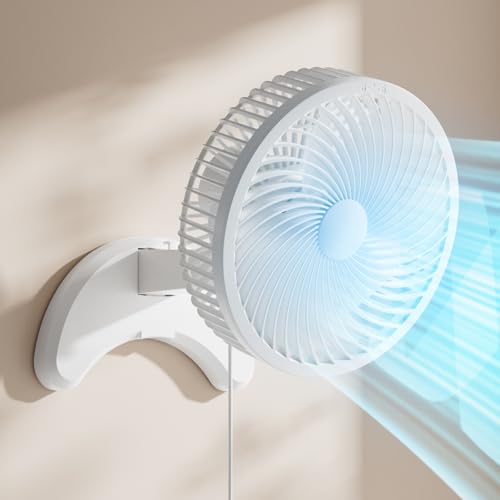
Rechargeable Suction Cup Bathroom Wall Fan
Drilling into tile feels like a big commitment for a little extra airflow, especially in a rented apartment, RV, or bathroom with no useful outlet nearby. This compact rechargeable model takes a less permanent route, attaching to smooth surfaces with a locking suction mount while running from a built-in battery or USB power. That setup gives it a legitimate place in the best wall fan for bathroom discussion, particularly where hands-free cooling and flexible placement matter more than permanent exhaust ventilation. The tradeoff is simple: it circulates air around the room, but it doesn't send steam or odors outdoors.
Rechargeable Suction Cup Wall Fan
The defining feature is the vacuum suction cup with a locking knob. It is designed to grip smooth surfaces such as tile, glass, mirrors, metal cabinets, and refrigerator panels without screws or adhesive pads. That approach can spare a finished bathroom wall from holes, cracked grout, or sticky residue. It also makes repositioning easier when one mounting angle sends air toward the wrong corner.
The suction cup can be rinsed and attached again, which is useful because bathroom residue has a habit of building up where no one expects it. Soap film, dust, and moisture can weaken contact between a cup and a glossy surface, so periodic cleaning isn't optional. A clean, flat mounting area should give the locking mount its best chance of staying secure. Textured tile, uneven grout lines, porous stone, and painted drywall are much less suitable because the cup needs an airtight seal.
The fan avoids the permanence of a conventional wall installation, but that doesn't mean placement can be careless. Even a strong suction system should stay away from direct splash zones, tubs, sinks, and spots where a fall could drop the unit into water. Mounting it over a dry counter, on a mirror edge away from the basin, or on smooth tile near the doorway is the more sensible play. The drill-free design solves a space problem, not the need for basic electrical caution.
Battery Life And Cordless Convenience
A built-in 4000mAh lithium battery gives the fan its portable character. The supplied description lists up to nine hours of operation on the lowest setting, making it suitable for short bathroom routines, grooming sessions, or intermittent use throughout the day. Higher speeds will naturally use power faster, although exact runtimes for those levels aren't provided. The battery is permanent and non-removable, so there is no option to swap in a fresh pack after it runs down.
USB operation adds a second way to keep the fan running. It can work cordlessly when no nearby outlet is available, then stay powered through a USB connection for longer use. That flexibility fits RV bathrooms, dorm rooms, temporary rentals, and compact spaces where conventional power access is awkward. The cordless mode also removes the annoyance of a cable crossing the vanity during quick daily routines.
The permanent battery creates a realistic long-term limitation. Rechargeable cells gradually lose capacity with age and repeated charging, and this model doesn't allow the pack to be replaced by the owner. Once runtime declines, continuous USB use may become more important. That isn't unusual for a small portable fan, but it does mean the battery design favors convenience now over easy repair later.
Five Speeds And Touchscreen Control
Five selectable speeds provide more adjustment than the usual low, medium, and high arrangement. The display identifies them as 20, 40, 60, 80, and 100, allowing airflow to be increased in smaller steps. A low setting can keep air moving while shaving or applying makeup, while the upper levels make more sense after a hot shower. This five-speed control helps prevent the familiar problem of choosing between barely noticeable airflow and a blast that feels too harsh.
The touchscreen keeps the front of the fan tidy and removes protruding switches that can collect grime. Battery level, charging status, and the selected speed appear on the smart display, so there's less guessing about whether the fan is nearly empty or simply running slowly. After three seconds, the screen returns to the battery reading, according to the provided details. That small behavior keeps the most useful information visible without leaving every setting lit at once.
Touch controls can be convenient, though wet fingertips may not always cooperate as neatly as dry ones. Bathroom use tends to involve damp hands, condensation, and hurried taps, so placing the unit where the panel stays dry will make operation less frustrating. A physical knob would be easier to feel without looking, but the digital panel gives clearer feedback. The real-time display is especially handy before travel because it shows whether the fan needs charging.
Flexible Airflow Without Permanent Mounting
The fan head offers 180-degree tilt and 340-degree rotation, giving it a wide range of aiming positions. Air can be directed toward a fogged mirror, damp towel rack, open doorway, or seated grooming area without moving the suction base. That freedom is valuable in tight bathrooms where wall space is limited and the most convenient mounting point isn't directly opposite the dampest area. A small change in angle can shift the fan from cooling skin to pushing humid air toward an existing vent.
Rotation also makes the fan easier to reuse outside the bathroom. The same mount can attach to an RV window, metal cabinet, smooth kitchen surface, or other compatible location. Its compact size supports travel, cruise use, camping, office work, and gym routines without demanding much storage room. The portable mounting system is more adaptable than a traditional wall fan that stays in one room year-round.
Wide adjustability doesn't equal automatic oscillation. The fan can be positioned through a broad range, but the supplied details don't say that it sweeps back and forth on its own. Airflow stays aimed where it is set until someone moves it. That fixed directional airflow is useful for a specific mirror or towel area, yet less helpful for spreading air evenly across a larger bathroom.
Bathroom Performance And Realistic Limits
This model is primarily a circulation fan, not an exhaust fan. It can help break up warm, stagnant air and may encourage surface drying, but it won't carry water vapor outside the building. A bathroom without a vent still needs an open door, window, or another route for humid air to leave. Calling it the best wall fan for bathroom use only makes sense where personal cooling and localized airflow are the main goals.
Positioned near an open doorway, the fan can help push damp air toward a drier adjoining room. Aiming it across a mirror may clear fog sooner, while pointing it near spaced-out towels can reduce the clammy feeling that develops in still air. Those are practical gains, but persistent condensation, peeling paint, or mildew signals a deeper ventilation problem. The air-circulation benefit shouldn't be confused with full moisture extraction.
The manufacturer describes the fan as quiet, yet no measured sound rating is included in the provided information. Lower settings should be less intrusive by nature, while top speed will likely make both airflow and motor sound more noticeable. Hard bathroom surfaces can amplify vibration and fan noise, especially if the suction base isn't seated evenly. The quiet-operation claim is appealing, but expectations should remain grounded without a published decibel figure.
Build Quality, Cleaning, And Daily Upkeep
The housing uses ABS and PC materials, a practical combination for keeping a portable fan light enough to move while maintaining a rigid outer shell. Lightweight construction matters here because the entire unit depends on a suction cup rather than screws or anchors. Less mass places less strain on the mount, particularly when the fan is rotated away from the wall. Even so, the locking knob should be checked regularly rather than assumed to remain tight forever.
Bathroom air carries lint, hair, powder, and aerosol residue straight toward fan grilles. Dust buildup can reduce airflow and make a small motor sound rougher over time. Wiping the housing, cleaning the intake area, and rinsing the detached suction cup should help maintain performance. The washable suction surface is a useful maintenance detail because replacing adhesive strips won't become part of the routine.
Condensation deserves attention even if the fan itself isn't directly splashed. Moving a cold fan between rooms or mounting it close to rising steam can leave moisture on the housing and control panel. Letting the surface dry before charging is the safer habit, and the USB port should stay clean and dry. The rechargeable electronics add convenience, but they also require more care than a simple passive vent grille.
Strengths, Weaknesses, And Best Use Cases
The strongest advantage is placement freedom. A smooth tile or mirror can become a temporary mounting point without drilling, wiring, or sacrificing counter space. Five speeds, broad angle adjustment, and dual battery or USB operation make the fan adaptable to changing routines. The suction mounting system is especially useful where permanent alterations aren't allowed.
The main weakness is that compatibility depends heavily on the surface. Textured tile, painted walls, porous stone, and grout joints may prevent the suction cup from sealing properly. Humidity alone may not defeat a clean locked mount, but residue, unevenness, and neglected maintenance still can. That surface limitation narrows the list of dependable mounting locations more than the product name might suggest.
The non-removable battery is another compromise worth weighing. It keeps the housing compact and avoids loose battery doors, yet it limits repairability and long-term runtime recovery. The absence of a stated water-resistance rating also means the fan belongs in a dry bathroom zone, not beside a shower spray. As a portable wall-mounted cooling fan, it offers useful control and impressive placement flexibility; as a replacement for a true bathroom exhaust system, it falls short by design.
Hurricane Supreme 12-Inch Bathroom Wall Fan
Floor space disappears fast in a compact bathroom, and a bulky pedestal fan only adds another obstacle around wet feet and swinging doors. Mounted above the clutter, the Hurricane Supreme uses a 12-inch fan head, three speed settings, and wide oscillation to circulate warm air without occupying the vanity or floor. Its stated 3036 CFM airflow gives it far more muscle than a typical personal fan, placing it firmly in the best wall fan for bathroom discussion for larger, well-ventilated spaces. That power comes with serious caveats, though, because this is a general-purpose indoor fan rather than a bathroom exhaust unit or a model described as moisture-rated.
Hurricane Supreme 12-Inch Wall Fan
The Hurricane Supreme follows a straightforward workshop-style design: a circular fan head, protective steel grille, support neck, wall bracket, and pull-cord controls. Its 12-inch size is compact enough for a wall yet large enough to produce broad airflow across more than one spot. The housing measures 13.6 inches long, 11.5 inches wide, and 20 inches high, so the complete installation needs more vertical room than the blade diameter suggests. Measuring around shelves, towel bars, doors, and light fixtures will prevent the fan assembly from feeling cramped after mounting.
Three speed modes offer a sensible amount of control without turning operation into a button-pushing exercise. Lower speed can keep air moving during routine grooming, while the strongest setting is better suited to clearing trapped heat after a shower. The listed motor reaches 1250 RPM, and the airflow figure is 3036 CFM according to the supplied specifications. Those numbers describe a forceful circulation fan, not a subtle personal breeze aimed only at the sink.
The fan can run in a fixed direction or sweep from side to side through 90-degree oscillation. Locking the head in place works well for directing air toward an open doorway or an existing exhaust vent. Oscillation spreads the breeze over a wider area, helping reduce stagnant pockets near towels, mirrors, or corners. That choice between steady and moving airflow makes the unit more adaptable than a fixed wall fan with one narrow path.
Strong Airflow In A Bathroom Setting
A hot shower can leave warm air layered near the ceiling while cooler, damp air lingers around walls and fixtures. The Hurricane Supreme's high stated airflow can break up those layers quickly, particularly in a larger bathroom or connected dressing area. Mounted high and angled carefully, it can push air toward an exit instead of letting steam sit in one place. The adjustable tilt matters here because airflow aimed directly downward may feel harsh on wet skin.
Raw circulation isn't the same as moisture removal. This fan moves indoor air around, but it doesn't vent humidity outdoors through a duct. A working exhaust fan, open window, or open doorway remains necessary if condensation needs a real escape route. Without that route, the 3036 CFM output may simply redistribute humid air through the bathroom and adjoining spaces.
Used alongside an exhaust system, the strong airflow becomes more purposeful. Air trapped behind a door, beside a tub, or around a towel rack can be pushed toward the exhaust intake instead of staying in a dead zone. That may help fog clear from mirrors and damp surfaces dry more evenly. The pairing of room circulation and proper extraction makes far more sense than expecting this wall fan to handle both jobs.
Smaller bathrooms may not need the full force of the highest setting. Loose tissues, light shower curtains, and hanging towels can flutter or shift under concentrated airflow, especially at close range. Lower speed or a more upward-facing angle should feel less intrusive while still stirring stagnant air. In a tight half bath, the fan's powerful output could be more than the room comfortably needs.
Oscillation, Tilt, And Pull-Cord Control
Wide oscillation is one of the Hurricane Supreme's most practical features. A 90-degree sweep allows the fan to cover a vanity, doorway, and towel area without being repositioned by hand. That movement is useful where humidity and heat don't settle evenly across the room. The side-to-side motion also softens the sensation of a constant blast hitting one spot.
Static mode has its own advantage. A fan aimed toward an open door can create a more direct path for warm air to leave, while a fixed angle toward an exhaust grille may support better circulation around the intake. The adjustable tilt adds another layer of control, letting air move above head height rather than straight into someone's face. This directional flexibility helps tame a motor that might otherwise feel too aggressive in a bathroom.
Pull cords make the fan easier to operate after it's mounted above normal reach. Speed and oscillation can be adjusted from below without stretching toward controls on the rear housing. That arrangement is particularly helpful in a bathroom, where climbing on a stool or leaning over a counter would be a poor idea. The accessible cord controls keep daily operation simple even with a high wall position.
Cords still need thoughtful placement. They shouldn't hang over a sink, trail into a wet zone, or brush against a frequently opened cabinet door. A mounting point beside a clear wall section gives the cords room to move without tangling around towels or toiletries. Proper positioning turns a basic control system into a convenience rather than another bathroom nuisance.
Construction And Mounting Practicalities
The fan uses chemical-resistant polypropylene blades, a powder-coated steel grille, and a steel support neck. Those materials suggest a design intended for busy indoor environments such as workshops, garages, and greenhouses. The steel components add rigidity around the moving fan head, while the polypropylene blades avoid the weight of metal blades. Bathroom use still calls for caution because durable materials don't automatically mean the motor or controls are approved for wet locations.
A hanging bracket is included, but the wall beneath it must support the fan's weight and vibration. Mounting into solid framing is preferable to relying on weak drywall anchors, particularly with a 1250 RPM motor and an oscillating head. Loose hardware can create buzzing, rattling, or gradual movement around the bracket. A secure wall connection protects both comfort and safety.
The powder-coated grille should resist ordinary scuffs better than bare steel, yet bathroom residue can still accumulate on its bars. Hairspray, powder, lint, and damp dust form a stubborn film if cleaning is postponed. Regular wiping will help preserve airflow and prevent buildup from reaching the blades. The steel grille also needs occasional inspection for chipped coating or early corrosion in a humid room.
Clearance around the rear intake matters just as much as clearance in front. A wall corner, shelf, or tall cabinet positioned too close behind the fan can restrict incoming air and increase turbulence. The oscillating head also needs enough side room to complete its sweep without tapping a wall or fixture. Leaving a generous buffer allows the air circulation system to work without unnecessary resistance.
Noise, Comfort, And Daily Operation
The product is described as quiet, yet no measured decibel or sone figure appears in the supplied details. A fan producing 3036 CFM and turning at 1250 RPM won't be silent, especially in a room filled with tile, glass, and other reflective surfaces. Lower speed should be the least intrusive choice for early mornings or late-night routines. The sound level remains something to weigh carefully for bathrooms next to bedrooms.
Mechanical noise isn't the only concern. Oscillation can add clicking or movement sounds, and an uneven bracket may transfer vibration into the wall. Hard surfaces often magnify a low motor hum that would seem less noticeable in a furnished room. Tight installation and balanced positioning can reduce that effect, though they can't erase the natural sound of high-volume airflow.
Comfort depends heavily on distance. Mounted too close to the vanity, the strongest setting may dry eyes, scatter lightweight items, or make stepping out of a shower feel chilly. A higher position across the room gives the airflow more space to spread before reaching skin. The three-speed motor helps, but careful placement does much of the real work.
Safety Limits And Best-Fit Rooms
The ETL listing indicates that the product meets applicable North American safety testing requirements according to the supplied information. That certification is reassuring for the fan as an electrical product, but it shouldn't be interpreted as proof of wet-location approval. No damp-rated or splash-resistant specification was provided. The fan should therefore remain in a dry mounting zone, safely separated from tubs, showers, and sinks.
The standard 120-volt power requirement fits ordinary household electrical service, yet the cord and outlet arrangement must stay clear of water. Bathroom electrical rules can vary by location, particularly around required outlet protection and fixture placement. A suitable outlet, tidy cord path, and stable mount are essential parts of the setup. The electrical placement deserves more attention than it might in a garage or workshop.
Larger bathrooms, utility rooms, home gyms, and dressing areas are the more natural fit for this fan's output. Compact bathrooms with limited clearance may feel overwhelmed by the 12-inch head and broad airflow. It also isn't the right answer for persistent mold, peeling paint, or heavy condensation caused by missing exhaust ventilation. Those problems require outdoor moisture extraction, not merely stronger indoor circulation.
The Hurricane Supreme's main strengths are easy to spot: forceful airflow, three speeds, pull-cord operation, adjustable tilt, and a wide oscillating sweep. Its weaknesses are equally plain, including the absence of a stated bathroom moisture rating, no outdoor exhaust path, and potentially excessive airflow for very small rooms. As a best wall fan for bathroom candidate, it suits dry, carefully chosen mounting locations where broad circulation is needed. Its workshop-style power rewards thoughtful installation, but it won't forgive a cramped wall, a splash-prone position, or unrealistic expectations about humidity removal.
Azmsorsm Rechargeable Bathroom Wall Fan
Counter space gets crowded in a hurry once toiletries, towels, chargers, and grooming tools start piling up. A compact fan that can move between a tabletop and a smooth wall surface offers a practical way to free up room without drilling into tile. The Azmsorsm model enters the best wall fan for bathroom conversation with a suction cup base, six speeds, oscillation, adjustable tilt, and a rechargeable battery. Its strongest appeal is flexible personal airflow, though it remains a circulation fan rather than a true exhaust system for removing humidity outdoors.
Azmsorsm Suction Cup Wall Fan
The Azmsorsm fan is designed to work in two basic positions. It can rest on a bathroom counter like a small desk fan, or attach to a clean, smooth surface using the suction cup base. That dual-purpose setup is useful in compact rooms where a permanent wall-mounted fan would feel excessive. It also lets the fan move between the bathroom, kitchen, RV, bedroom, and office without leaving screw holes behind.
The suction mount favors surfaces such as smooth tile, glass, mirrors, and other nonporous finishes. Rough stone, textured tile, grout lines, and painted drywall may not create the airtight seal the cup needs. Cleaning both the mounting surface and the suction cup helps improve grip, especially in a bathroom where soap residue and fine dust can build up quickly. The tool-free mounting is convenient, but surface compatibility still decides whether the installation feels secure.
Easy removal adds a nice bit of flexibility. The fan can be taken down for cleaning, moved closer to a mirror, or relocated to a cooler room without wrestling with brackets or hardware. That’s handy in rentals, dorm rooms, and RVs where permanent changes may not be allowed. The repositionable design also makes it easier to experiment with airflow until the angle feels right.
Battery Runtime And USB Charging
A built-in rechargeable battery keeps the fan independent from a nearby wall outlet. The supplied information states that a full charge takes about two hours, while runtime can reach up to 12 hours depending on the selected speed and operating conditions. Lower settings should stretch the battery farther, while stronger airflow and oscillation will likely shorten the usable time. Exact runtime at each speed isn’t provided, so the 12-hour figure should be treated as a best-case estimate rather than a universal result.
USB charging fits naturally into modern bathroom and travel routines. A power bank, computer port, or compatible USB adapter can recharge the fan without requiring a specialized cable system. That setup is useful in an RV or small bathroom where the available outlet is already occupied by a hair dryer, electric toothbrush, or shaver. The cord-free operation also keeps a loose cable from stretching across a wet counter during normal use.
The rechargeable format comes with a practical limitation. The description doesn’t mention a removable battery, so long-term battery replacement may not be simple once capacity begins to decline. Keeping the fan plugged in during extended use may help later in its life, assuming the charging arrangement supports operation while connected. For short grooming sessions and post-shower airflow, though, the portable battery should be more convenient than dragging an extension cord into the room.
Six Speeds And Digital Controls
Six adjustable speeds give this small fan more control than a basic three-speed model. A gentle setting can provide light airflow while applying makeup, shaving, or brushing teeth, while the stronger levels can push warm air away after a hot shower. Smaller changes between speeds make it easier to avoid that awkward jump from barely noticeable airflow to an uncomfortable blast. The six-speed range suits compact bathrooms where distance from the fan may be limited.
The digital display shows the current speed level at a glance. That sounds minor, but it removes the usual guesswork that comes with cycling through several settings on a small fan. A quick look can confirm whether the fan is running gently for quiet background circulation or at a stronger level for faster air movement. The clear display also helps prevent accidental battery drain from leaving the fan on a higher setting than intended.
Digital controls tend to look cleaner than bulky knobs, though damp fingers may not always interact with them smoothly. Bathroom placement should keep the control panel away from direct splashes, drips, and heavy condensation. A dry section of mirror or tile near the doorway makes more sense than a spot beside the sink basin. The electronic control panel is convenient, but it still needs the same careful treatment as any rechargeable device used near water.
Oscillation And Adjustable Airflow
Oscillation helps the Azmsorsm fan cover more than one narrow spot. Instead of sending a fixed stream toward the mirror all day, the fan can sweep airflow across a wider personal area. That movement may help reduce stagnant pockets around a vanity, towel rack, or open doorway. The oscillating airflow is particularly useful in small rooms where several damp surfaces sit close together.
Vertical tilt gives the fan another layer of control. Air can be aimed upward to mix warmer air near the ceiling, straight ahead across a fogged mirror, or slightly downward toward a countertop workspace. That adjustability matters because the best mounting point may not line up naturally with the area that needs circulation. The adjustable tilt lets the fan compensate without forcing the suction base into an awkward location.
A fixed fan can sometimes feel harsh in a tight bathroom, especially when someone stands directly in front of it with wet skin. Oscillation softens that effect by spreading the breeze rather than holding it in one place. Still, broad airflow isn’t always the answer. Aiming the fan toward an existing exhaust vent or open door may be more useful than letting it sweep randomly across the room.
Quiet Operation In Small Rooms
The product is described as quiet, but the provided details don’t include a measured decibel rating. Small fans can sound fairly restrained at low speed, yet higher speeds and oscillation usually add more motor and airflow noise. Tile, glass, and hard counters also reflect sound, making a bathroom feel louder than a carpeted bedroom. The quiet-operation claim is encouraging, though expectations should stay realistic without a published measurement.
Lower speeds are the natural fit for early mornings and late-night routines. Gentle airflow can keep the room from feeling stuffy without creating a constant hum beside the sink. Stronger settings make more sense after showering, when running water and ventilation noise already fill the room. The speed flexibility lets the fan shift between quiet comfort and more noticeable circulation.
Suction mounting can affect noise as much as the motor itself. A cup attached unevenly may allow the housing to vibrate against tile or glass, producing an annoying buzz. A clean, flat surface and firm attachment should reduce that problem. The mounting stability deserves regular attention because bathroom humidity and residue can gradually weaken the seal.
Bathroom Use And Moisture Limits
The fan can help move warm air and may encourage wet surfaces to dry more evenly. Directed across a mirror, it can reduce the time fog hangs around after a shower. Positioned near a spaced towel rack, it may also lessen that clammy feeling caused by still air. These are useful benefits, but they come from air circulation, not active moisture extraction.
A bathroom without a working vent still needs a route for humid air to leave. An open window, open door, or separate exhaust fan is necessary if steam is collecting on walls and ceilings. The Azmsorsm fan can push damp air toward that exit, but it cannot remove water vapor from the building on its own. That distinction matters for anyone dealing with peeling paint, recurring mildew, or persistent condensation.
The supplied information doesn’t mention a water-resistance rating or approval for wet locations. That absence means the fan should stay well outside shower and tub zones and away from direct splashes. Mounting it on a dry mirror section or smooth wall near the bathroom entrance is the more cautious approach. The rechargeable electronics make convenient placement possible, but they also rule out careless placement near running water.
Cleaning And Everyday Maintenance
Bathroom air carries more than steam. Hair spray, powder, lint, and fine dust can stick to the grille and fan blades, especially once humidity makes those particles tacky. Regular wiping helps preserve airflow and keeps the fan from looking grimy against a clean mirror or tile wall. The compact housing should also remain easy to remove from its mount for routine care.
The suction cup needs its own cleaning routine. Soap film or dust can prevent the cup from forming a strong seal, even if the wall looks clean from a distance. Removing the fan, rinsing or wiping the suction surface, and drying the mounting area can restore grip. The easy-to-clean base is a real advantage over adhesive mounts that lose strength and leave residue behind.
Charging ports deserve special attention in a humid environment. Moisture should be allowed to dry before connecting a USB cable, and the port area should stay free of dust or cosmetic residue. Storing the charging cable outside the bathroom may reduce clutter and limit accidental contact with water. The USB charging system keeps things simple, but a dry connection remains essential.
Strengths, Weaknesses, And Practical Fit
The strongest feature is adaptability. The fan can sit on a desk, attach to a smooth wall, run cordlessly, oscillate, and tilt toward a specific spot. Six speeds and a digital display add useful control without making the device feel overly complicated. The portable wall-mount design suits small bathrooms where drilling, wiring, or sacrificing counter space isn’t appealing.
Surface dependence is the biggest weakness. A suction cup may hold firmly on clean glass or polished tile but struggle on textured or uneven materials. The mount also needs occasional inspection because bathroom residue can weaken the seal over time. The installation limitation means the fan’s usefulness depends heavily on the surfaces already available in the room.
The second compromise is ventilation performance. This model offers personal cooling and localized airflow, yet it doesn’t exhaust steam, odors, or moisture outdoors. It fits the best wall fan for bathroom category most naturally as a removable circulation fan for grooming, travel, RV use, or added airflow beside an existing vent. Persistent humidity problems require a dedicated exhaust solution, while this fan handles the smaller job of making a warm, stagnant bathroom feel less stuffy.

Best Quiet Ceiling Fan For Bedroom 2026 Ultimate Comfort Picks

Best Ceiling Fan For Master Bedroom 2026 With Ultimate Comfort

Best White Ceiling Fan With Light For Bedroom 2026 Top Picks

Best Quorum Medallion Ceiling Fan 2026 With Style & Breeze
Best Outdoor Fan For Pergola 2026 Comfort Boost

Best Ceiling Fan For Great Room 2026 With Ultimate Comfort

Best Outdoor DC Ceiling Fans 2026 For Breezy Comfort
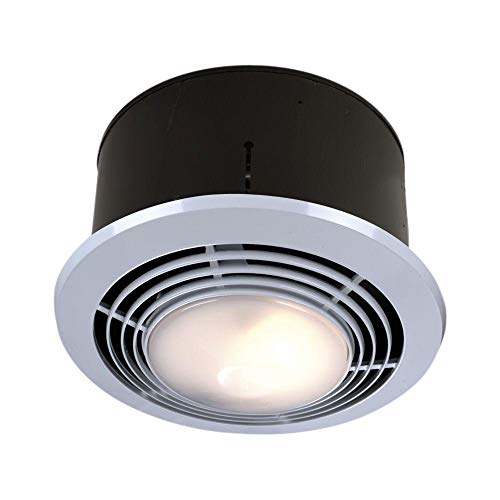
Best ceiling exhaust bath fan with light and heater 2026