
How to Measure a Fluorescent Tube Light Bulb for the Right Fit

Measure the bulb from pin to pin. That total length, combined with the glass thickness, gives you the exact replacement size. Run a tape measure from the tip of the metal prong on one end to the prong tip on the other end. Next, measure the tube diameter across the circular face of the glass. You can often skip measuring altogether if the stamped code on the glass is still legible, as that printout gives you both measurements right away.
A few details can change how you measure. A circular ceiling ring requires measuring across the outer edges, while a U-shaped bulb requires checking the distance between the two legs. If the old tube shattered or went missing, measuring from socket to socket inside the empty fixture tells you what will fit. The spacing and shape of the metal connection pins also determine whether a bulb slides into place. Here is how to measure each style properly so you get the right match.
Check the Stamped Glass Label Before Grabbing a Tape Measure
Looking at the glass near one end of the tube can save you a trip to the store. Manufacturers stamp an identification code in silver, gray, or white ink directly onto the glass surface. This code reveals the exact length, width, and electrical rating without tools.
Read the printed markings in order:
- The letter F: Indicates a standard fluorescent tube. If the code says LED, you have a solid-state retrofit lamp.
- The wattage or nominal length: On linear tubes, this number usually shows wattage, such as F32 for a 32-watt tube. Because 32-watt linear tubes are standardized at four feet, this identifies the standard length. On shorter specialty tubes, it may state length directly, like F14 for a 15-inch bulb.
- The letter T and diameter number: The letter T stands for tubular shape. The number directly following it tells you glass thickness in eighths of an inch. A T8 bulb is eight-eighths of an inch (one inch thick), while a T12 bulb is twelve-eighths of an inch (one and a half inches thick).
- The color code: Markings such as 841 or 850 describe light appearance. For instance, 841 provides 4100K cool white light for kitchens, while 850 indicates 5000K daylight white for sharp task visibility.
Inspect both ends under a bright lamp. Heat from internal filaments can scorch the glass and fade the ink over time. Understanding how long fluorescent bulbs last in real life use helps explain why these markings often fade on older tubes. If the label has rubbed off completely, taking manual measurements is the next step.
Steps to Measure a Straight Fluorescent Tube from Pin to Pin
Measuring a linear fluorescent bulb takes only a minute. The critical rule is measuring the entire overall length from the outer tip of the pins on one end to the tip of the pins on the opposite end, rather than measuring only the glass cylinder.
- Turn off the wall switch and shut off the circuit breaker. Fluorescent fixtures deliver electrical current directly to socket contacts, so cutting power eliminates shock risk before touching the tube ends.
- Rotate the bulb a quarter turn to free it from the fixture. Standard linear fixtures use slotted sockets that release the metal pins when rotated 90 degrees, allowing the bulb to slide down freely without cracking the glass.
- Place the tube on a flat, cushioned surface like a carpet or towel. Long glass tubes flex easily and roll off slick countertops, so a soft surface prevents drops and broken glass.
- Hook your tape measure over the outer tip of the metal pins at one end. Fixture sockets rely on full pin-to-pin contact, so starting at the pin tip captures the true working length required for the replacement to fit.
- Pull the tape straight along the tube to the tips of the opposite pins. Measuring only the glass cylinder leaves you about half an inch short, which is why many buyers bring home the wrong size.
- Match your pin-to-pin measurement to the nominal store size. Hardware stores label bulbs by nominal length (standard store size). A bulb measuring 47 and three-quarter inches from pin tip to pin tip is sold as a 48-inch bulb because socket slots occupy the remaining quarter inch inside the fixture.
How to Measure Tube Diameter and Understand the T Number
Finding the correct length is essential, but your replacement must also match the tube thickness of your fixture. The lighting industry classifies tube diameter with the letter T (tubular) followed by a number representing eighths of an inch.
The three most common linear tube sizes break down as follows:
- T5 tubes: Five-eighths of an inch in diameter (0.625 inches). These slim tubes are common in under-cabinet kitchen lighting and compact display fixtures.
- T8 tubes: Eight-eighths of an inch in diameter, which equals exactly one inch. This is the modern standard for home garages, basements, and laundry rooms.
- T12 tubes: Twelve-eighths of an inch in diameter, which equals one and a half inches. These thick tubes remain widespread in older basement fixtures and workshop strip lights.
To check diameter, hold a ruler across the flat face of the metal end cap, or measure across the widest curve of the glass. You can also wrap a narrow strip of paper around the glass, mark where it overlaps, measure that strip to find the circumference, and divide by 3.14 to calculate diameter.
Matching diameter matters because each size pairs with a specific ballast, the fixture power box regulating current. While a one-inch T8 tube and a one-and-a-half-inch T12 tube share identical lengths and two-prong pins, running them on incompatible ballasts causes flickering, buzzing, or premature failure.
How to Measure Circular Fluorescent Bulbs
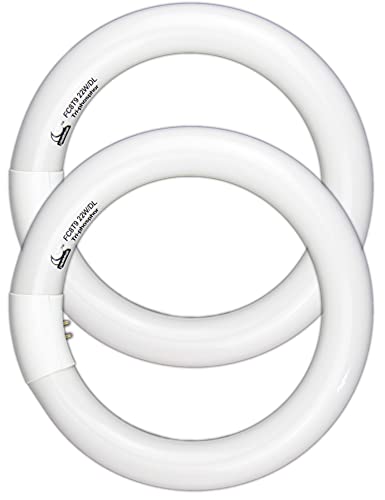
Circular fluorescent bulbs, often sold as circline lamps, illuminate round ceiling fixtures, bathroom vanities, and ceiling fans. Measuring a round tube requires measuring the outside diameter rather than the internal opening.
Take these steps to measure a round bulb correctly:
- Unplug the four-pin electrical harness. Switch off the light, allow the glass to cool, and pull the plastic wiring plug straight off the four metal prongs on the bulb.
- Release the bulb from the fixture support clips. Gently flex the spring-loaded metal or plastic clips outward to detach the glass ring from the fixture pan.
- Set the bulb flat on a level table. Laying the ring flat prevents the curved glass from rocking while you measure.
- Measure straight across the widest outer edge. Pull your tape measure from the outer edge of the glass on one side, across the open center, to the outer glass edge on the opposite side. Retail packaging always references this outside diameter.
Standard circular sizes in home fixtures are 8 inches, 9 inches, and 12 inches. An 8-inch circular bulb draws about 22 watts under code FC8T9, while a 9-inch circle draws around 30 watts under FC9T9. Never measure the inside hole of the ring, as retail packaging does not use inside dimensions.
How to Measure an Empty Fixture Without a Bulb
When moving into a new home or dealing with a broken bulb that was discarded, you can determine the correct tube size by measuring the fixture housing directly.
Follow this sequence to measure an empty fixture:
- Shut off the circuit breaker that controls the light. Because your hands and measuring tape will be near electrical sockets, cutting breaker power ensures complete safety against shock.
- Locate the two plastic sockets (tombstones). Inspect both ends of the fixture channel to find the upright white plastic holders that support the bulb prongs.
- Measure the distance between the inside socket faces. Hook your tape measure against the inside flat surface of one tombstone and pull it straight across to the inside face of the opposite tombstone.
- Match the distance to standard nominal sizes. If the distance between socket faces measures 48 inches, the fixture requires standard 4-foot tubes. A span of 24 inches takes 2-foot tubes, while a 36-inch span requires 3-foot tubes.
- Examine the socket entry slots. Check whether the sockets have vertical slots where pins twist into place, or if they are solid spring-loaded sockets where you depress one end to insert the tube.
Comparing Base Pin Types and Pin Spacing
Even if length and diameter match your fixture, a replacement bulb will not function if the metal base pins cannot fit into the sockets. Fluorescent tubes utilize several base styles tailored to bulb size and application.
Compare the common base styles below:
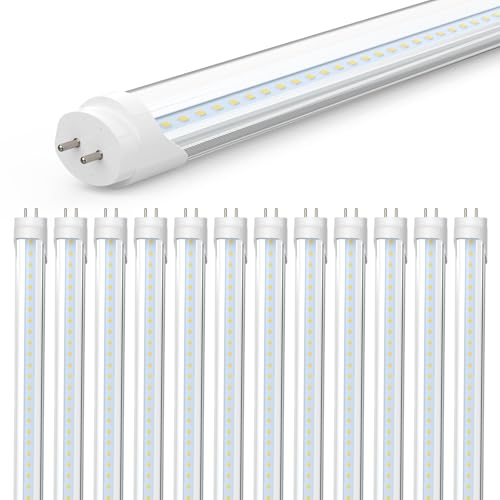
- Medium Bi-Pin (G13 base): The standard two-prong base found on almost all 2-foot, 3-foot, and 4-foot T8 and T12 linear tubes. The two prongs are spaced exactly 13 millimeters (about half an inch) apart from center to center.
- Miniature Bi-Pin (G5 base): Found on slim T5 tubes. Prongs sit 5 millimeters (under a quarter inch) apart, making them too narrow for T8 or T12 sockets.
- Single Pin (Fa8 base): Features a single cylindrical metal pin centered on each end cap. These are common on 8-foot industrial strip lights.
- Recessed Double Contact (RDC base): Features two internal contacts tucked inside a black plastic sleeve on each end, typical for high-output outdoor signage.
- Four-Pin Base (G10q base): Exclusive to circular ring bulbs. All four prongs sit in a compact square cluster along the inner perimeter of the tube, plugging into a molded socket clip.
Use a small ruler to check the distance between prong centers on your old bulb. If the gap measures half an inch, you need a standard medium bi-pin replacement.
Choosing the Right Replacement Bulb for Your Fixture
After taking measurements and checking pin spacing, selecting a replacement bulb involves deciding between traditional fluorescent tubes and modern LED replacements. Both options can brighten your room, but they differ in energy use, longevity, and installation requirements.
Review these core factors before choosing your replacement:
- Fluorescent versus LED tubes: Standard fluorescent tubes drop straight into existing fixtures and depend on the fixture power box (ballast) to run. LED retrofit tubes offer long operating life and cut energy consumption significantly. Some LED tubes are plug-and-play, meaning they work with your existing ballast without wiring changes. Other LED models require bypassing the old ballast to wire line power directly to sockets. Hybrid LED tubes support both methods.
- Color temperature: Match the Kelvin rating on the package to your room needs. For cozy living spaces, 2700K provides soft warm white light. For bathrooms and kitchens, 3000K warm white or 4000K clean cool white delivers sharp clarity without feeling harsh. In garages, basements, and workshops, 5000K or 6000K daylight white provides bright task lighting that reduces eye strain.
- Brightness in lumens: Compare bulbs using lumens (actual brightness) rather than wattage (power draw). A standard four-foot fluorescent tube typically produces 2,400 to 2,800 lumens. An equivalent LED tube provides that same brightness while drawing less than half the electrical power.
- Damp and enclosed fixture ratings: If installing the bulb in an unheated garage, laundry room, or enclosed ceiling fixture, make sure the packaging indicates it is damp-location or enclosed-fixture rated so heat and humidity do not shorten its lifespan.
- LFR Score9.2
LFR Score is a ranking system developed by lightfansreviews.com. LFR Score has no relationship or impact from any manufacturers or sales agent websites. Learn more
- BrandCHKADAWA

- LFR Score9.0
LFR Score is a ranking system developed by lightfansreviews.com. LFR Score has no relationship or impact from any manufacturers or sales agent websites. Learn more
- BrandFulight

- LFR Score8.8
LFR Score is a ranking system developed by lightfansreviews.com. LFR Score has no relationship or impact from any manufacturers or sales agent websites. Learn more
- BrandKonideke

TSEXES 2FT T8 LED Tube Light,12W(30W Equivalent),Ballast Bypass,1560LM,Led Replacement F20T10
View on Amazon- LFR Score8.8
LFR Score is a ranking system developed by lightfansreviews.com. LFR Score has no relationship or impact from any manufacturers or sales agent websites. Learn more
- BrandTSEXES

- LFR Score8.6
LFR Score is a ranking system developed by lightfansreviews.com. LFR Score has no relationship or impact from any manufacturers or sales agent websites. Learn more
- BrandJESLED

- LFR Score8.6
LFR Score is a ranking system developed by lightfansreviews.com. LFR Score has no relationship or impact from any manufacturers or sales agent websites. Learn more
- BrandRomwish
- LFR Score8.6
LFR Score is a ranking system developed by lightfansreviews.com. LFR Score has no relationship or impact from any manufacturers or sales agent websites. Learn more
- BrandRomwish

- LFR Score8.6
LFR Score is a ranking system developed by lightfansreviews.com. LFR Score has no relationship or impact from any manufacturers or sales agent websites. Learn more
- BrandXapolu

- LFR Score8.4
LFR Score is a ranking system developed by lightfansreviews.com. LFR Score has no relationship or impact from any manufacturers or sales agent websites. Learn more
- BrandCHKADAWA

- LFR Score7.8
LFR Score is a ranking system developed by lightfansreviews.com. LFR Score has no relationship or impact from any manufacturers or sales agent websites. Learn more
- BrandMarxlait
Last update on 2026-10-02 / Affiliate links / Images, Product Titles, and Product Highlights from Amazon Product Advertising API
FAQs
Do I include the metal pins when measuring the length of a fluorescent tube?
Yes, always include the metal pins when measuring a linear fluorescent bulb by hand. Hook your tape measure over the outer tip of the pins on one end and pull it to the pin tips on the opposite end. Measuring only the glass leaves your reading about half an inch short, which often leads to purchasing the wrong replacement.
Can I replace a thick T12 fluorescent tube with a thinner T8 tube?
It depends on your fixture power box (ballast). While standard 4-foot T8 and T12 tubes share identical lengths and medium bi-pin prongs, older magnetic ballasts engineered for T12 bulbs can overheat or flicker when paired with T8 tubes. If your fixture contains an older magnetic ballast, you should replace the ballast or install a direct-wire LED retrofit tube that bypasses the ballast entirely.
What does nominal length mean on a light bulb box?
Nominal length represents the standard commercial size of the fixture rather than the physical pin-to-pin dimension of the bulb itself. For example, a bulb labeled with a nominal length of 48 inches actually measures roughly 47 and three-quarter inches from pin tip to pin tip. The remaining quarter inch accounts for the space occupied by electrical sockets on either end of the fixture.
Why does my new replacement fluorescent tube flicker or hum when I turn it on?
Flickering or humming usually points to an aging ballast or poor contact between the bulb pins and socket slots. Turn off the light switch and ensure the bulb is fully rotated into the sockets so both pins seat securely. If the problem continues with a fresh bulb of the correct size and wattage, the internal ballast has likely failed and requires replacement.

Best Bulb For Exposed Light 2026 That Shines Bright

Best Industrial Light Bulb Reviews: Top Picks for 2026
Best Outdoor Light Bulb Reviews: Top-Rated Picks for 2026
Best LED Reading Light Bulb Reviews - Top Picks for 2026

Best Vintage Light Bulb 2026 With Style And Glow
Best Yellow Fog Light Bulb 2026 For Clearer Night Drives

Best Z Wave Light Bulb 2026 Top Picks For Smart Control
Best Light Bulb For Vanity Mirror 2026 Brightness Boost






