
What Size Light Fixture for a 48-Inch Vanity?

Aim for 36 to 40 inches wide. That puts an overhead bar at roughly 75 percent of the counter width, creating a balanced frame that will not overpower the room. Matching the fixture to the full four-foot cabinet might sound logical, but a light that wide often hangs past the edges of the mirror and throws harsh shadows across your face.
A few room details can shift those numbers. Swapping an overhead bar for a pair of wall sconces (side lights mounted at eye level) calls for slender fixtures around 16 to 24 inches tall alongside a narrower mirror. The width of your glass matters too, since an overhead light should never stretch wider than the frame below it. Ceiling height and tall linen cabinets also limit your usable wall space. Here is how to find the ideal size and layout for your space.
The Short Version
- Target width: Choose an overhead light bar between 36 and 40 inches wide, which equals roughly 75 percent of your 48-inch cabinet width.
- Avoid matching sizes: Do not install a 48-inch fixture over a 48-inch counter, because it will crowd the wall and overhang the edges of your mirror.
- Side sconce alternative: If you prefer side lighting, mount two sconces measuring 16 to 24 inches tall on either side of a narrower 24- to 30-inch mirror.
- Mirror proportions: Always keep your light fixture narrower than the mirror below it, leaving a few inches of visible mirror margin on both sides.
The 75-Percent Rule for Overhead Vanity Lights
When you stand in your bathroom with a tape measure, your first thought might be to match numbers. If your vanity cabinet measures 48 inches across, buying a 48-inch light bar seems logical. In home design, that simple match is actually the most common decorating mistake.
A light fixture that spans the full 48 inches creates too much visual weight near the ceiling. Instead of framing your reflection, an edge-to-edge fixture acts like a heavy roof sitting on top of your mirror. It crowds the wall, leaves no breathing room around the edges, and makes the entire bathroom feel narrower than it really is.
The standard guideline for bathroom lighting is the 75-percent rule. You take the total width of your counter and multiply it by 0.75 to find your ideal fixture width. For a 48-inch cabinet, 75 percent comes out to exactly 36 inches.
A fixture between 36 and 40 inches wide sits comfortably inside the boundaries of your vanity. It leaves 4 to 6 inches of open wall space on each side of the cabinet. That gap creates a balanced, tapered look from the wide counter base up to the narrower light above. It also gives you plenty of light coverage across the sink without feeling cramped.
Manufacturers do produce 48-inch light bars, but those long fixtures belong over wide 60-inch double vanities or commercial washrooms. Sticking to the 36- to 40-inch range ensures your 48-inch vanity looks intentional, open, and well-proportioned.
Overhead Light Bar versus Side Sconces for a 48-Inch Counter
A 48-inch vanity is a versatile size. It is large enough to support a single overhead fixture or a pair of side wall sconces (a wall-mounted side light). Both options work well, but they create different lighting effects and require different wall layouts.
An overhead light bar is the most common choice. It mounts directly above your mirror and wires into a single junction box (a wall box where electrical wires join). If your bathroom already has one central electrical box above the sink, an overhead bar is the easiest fixture to install. A 3-light or 4-light bar spread across 36 inches casts broad light downward across the entire counter surface. The main drawback is shadow placement. Direct downward light can cast dark shadows under your eyes, nose, and chin, which makes detailed grooming tasks like shaving or applying cosmetics harder.
Side sconces solve the shadow problem completely. Mounting a sconce on each side of your mirror provides cross-illumination. The light washes across your face from the left and right, filling in hollows and eliminating under-eye shadows. This makes side sconces the gold standard for daily grooming.
The challenge with side sconces on a 48-inch counter is horizontal space. You have 48 inches of total width to fit two lights and a mirror. To make this work, choose a narrower mirror between 24 and 30 inches wide. A 24-inch mirror leaves 24 inches of leftover space, giving you 12 inches of open wall on each side. That provides plenty of room to mount two sconces that measure 5 to 6 inches wide. But if you already own a 36-inch or 40-inch mirror, you will not have enough room on the sides for sconces, making an overhead bar your best route.
Matching Light Size to Mirror Width
Your vanity light must balance with your counter, but its relationship to your mirror is even more critical. A light fixture should never be wider than the mirror hanging underneath it. When a light bar extends past the glass, the top of the wall looks top-heavy and unfinished.
Use this checklist before you buy your mirror and light:
- Mirror width check: For a 48-inch vanity, pick a mirror between 36 and 42 inches wide. This leaves a neat 3- to 6-inch border of drywall on either side of the vanity base.
- The overhang rule: Your overhead light bar should be about 2 to 4 inches shorter than the mirror on both ends. If your mirror is 40 inches wide, a 36-inch light bar leaves a clean 2-inch step-down on each side.
- Frame thickness: A mirror with a thick, heavy wooden frame can support a slightly wider fixture, up to 38 or 40 inches, because the frame adds visual bulk. A frameless or thin metal mirror looks best paired with a slimmer 36-inch bar.
- Cabinet door swing: If your mirror is actually the front of a surface-mounted medicine cabinet, check how far the door projects from the wall. You need a light fixture with enough outward depth so the swinging door does not hit the light shades.
- Two-mirror setups: If your 48-inch counter has two small sinks, you might use two separate 18- to 20-inch mirrors. Never hang a single long bar across two mirrors. Instead, install two small 14- to 16-inch fixtures centered over each mirror, or mount three vertical sconces across the wall.
Height and Placement Rules for Mounting Your Fixture
Getting the size right is only half the battle. Mounting your light at the correct height ensures good illumination and prevents awkward gaps on the drywall.
- Cut power at the panel: Before measuring near wiring or removing an old fixture, shut off the circuit breaker at the main electrical panel. Never rely on a wall light switch alone to keep you safe from live electricity.
- Establish the junction box height: For an overhead light, the standard height for the junction box is 75 to 80 inches from the finished bathroom floor. This puts the light source just above the average adult eye line, preventing direct bulb glare.
- Check clearance above the mirror: Mount the bottom of your light fixture 2 to 4 inches above the top edge of your mirror. If the fixture touches the mirror frame, the setup looks jammed together and cleaning the glass becomes frustrating.
- Confirm ceiling clearance: Leave at least 3 inches between the top of your light fixture and your ceiling. If your bathroom has low 8-foot ceilings and a tall mirror, look for a slim horizontal bar rather than upward-pointing glass shades that bump against the drywall.
- Position side sconces at eye level: If you choose side sconces, mount them so the center of the bulb or light source sits 60 to 65 inches off the finished floor. This places the light directly across from your face. Space the two sconces 36 to 40 inches apart for balanced illumination.
If your existing electrical wall box is off-center from the vanity or sink, hire a licensed electrician to move the box. Trying to compensate by hanging an extra-wide fixture off-center will only highlight the mistake.
Brightness and Color Tone for Bathroom Grooming
Size determines how your vanity looks, but brightness and color determine how well your bathroom functions. The wrong bulbs can make a beautifully sized fixture feel harsh or dingy.
When shopping for fixtures or bulbs, look at brightness in lumens rather than wattage. Lumens measure actual brightness while watts only measure power draw. For a primary 48-inch grooming vanity, you need roughly 1,600 to 2,400 total lumens. If your overhead fixture holds three light sockets, look for three bulbs producing about 600 to 800 lumens each. If you use two side sconces, select bulbs that produce 800 to 1,000 lumens per sconce.
Light warmth also matters. Color tone or warmth (Kelvin) tells you whether a light looks cozy yellow or sharp blue. A rating of 2700K produces a warm soft white that feels welcoming, but it can look too yellow for precise grooming. A range between 3000K and 3500K provides a crisp, clean neutral white that reflects skin tones accurately. Daylight fixtures rated at 5000K produce a crisp daylight tone, but that can sometimes feel stark or clinical in a small bathroom.
Check the color accuracy (CRI) rating on the packaging as well. A rating of 90+ CRI ensures that skin tones, clothing colors, and makeup shades look true to life rather than dull or greenish.
Pair your lights with an LED-compatible dimmer switch so you can dial down the brightness for relaxing evening baths or crank it up for morning routines. Older wall switches often cause humming, buzzing, or flickering when paired with modern fixtures. If you need subtle guidance at night without switching on bright vanity lights, installing indoor motion sensor lights for hallways and stairs outside the bathroom door provides a safe, low-glare pathway.
Always verify that your fixture is damp-rated for steamy bathrooms. Bathrooms build up high humidity from hot showers, and a damp rating ensures the internal wiring and finish resist rust and moisture damage over time.
What to Look for in a 48-Inch Vanity Light Fixture
When you browse fixtures for a 48-inch cabinet, look for a hardwired fixture (wired directly into a ceiling or wall electrical box) that includes a sturdy mounting plate to support the width of the bar. A solid metal backplate keeps longer fixtures from sagging over time.
Decide between a built-in LED fixture and one with a standard screw-in bulb base (E26 medium base). A built-in LED bar delivers a slim, low-profile look with smooth light distribution. Many of these modern bars even feature built-in switches that let you select your color tone during installation. On the other hand, fixtures with standard screw-in bases give you the freedom to swap out individual bulbs whenever you want to change your brightness or warmth.
Pay close attention to shade orientation. Many multi-light fixtures allow reversible mounting, meaning you can point the glass shades upward or downward. Pointing shades down delivers direct task light onto your sink and counter, while pointing them up bounces light off the ceiling for a softer, glare-free ambient glow.

- LFR Score9.7
LFR Score is a ranking system developed by lightfansreviews.com. LFR Score has no relationship or impact from any manufacturers or sales agent websites. Learn more
- BrandHUMHOLD

- LFR Score9.6
LFR Score is a ranking system developed by lightfansreviews.com. LFR Score has no relationship or impact from any manufacturers or sales agent websites. Learn more
- BrandEnsenior

- LFR Score9.3
LFR Score is a ranking system developed by lightfansreviews.com. LFR Score has no relationship or impact from any manufacturers or sales agent websites. Learn more
- BrandProgress Lighting

- LFR Score8.7
LFR Score is a ranking system developed by lightfansreviews.com. LFR Score has no relationship or impact from any manufacturers or sales agent websites. Learn more
- BrandDonrao
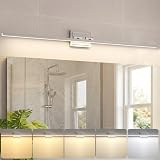
- LFR Score7.1
LFR Score is a ranking system developed by lightfansreviews.com. LFR Score has no relationship or impact from any manufacturers or sales agent websites. Learn more
- BrandVOLISUN
Last update on 2026-10-26 / Affiliate links / Images, Product Titles, and Product Highlights from Amazon Product Advertising API
FAQs
Can I use a 48-inch light fixture over a 48-inch vanity?
You can physically mount one, but it is rarely a good design choice. An edge-to-edge fixture crowds the wall, overhangs standard mirrors, and creates an unbalanced, top-heavy appearance. Sticking to a 36- to 40-inch fixture leaves attractive margins on both sides and frames your mirror much better.
Should bathroom vanity lights point up or down?
Pointing shades downward provides direct task lighting onto your counter, which is helpful for shaving, washing, and makeup application. Pointing shades upward bounces light off the ceiling, creating softer ambient illumination with fewer harsh glares. If your fixture sits close to the ceiling, point the shades down to avoid dark ceiling scorch marks or heat buildup.
What size mirror should I buy for a 48-inch vanity?
A mirror measuring 36 to 42 inches wide is the ideal match for a 48-inch vanity counter. This size leaves 3 to 6 inches of visible wall space on each end, keeping the cabinet grounded. It also gives you the perfect width to hang a 36-inch overhead light bar without the light extending past the glass.
Can I install two overhead lights over a 48-inch vanity?
Installing two separate overhead lights only works if your 48-inch vanity features a double-sink configuration with two narrow mirrors. For a standard single-sink vanity, two overhead lights look crowded and place harsh light in odd spots. Stick with a single centered overhead fixture or two side sconces for a single-sink setup.


Best Lighting For Makeup 2026 Bright Ideas For Flawless Looks

Best Wall Sconces For Staircase 2026 Brighten Your Home

Best Lighting For Computer Desk 2026 For Focused Work

Best Boat Black Lights 2026 For Nighttime Adventure

Best Black 30 Inch Light Bar Reviews – Top Picks of 2026

Best Black Light For Aquarium 2026 For Vibrant Glow

Best Black Light for Authenticating Glass 2026 Top Picks

Best Waterproof Spotlight 2026 That Outshines Expectations






