
What Size Vanity Light for a 48-Inch Vanity?

A single overhead fixture for a 48-inch vanity should measure between 36 and 40 inches wide. That standard size changes depending on the exact width of the mirror hanging underneath. Aiming for roughly three-quarters of the cabinet width gives you plenty of bright, balanced glow without crowding the room. A light in this sweet spot keeps the wall looking proportional and prevents awkward, dark shadows when you stand at the sink.
Mirror width is the first detail to check, because the fixture should never extend past the edges of the glass below it. Fixture style plays a role too, especially if you decide to mount sconces (wall lights on either side of the mirror) instead of one long overhead bar. Low ceilings can also force you toward a flatter, compact design rather than deep downward shades. Here is how to match these measurements to your exact layout before drilling any holes.
The Short Version
- Target width: Aim for an overhead light fixture between 36 and 40 inches wide. This spans roughly 75 to 80 percent of your 48-inch vanity base.
- The mirror limit: Your light fixture should never extend past the outer edges of your mirror. If your mirror is 36 inches wide, your light fixture should measure between 27 and 30 inches wide.
- Mounting height: Hang an overhead bar roughly 75 to 80 inches above the finished floor, or about 2 to 4 inches above the top of your mirror frame.
- Side sconce spacing: If you use side sconces (wall-mounted side lights) instead of a top bar, mount them at eye level, about 60 to 65 inches from the floor and 28 to 36 inches apart.
The Golden Width Rule for a 48-Inch Vanity
When you stand in front of a bathroom counter, your eyes look for balance. A 48-inch vanity is a generous medium-sized setup. It gives you plenty of counter space, but it also creates a broad visual base. If you place a light fixture that is too narrow above it, the counter feels heavy and the corners remain dim. If you choose a fixture that is too wide, the room feels crowded, and the fixture looks like it is about to tip over.
The standard guideline for bathroom design is the 75 percent rule. For a 48-inch vanity, multiplying 48 inches by 0.75 gives you 36 inches. You can stretch this slightly up to roughly 80 percent, which equals 38.4 inches. That means the sweet spot for an overhead fixture above a 48-inch vanity is almost always 36 to 40 inches wide.
A fixture in this size range usually contains three or four individual light shades. That gives you enough physical spread to cast light evenly across the sink basin and the counter space on either side. It keeps bright illumination directly over your face while leaving comfortable breathing room between the ends of the light bar and the edges of the cabinet below.
Scale also affects how tall the room feels. A fixture between 36 and 40 inches provides enough physical presence to anchor a 48-inch counter without crowding the ceiling. It leaves several inches of exposed wall on either side. That exposed wall space frames your mirror and keeps your bathroom feeling open rather than cramped.
Matching Your Light to the Mirror Width
While your counter establishes the foundation of your room, your light fixture actually pairs directly with the mirror beneath it. The mirror serves as the visual bridge between your counter and your lighting. If you pick a light bar based only on your 48-inch vanity without measuring your mirror, the final setup can look awkward.
Use this simple checklist before picking your fixture size:
- Full-width mirror (46 to 48 inches wide): If your mirror spans nearly the entire counter, stick to the standard 36 to 40-inch fixture. This keeps the light centered over the glass while leaving at least 3 to 4 inches of mirror surface showing on either side.
- Standard framed mirror (36 to 40 inches wide): This is the most common mirror setup for a 48-inch counter. Here, your mirror is already narrower than the vanity. You must size your light fixture to the mirror, not the counter. Choose a fixture that spans 75 to 80 percent of the mirror width, which means a light between 27 and 32 inches wide.
- Narrow mirror (30 to 32 inches wide): If you chose a compact vertical mirror to leave drywall open for decor, your light bar should measure roughly 24 inches wide. A 36-inch light bar above a 30-inch mirror will stick out past the glass edges, creating an awkward top-heavy look.
- Dual mini mirrors: Some homeowners install two tall, narrow mirrors over a single-sink 48-inch vanity for visual interest. If you do this, avoid a single overhead bar altogether. Instead, mount individual smaller fixtures (around 18 to 22 inches wide) centered over each mirror, or place wall-mounted lights between and beside them.
The golden rule is straightforward: your light fixture should never be wider than the mirror hanging below it. When light extends past the frame of a mirror, it creates odd shadows down the side walls and makes the glass look undersized.
Can You Use a Full 48-Inch Light Fixture?
Many homeowners assume that buying a 48-inch light for a 48-inch vanity is the most logical choice. After all, the numbers match. In practice, installing an edge-to-edge light fixture rarely looks good on a standard freestanding bathroom vanity.
When an overhead light bar matches the exact width of the counter below it, it creates a heavy roofline across your wall. The fixture feels like a lid sitting on top of the space. Instead of a balanced, airy room, you get a rigid box shape. It also pushes the light sources out toward the outer corners of the room, which can throw glare into your eyes when you walk through the doorway.
There is only one common situation where a full 48-inch fixture works well: an enclosed alcove. If your 48-inch vanity sits tightly between two side walls, the room has distinct natural borders. In a recessed alcove, an edge-to-edge light bar can create a clean, modern architectural look. Even then, the mirror underneath should span the entire wall from corner to corner to balance that horizontal line.
If your vanity has open wall space on one or both sides, skip the 48-inch fixture. Stick to the 36 to 40-inch range. It delivers better visual balance and prevents the room from feeling top-heavy.
Mounting Height and Box Position Step by Step
Getting the right fixture width solves only half the problem. You also need to position the junction box (the wall electrical box where wires connect) at the right vertical height and horizontal location.
- Shut off the power first: Before touching any existing wiring or opening electrical cutouts, shut off the circuit breaker at the main electrical panel. Never rely on the wall toggle switch alone to protect you from live current.
- Find the center point: Locate the exact center of your sink basin and your mirror. On most 48-inch vanities, the sink sits directly in the middle (24 inches from either edge). But some vanities feature an offset sink with drawers on one side. Always center your light fixture over the mirror and sink basin where you stand, not necessarily the exact geometric center of the wooden cabinet base.
- Measure from the finished floor: For standard 8-foot ceilings, plan for the center of the light fixture to sit roughly 75 to 80 inches above the finished floor. This places the light slightly above the average person's forehead, allowing illumination to wash downward naturally without blinding your eyes.
- Check clearance above the mirror: Measure your mirror height before setting your wall box. You want roughly 2 to 4 inches of open wall between the top frame of the mirror and the bottom edge of your light fixture shades. If your mirror is very tall, you may need to mount the fixture slightly higher to avoid overlapping the glass.
- Account for shade drop or rise: Look closely at the fixture design before cutting drywall. Some fixtures have mounting plates directly in line with the bulbs. Others feature decorative arms that drop the glass shades several inches below the junction box, or raise them several inches above it. Adjust your junction box placement based on where the bulbs will actually sit, not just where the plate screws to the wall.
If you find that your existing junction box sits off-center by an inch or two, look for vanity light fixtures with a wide backplate. Many backplates allow you to make minor horizontal adjustments inside the plate before locking the fixture down. If the wiring box is severely misplaced, hire a licensed electrician to move the box safely.
Overhead Bar Versus Side Sconces for a 48-Inch Setup
An overhead bar is the most common way to light a 48-inch vanity, but it is not your only option. You can also light the counter using side sconces mounted on either side of your mirror.
Overhead bars are simple to install because they require only one junction box centered on the wall. They work wonderfully with wide mirrors, providing strong downward illumination across the entire counter surface. The main drawback of an overhead bar is downward shadow. When light comes purely from above your head, it casts subtle shadows under your eyes, nose, and chin, which can make shaving or applying makeup slightly harder.
Side sconces solve the shadow problem completely. By placing a light source on the left and right sides of your face, they provide cross-illumination. This bathes your face in even light without casting deep downward shadows. For grooming tasks, side lighting provides the most flattering results.
However, side sconces require careful planning on a 48-inch vanity. Sconces need to sit at eye level, roughly 60 to 65 inches above the floor, and about 28 to 36 inches apart from each other. That means your mirror must be relatively narrow (usually 24 to 28 inches wide) to leave enough drywall on each side for the sconce backplates. If you prefer a wide, panoramic mirror that fills the 48-inch space, stick with an overhead bar.
Choosing the Right Fixture Type for Balanced Bathroom Light
Once you know your target dimensions, look for a fixture built to handle daily bathroom use. The right fixture combines comfortable brightness with safe moisture protection.
Always verify the location rating on the fixture packaging. Bathrooms collect steam quickly from showers, so you need a hardwired fixture (wired directly into a wall electrical box) marked as damp-rated for steamy bathrooms. Fixtures marked as dry-rated belong in living rooms or bedrooms, and their internal components may corrode prematurely when exposed to shower moisture.
Next, consider your brightness in lumens. Remember that lumens measure actual brightness, while watts only measure power draw. For a 48-inch vanity acting as the main grooming station, aim for a total output between 1,600 and 2,400 lumens across all bulbs. If your fixture uses built-in LED components rather than screw-in bulbs, make sure it connects to an LED-compatible dimmer switch. Older wall dimmers can cause unwanted buzzing, hums, or flickering.
Pay attention to color tone or warmth, measured in Kelvin. A rating of 2700K produces a warm, soft white tone similar to classic incandescent bulbs, which feels cozy in powder rooms. For everyday grooming, 3000K offers a clean, neutral white that keeps colors looking accurate without feeling harsh. Reserve 5000K crisp daylight tones for utility spaces, as they can look stark against bathroom tile. For nighttime bathroom trips when you want to avoid turning on bright overhead bars, adding indoor motion sensor lights for hallways and stairs can help guide your way safely without disrupting your sleep.

- LFR Score9.7
LFR Score is a ranking system developed by lightfansreviews.com. LFR Score has no relationship or impact from any manufacturers or sales agent websites. Learn more
- BrandHUMHOLD

- LFR Score9.6
LFR Score is a ranking system developed by lightfansreviews.com. LFR Score has no relationship or impact from any manufacturers or sales agent websites. Learn more
- BrandEnsenior
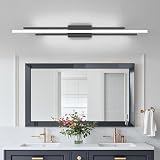
- LFR Score8.0
LFR Score is a ranking system developed by lightfansreviews.com. LFR Score has no relationship or impact from any manufacturers or sales agent websites. Learn more
- BrandVitaLink

- LFR Score7.2
LFR Score is a ranking system developed by lightfansreviews.com. LFR Score has no relationship or impact from any manufacturers or sales agent websites. Learn more
- BrandEnsenior
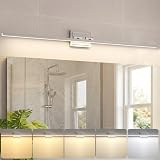
- LFR Score7.1
LFR Score is a ranking system developed by lightfansreviews.com. LFR Score has no relationship or impact from any manufacturers or sales agent websites. Learn more
- BrandVOLISUN
Last update on 2026-10-27 / Affiliate links / Images, Product Titles, and Product Highlights from Amazon Product Advertising API
FAQs
Should the vanity light be centered over the sink or the mirror?
The light fixture should always be centered directly over the mirror and the sink basin below it. If your 48-inch vanity has an offset sink with drawers on one side, center both your mirror and your light over the sink itself. Centering the light over the wooden cabinet base while your sink sits off to the side looks unbalanced and leaves you standing in shadows.
How many bulbs should a light bar have for a 48-inch vanity?
A light bar for a 48-inch vanity typically features three or four bulbs. A three-light or four-light fixture usually spans between 36 and 40 inches, which provides ideal visual balance across the counter. This multi-bulb spread ensures even illumination across the sink bowl without leaving dark corners on the counter wings.
Can vanity light shades point up or down?
Many fixtures can be mounted with shades pointing either up toward the ceiling or down toward the sink. Pointing the shades downward gives you direct task lighting for brushing teeth and applying makeup, though it can create slight glare if the bulbs sit at eye level. Pointing the shades upward bounces light off the ceiling for a softer, glare-free ambient glow, but it reduces the direct task light hitting your face.
How far above the mirror should the light fixture hang?
Mount the bottom edge of your vanity light fixture roughly 2 to 4 inches above the top edge of your mirror frame. This provides a clean visual separation between the glass and the fixture while keeping the light close enough to illuminate your face effectively. Leaving more than 6 inches of empty space can make the fixture feel disconnected from the mirror below it.


Best Lighting For Makeup 2026 Bright Ideas For Flawless Looks

Best Wall Sconces For Staircase 2026 Brighten Your Home

Best Lighting For Computer Desk 2026 For Focused Work

Best Boat Black Lights 2026 For Nighttime Adventure

Best Black 30 Inch Light Bar Reviews – Top Picks of 2026

Best Black Light For Aquarium 2026 For Vibrant Glow

Best Black Light for Authenticating Glass 2026 Top Picks

Best Waterproof Spotlight 2026 That Outshines Expectations



