
Best Box Fan for Garage 2026: Strong Airflow Picks

A stuffy garage can turn a quick repair, workout, or weekend project into a sweaty chore. The best box fan for garage use should move a noticeable amount of air across a wide area without demanding permanent installation or eating up valuable floor space. A slim square frame fits against a wall, near an open door, or beside a workbench, and the fan can be moved whenever the layout changes. That flexibility matters because garages rarely stay organized the same way for long.
Airflow strength deserves more attention than flashy extras. A box fan needs enough force to break up hot pockets around parked vehicles, storage racks, exercise equipment, and crowded work surfaces. Three speed settings are usually more useful than complicated controls because they let the fan shift from a mild background breeze to stronger ventilation during sanding, painting preparation, or heavy physical work. Still, raw power has a tradeoff, since the highest setting will usually create more noise and may stir loose dust from shelves or unfinished floors.
Placement can make or break the result. Set near an open garage door, the fan can help push trapped warm air outward, while a second opening allows fresher air to enter from another direction. Turned inward during cooler hours, it can pull outdoor air across the room and make the space feel less stagnant. For better comfort, avoid aiming the strongest setting directly at papers, sawdust, lightweight tools, or delicate seedlings waiting to be moved into the garden.
A stable frame also matters more than it first appears. Thin feet and lightweight housings can rattle across concrete, especially when the blades spin at full speed. Wider supports, rubber contact points, and a solid carrying handle make everyday use less irritating. A removable front grille is helpful too, since garage dust clings quickly to blades and can reduce airflow if cleaning keeps getting postponed.
Noise tolerance depends on how the garage is used. A loud motor may be fine during power-tool work, but it can become distracting during phone calls, focused repairs, home workouts, or late-night projects. Lower speeds should produce a steady hum rather than clicking, scraping, or uneven vibration. No basic box fan will be whisper quiet at maximum output, so realistic expectations prevent disappointment.
Safety deserves a firm look before any fan earns a place near a workbench. A fused plug, protected cord connection, durable grille, and controls that don't feel loose all add practical reassurance. The fan shouldn't sit where water, oil, metal shavings, or combustible fumes can reach the motor. Box fans circulate air, but they aren't substitutes for purpose-built exhaust equipment when hazardous vapors, welding smoke, or heavy chemical fumes are present.
The strongest value often comes from a simple model that does the basics well. Reliable speed controls, easy cleaning, a manageable footprint, and steady airflow will matter far longer than a decorative finish or rarely used electronic feature. Well, a timer or remote can be convenient, but those additions aren't worth much if the frame vibrates or the motor struggles after repeated dusty use. The right balance is practical rather than glamorous: enough airflow for the space, acceptable noise, sturdy construction, and no fuss when it's time to carry the fan across the garage.

- LFR Score9.4
LFR Score is a ranking system developed by lightfansreviews.com. LFR Score has no relationship or impact from any manufacturers or sales agent websites. Learn more
- BrandLasko

- LFR Score9.4
LFR Score is a ranking system developed by lightfansreviews.com. LFR Score has no relationship or impact from any manufacturers or sales agent websites. Learn more
- BrandBILT HARD

- LFR Score9.0
LFR Score is a ranking system developed by lightfansreviews.com. LFR Score has no relationship or impact from any manufacturers or sales agent websites. Learn more
- BrandiLiving

- LFR Score8.8
LFR Score is a ranking system developed by lightfansreviews.com. LFR Score has no relationship or impact from any manufacturers or sales agent websites. Learn more
- BrandHurricane

- LFR Score8.8
LFR Score is a ranking system developed by lightfansreviews.com. LFR Score has no relationship or impact from any manufacturers or sales agent websites. Learn more
- BrandGenesis
- LFR Score8.8
LFR Score is a ranking system developed by lightfansreviews.com. LFR Score has no relationship or impact from any manufacturers or sales agent websites. Learn more
- BrandHurricane

- LFR Score8.4
LFR Score is a ranking system developed by lightfansreviews.com. LFR Score has no relationship or impact from any manufacturers or sales agent websites. Learn more
- BrandAmazon Basics

- LFR Score8.4
LFR Score is a ranking system developed by lightfansreviews.com. LFR Score has no relationship or impact from any manufacturers or sales agent websites. Learn more
- BrandPELONIS

- LFR Score8.4
LFR Score is a ranking system developed by lightfansreviews.com. LFR Score has no relationship or impact from any manufacturers or sales agent websites. Learn more
- BrandPELONIS
Last update on 2026-07-08 / Affiliate links / Images, Product Titles, and Product Highlights from Amazon Product Advertising API
Lasko U12104 Pivoting Utility Fan
A garage can feel tolerable one minute and downright oppressive once a vehicle, mower, or power tool starts adding heat to the room. Standard square fans often move air broadly, but they don’t always send it toward the exact patch of floor, workbench, or damp carpet that needs attention. The best box fan for garage setups sometimes isn’t a traditional box-shaped model at all, and the Lasko U12104 makes that case with a compact blower design, focused airflow, and a pivoting body. Its real appeal lies in control: you can place it low, aim it sharply, and move it without wrestling with a bulky frame.
Lasko Pivoting Utility Fan
The Lasko U12104 is built around a simple idea: direct the air instead of merely stirring it. Its pivoting body rotates through a stated 270-degree range, giving the airflow a much more precise path than a conventional upright fan. That matters beside a workbench, under shelving, near a wet entryway, or across a garage floor where moisture tends to linger. Rather than pushing air in one fixed horizontal line, the fan can aim upward, forward, or closer to floor level.
Three speed settings provide enough adjustment for different jobs without burying the controls under unnecessary modes. The manufacturer lists airflow from about 251 CFM on low to 289 CFM on high, so the jump between settings is useful but not enormous. Low speed should suit steady circulation in a smaller enclosed area, while high speed is better reserved for concentrated cooling or drying. This isn’t a whole-garage wind machine, though, and that distinction keeps expectations grounded.
The body measures roughly 12.19 by 9.63 inches at the base and stands about 12.25 inches tall. That compact footprint is handy in garages where floor space disappears quickly beneath tool chests, storage tubs, bicycles, and lawn equipment. A larger box fan may block a walkway or demand a clear wall section, while this blower can tuck beside a cabinet or sit under a bench. Small size also makes repositioning less of a production when the task shifts across the room.
At about 7.5 pounds, the fan is light enough to carry one-handed using the oversized handle. That sounds like a minor feature until a project requires repeated moves between the garage, basement, kitchen, and utility room. Heavy industrial air movers can be tiring to haul, while flimsy portable fans often feel awkward or poorly balanced. This Lasko lands in the middle, offering a rugged-looking housing without turning portability into a chore.
Focused Airflow For Garage Jobs
Focused air movement is where this fan separates itself from a standard box fan. A wide fan face spreads air across a broad zone, which can help with general comfort but may lose force over distance. The Lasko’s high-velocity blower format pushes air through a narrower outlet, creating a more concentrated stream. That focused pattern is especially useful when the goal is drying a specific area rather than cooling every corner at once.
Wet carpeting, damp concrete, and recently cleaned floor mats can stay clammy for hours in a closed garage. Aiming the fan along the surface helps move humid air away from the material, encouraging more consistent evaporation. The pivoting housing makes this easier because the fan doesn’t need to be propped against a bucket or balanced on scrap wood. Still, heavily soaked materials may require dehumidification or extraction equipment, since airflow alone won’t remove standing water.
Hot work zones benefit from the same directional control. Set beside a bench, the fan can send air toward the upper body without blasting receipts, hardware, or lightweight materials across the room. Placed farther back, it can help circulate stagnant air toward an open garage door. The 289 CFM maximum output is better suited to spot cooling and small-zone ventilation than pushing heat through a large multi-car garage.
Fresh paint and strong odors require a careful distinction. The fan can help move ordinary stuffy air toward an open exit, and its pivoting angle gives the airflow a useful path. It isn’t explosion-proof equipment, however, so it shouldn’t be treated as a safe exhaust solution around flammable vapors or hazardous fumes. For ordinary household airflow, a related perspective on window-mounted circulation appears in window fan under $100, especially where air needs a defined route into or out of a room.
Outlets, Cord Length, And Placement
Two grounded 120-volt accessory outlets are built into the fan, adding practical value around a busy workspace. They can reduce the need to run a separate extension cord for a light-duty accessory, which keeps some cable clutter off the floor. That convenience feels particularly relevant in a garage where wall receptacles may already be occupied. Electrical load limits still matter, so high-draw tools shouldn’t be connected casually without checking their requirements.
The attached 10-foot power cord gives the fan more freedom than models with short cords that hug the nearest outlet. Extra reach lets it sit closer to a wet patch, underneath a vehicle door, or near the center of a workspace without immediately requiring an extension. Fewer connections also mean fewer plugs lying where boots, wheels, or equipment can catch them. The cord won’t solve every layout problem, but ten feet is generous for a fan this compact.
Placement remains important because concentrated airflow can stir up more than heat. Sawdust, loose insulation, pollen, and fine dirt can become airborne if the fan points directly across a messy floor. A quick sweep before running high speed can spare lungs, tools, and freshly painted surfaces from a cloud of debris. The adjustable angle helps here, since the airflow can be raised above dusty areas rather than aimed straight through them.
The short body also reduces tipping concerns compared with tall pedestal fans, but the fan still needs a stable surface. Uneven concrete, coiled cords, or scattered hardware can prevent the base from sitting flat. Its rugged construction looks better suited to workshop bumps than a thin household grille, though it shouldn’t be dropped or used as a step. Compact doesn’t mean indestructible, and a little care will keep the pivot mechanism moving smoothly.
Safety And Everyday Usability
The Lasko U12104 includes an ETL listing, a three-prong grounded plug, a circuit breaker, and a reset button. Those features provide a more reassuring electrical package than a bargain fan with a basic two-prong cord. Garage environments can be unpredictable, with extension cords, damp areas, and multiple devices sharing nearby circuits. Built-in protection doesn’t replace sensible electrical habits, but it adds a useful layer of defense.
Power consumption is listed at approximately 92 watts on low and 100 watts on high. That narrow range suggests speed selection is more about airflow and noise than dramatic energy savings. The fan draws roughly 0.77 to 1.0 amps according to the supplied specifications, which is modest compared with many shop tools. Even so, accessory outlets and the fan’s own load must be considered together to avoid overloading the circuit.
Controls appear straightforward, which is usually a blessing in dusty, work-focused spaces. Simple speed selection is easier to operate with gloves or dirty hands than a touch panel packed with tiny icons. There’s no remote, smart control, or elaborate timer mentioned in the product details, and some households may miss those conveniences. For garage use, though, mechanical simplicity often holds up better than delicate electronics.
Cleaning will likely require more attention than it would in a bedroom or office. The narrow outlet and internal blower wheel can collect dust, hair, and workshop debris over time, which may affect airflow or create extra noise. Unplugging the unit before surface cleaning is non-negotiable, and compressed air should be used cautiously so debris isn’t driven deeper into the motor housing. The product information doesn’t describe tool-free grille removal, so buyers who prioritize effortless deep cleaning may prefer a more open fan design.
Strengths, Weaknesses, And Best Use
The strongest advantage is directional flexibility. A traditional box fan moves a broad wall of air, while this model concentrates airflow and lets the housing pivot through a wide arc. That makes it better for drying floors, cooling a defined work zone, or moving air beneath benches and around obstacles. The small base and large handle support that job-focused design rather than trying to imitate a permanent ventilation system.
Its accessory outlets and long cord add genuine usefulness, not decorative fluff. A fan that can sit ten feet from a wall and provide nearby power for a modest accessory solves two common workspace frustrations at once. The circuit breaker and reset button also make the outlet feature feel more thoughtfully integrated. Still, the outlets shouldn’t be mistaken for permission to run demanding saws, heaters, or compressors without checking the electrical load.
The main weakness is limited whole-room coverage. A maximum of 289 CFM can feel effective at close range, but large garages may need substantially more airflow or multiple fans placed strategically. People expecting the room-wide breeze of a large 20-inch box fan may find the narrower stream less comfortable from across the space. This model earns its keep through precision and portability, not raw volume.
Noise is another realistic tradeoff with any compact high-velocity blower. Concentrating air through a smaller opening tends to produce a sharper sound than the softer whoosh of a broad fan blade. The supplied details don’t include decibel ratings, so it would be careless to promise quiet operation. In a garage filled with tools, the sound may blend in, but it could feel intrusive during phone calls, studying, or late-night work.
The Lasko U12104 makes the most sense where spot cooling, floor drying, and flexible placement matter more than covering a large room evenly. It’s easy to carry, compact enough for crowded storage areas, and adjustable enough to aim air where a fixed fan would miss. Buyers dealing with a large, sealed, or intensely hot garage may need a stronger air mover or dedicated exhaust setup. For smaller jobs and targeted airflow, though, its practical design addresses the everyday annoyances that broad, stationary fans often leave untouched.
BILT HARD 20-Inch High Velocity Floor Fan
Heat trapped around tool cabinets, parked vehicles, and crowded workbenches can make even a small task feel twice as tiring. A lightweight household fan may stir the nearest patch of air, yet it often struggles to push a useful breeze across a deep garage. The BILT HARD model approaches the best box fan for garage role with a 20-inch metal frame, three strong airflow settings, and a head that can be aimed instead of staying locked in one position. It isn’t subtle or especially compact, but its design makes sense where air volume, rugged construction, and flexible placement matter more than bedroom-style quietness.
BILT HARD 20-Inch Industrial Fan
The headline feature is the stated 3,900 to 4,600 CFM airflow range. Low speed is listed at 3,900 CFM, the middle setting reaches 4,100 CFM, and high climbs to 4,600 CFM. Those figures place this model well beyond small personal fans and compact utility blowers, giving it enough output to move air through open work areas rather than cooling only the person sitting directly in front of it. The three-speed control also keeps operation straightforward, with no digital panel or extra modes to fuss over.
That much airflow can help break apart the heavy, stagnant feeling common in garages during summer afternoons. Positioned near an open door, the fan can push warm indoor air outward or help draw cooler air through another opening. Aimed across a workbench, it creates a broader stream that reaches beyond one chair or narrow corner. Still, airflow isn’t refrigeration, so it won’t lower the room temperature below the surrounding air or overcome a sealed, poorly insulated garage on its own.
The built-in handle is formed into the grille housing, giving the fan a sensible lifting point. That detail matters because a 20-inch all-metal fan isn’t something most people want to grab awkwardly by the blades or frame edge. Moving it between a garage bay, workshop, greenhouse, or warehouse section should be manageable, although the supplied description doesn’t list its weight. The portable handle and floor-standing base make relocation practical without pretending this is a tiny grab-and-go desk fan.
Its proportions also demand a little planning. A 20-inch fan needs more floor room than a compact blower and may become a tripping obstacle beside narrow shelving or crowded vehicle doors. The wall-mounting hardware helps solve that issue, especially where open floor space is precious. Even so, the mounting surface must be solid enough to support the fan and withstand vibration during high-speed operation.
Airflow Control And Direction
The fan head pivots through a stated 360-degree range, allowing airflow to be directed upward, downward, or across the room. That range is particularly useful in a garage because heat and dampness don’t always collect in convenient places. Air can be aimed along a wet floor, toward an elevated storage loft, or across the center of a work zone. A fixed upright fan simply can’t offer the same degree of control.
Floor-level positioning supports practical drying jobs after washing a vehicle, cleaning mats, or dealing with light moisture near an entry. Tilting the fan slightly downward sends air across concrete rather than over the top of the damp area. For general comfort, a modest upward angle spreads the breeze farther through the occupied zone. The adjustable head lets one fan handle several jobs without balancing it on boxes or leaning it against a wall.
High speed will likely be the setting people notice first, but it won’t always be the smartest one. Strong air can scatter receipts, sawdust, loose fasteners, potting mix, and lightweight drop cloths in seconds. Medium or low speed may provide better control during detailed bench work, painting preparation, or greenhouse use. The fan’s strength becomes most useful when the area is cleared enough to handle a broad, forceful stream.
Air direction also affects ventilation results. Pushing air toward an open garage door can help remove trapped heat, while placing the fan near the doorway and facing inward may bring in cooler evening air. The better arrangement depends on available openings and wind direction, so a little repositioning can make a noticeable difference. This fan circulates ordinary air effectively, but it shouldn’t replace specialized exhaust equipment around combustible fumes, welding gases, or hazardous chemical vapors.
Metal Construction And Stability
The frame uses all-metal construction with aluminum blades and a black powder-coated finish. That setup feels better suited to workshops and garages than thin plastic housings that may crack after repeated bumps or seasonal temperature swings. Aluminum blades also keep rotating mass more manageable while maintaining the rigid profile expected from an industrial-style fan. The powder coating adds a layer of surface protection, though scratches and moisture should still be addressed rather than ignored.
A tubular base supports the fan on the floor, while rubber feet help reduce sliding and direct metal contact with concrete. Those feet matter at higher speeds because vibration can cause poorly supported fans to creep across smooth surfaces. They may also soften some rattling where the base meets the floor. Stability still depends on proper assembly and a level surface, so loose bolts or uneven concrete can undermine the design.
The grille uses small spacing intended to reduce accidental contact from fingers and paws. That’s a sensible feature in a busy garage where children, pets, cords, and equipment may pass near the fan. No grille makes careless placement acceptable, though, especially around loose clothing, long hair, or dangling straps. The protective grille and sturdy base add reassurance without replacing basic caution.
Dust is the less glamorous side of owning a high-output shop fan. Strong airflow pulls airborne debris toward the grille and blades, particularly in garages used for woodworking, gardening, or vehicle maintenance. Regular cleaning can help prevent buildup from reducing airflow or causing uneven vibration. The product details don’t state that the grille opens without tools, so deep cleaning may require more effort than a quick wipe across the exterior.
Floor Use Versus Wall Mounting
The included wall bracket gives this fan more flexibility than a floor-only model. Mounted above clutter, it can move air without occupying the strip of space beside a vehicle or workbench. Elevated placement also helps spread airflow across a wider portion of the room instead of blasting only at ankle height. For cramped garages, wall mounting can turn a bulky floor fan into a cleaner permanent setup.
Wall installation introduces tradeoffs, of course. The mounting point needs solid framing or suitable anchors, and the fan must be secured carefully enough to handle ongoing vibration. Access to the speed control and power cord should remain convenient after installation. A badly chosen location can leave the fan too high to adjust easily or aimed across shelves that block much of the airflow.
Keeping the fan on the floor preserves mobility. It can be rolled out conceptually, though not literally because no wheels are mentioned, and carried wherever the current project needs air. The floor setup suits temporary drying, seasonal garage work, or occasional greenhouse use. Wall mounting makes more sense when airflow is needed from the same direction day after day.
Ceiling-mounted circulation creates a different airflow pattern and may suit rooms where floor and wall space are already spoken for. A neutral reference to those layout considerations appears in ceiling fans for mobile homes, where overhead clearance and room proportions play a larger role. The BILT HARD fan remains more directional and portable, while a ceiling fan is generally intended for broad, ongoing circulation. Neither format is automatically better because the room layout decides which compromise feels less intrusive.
Assembly, Safety, And Daily Operation
The supplied information describes assembly as easy, which likely refers to attaching the base and related hardware. Simple assembly is welcome, but every fastener should still be tightened evenly before the first high-speed run. A loose frame can create extra vibration, rattling, and premature wear. Rechecking the connections after several uses is a sensible habit with any powerful metal floor fan.
The fan is listed as UL certified, adding a recognized safety credential to its industrial design. Certification doesn’t make the fan suitable for wet locations or hazardous atmospheres unless those uses are specifically stated. The power cord should stay away from standing water, sharp metal edges, and vehicle paths. Garage equipment lasts longer when cables aren’t pinched under toolboxes or stretched across doorways.
Operation is refreshingly uncomplicated. Three speeds cover the main choices, and the pivoting frame handles direction without extra electronic controls. There’s no provided mention of a timer, remote, thermostat, or smart connectivity. That absence may disappoint anyone seeking automated cooling, but simple mechanical control often feels appropriate in dusty spaces where reliability matters more than app support.
The manufacturer states a one-year warranty and mentions a free exchange for qualifying quality problems during that period. Warranty coverage offers some reassurance, though the exact terms, exclusions, and claim process should be reviewed through the seller or manufacturer documentation. A year is useful, but it doesn’t remove the need for proper cleaning, secure assembly, and dry storage. Heavy-duty styling can encourage rough treatment, yet motors and bearings still respond better to sensible care.
Strengths And Practical Tradeoffs
The clearest strength is the combination of strong airflow and broad coverage. A maximum listed output of 4,600 CFM gives this model the muscle to serve workshops, larger garages, and warehouse areas more credibly than a small household box fan. The three speeds keep that power manageable instead of forcing full output at all times. Its pivoting head then directs the airflow toward the place where it can actually help.
Construction is another meaningful advantage. Metal blades, a metal frame, rubber feet, and a powder-coated surface fit the bumps, dust, and temperature swings common in utility spaces. The wall bracket adds a second installation style rather than locking the fan into floor use. These features address real garage frustrations instead of piling on decorative controls.
Noise is the obvious compromise, even though no decibel rating is provided. A 20-inch high-velocity fan moving thousands of cubic feet of air per minute won’t behave like a quiet bedroom circulator. High speed may interfere with conversation, phone calls, or concentrated work. In a space already filled with saws, compressors, and engines, that may be acceptable, but quiet operation shouldn’t be assumed.
Size is the other drawback. The fan can dominate a narrow floor area, and its strong breeze may be excessive at close range. Wall mounting reduces clutter but requires installation and gives up some portability. The BILT HARD model fits the best box fan for garage conversation most convincingly where durable materials, high airflow, and adjustable direction outweigh the need for compact dimensions or soft background noise.
iLIVING 20-Inch High Velocity Metal Fan
A parked car radiating heat, a running compressor, and an afternoon sun beating against the garage door can turn a routine project into a sweaty mess. Small household fans often make plenty of noise without moving enough air beyond the nearest chair. The iLIVING 20-inch model enters the best box fan for garage discussion with a stated 5,800 CFM output, a heavy-duty metal build, and a head that can be aimed through a full rotation. It’s built less like a polite room fan and more like practical shop equipment, which brings serious airflow along with a few compromises worth understanding.
iLIVING 20-Inch Heavy Duty Fan
The main attraction is hard to miss: 5,800 CFM of airflow from a 20-inch fan. That level of output is meant to move a broad mass of air through garages, workshops, greenhouses, attics, and commercial work areas. Instead of delivering a narrow breeze that fades a few feet away, the fan is designed to keep air moving across a larger open space. It won’t air-condition the room, of course, but it can help break up stagnant heat and make evaporation feel less painfully slow.
A 165-watt permanently lubricated motor powers the fan. Permanent lubrication reduces one common maintenance chore because the motor isn’t presented as needing routine oiling. That doesn’t make the entire unit maintenance-free, since dust can still collect on the blades, grille, and motor vents. Still, fewer lubrication concerns are welcome in a garage where the equipment list is already long enough.
Three speed settings let the airflow match the task instead of forcing maximum output every time. High speed suits aggressive circulation across a hot garage, while a lower setting may feel more manageable near a bench or workstation. The difference matters because loose papers, sawdust, potting soil, and small hardware can scatter under a strong air stream. Adjustable speed control gives the fan more everyday usefulness than a single-speed industrial model that’s either roaring or off.
The 20-inch format strikes a familiar balance between coverage and physical size. It’s large enough to move substantial air, yet it doesn’t occupy the footprint of oversized drum fans commonly seen in warehouses. Even so, this isn’t a compact blower that disappears beneath a shelf. Garage layouts with narrow walking paths will need a deliberate spot for the frame, especially if the fan remains on the floor.
Airflow That Reaches Beyond The Workbench
Broad airflow is the key difference between this fan and a small utility blower. A compact blower often sends a concentrated stream toward one damp patch or seated person, while the iLIVING uses its larger blade diameter to move air across a wider zone. That makes room circulation one of its stronger roles. Set near an open garage door, it can help push trapped warm air outward or support a cross-breeze when another door or window is open.
Garages hold heat in awkward places, particularly around storage racks, vehicle bays, and ceilings with poor insulation. A high-output fan can reduce those dead pockets by keeping warmer and cooler layers from sitting still. The effect is usually most noticeable after sunset or during cooler morning hours, when outdoor air is already more comfortable. During extreme midday heat, the fan will move hot air effectively, but it won’t magically make that air cold.
Drying is another practical use. Air moving across damp concrete, washed floor mats, or a recently cleaned work area helps moisture evaporate more steadily. The fan’s output can cover more surface area than a narrow blower, which is useful after routine cleaning. Saturated carpet, flooding, or hidden moisture still calls for extraction and dehumidification, so realistic drying expectations matter.
Strong airflow can become a nuisance when the workspace isn’t prepared. Sawdust may lift off the floor, lightweight packaging can tumble across the room, and dust on shelving can suddenly become airborne. A quick sweep and a sensible fan angle save a lot of aggravation. Power is handy, but power without placement is just a noisy way to rearrange the mess.
Full-Rotation Air Direction
The fan head offers a stated 360-degree tilt range, allowing the airflow to follow the job rather than staying fixed straight ahead. It can point across the floor, angle toward a raised work surface, or send air upward where heat gathers. That range is especially useful in a garage filled with cabinets and equipment that interrupt a straight airflow path. Instead of stacking the fan on a crate, the head itself handles the adjustment.
Low-angle airflow works well for drying concrete and moving air beneath a vehicle or workbench. A level position creates the familiar broad breeze needed for general circulation. Tilted upward, the fan can help mix warmer ceiling air with the occupied zone below. The adjustable head turns a basic metal fan into a more flexible air-moving tool without adding complicated electronics.
The pivot should also make seasonal repositioning less tedious. Summer projects may call for airflow aimed directly into the work zone, while cooler months may only need gentle circulation to reduce dampness. A greenhouse setup might use a different angle altogether, pushing air above plant benches rather than blasting leaves at close range. One sturdy frame can handle several positions, provided the stand is tightened properly after adjustment.
Directional flexibility has limits, naturally. Air still follows the room’s obstacles, so a fan aimed into a solid cabinet won’t circulate the far corner efficiently. Open pathways produce better results than brute force aimed through clutter. The fan’s 5,800 CFM capacity is substantial, but thoughtful placement remains the difference between useful movement and wasted turbulence.
Floor Standing And Wall-Mounted Use
The iLIVING can operate as a free-standing floor fan or be mounted on a wall. Floor use preserves mobility, making it easier to shift airflow between a vehicle bay, workshop table, greenhouse bench, or attic access point. That setup suits changing projects and temporary ventilation needs. The tradeoff is obvious: a 20-inch metal fan claims floor space and can become an obstacle in a crowded garage.
Wall mounting clears the walking area and raises the airflow above boxes, tool cases, and low cabinets. An elevated fan can distribute air across a broader section of the garage without constantly being moved out of the way. It also keeps the frame farther from floor-level dust and accidental bumps. Installation needs a secure structural surface, though, because weight and vibration demand more than a casual screw in drywall.
Control access deserves thought before the bracket goes up. A fan mounted too high may leave the speed switch inconvenient to reach, while a low placement can defeat the purpose of freeing floor space. The power cord also needs a safe path that doesn’t stretch across sharp edges or hang where it can snag tools. A few minutes spent planning the location will matter every day afterward.
Overhead airflow solves a different set of layout problems where wall space is already occupied. A neutral reference to that arrangement appears in ceiling fans for drop ceilings, where support, clearance, and ceiling structure shape the installation decision. The iLIVING remains more directional and easier to aim at a specific zone. A ceiling-mounted fan generally favors broad circulation, while this metal fan keeps the airflow concentrated enough for shop tasks.
Metal Frame And Protective Grilles
Heavy-duty shop fans live around rolling carts, lumber, tools, and equipment that occasionally gets moved with more enthusiasm than precision. A metal housing fits that environment better than a thin plastic shell prone to cracking after a hard bump. The supplied details don’t specify the frame thickness or blade material, so there’s no reason to invent durability claims beyond the stated heavy-duty metal construction. Even so, the material choice aligns well with garage use.
Reinforced wire grilles cover both the front and rear of the fan. Those guards help reduce accidental contact with the moving blades and add rigidity around the fan head. Small items, loose fabric, long hair, and curious hands should still stay well away from the grille. Protective guards lower risk, but they don’t turn a powerful fan into something that can be placed carelessly.
Metal construction comes with a likely weight penalty compared with lightweight household fans. The product information doesn’t provide an exact weight, so portability can’t be judged by a number here. Moving it occasionally should be possible, but repeated trips between floors or buildings may become less appealing than leaving it mounted. The sturdy feel that suits a workshop may not suit someone expecting one-handed, room-to-room convenience.
Vibration is another practical point. A powerful motor and large blades can expose loose hardware quickly, especially after assembly or repeated angle changes. Properly tightened fasteners help keep the frame stable and reduce rattling. Periodic checks aren’t glamorous, but they’re part of owning high-velocity metal equipment rather than a small plastic desk fan.
Setup, Safety, And Maintenance
The fan is described as requiring simple assembly, which should help get it running without a drawn-out setup. Even easy assembly deserves care because the stand and pivot points carry the moving fan head. Hardware should be tightened evenly, and the frame should sit securely before the first high-speed run. A rushed setup can turn normal vibration into rattling or unwanted movement.
The iLIVING fan is listed as UL certified, indicating compliance with applicable safety requirements covered by that certification. That credential offers useful reassurance for equipment intended for garages, offices, shops, and commercial spaces. It doesn’t mean the fan is approved for every hazardous environment. Flammable vapors, combustible dust, standing water, and wet electrical connections require equipment specifically rated for those conditions.
Cleaning will be part of the ownership routine, especially in garages used for woodworking, gardening, or auto care. Dust gathering on the grille restricts airflow, while buildup on the blades can contribute to imbalance and extra vibration. The fan should be unplugged before any cleaning begins. Since no tool-free grille feature is mentioned, deeper access may require more effort than wiping the outer wire guard.
The permanently lubricated motor reduces maintenance around the motor bearings, but vents still need breathing room. Pushing the rear grille against a wall, curtain, or stack of boxes can choke incoming air and make the fan work harder. Plenty of clearance behind the unit supports steadier airflow and cooling around the motor. Simple upkeep and open placement will do more for long-term usefulness than treating the fan as indestructible shop furniture.
Noise, Power, And Realistic Tradeoffs
A fan moving a stated 5,800 CFM won’t behave like a quiet bedroom circulator. The product details don’t provide a decibel rating, so promising soft operation would be guesswork. High speed will likely suit active workshops better than phone calls, detailed recording, or late-night projects beside living spaces. Noise is the price of strong airflow, and that tradeoff deserves attention before purchase.
The 165-watt motor brings meaningful air movement without the enormous draw of heating equipment or major shop machinery. Still, actual energy use depends on speed selection and operating time. Running the fan for several hours each day will consume more power than using it for short drying sessions. The simple three-speed design allows some control without pretending that low speed turns a large industrial fan into a tiny energy-sipping personal model.
Size may be the bigger issue in a single-car garage. A 20-inch fan needs clearance around the grille and enough room for the tilted head to rotate without hitting shelves or equipment. Wall mounting eases the floor-space problem, but installation reduces spontaneous portability. The floor-or-wall flexibility is valuable precisely because neither arrangement is free of compromise.
The fan’s strongest fit is a garage or workshop that needs broad, forceful circulation and has room for a metal frame. Smaller spaces used mostly for quiet hobbies may be better served by a less aggressive circulator. Likewise, a sealed room filled with hazardous fumes needs dedicated ventilation rather than an ordinary fan. The iLIVING model is powerful air-moving equipment, not a substitute for air conditioning, filtration, or explosion-rated exhaust systems.
Where This Fan Earns Its Space
The clearest strength is high-volume airflow. A stated 5,800 CFM gives the fan enough reach for larger work zones where compact blowers feel too narrow and ordinary box fans feel too mild. Three speed settings keep that output from becoming an all-or-nothing proposition. The full-rotation head then places the breeze where it has a job to do.
Installation flexibility is just as meaningful. Floor placement supports temporary jobs, wet-floor drying, and changing workbench layouts. Wall mounting clears clutter and creates a more permanent circulation point. Few features feel more practical in a packed garage than equipment that can move off the floor once the available walking lane starts shrinking.
The weaknesses are equally clear: expected noise, considerable size, and limited portability compared with plastic household fans. None of those drawbacks automatically disqualifies it, but they shape where the fan feels sensible. A calm office corner and a busy metalworking shop don’t ask the same thing from an air mover. This model leans firmly toward the latter style of environment.
For the best box fan for garage search, the iLIVING stands out as a heavier, more forceful alternative to a traditional square box fan. It favors durable construction, broad airflow, adjustable direction, and mounting flexibility over quiet operation or compact storage. That balance suits hot work areas, open garages, greenhouses, and shops where the air needs more than a gentle nudge. In tight or noise-sensitive spaces, its muscle may feel like overkill, but in a roomy garage, that same muscle is the whole point.
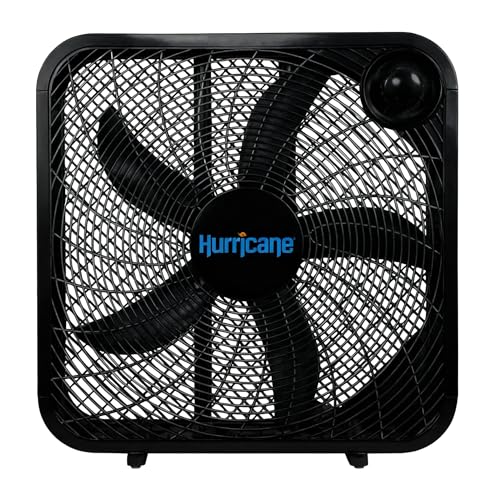
Hurricane Classic 20-Inch Box Fan
A garage can feel muggy long before the thermometer looks alarming, especially after a car pulls in hot or the afternoon sun has baked the door for hours. A bulky industrial fan may solve the airflow problem, but it can also bring extra noise, weight, and storage headaches. The Hurricane Classic takes a lighter approach to the best box fan for garage role, using a slim 20-inch frame, three speed settings, and a stated 2,400 CFM airflow to keep stale air moving. It won’t replace a heavy-duty air mover in a large commercial shop, but its balance of portability, broad circulation, and manageable sound gives it a practical lane of its own.
Hurricane Classic Floor Box Fan
The familiar square shape keeps the fan simple, and that’s part of the appeal. Its 20-inch blade area produces a broad stream rather than the narrow blast common with compact utility blowers. The manufacturer lists 2,400 CFM at 1,100 RPM, which gives the fan enough reach for general circulation in a garage, basement, workshop, bedroom, or greenhouse. That output is better suited to refreshing a room and reducing stagnant pockets than attacking one wet patch with concentrated pressure.
Three speed settings let the fan move from a softer background breeze to a stronger draft. This matters in a garage because full power isn’t always the right answer. High speed can help push warm air toward an open door, while a lower setting is less likely to scatter receipts, sandpaper, plant labels, or lightweight hardware across a bench. Simple speed control also means there’s no menu, remote, or electronic display to slow down a routine adjustment.
The slim frame gives the Hurricane Classic a different personality from thick metal drum fans. It can sit near a doorway, beside a cabinet, or against a wall without swallowing a huge section of floor. Storage should also be easier because the body doesn’t have a deep cylindrical housing. For a garage already packed with ladders, seasonal bins, and yard tools, space-saving design isn’t a minor perk.
Portability rounds out the basic package. The polymer construction keeps the fan lighter than many all-metal alternatives, making room-to-room moves less awkward. That flexibility works well when the fan spends weekdays in a garage and weekends in a basement, home gym, or greenhouse. The tradeoff is that lightweight construction may feel less planted than a heavy shop fan on rough concrete or around strong crosswinds.
Broad Airflow For Everyday Garage Heat
The Hurricane Classic shines most clearly as a general air circulator. Its wide fan face spreads air across a larger zone, helping reduce the heavy, still feeling that settles around parked vehicles and storage shelves. Aiming it toward an open garage door can support natural ventilation by nudging warm air outside. Placed near a cooler opening, it can also pull fresher air inward during mornings or evenings.
That broad pattern feels different from a high-velocity blower. A blower concentrates air into a smaller channel, while this box fan creates a wider breeze that’s often more comfortable for longer work sessions. Someone sanding a cabinet, organizing tools, or using a treadmill may prefer air that reaches the whole body rather than one intense spot. The 2,400 CFM output offers useful circulation without pretending to be warehouse equipment.
Warm garages aren’t the only problem. Stale air can linger after routine cleaning, lawn equipment storage, or long periods with the door closed. The fan can help mix and exchange ordinary indoor air, especially when another opening creates a clear path. It shouldn’t be used as a substitute for rated exhaust equipment around flammable vapors, combustible fumes, or hazardous chemicals.
Airflow also helps with mild surface dampness. A box fan placed several feet from wet mats or freshly mopped concrete can encourage more even evaporation across a broad area. It won’t remove standing water or dry soaked structural material by itself, so expectations need to stay realistic. For everyday moisture and stuffiness, though, steady wide-area movement is often more useful than a harsh blast aimed at one corner.
Quiet Speeds And Realistic Noise Expectations
The product description presents the three settings as quiet speeds, which is appealing in garages attached to living spaces. A less aggressive sound profile can matter during phone calls, late-night projects, home workouts, or focused bench work. The supplied information doesn’t include a decibel rating, so exact loudness can’t be confirmed. “Quiet” should be read as a relative design goal rather than a promise of near-silent operation.
Low speed will likely be the easiest setting to live with over long periods. It can keep air moving without creating the same rush and blade noise expected at maximum output. Medium speed offers a useful middle ground when the garage feels stuffy but doesn’t need the full 2,400 CFM. High speed is the practical choice for quick ventilation, though stronger airflow naturally brings more sound.
Box fans tend to produce a broad whoosh rather than the sharper pitch of compact blowers. That difference can feel less irritating even when the fan remains clearly audible. Frame vibration, floor condition, and nearby walls also affect perceived noise. Setting the fan on a flat surface and making sure the adjustable feet are secure can help reduce rattling.
Noise sensitivity varies with the job. A fan that disappears behind a mower or shop vacuum may feel too noticeable during reading or recording. The Hurricane Classic fits better where moderate sound and broad airflow are acceptable companions rather than deal breakers. Anyone expecting bedroom-level silence at top speed may need to lower expectations.
Slim Frame And Adjustable Feet
The fan’s thin body makes placement easier in tight garages. It can stand near the edge of a workbench, between storage racks, or just inside an open door without projecting far into the walkway. That matters when vehicle clearance is already tight. A deep industrial frame may deliver more raw power, but it can become a daily obstacle in a one-car space.
Adjustable feet support the fan while keeping the frame upright. They also allow the base to fold or shift for storage, depending on the exact design arrangement. Proper positioning matters because a lightweight fan needs a stable stance on concrete. Secure footing helps prevent wobbling and reduces the chance of vibration traveling through the frame.
The slim shape also makes seasonal storage less painful. A fan that can slide behind a shelf, beside a cabinet, or along a basement wall is easier to keep than a bulky drum model. That convenience matters in cooler months when garage cooling drops down the priority list. Small storage demands often decide whether a fan stays useful or becomes clutter.
Floor placement still has limitations. A square fan sitting in a narrow lane can catch cords, bags, or shoes if the space is poorly organized. Its polymer frame should also stay away from hot exhaust components, sharp metal edges, and areas where heavy tools may fall. The lightweight body improves mobility, but it doesn’t invite careless handling.
Polymer Blades And Everyday Durability
The Hurricane Classic uses lightweight polymer blades paired with a robust motor. Polymer blades reduce weight and avoid the exposed metal edges found on some industrial designs. They also help keep the entire unit easier to carry. That construction suits household and light workshop use, though it won’t feel as rugged as an all-metal fan built for rough commercial environments.
Durability depends on more than blade material. Dust buildup, blocked airflow, loose feet, and repeated impacts can shorten the life of any portable fan. Garage use adds pollen, sawdust, pet hair, and fine debris to the mix, so the grille and blade area will need regular attention. Routine cleaning supports steadier airflow and helps prevent imbalance.
The supplied details describe a robust motor designed for reliable use, but they don’t provide bearing type, motor lifespan, or service intervals. Claims beyond those facts would be guesswork. The practical takeaway is simpler: keep the intake clear, avoid wet conditions, and don’t run the cord where vehicle tires or heavy equipment can damage it. Sensible placement often matters more than marketing language.
Plastic construction also brings a temperature consideration. The fan shouldn’t sit against heaters, hot engine components, or direct high-heat exhaust. Ordinary summer garage temperatures fall within the intended use implied by the description, but concentrated heat sources are another story. The polymer design favors low weight and everyday convenience over the brute toughness of a metal shop fan.
Ventilation Limits And Safe Placement
Moving stagnant air and venting hazardous fumes are not the same job. The Hurricane Classic can support fresh-air exchange in a garage with open doors or windows, but it isn’t described as explosion-proof or rated for combustible atmospheres. Gasoline vapors, solvent fumes, and similar hazards require equipment specifically designed for those conditions. Ordinary circulation is the safe lane supported by the provided information.
Placement near an open door often gives the fan its best chance to help. Facing outward can encourage warm indoor air to leave, while facing inward can bring cooler outdoor air into the space. The most effective direction depends on the temperature outside and whether another opening allows air to travel through. A fan pressed against a closed wall will mostly recirculate the same air.
Loose debris deserves a quick check before high speed begins. Potting mix, sanding dust, grass clippings, and lightweight packaging can become airborne in a hurry. A short cleanup keeps the breeze useful instead of turning it into a dust storm. The three-speed control helps here because lower output may be enough once air starts moving.
Electrical placement matters too. The cord should remain clear of standing water, sharp corners, and vehicle paths. The product description doesn’t list specialized wet-location protection, so damp environments call for extra caution. Dry footing and an unobstructed intake are basic habits, but they prevent a surprising number of avoidable problems.
How It Differs From Heavy-Duty Shop Fans
The Hurricane Classic trades industrial muscle for lighter weight and easier storage. Metal high-velocity fans often deliver much higher airflow, stronger frames, and more aggressive noise. This model offers 2,400 CFM, which is plenty for broad household circulation but modest beside commercial shop fans rated at several thousand additional CFM. That difference shapes where each type feels comfortable.
A heavy metal fan suits large workshops where equipment noise is already normal and floor space is less restrictive. The Hurricane Classic fits smaller garages, attached work areas, home gyms, and multipurpose rooms where the fan may move around often. Its quieter positioning and polymer body make it easier to live with indoors. The compromise is less concentrated power across very large spaces.
Wall mounting isn’t listed for this model, so floor placement remains the main arrangement. Overhead fans address a separate space problem by keeping the floor completely open, and that layout difference is reflected in 48-inch ceiling fans used where permanent circulation and lighting share the same fixture. The Hurricane remains portable and easy to store, while ceiling models favor fixed, room-wide airflow. Each solves a different frustration.
Traditional box geometry also limits precise aiming. The adjustable feet support the frame, but the product description doesn’t claim a pivoting head or full tilt mechanism. Air travels mainly straight ahead, so changing direction usually means moving the entire fan. The wide airflow pattern makes that less troublesome for room circulation, though it’s not ideal for sharply targeted drying.
Strengths, Weaknesses, And Daily Fit
The strongest part of this fan is its balanced everyday design. It combines a stated 2,400 CFM output with three speeds, a lightweight frame, and a slim profile that stores without much drama. Those features solve common garage annoyances without creating the bulk of a commercial air mover. It’s easy to picture this fan shifting between a garage, basement, workout room, and greenhouse as seasons change.
Broad airflow is another clear advantage. A 20-inch blade area moves air across a wider section of the room than a small desktop or utility fan. That makes the breeze feel less pinpointed and more natural during longer work sessions. For general cooling and stagnant-air relief, coverage matters as much as raw force.
The main weakness is limited power compared with heavy-duty metal models. Large two-car garages, warehouses, and intensely hot workshops may need more than 2,400 CFM, especially if there’s no cross-ventilation. The fan also lacks the directional flexibility of a pivoting blower. It’s better at moving air broadly than sending it under a bench or sharply upward.
Light construction creates another tradeoff. Portability improves, but the fan may feel less stable around strong drafts, rough floors, or busy shop traffic. Careful placement and fully opened feet become more important. The polymer body suits normal household and garage handling, not repeated collisions with carts and heavy equipment.
Within the best box fan for garage category, the Hurricane Classic makes sense for moderate-size spaces where storage, portability, and tolerable sound carry real weight. It won’t overpower a large industrial shop, and it doesn’t offer precise pivoting airflow. What it does provide is straightforward circulation with enough output for everyday heat, a frame that’s easy to move, and three speeds that don’t force every task into full blast. That practical middle ground is exactly where many garage fans either earn their keep or wind up shoved behind a shelf.
Hurricane Classic 20-Inch Box Fan
A garage can feel muggy long before the thermometer looks alarming, especially after a car pulls in hot or the afternoon sun has baked the door for hours. A bulky industrial fan may solve the airflow problem, but it can also bring extra noise, weight, and storage headaches. The Hurricane Classic takes a lighter approach to the best box fan for garage role, using a slim 20-inch frame, three speed settings, and a stated 2,400 CFM airflow to keep stale air moving. It won’t replace a heavy-duty air mover in a large commercial shop, but its balance of portability, broad circulation, and manageable sound gives it a practical lane of its own.
Hurricane Classic Floor Box Fan
The familiar square shape keeps the fan simple, and that’s part of the appeal. Its 20-inch blade area produces a broad stream rather than the narrow blast common with compact utility blowers. The manufacturer lists 2,400 CFM at 1,100 RPM, which gives the fan enough reach for general circulation in a garage, basement, workshop, bedroom, or greenhouse. That output is better suited to refreshing a room and reducing stagnant pockets than attacking one wet patch with concentrated pressure.
Three speed settings let the fan move from a softer background breeze to a stronger draft. This matters in a garage because full power isn’t always the right answer. High speed can help push warm air toward an open door, while a lower setting is less likely to scatter receipts, sandpaper, plant labels, or lightweight hardware across a bench. Simple speed control also means there’s no menu, remote, or electronic display to slow down a routine adjustment.
The slim frame gives the Hurricane Classic a different personality from thick metal drum fans. It can sit near a doorway, beside a cabinet, or against a wall without swallowing a huge section of floor. Storage should also be easier because the body doesn’t have a deep cylindrical housing. For a garage already packed with ladders, seasonal bins, and yard tools, space-saving design isn’t a minor perk.
Portability rounds out the basic package. The polymer construction keeps the fan lighter than many all-metal alternatives, making room-to-room moves less awkward. That flexibility works well when the fan spends weekdays in a garage and weekends in a basement, home gym, or greenhouse. The tradeoff is that lightweight construction may feel less planted than a heavy shop fan on rough concrete or around strong crosswinds.
Broad Airflow For Everyday Garage Heat
The Hurricane Classic shines most clearly as a general air circulator. Its wide fan face spreads air across a larger zone, helping reduce the heavy, still feeling that settles around parked vehicles and storage shelves. Aiming it toward an open garage door can support natural ventilation by nudging warm air outside. Placed near a cooler opening, it can also pull fresher air inward during mornings or evenings.
That broad pattern feels different from a high-velocity blower. A blower concentrates air into a smaller channel, while this box fan creates a wider breeze that’s often more comfortable for longer work sessions. Someone sanding a cabinet, organizing tools, or using a treadmill may prefer air that reaches the whole body rather than one intense spot. The 2,400 CFM output offers useful circulation without pretending to be warehouse equipment.
Warm garages aren’t the only problem. Stale air can linger after routine cleaning, lawn equipment storage, or long periods with the door closed. The fan can help mix and exchange ordinary indoor air, especially when another opening creates a clear path. It shouldn’t be used as a substitute for rated exhaust equipment around flammable vapors, combustible fumes, or hazardous chemicals.
Airflow also helps with mild surface dampness. A box fan placed several feet from wet mats or freshly mopped concrete can encourage more even evaporation across a broad area. It won’t remove standing water or dry soaked structural material by itself, so expectations need to stay realistic. For everyday moisture and stuffiness, though, steady wide-area movement is often more useful than a harsh blast aimed at one corner.
Quiet Speeds And Realistic Noise Expectations
The product description presents the three settings as quiet speeds, which is appealing in garages attached to living spaces. A less aggressive sound profile can matter during phone calls, late-night projects, home workouts, or focused bench work. The supplied information doesn’t include a decibel rating, so exact loudness can’t be confirmed. “Quiet” should be read as a relative design goal rather than a promise of near-silent operation.
Low speed will likely be the easiest setting to live with over long periods. It can keep air moving without creating the same rush and blade noise expected at maximum output. Medium speed offers a useful middle ground when the garage feels stuffy but doesn’t need the full 2,400 CFM. High speed is the practical choice for quick ventilation, though stronger airflow naturally brings more sound.
Box fans tend to produce a broad whoosh rather than the sharper pitch of compact blowers. That difference can feel less irritating even when the fan remains clearly audible. Frame vibration, floor condition, and nearby walls also affect perceived noise. Setting the fan on a flat surface and making sure the adjustable feet are secure can help reduce rattling.
Noise sensitivity varies with the job. A fan that disappears behind a mower or shop vacuum may feel too noticeable during reading or recording. The Hurricane Classic fits better where moderate sound and broad airflow are acceptable companions rather than deal breakers. Anyone expecting bedroom-level silence at top speed may need to lower expectations.
Slim Frame And Adjustable Feet
The fan’s thin body makes placement easier in tight garages. It can stand near the edge of a workbench, between storage racks, or just inside an open door without projecting far into the walkway. That matters when vehicle clearance is already tight. A deep industrial frame may deliver more raw power, but it can become a daily obstacle in a one-car space.
Adjustable feet support the fan while keeping the frame upright. They also allow the base to fold or shift for storage, depending on the exact design arrangement. Proper positioning matters because a lightweight fan needs a stable stance on concrete. Secure footing helps prevent wobbling and reduces the chance of vibration traveling through the frame.
The slim shape also makes seasonal storage less painful. A fan that can slide behind a shelf, beside a cabinet, or along a basement wall is easier to keep than a bulky drum model. That convenience matters in cooler months when garage cooling drops down the priority list. Small storage demands often decide whether a fan stays useful or becomes clutter.
Floor placement still has limitations. A square fan sitting in a narrow lane can catch cords, bags, or shoes if the space is poorly organized. Its polymer frame should also stay away from hot exhaust components, sharp metal edges, and areas where heavy tools may fall. The lightweight body improves mobility, but it doesn’t invite careless handling.
Polymer Blades And Everyday Durability
The Hurricane Classic uses lightweight polymer blades paired with a robust motor. Polymer blades reduce weight and avoid the exposed metal edges found on some industrial designs. They also help keep the entire unit easier to carry. That construction suits household and light workshop use, though it won’t feel as rugged as an all-metal fan built for rough commercial environments.
Durability depends on more than blade material. Dust buildup, blocked airflow, loose feet, and repeated impacts can shorten the life of any portable fan. Garage use adds pollen, sawdust, pet hair, and fine debris to the mix, so the grille and blade area will need regular attention. Routine cleaning supports steadier airflow and helps prevent imbalance.
The supplied details describe a robust motor designed for reliable use, but they don’t provide bearing type, motor lifespan, or service intervals. Claims beyond those facts would be guesswork. The practical takeaway is simpler: keep the intake clear, avoid wet conditions, and don’t run the cord where vehicle tires or heavy equipment can damage it. Sensible placement often matters more than marketing language.
Plastic construction also brings a temperature consideration. The fan shouldn’t sit against heaters, hot engine components, or direct high-heat exhaust. Ordinary summer garage temperatures fall within the intended use implied by the description, but concentrated heat sources are another story. The polymer design favors low weight and everyday convenience over the brute toughness of a metal shop fan.
Ventilation Limits And Safe Placement
Moving stagnant air and venting hazardous fumes are not the same job. The Hurricane Classic can support fresh-air exchange in a garage with open doors or windows, but it isn’t described as explosion-proof or rated for combustible atmospheres. Gasoline vapors, solvent fumes, and similar hazards require equipment specifically designed for those conditions. Ordinary circulation is the safe lane supported by the provided information.
Placement near an open door often gives the fan its best chance to help. Facing outward can encourage warm indoor air to leave, while facing inward can bring cooler outdoor air into the space. The most effective direction depends on the temperature outside and whether another opening allows air to travel through. A fan pressed against a closed wall will mostly recirculate the same air.
Loose debris deserves a quick check before high speed begins. Potting mix, sanding dust, grass clippings, and lightweight packaging can become airborne in a hurry. A short cleanup keeps the breeze useful instead of turning it into a dust storm. The three-speed control helps here because lower output may be enough once air starts moving.
Electrical placement matters too. The cord should remain clear of standing water, sharp corners, and vehicle paths. The product description doesn’t list specialized wet-location protection, so damp environments call for extra caution. Dry footing and an unobstructed intake are basic habits, but they prevent a surprising number of avoidable problems.
How It Differs From Heavy-Duty Shop Fans
The Hurricane Classic trades industrial muscle for lighter weight and easier storage. Metal high-velocity fans often deliver much higher airflow, stronger frames, and more aggressive noise. This model offers 2,400 CFM, which is plenty for broad household circulation but modest beside commercial shop fans rated at several thousand additional CFM. That difference shapes where each type feels comfortable.
A heavy metal fan suits large workshops where equipment noise is already normal and floor space is less restrictive. The Hurricane Classic fits smaller garages, attached work areas, home gyms, and multipurpose rooms where the fan may move around often. Its quieter positioning and polymer body make it easier to live with indoors. The compromise is less concentrated power across very large spaces.
Wall mounting isn’t listed for this model, so floor placement remains the main arrangement. Overhead fans address a separate space problem by keeping the floor completely open, and that layout difference is reflected in 48-inch ceiling fans used where permanent circulation and lighting share the same fixture. The Hurricane remains portable and easy to store, while ceiling models favor fixed, room-wide airflow. Each solves a different frustration.
Traditional box geometry also limits precise aiming. The adjustable feet support the frame, but the product description doesn’t claim a pivoting head or full tilt mechanism. Air travels mainly straight ahead, so changing direction usually means moving the entire fan. The wide airflow pattern makes that less troublesome for room circulation, though it’s not ideal for sharply targeted drying.
Strengths, Weaknesses, And Daily Fit
The strongest part of this fan is its balanced everyday design. It combines a stated 2,400 CFM output with three speeds, a lightweight frame, and a slim profile that stores without much drama. Those features solve common garage annoyances without creating the bulk of a commercial air mover. It’s easy to picture this fan shifting between a garage, basement, workout room, and greenhouse as seasons change.
Broad airflow is another clear advantage. A 20-inch blade area moves air across a wider section of the room than a small desktop or utility fan. That makes the breeze feel less pinpointed and more natural during longer work sessions. For general cooling and stagnant-air relief, coverage matters as much as raw force.
The main weakness is limited power compared with heavy-duty metal models. Large two-car garages, warehouses, and intensely hot workshops may need more than 2,400 CFM, especially if there’s no cross-ventilation. The fan also lacks the directional flexibility of a pivoting blower. It’s better at moving air broadly than sending it under a bench or sharply upward.
Light construction creates another tradeoff. Portability improves, but the fan may feel less stable around strong drafts, rough floors, or busy shop traffic. Careful placement and fully opened feet become more important. The polymer body suits normal household and garage handling, not repeated collisions with carts and heavy equipment.
Within the best box fan for garage category, the Hurricane Classic makes sense for moderate-size spaces where storage, portability, and tolerable sound carry real weight. It won’t overpower a large industrial shop, and it doesn’t offer precise pivoting airflow. What it does provide is straightforward circulation with enough output for everyday heat, a frame that’s easy to move, and three speeds that don’t force every task into full blast. That practical middle ground is exactly where many garage fans either earn their keep or wind up shoved behind a shelf.

Best Quiet Ceiling Fan For Bedroom 2026 Ultimate Comfort Picks

Best Ceiling Fan For Master Bedroom 2026 With Ultimate Comfort

Best White Ceiling Fan With Light For Bedroom 2026 Top Picks

Best Quorum Medallion Ceiling Fan 2026 With Style & Breeze
Best Outdoor Fan For Pergola 2026 Comfort Boost

Best Ceiling Fan For Great Room 2026 With Ultimate Comfort

Best Outdoor DC Ceiling Fans 2026 For Breezy Comfort
Best ceiling exhaust bath fan with light and heater 2026





